loupe
Health Warn
- License — License: Apache-2.0
- Description — Repository has a description
- Active repo — Last push 0 days ago
- Low visibility — Only 8 GitHub stars
Code Pass
- Code scan — Scanned 12 files during light audit, no dangerous patterns found
Permissions Pass
- Permissions — No dangerous permissions requested
No AI report is available for this listing yet.
Android devices, emulators and iOS simulators from your Mac, live in any browser at 60 fps, shared between you and your agents over a CLI, MCP or HTTP.
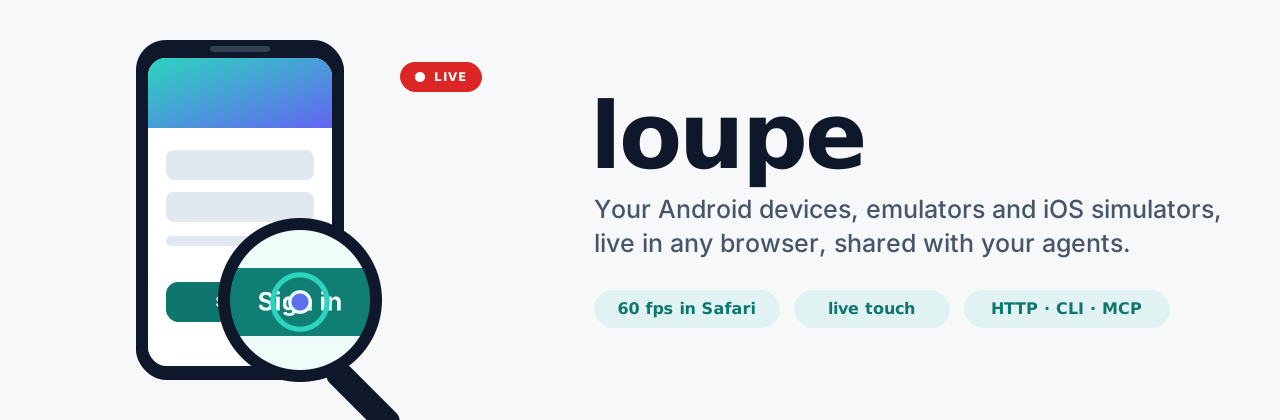





The device on your desk, in your hand.
Stream Android devices, emulators and iOS simulators from your Mac to any browser at 60 fps, with live touch.
Agents drive the same device through a CLI, MCP or HTTP while you watch.
Quick start
brew install bmcreations/tap/loupe
brew services start loupe
open "http://localhost:18456/?token=$(cat ~/Library/Caches/loupe/token)"
The picker lists every Android device on adb and every AVD you have
installed, booted or not. Open one to stream it. iOS simulators need
simcap, built with your own Xcode:
brew install --HEAD bmcreations/tap/simcap && brew services restart loupe
Without a certificate the service answers on loopback only. To reach it from
your phone, give it TLS:
docs/getting-started.md walks through it with
Tailscale, then pairing a phone and connecting an agent.
Drive it from a shell or an agent
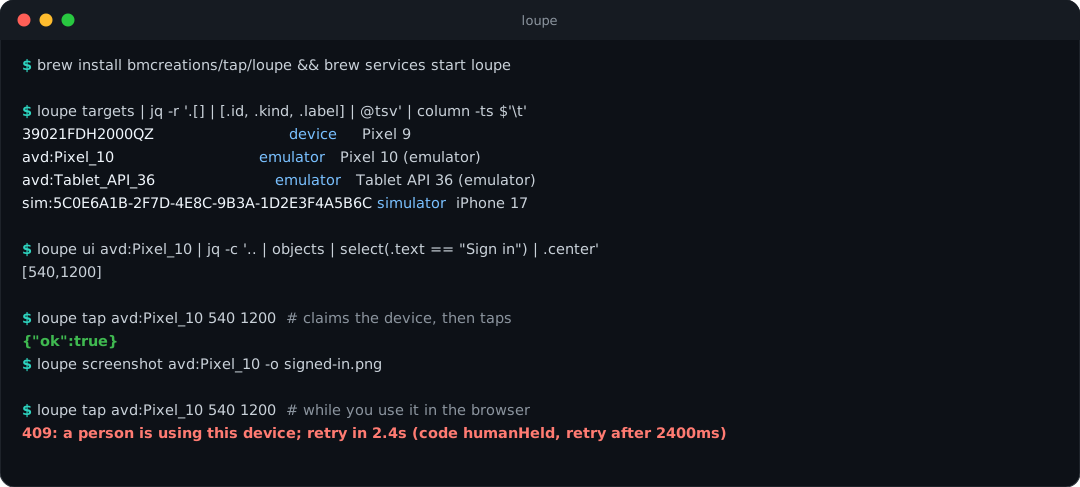
Every command is also an MCP tool. Point Claude Code or any MCP client atloupe mcp and it gets the same commands, with the same claims:
claude mcp add loupe -- loupe mcp
tap takes a node instead of a point: loupe tap <target> --text "Sign in"
finds it in the accessibility tree and taps its center, and --id and--desc match the other fields. Two matches are refused with the candidates
rather than guessed at. Coordinates still work, in device pixels, the onesui reports in each node's center. sequence runs several steps in one
call, and stops at the first that fails. Drive from the accessibility tree
rather than from the video. boot starts a shut-down AVD or simulator, with--wait for how long to wait (0 returns at once), and boot-status reports
on an AVD boot still running.
docs/cli.md covers the commands, docs/mcp.md
the tools, and docs/agent-api.md every HTTP route.
What it does
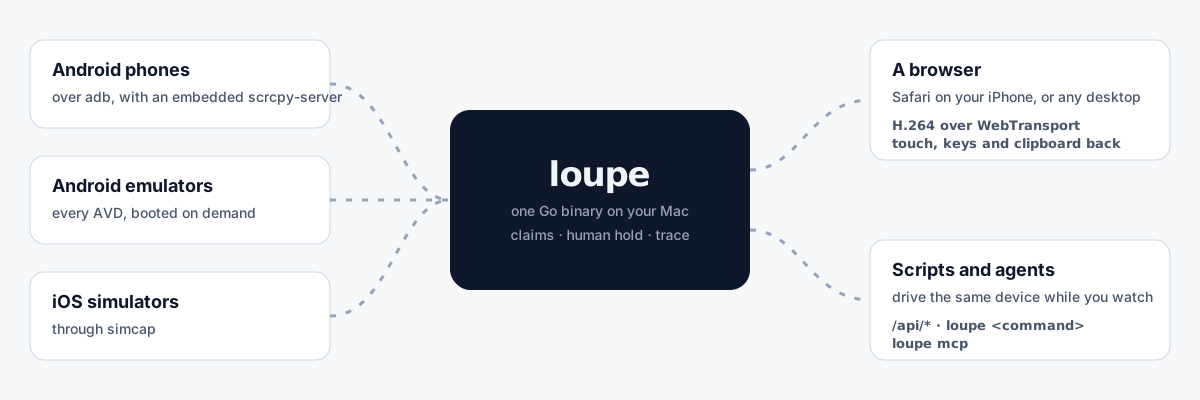
Streams devices
- Android phones over adb. One plugged in later appears in the picker;
one unplugged stays listed as missing, with the reason. - Every installed AVD, booted or not. Opening one boots it from a warm
snapshot. An idle emulator is paused after 5 minutes and shut down after- Reset returns one to a clean state, and New device creates an AVD from
the system images you have.
- Reset returns one to a clean state, and New device creates an AVD from
- iOS simulators through simcap.
Physical iPhones and iPads are a preview: they stream over a cable, and
input is still being worked on. See docs/ios.md. - Devices on your other machines. Add another loupe server as a peer
and its targets join your picker. See
docs/remote-targets.md.
Feels like the device is in your hand
- Video goes over WebTransport (HTTP/3), with WebSocket as a fallback.
Adaptive bitrate lowers the encoder's rate when the link can't carry it
and raises it again when the link recovers. - Multi-touch, swipes, hardware buttons, and your phone's own keyboard.
- The clipboard works both ways, and can be shared across every open target
and the Mac's pasteboard. - Add it to the Home Screen and it runs full screen as an app.
Lets agents work beside you
- The accessibility tree with a precomputed
centerper node, tap by text,
resource id or description, swipe, text, keys, waiting for a node, app launch, deep links, screenshots, APK install, logs, crash
reports, boot and shutdown. On a debuggable Compose app, each node names
the composable that drew it, with its source line. camerapoints an AVD's, simulator's or iPhone's back camera at an
image, so a scanner can be tested without holding a phone up to a screen.- An agent claims a device before it drives it. Your own input holds agents
off, you can mark a device hands off, and viewers see an agent's cursor
before it taps. Between an agent's calls the cursor stays where it last
acted for 20 seconds, dimmed. - Flags: box an area of the screen, write a note, and send the
screenshot and UI tree to an agent, or interrupt one mid-task. - Recording writes the encoder's output to an MP4, with no re-encode.
Fits into your workflow
- A GitHub Action installs a pull request's APK on a target and comments on
the PR with a link that opens it. See action/README.md. - Extensions are separate programs that loupe proxies under
/api/ext, and
they can draw overlays on a device. See
docs/extensions.md. loupe pairgives a device its own session, which you can revoke without
re-keying every other device.
Security
Anyone who can reach the port can drive every device on it, so every
request needs the shared token or a paired session, and plain HTTP is
refused on anything but loopback. The token and every session have full
access; there are no scopes yet. docs/security.md says
what is protected and what isn't.
Build from source
git clone https://github.com/bmcreations/loupe && cd loupe
make build
./loupe -addr 127.0.0.1:8080 -synthetic -no-devices
Go is all it takes. The scrcpy-server jar is embedded and the web client has
no build step, so there is no scrcpy to install and no npm. The test
pattern needs ffmpeg; it should hold about 60 fps in the stats overlay
before you plug in a device. docs/running.md lists every
flag.
Docs
| Doc | For |
|---|---|
| getting-started.md | From an install to a phone, a service and an agent |
| cli.md | loupe <command>, claims between commands |
| mcp.md | loupe mcp and pushing flags into Claude Code |
| agent-api.md | Every /api/* route, claims and the human hold |
| targets.md | AVDs, Android devices, the phone keyboard, the clipboard, device frames |
| ios.md | iOS simulators, and physical iPhones in preview |
| running.md | Every flag, the settings file, the stats overlay, tests |
| security.md | The token, TLS, pairing and sessions |
docs/README.md indexes the rest: architecture, the wire
protocol, flags, recording, extensions and notes for working on the code.
Licensing
loupe is Apache 2.0. It embeds and redistributes the scrcpy-server jar,
which is also Apache 2.0; third_party/scrcpy/LICENSE andTHIRD_PARTY_NOTICES.md carry that text and the upstream attribution.
Section 6 grants no trademark rights: nothing here may imply this is scrcpy
or that Genymobile endorses it.
simcap, the iOS helper, is also Apache 2.0 and lives in its own repo,
bmcreations/simcap. It calls
private frameworks from your own Xcode install; docs/ios.md
says which, and what that means for an Xcode update.
iPhone, iPad, Mac, macOS and Xcode are trademarks of Apple Inc. loupe is
not affiliated with Apple.
Reviews (0)
Sign in to leave a review.
Leave a reviewNo results found