kovan
Health Pass
- License — License: MIT
- Description — Repository has a description
- Active repo — Last push 0 days ago
- Community trust — 10 GitHub stars
Code Pass
- Code scan — Scanned 12 files during light audit, no dangerous patterns found
Permissions Pass
- Permissions — No dangerous permissions requested
No AI report is available for this listing yet.
Teach your engineering methodology once; every AI agent inherits it. Methods, gates, and durable memory, from one terminal board.
kovan
Teach your engineering methodology once. Every future agent inherits it.


AI agents are temporary. Your way of working isn't.
Kovan turns your engineering methodology into infrastructure. Every new agent
inherits it, gates enforce it, and task knowledge survives long after the
agent is gone. Around that core, agents run in isolated worktrees, stay
detached in tmux, and are watched from a single terminal cockpit.
One binary. No daemon. No custom runtime.
Kovan doesn't replace Claude Code. It gives it a durable operating environment.
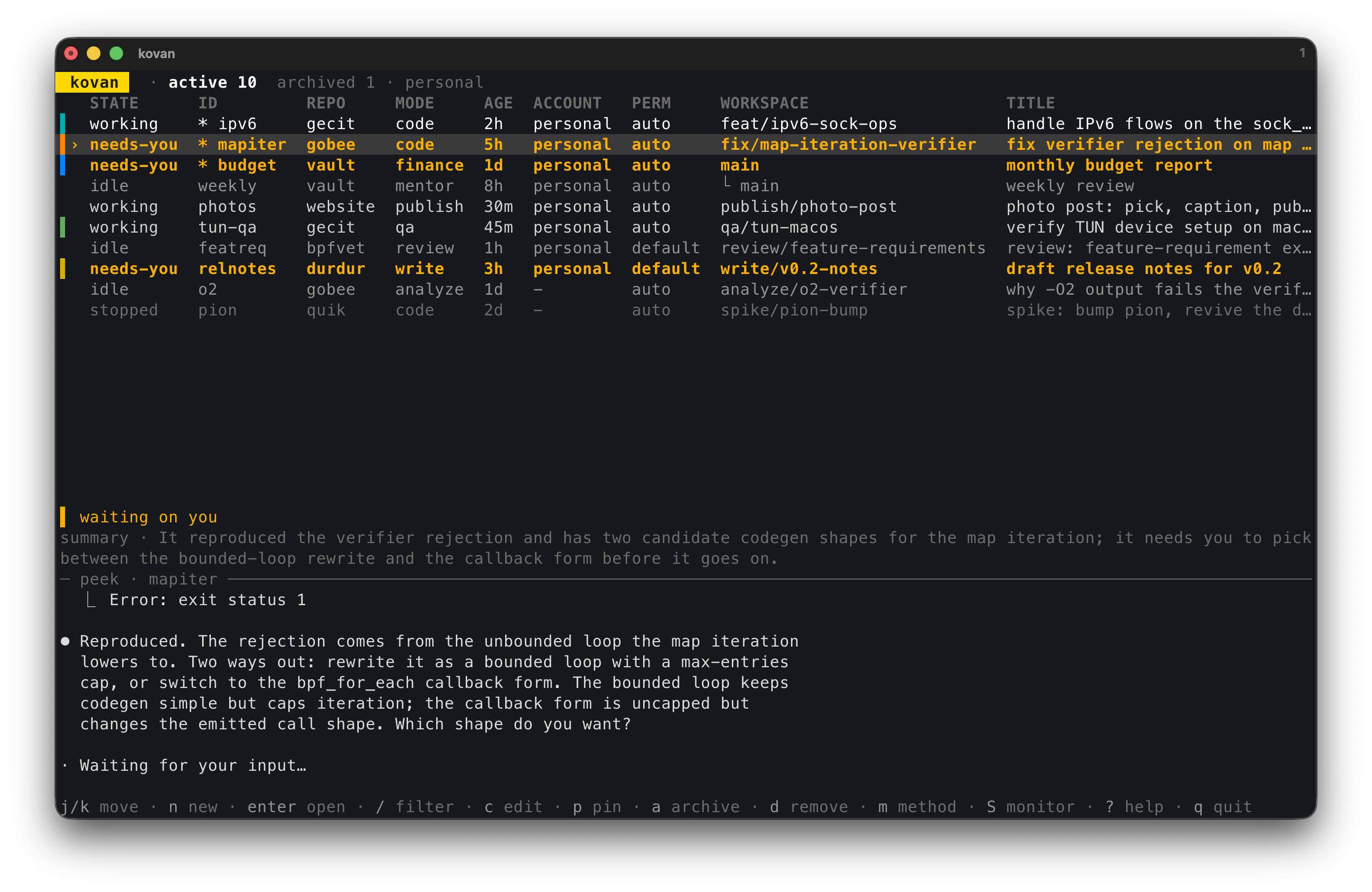
Ten agents across seven projects, each in its own worktree and its own tmux
session. Two are paused: full auto-mode, and they still stopped at a decision
that is yours. The mode column is the other half of the story. code,review, write and analyze ship with kovan; qa, publish, finance
and mentor are ones this user added, a directory each. Same machinery,
different method.
what you get
your method, everywhere. rules live once under
~/.kovanin layers
(global, per-account, per-domain, per-repo) and compose into every agent via@import. edit a layer file, every agent picks it up live. modes aren't
code-only:code,review,writeandanalyzeship, and a new mode is a
directory with a method file and a posture, so the same machinery runs a QA
or a finance agent.gates that hold in auto-mode. escalated to you as Claude Code hooks,
which fire in every permission mode. prose rules slip; hooks don't. the
built-ins and your own rules live in one place,~/.kovan/config.yaml:gates: push: ask # git push, gh pr create, writes to the GitHub API default_branch: action: ask # git commit on main or master read_only: ask # a read-only mode editing the repo patterns: - match: "docker push" # and your own, as regex action: ask # stop, hand the decision to you - match: "npm publish" action: deny # refuse outright, no promptpatterns run per command segment, after quoting,
sudo,envandbash -care peeled off. configuration has
the rest, including what the matcher cannot see.tasks that remember. every task gets a brief, a spec, and a learnings
file in a durable store outside the worktree. agents come and go, the notes
accumulate.
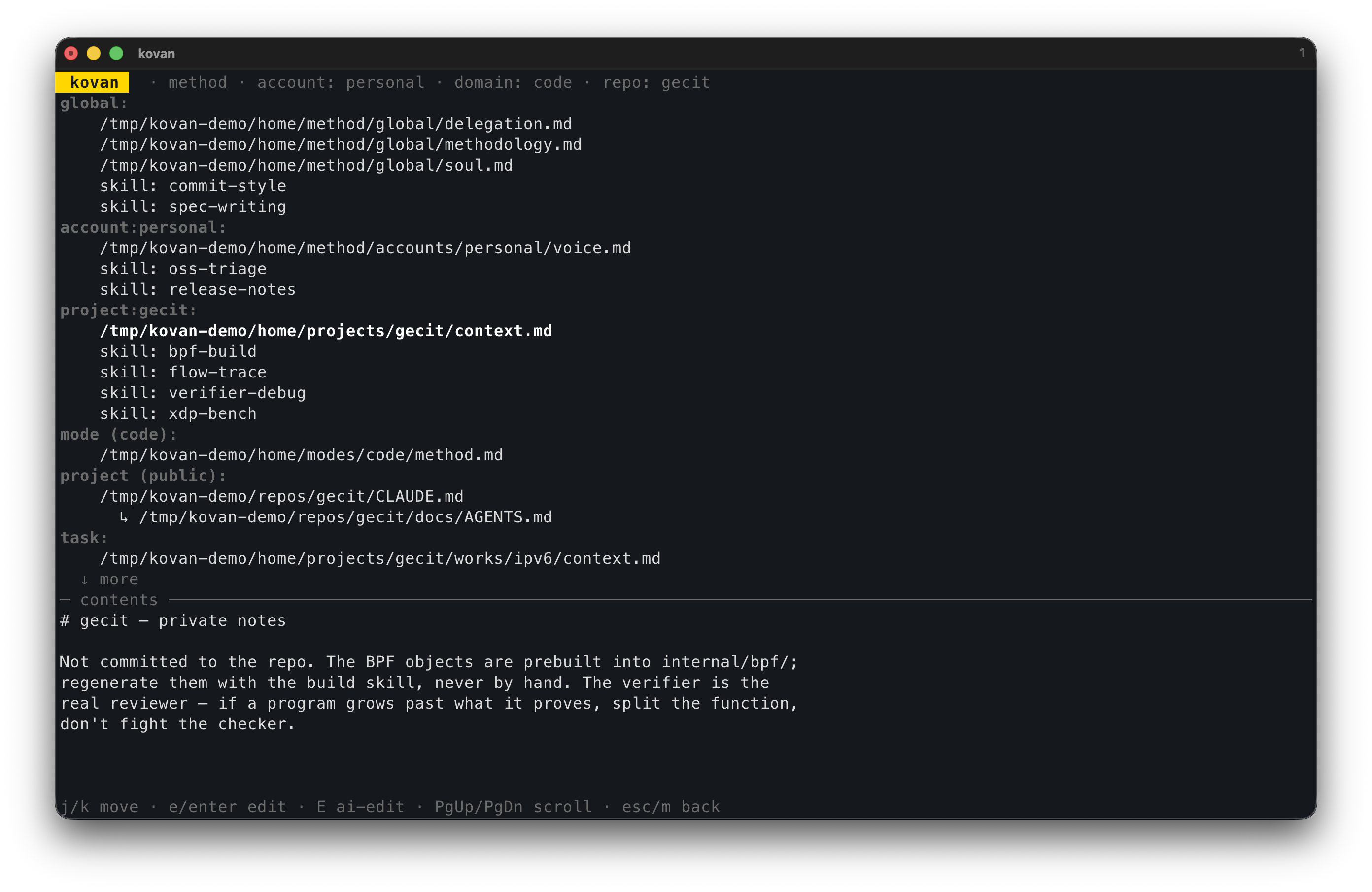
Every agent is born into this: your global rules, account voice, domain
knowledge, mode workflow, project context, task brief, composed live, plus
the gates that hold it all.
why not just a multiplexer
Multiplexers keep your agents alive. kovan keeps their work disciplined:
written methods, gates the agent can't talk its way past, and task memory
that outlives any session. Good multiplexers exist (claude-squad, herdr) and
kovan overlaps on the worktrees and the board, but it's built for the day
after the demo: you never re-teach an agent your rules, auto-mode can't push
without you, and what an agent learned outlives its worktree. If you want
many providers in one view, use a multiplexer. If you want your agents to
work your way, this is that.
The design doc walks the whole machine: how one method
reaches every agent, and why enforcement is hooks, not prose.
install
macOS, via Homebrew:
brew install boratanrikulu/tap/kovan
Linux, from the releases
page — .deb, .rpm and .apk, amd64 and arm64:
sudo dpkg -i kovan_*_linux_amd64.deb
Or from source, anywhere:
go install github.com/boratanrikulu/kovan/cmd/kovan@latest
Prebuilt tarballs (darwin/linux, amd64/arm64) are on the same releases page.
You need git, tmux, and the claude CLI on PATH. Claude Code is the
supported agent today; Codex support is on the way. Desktop notifications and
clipboard-image paste are macOS; everything else works anywhere Go and tmux
do.
demo in 60 seconds
No tokens, no agents, no Claude account. One command seeds a fake fleet and
opens the board on it:
kovan demo
Ten agents across seven throwaway repos, each with its own worktree and tmux
session, so every key on the board does what it does for real. Your ~/.kovan
and your own repos are never touched. kovan demo --remove deletes every
trace.
quickstart
kovan setup                # once per machine: wire the Claude Code hooks
cd your-repo
kovan init                 # onboard the repo: sort its AI files into layers (or just set defaults if it has none)
kovan                      # the board
Press n. One form: id, title, project, where it runs, mode, account, and
the brief written inline (ctrl+v pastes a screenshot straight into it).ctrl+d submits; the agent spawns in its own worktree and starts working,
detached.
The agent pauses where your rules say it must. A detached auto-mode agent
that tries to push gets held at an ask; the board flips to needs-you, the
summary tells you what it wants, and macOS pings you. You drop in, say go or
steer, detach again.
the cockpit around it
- one board, every project. color-coded states (working, idle, needs-you,
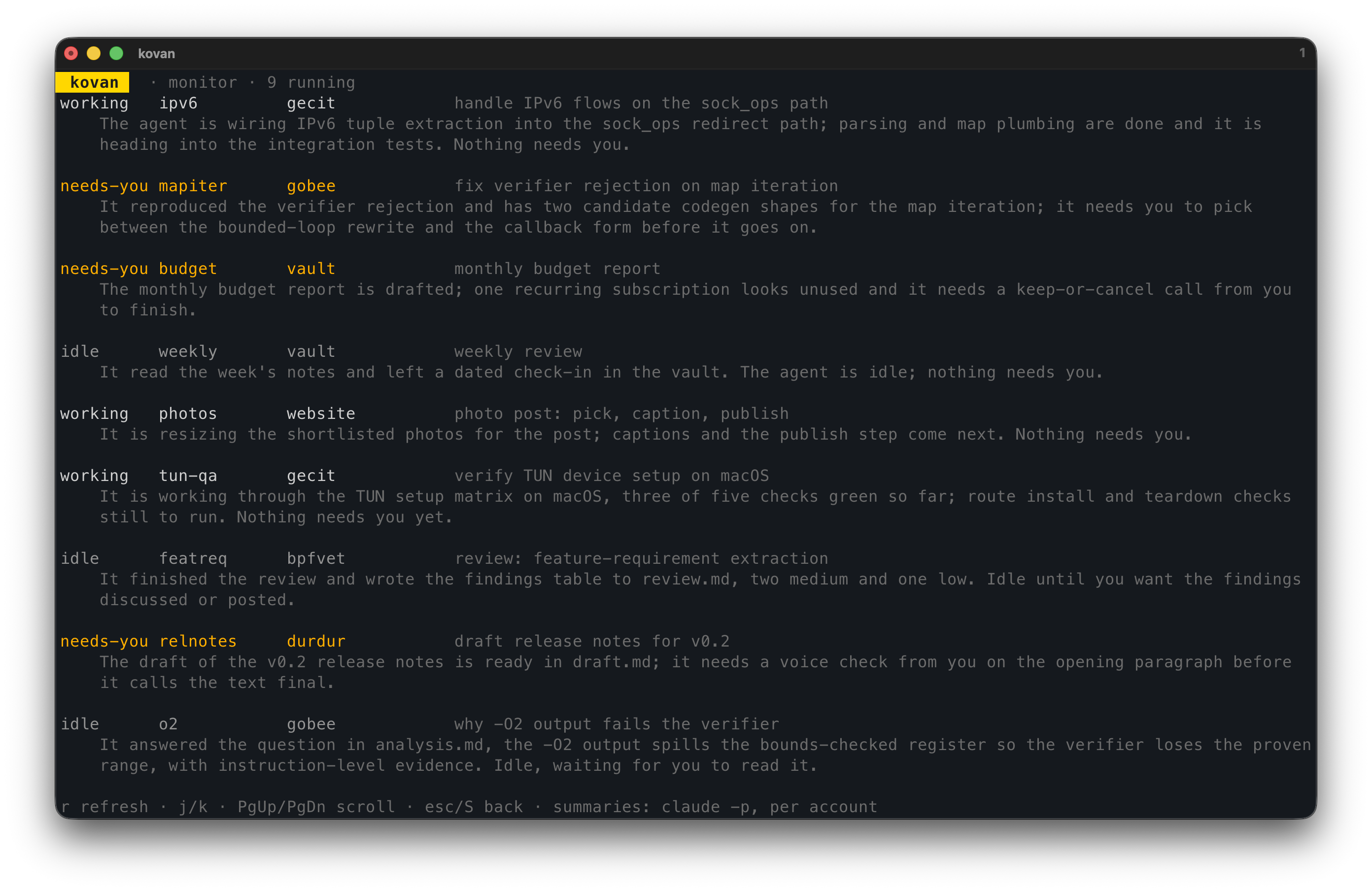
stopped), a live peek of the selected agent, keyboard and mouse both. - summaries instead of tab-cycling. every running agent gets a one-line
summary: what it's doing, whether it's blocked on you. on the board, on one
page (S), and in each manifest so your other agents can read the hive too. - isolated by construction. each agent in its own worktree and its own
plain tmux session you can always attach to yourself. remove the agent,
keep the branch and the notes. - accounts side by side. personal-plan agents next to company ones; the
right OAuth token injected per session, never through argv, logs, or the
manifest.
docs
- getting started — install to daily loop
- configuration — every knob: gates, accounts, modes, apps
- design — the two pillars, the delegation loop, why hooks
- security — token handling, what the hooks touch
- contributing
status
Personal infrastructure that happens to be public. I use it daily and evolve
it with my own working method; breaking changes land whenever they make the
tool better for me (0.x, no stability promises). Claude Code is the agent it
drives today, with Codex support planned. Issues and PRs are welcome and I
read everything, but support is best-effort and features that don't fit the
philosophy will be kindly declined. Need stability? Pin a version or fork.
Reviews (0)
Sign in to leave a review.
Leave a reviewNo results found