charter
Health Uyari
- License — License: Apache-2.0
- Description — Repository has a description
- Active repo — Last push 0 days ago
- Low visibility — Only 8 GitHub stars
Code Gecti
- Code scan — Scanned 12 files during light audit, no dangerous patterns found
Permissions Gecti
- Permissions — No dangerous permissions requested
Bu listing icin henuz AI raporu yok.
Define, deploy, and govern production AI agents using YAML. Built on Boundflow.
Charter
Build and manage production-ready agents that run on your own compute.
Pre-alpha, and in the open early. The design is settled enough to read and
argue with. The code is not settled enough to run anything you care about.
Expect the configuration format to change.
Charter provides the infrastructure for running AI agents in production. You define
an agent and its policies in YAML. Charter runs it on your compute and governs it
from a persistent control plane.
Why Charter
- Durable execution. A run parks for a human and resumes days later on another
worker, with its state intact. - Policy that acts. Set thresholds on the metrics an agent produces. One that
crosses a threshold pauses, cools down, or rolls back to the version that worked. - Declared authority. The model sees only the tools you list, gated tools
require human approval, and budgets cap what a task may spend. - Fleet operations. Every agent's operational state, run history, metrics and
open decisions, from the CLI or the console. - Your network, your data. Workers run in your environment, so agents reach
internal services and databases directly. Model keys and prompts never reach the
control plane, and the agent's conversation, files and traces stay in stores you
run.
DESIGN.md documents every field.
Quickstart
pip install boundflow-charter          # add [ui] for the console, [otel] for traces
pip install --pre boundflow-charter    # or whatever main is, published every green build
A control plane
Charter needs one to run agents against. To run one locally:
curl -sSLO https://raw.githubusercontent.com/boundflow/charter/main/deploy/local.compose.yml
docker compose -f local.compose.yml up -d --wait
docker compose -f local.compose.yml run --rm server -mode=provision -name=me
That prints an API key. With it:
export BOUNDFLOW_API_KEY=<the key it printed>
export BOUNDFLOW_SERVER_ADDRESS=http://localhost:50051
export BOUNDFLOW_WORKER_ADDRESS=http://localhost:50052
export CHARTER_STORE_URL=postgres://charter:charter@localhost:5434/charter
Remove it with docker compose -f local.compose.yml down -v. Cloning the repo
works too, and gets you the examples and the demo alongside it.
For production you have two options. Run the BoundFlow backend yourself, following
its deployment docs.
Or use BoundFlow Cloud, which is managed and in early access
(request access): it gives you an API key and the two
addresses, and you export those instead of the local ones. The worker still runs
wherever you put it, so CHARTER_STORE_URL stays yours.
Either way the control plane never sees your model key or its traffic.
Your first agent
charter init triage
That writes two files. triage/v1.yaml, the agent:
apiVersion: charter/v1
kind: AgentConfig

name: triage
version: 1
model: claude-haiku-4-5

objective: |
  Triage this support ticket and say what should happen to it:

  {{ inputs.ticket }}

inputs:
  ticket: { type: string, required: true }

response_format:
  category:
    type: string
    description: billing, bug, account, or other.
  next_step:
    type: string
    description: What a person should do about it, in one sentence.
and worker.yaml beside it, the deployment:
apiVersion: charter/v1
kind: Worker

control_plane:
  endpoint: ${BOUNDFLOW_SERVER_ADDRESS}
  worker_endpoint: ${BOUNDFLOW_WORKER_ADDRESS}
  api_key: ${BOUNDFLOW_API_KEY}
  tenant: default

llm:
  provider: anthropic
  api_key: ${ANTHROPIC_API_KEY}

store:
  url: ${CHARTER_STORE_URL}

agents_dir: ./
serves:
  - agent: triage
    versions: [1]
It calls no tools and sets no budget. Both are optional, and the sections below
add them.
Run it
charter tenant create default        # once per control plane
charter agent create triage          # prints an instance id
charter apply .                      # arm config and policy
charter worker .                     # leave this running, it is the process
Then, from another terminal:
charter run triage --instance <id> --ticket "card declined twice, tried a new one"
charter status <task-id>
status prints what the agent returned, in the shape response_format declared:
task      f683f822-d8f4-40a7-b528-8db1a576140c
outcome   successful
took      11s

inputs
  ticket   card declined twice, tried a new one

result
  category    billing
  next_step   Verify if the new card payment processed successfully and contact
              the customer to resolve any ongoing payment issues.
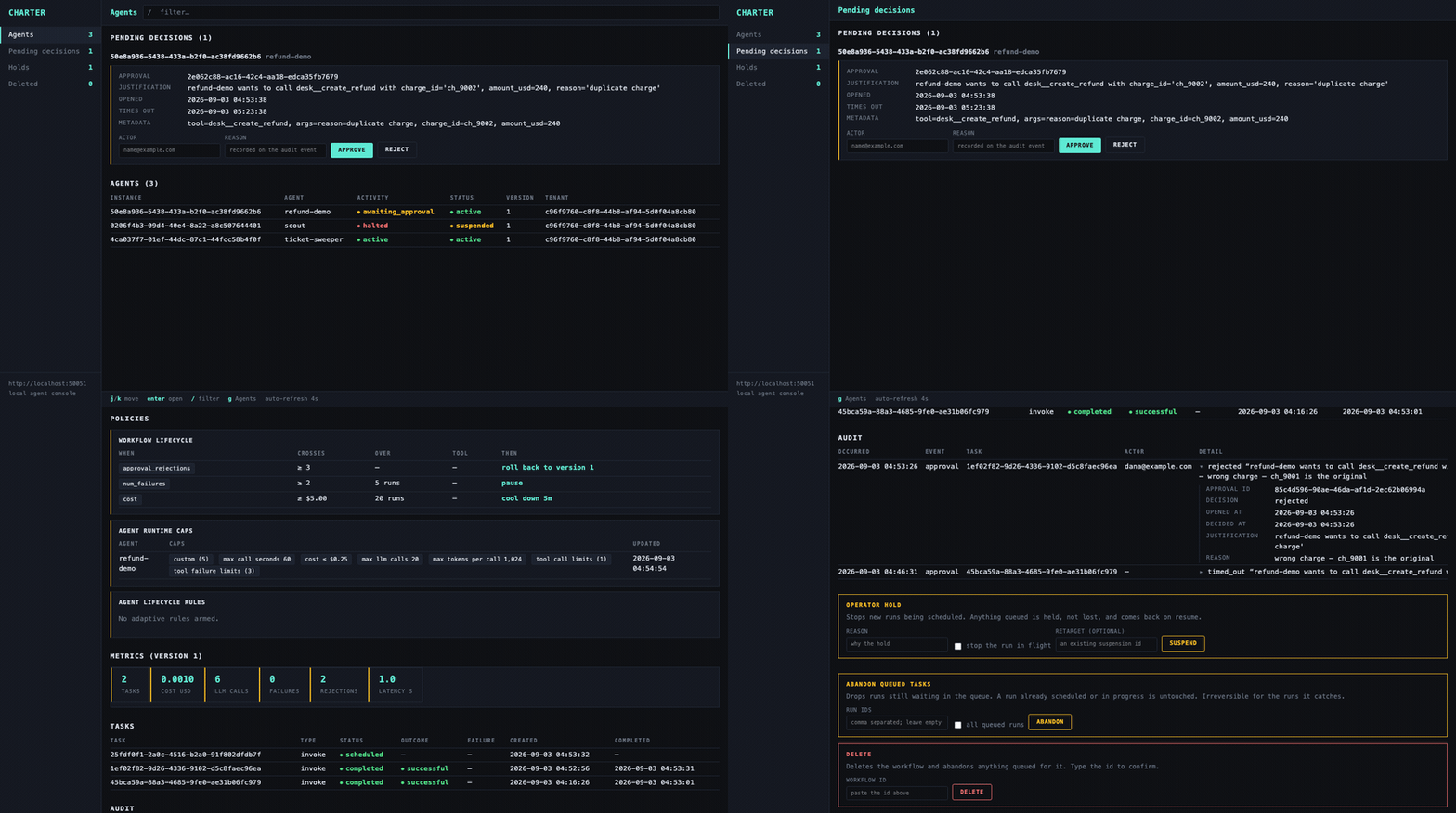
The console shows the same thing in a browser, for all agents:
charter ui
Approvals and policy
Tools can be gated on human approval. Behaviour is versioned, so adding one means
writing a new version file:
mcp:
  - name: stripe
    url: https://mcp.stripe.com
    env: [STRIPE_API_KEY]
    tools:
      - tool: get_charge
      - tool: create_refund
        approval: always
Charter stops the task and shows a person the call it wants to make and the
reasoning behind it:
charter approve apr_01J8Z --reason "third dispute this month"
Nothing waits in your terminal. The task ends at the gate and resumes when someone
answers, which can be days later on a different worker.
Limits are policy rather than behaviour, so they sit outside the version.runtime.yaml holds what one task may spend and what the agent may reach:
apiVersion: charter/v1
kind: RuntimePolicy
agent: triage

per_run:
  max_cost_usd: 0.50
  max_llm_calls: 20
  max_seconds: 300
  max_parallel_subagents: 3
  capability_call_limits:
    - { capability: write, max_calls: 10 }

limits:
  max_call_seconds: 60
  max_tool_seconds: 30

authority:
  allowed_capabilities: [read, write]
  approval_timeout_seconds: 3600
lifecycle.yaml acts on the agent over time. When a metric crosses a threshold the
control plane can pause it, cool it down, or roll it back to an earlier version:
apiVersion: charter/v1
kind: LifecyclePolicy
agent: triage

rules:
  - when: { metric: num_failures, threshold: 3 }
    then: { pause: { window: 5 } }

  - when: { metric: approval_rejections, threshold: 2 }
    then: { cooldown: { window: 10, seconds: 3600 } }

  - when: { metric: cost, threshold: 2.00 }
    then: { set_version: { target: 1 } }
Both are re-applied on every charter apply, so a ceiling can be lowered without
cutting a release.
Architecture
charter apply compiles your configuration into workflows and policy on the
BoundFlow control plane. A Charter worker
runs the agent in your environment and talks to your MCP servers with credentials
that stay there.
The agent loop itself is deepagents,
so its tools, subagents, filesystem and skills work here unchanged. Charter makes
that loop durable and governed: it checkpoints the run, turns the harness's
interrupts into approvals a person can answer tomorrow, and holds it to the limits
your config declares.
                    BoundFlow
                  Control Plane
             state • policy • lifecycle
                       │
                      RPC
                       │
                       ▼
              Your environment
        ┌─────────────────────────┐
        │ Charter worker          │
        │                         │
        │ model ↔ agent loop      │
        │             │           │
        │          MCP tools      │
        └─────────────────────────┘
Charter adds no database or service of its own. Deployed agents keep running
through their workers and the control plane whether or not the CLI is installed.
Documentation
- DESIGN.md: every field of every file, and the decisions behind them
- deploy/: running workers as containers, and a control plane locally
- examples/: fuller configurations, for reading. They name real
Zendesk and Stripe servers, so they do not run as-is - demo/leads/: an agent that runs end to end against a local MCP
server, where you play the people it contacts
Development
python -m venv .venv
.venv/bin/pip install -e '.[dev,ui,otel]'
.venv/bin/pytest
boundflow comes from PyPI. Add --pre --upgrade boundflow to track its main,
which is what CI's second unit job does.
End-to-end tests need a control plane, and skip themselves without one. The compose
file CI uses runs the published image:
docker compose -f deploy/local.compose.yml up -d --wait
key=$(docker compose -f deploy/local.compose.yml run --rm server \
        -mode=provision -name=dev | awk '/^api_key/{print $NF}')

export BOUNDFLOW_API_KEY=$key
export BOUNDFLOW_SERVER_ADDRESS=http://localhost:50051
export BOUNDFLOW_WORKER_ADDRESS=http://localhost:50052
export CHARTER_STORE_URL=postgres://charter:charter@localhost:5434/charter
pytest tests/e2e
They use a real control plane, a real MCP subprocess and real governance gates.
Only the model is faked, so the suite stays deterministic and free.
Yorumlar (0)
Yorum birakmak icin giris yap.
Yorum birakSonuc bulunamadi