vscode-tailwindshades
Health Gecti
- License — License: MIT
- Description — Repository has a description
- Active repo — Last push 0 days ago
- Community trust — 77 GitHub stars
Code Uyari
- network request — Outbound network request in apps/web/app/mcp/route.ts
Permissions Gecti
- Permissions — No dangerous permissions requested
Bu listing icin henuz AI raporu yok.
Tailwind CSS palettes (50–950) from any color, for Tailwind v4, v3, v2 and v1. A VS Code extension, a CLI, and an MCP server for AI agents.
Tailwind CSS Shades






Generate a full Tailwind CSS color palette (50 to 950) from any color, right in your editor. Works with Tailwind v4, v3, v2 and v1.
VS Code Marketplace · Open VSX (Cursor, Windsurf, VSCodium)
Also as a command line tool and an MCP server for AI agents, with the same palettes. Try it in the browser: tailwindshades.bourhaouta.com.
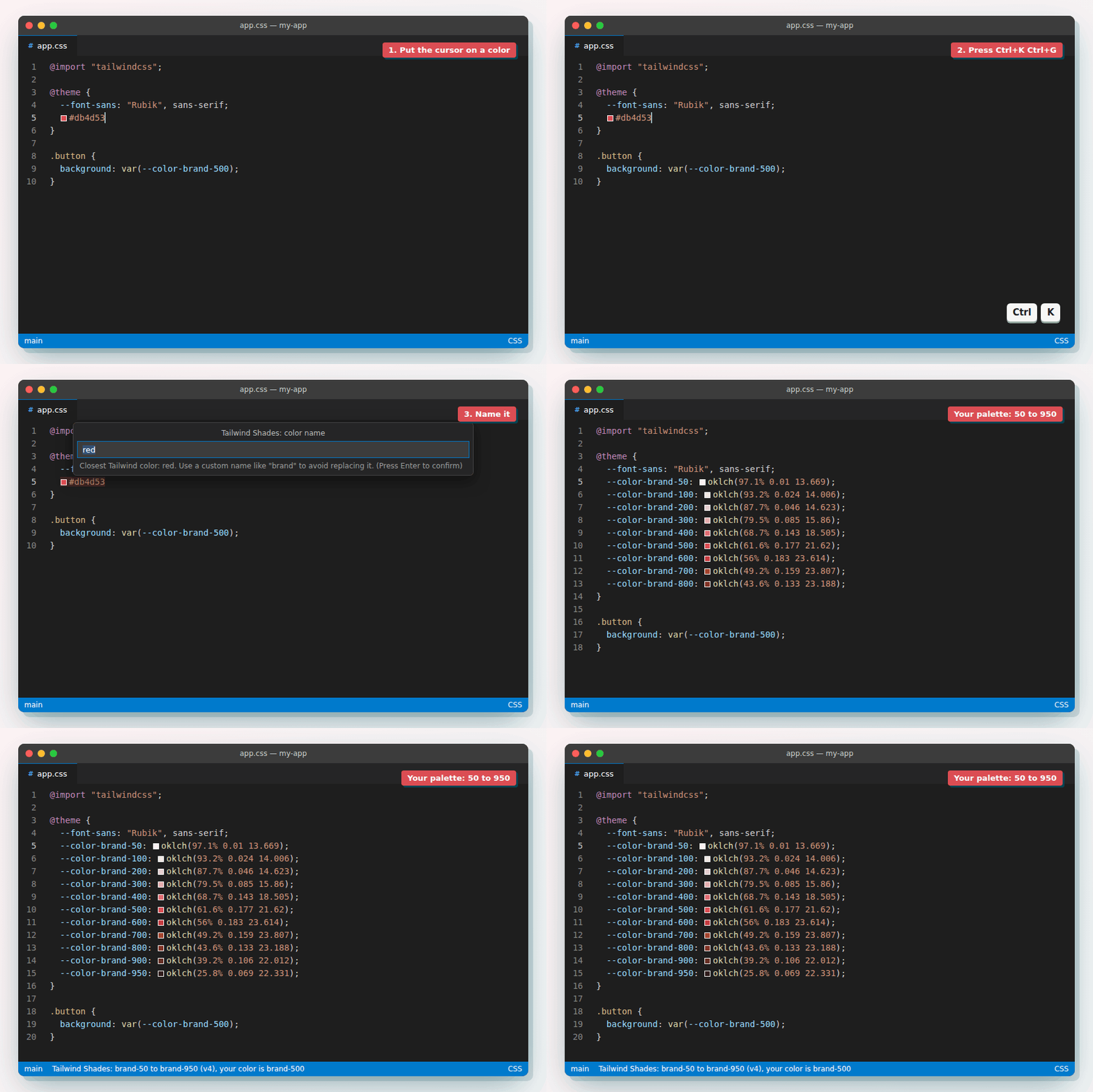
Usage
- Select a color, or just put the cursor on it:
#db4d53,rgb(…),hsl(…),oklch(…)or a CSS color name. - Press Cmd+K Cmd+G (macOS) or Ctrl+K Ctrl+G, or run Tailwind Shades: Generate color palette from the Command Palette.
- Pick a name. The closest Tailwind color is suggested; type your own (like
brand) to keep Tailwind's color too.
With no color under the cursor, the extension asks you for one.
Tailwind v4 (CSS file)
@theme {
  --color-brand-50: oklch(97.1% 0.01 13.669);
  --color-brand-100: oklch(93.2% 0.024 14.006);
  --color-brand-200: oklch(87.7% 0.046 14.623);
  --color-brand-300: oklch(79.5% 0.085 15.86);
  --color-brand-400: oklch(68.7% 0.143 18.505);
  --color-brand-500: oklch(61.6% 0.177 21.62);
  --color-brand-600: oklch(56% 0.183 23.614);
  --color-brand-700: oklch(49.2% 0.159 23.807);
  --color-brand-800: oklch(43.6% 0.133 23.188);
  --color-brand-900: oklch(39.2% 0.106 22.012);
  --color-brand-950: oklch(25.8% 0.069 22.331);
}
Already inside an @theme { … } block? Only the variables are added.
Tailwind v3 (tailwind.config.js)
brand: {
  50: '#fdf2f3',
  100: '#fae2e3',
  200: '#f6c9cc',
  300: '#efa5a9',
  400: '#e7757a',
  500: '#db4d53',
  600: '#ca373c',
  700: '#aa2c30',
  800: '#8d272b',
  900: '#772528',
  950: '#411012',
},
How the shades are made
The palette follows Tailwind's own colors instead of simply mixing with white and black:
- It finds the Tailwind color closest to yours, and copies how that color's lightness, saturation and hue change from light to dark.
- Your color stays exactly as it is, at the shade where it fits best. A light color can become
200, not always500. - The math happens in OKLCH, the color space Tailwind v4 uses, so the steps look even to the eye.
Tailwind versions
The version is detected from your project, most reliable source first:
- The closest
package.jsonwith atailwindcssdependency - The current CSS file:
@import "tailwindcss",@theme,@utility,@plugin→ v4;@tailwind base;→ v3 - A
tailwind.config.js(or.ts,.cjs,.mjs) in the project → v3 - Other CSS files in the project, with the same hints as step 2
If nothing is found, v4 is used. The status bar tells you which version was used and why, e.g. v3 from tailwind.config.js.
| Version | Shades | In CSS files | In JS/TS files | Colors |
|---|---|---|---|---|
| v4 | 50–950 | @theme block |
config object | OKLCH |
| v3 | 50–950 | CSS variables | config object | hex |
| v2 | 50–900 | CSS variables | config object | hex |
| v1 | 100–900 | CSS variables | config object | hex |
Each version uses its own default palette as the reference, so a v1 palette looks like v1 colors.
Commands
| Command | What it does |
|---|---|
| Generate color palette | Picks the version and output for you (see above). Shortcut: Ctrl/Cmd+K Ctrl/Cmd+G |
| Generate color palette (choose version and output)… | Asks which Tailwind version and output to use |
| Generate color palette as CSS variables | Always writes --brand-500: …; variables |
Settings
| Setting | Default | Options |
|---|---|---|
tailwindshades.tailwindVersion |
auto |
auto, 4, 3, 2, 1 |
tailwindshades.colorFormat |
auto (OKLCH for v4, hex before) |
auto, oklch, hex, rgb |
tailwindshades.output |
auto (from the file type) |
auto, theme, config, cssVariables |
tailwindshades.promptForName |
true |
Ask for the color name |
Command line
The same palettes, without an editor:
npx tailwindshades-cli "#db4d53" --name brand
| Option | Values | Default |
|---|---|---|
-n, --name |
letters, digits and dashes | the closest Tailwind color |
-t, --tailwind |
4, 3, 2, 1 |
4 |
-f, --format |
oklch, hex, rgb |
oklch for v4, hex before |
-o, --output |
theme, config, css |
theme for v4, config before |
The palette goes to stdout, so you can add it to a file: npx tailwindshades-cli db4d53 -o css >> colors.css. More in the package README.
Use it with AI agents
AI coding agents often guess Tailwind shades, or add one --color-brand line instead of a palette. The tailwindshades-mcp server gives them two tools:
generate_palette: the same palette code as the extension, for the project's Tailwind versionclosest_tailwind_color: the Tailwind class closest to a color (e.g.#db4d53→red-500), and whether the difference is visible
Then ask things like "Add a brand color #db4d53 to my theme".
Remote, nothing to install: connect to https://tailwindshades.bourhaouta.com/mcp.
Claude Code
claude mcp add --transport http --scope user tailwindshades https://tailwindshades.bourhaouta.com/mcp
Cursor (~/.cursor/mcp.json, or .cursor/mcp.json in a project)
{
  "mcpServers": {
    "tailwindshades": { "url": "https://tailwindshades.bourhaouta.com/mcp" }
  }
}
VS Code (.vscode/mcp.json)
{
  "servers": {
    "tailwindshades": { "type": "http", "url": "https://tailwindshades.bourhaouta.com/mcp" }
  }
}
Local: run npx -y tailwindshades-mcp as a stdio server instead, for example claude mcp add --scope user tailwindshades -- npx -y tailwindshades-mcp. Setup for each agent is in the package README.
It's also in the MCP Registry as io.github.bourhaouta/tailwindshades, with both options.
Development
An npm workspace: the extension is at the root, the palette engine and CLI in packages/core, the MCP server in packages/mcp, and the website with the remote MCP endpoint (/mcp) in apps/web (npm run dev -w apps/web).
npm install
npm run check   # type check + tests
npm run build   # bundle the extension to dist/
Press F5 in VS Code to try the extension in a new window. After upgrading a tailwindcss dev dependency, run npm run palette to refresh the reference palettes. After an engine change, node media/demo/record.mjs re-records the demo GIF (see the file for setup).
License
MIT © Omar Bourhaouta
Yorumlar (0)
Yorum birakmak icin giris yap.
Yorum birakSonuc bulunamadi