personal-tutor
Health Warn
- License — License: Apache-2.0
- Description — Repository has a description
- Active repo — Last push 0 days ago
- Low visibility — Only 6 GitHub stars
Code Pass
- Code scan — Scanned 12 files during light audit, no dangerous patterns found
Permissions Pass
- Permissions — No dangerous permissions requested
No AI report is available for this listing yet.
A collection of skills to turn claude code/codex into a long-lived personal tutor.

The Personal Tutor Skill
Turn your coding agent into a tutor that learns how you learn.
You can ask an AI to explain almost anything. But have you ever actually learned something hard from a chat window? You ask a question, you get a wall of text, you nod along, you scroll, and three days later you remember approximately none of it. Chat is a great place to get answers. It's a pretty bad place to learn.
That's because learning isn't reading. It's doing. It's answering a question before you see the explanation. It's changing a number in a simulation and watching the system react. It's writing code, running it, and finding out you were wrong in an interesting way. In a chat, all of those moments flatten into more text in a very long scroll.
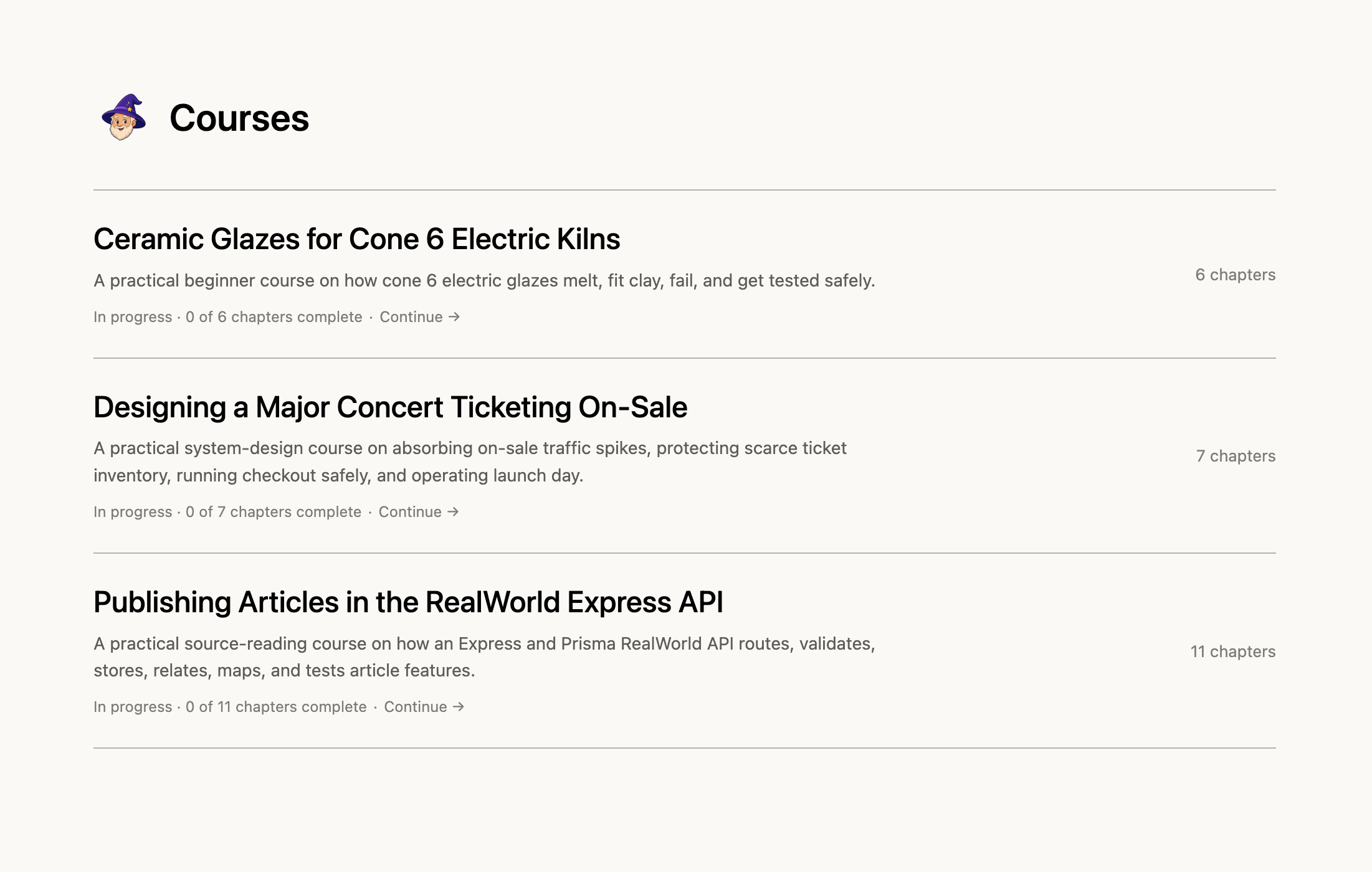
Homepage generated by skill. From ceramics to system design! 😎
Personal Tutor gives your coding agent an actual teaching toolkit instead. It builds real courses, locally, out of things like:
- Clear lessons and worked examples
- Images, diagrams, charts, and visual explanations
- Interactive simulations and small experiments
- Multiple choice and matching quizzes with feedback
- Runnable coding exercises with answer checking
- Glossaries and flashcards for later review
- Fully custom interfaces when a topic needs something weird (more on this below)
A tutor that remembers you
Here's the thing about a good human tutor: half their value isn't what they know, it's what they know about you. They remember that you already get recursion but freeze up on off-by-one errors. They remember you like diagrams. They don't re-explain chapter one every Tuesday.
Your coding agent, by default, has the memory of a goldfish. Every new session, you're a stranger again.
Personal Tutor fixes that by keeping your courses, progress, quiz results, coding attempts, and study history together in ~/.personal-tutor. When your agent writes the next lesson, it reads that history first. It checks what you've finished, where you struggled, and how you like things explained. The more you use it, the better it gets at teaching you specifically, which is kind of the whole point of the word "personal."
What's up with the fancy UI?
I'm glad you asked! This is my favorite part, and it's a bit of a have-your-cake-and-eat-it-too situation 😁.
Coding agents can build genuinely wonderful custom interfaces, and that flexibility is one of the coolest things about them. But asking an agent to hand-write a quiz component, a progress tracker, and a chart renderer from scratch for every single lesson is slow, expensive, and burns a pile of tokens reinventing the same wheels. Nobody needs their tutor to lovingly craft a bespoke multiple-choice button for the 40th time.
So Personal Tutor ships with a kit of polished, pre-built teaching components as part of the skill. The agent invokes quizzes, flashcards, diagrams, charts, glossaries, and coding exercises with a few lines of code, which is fast, cheap, and token-efficient. And when a topic genuinely calls for something unusual (a little traffic simulator, a kiln temperature explorer, whatever), the agent can still drop down and write raw TypeScript, JSX, CSS, Canvas, SVG, or WebGL.
Sturdy building blocks for the common stuff, full creative freedom for the moments that make an idea click. Best of both worlds.
See it in action
Here are three courses made from simple prompts. They all live in the same local library, even though the subjects have almost nothing in common. That's part of the fun of having an "expert in everything" as your tutor.
Learn an unfamiliar codebase
Prompt: Teach me how the Node Express Realworld Example App handles publishing a new article. I'm comfortable with TypeScript, but I'm new to Express and Prisma.
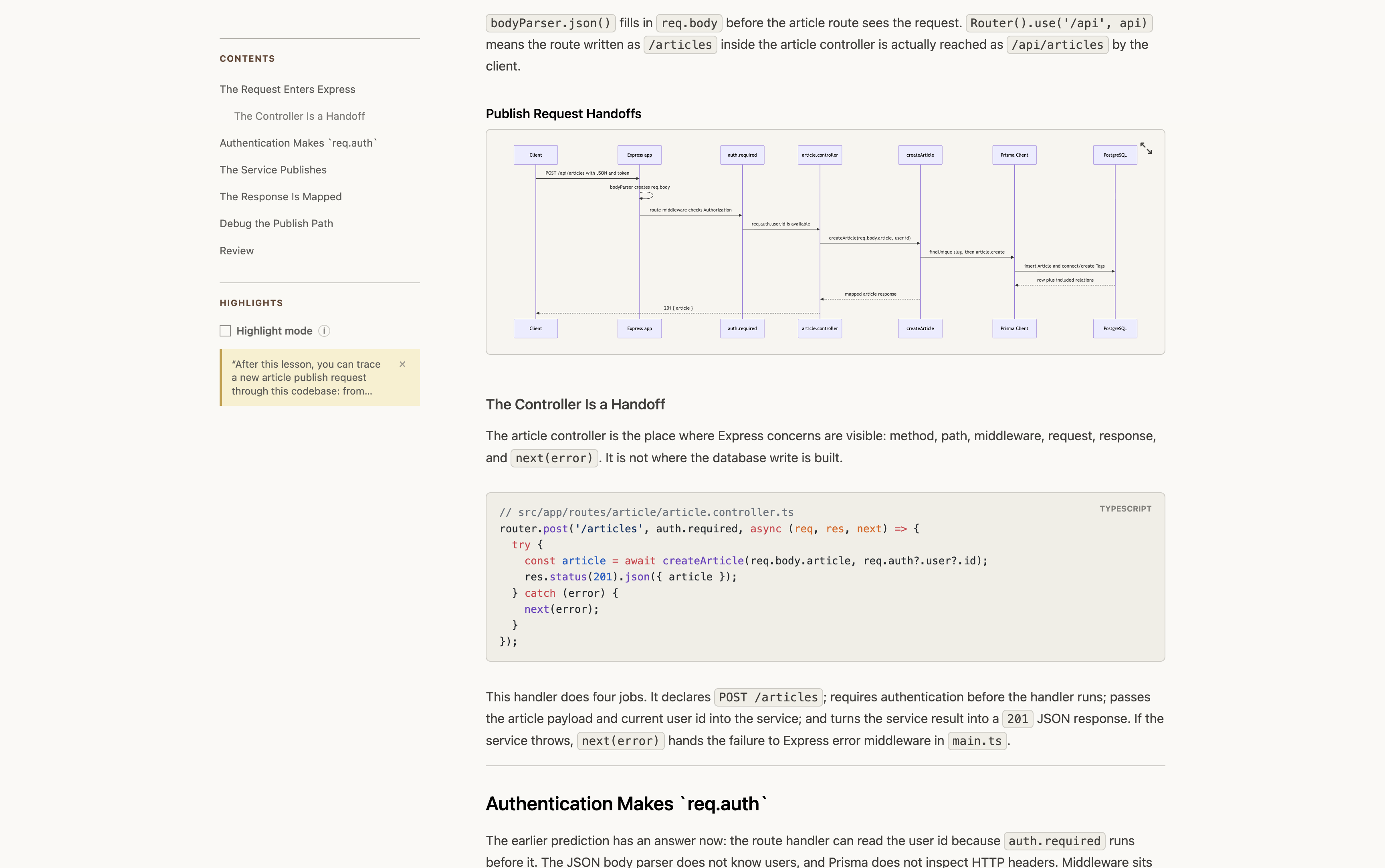
Follow a real request through the codebase and see how the routes, middleware, application logic, and database calls fit together.
Explore system design through simulation
Prompt: Teach me how to design a concert ticketing system for a major on-sale. I understand APIs and databases, but I’m not sure how to handle the traffic spike, prevent seats from being double-booked, or manage the checkout flow.
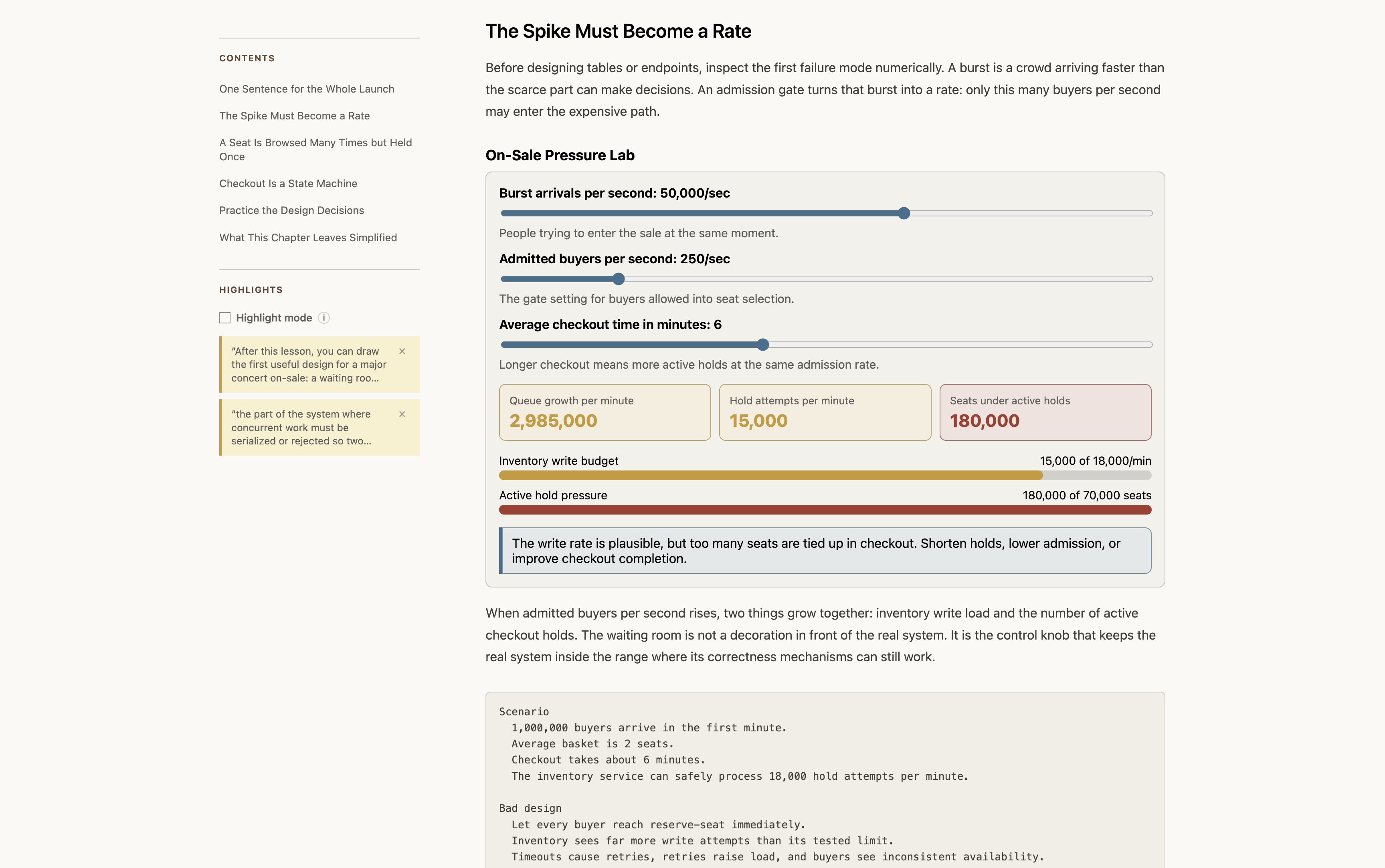
Change the arrival rate, admission rate, and checkout time. Then watch what happens to the queue and active seat holds.
Practice with visual examples
Prompt: Teach me how ceramic glazes work. I’m a beginner potter using cone 6 clay in an electric kiln. I want to understand glaze ingredients, common defects, and how to start testing my own recipes safely.
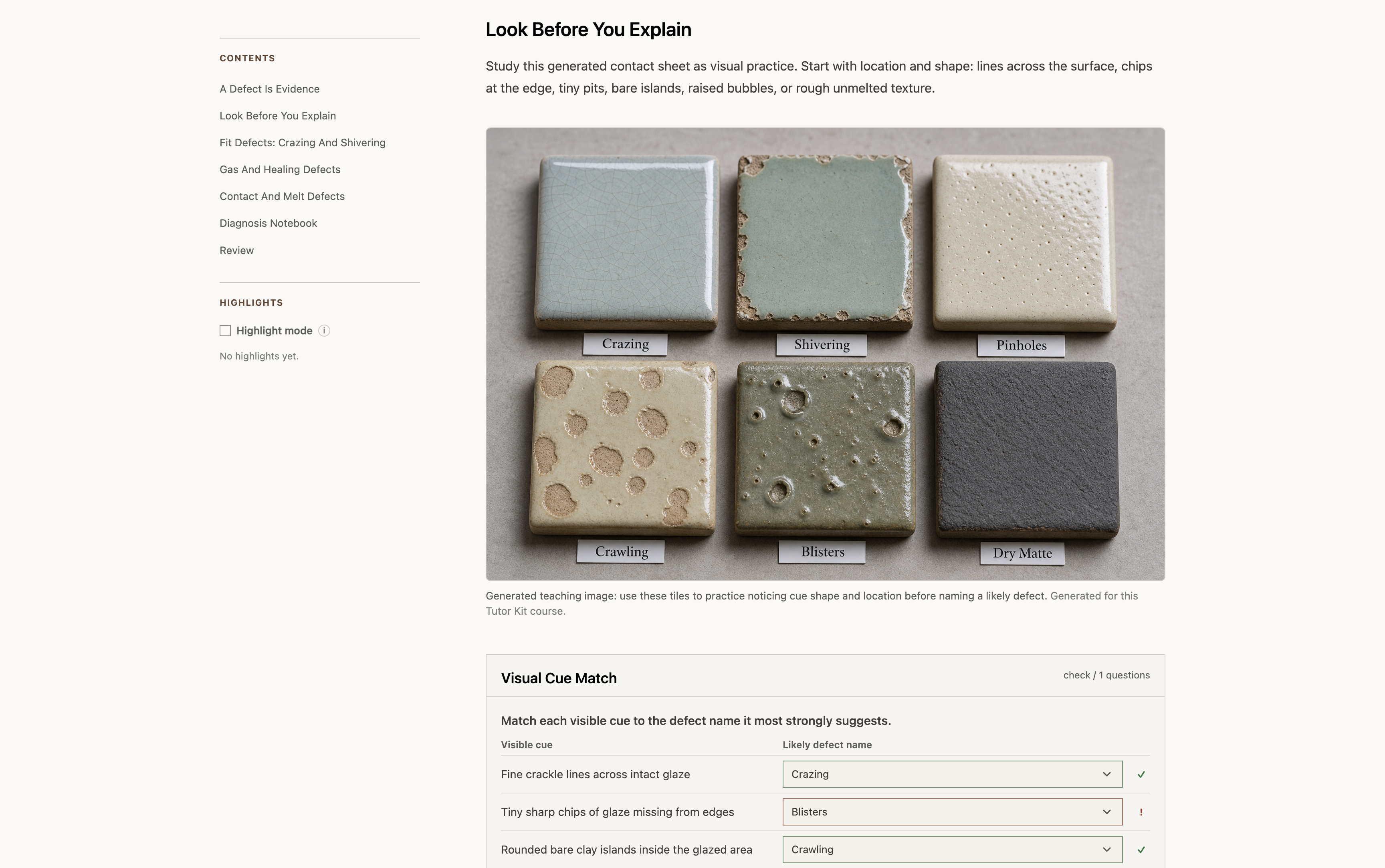
Compare glaze defects, spot the visual clues, and check your answer inside the lesson.
Quick start
Personal Tutor requires Node.js 20.19.x, or Node.js 22.12.0 or newer. Node.js 21.x is not supported because Tutor Kit's Vite/Rolldown runtime dependencies do not support it.
1. Install
For Codex:
npx skills add briannajzhang/personal-tutor --skill personal-tutor --global --agent codex
For Claude Code:
npx skills add briannajzhang/personal-tutor --skill personal-tutor --global --agent claude-code
For both:
npx skills add briannajzhang/personal-tutor --skill personal-tutor --global --agent codex --agent claude-code
These commands use the skills CLI. Personal Tutor installs its Tutor Kit packages the first time you use it.
2. Ask your coding agent to build a course
Use $personal-tutor in Codex or /personal-tutor in Claude Code. Then describe what you want to learn and what you already know:
Teach me 1D dynamic programming for technical interviews. I understand recursion, but I struggle to recognize when to use DP.
Personal Tutor may ask a few questions before it creates the first chapter, just as a good tutor would ask what you already know before starting a lesson.
3. Open the course
Start the local course app:
node ~/.agents/skills/personal-tutor/scripts/tutor-kit.mjs dev
Your courses and learning history stay in ~/.personal-tutor.
[!WARNING]
Personal Tutor can run course code and browser components. Only open courses and workspaces you trust.
4. Continue later
Come back tomorrow, next month, or whenever the motivation strikes, and just ask:
Continue my dynamic programming course.
Personal Tutor picks up the existing course, checks your saved progress, and figures out what should come next. No "as I mentioned in our previous conversation" required.
Development
npm install
npm test
npm run build:skill:check
License
Personal Tutor is licensed under the Apache License 2.0.
Reviews (0)
Sign in to leave a review.
Leave a reviewNo results found