Wick
Health Warn
- License — License: MIT
- Description — Repository has a description
- Active repo — Last push 0 days ago
- Low visibility — Only 5 GitHub stars
Code Pass
- Code scan — Scanned 8 files during light audit, no dangerous patterns found
Permissions Pass
- Permissions — No dangerous permissions requested
This MCP server captures C# exception telemetry from Godot Engine projects and enriches it using Roslyn. It feeds the complete source context and stack traces directly to an AI assistant to speed up debugging.
Security Assessment
Overall risk: Low. The code scan of 8 files found no dangerous patterns, hardcoded secrets, or requests for risky permissions. The server runs locally via the .NET SDK, using local environment variables to point to your Godot executable and project path. While it reads local source code and project files to perform its analysis, it does not appear to make external network requests or execute arbitrary, hidden shell commands. It strictly limits its scope to your local development environment.
Quality Assessment
The project is actively maintained, with its most recent push occurring today. It uses the permissive and standard MIT license. However, community trust and visibility are currently very low. It only has 5 GitHub stars, meaning the codebase has not been widely peer-reviewed or battle-tested by a large audience yet. Developers should expect a highly specialized, early-stage tool rather than a mature community standard.
Verdict
Safe to use, but keep in mind that this is a very early-stage project with minimal community oversight.
Roslyn-enriched C# exception telemetry for Godot Engine, exposed over MCP
Wick
Roslyn-enriched C# exception telemetry for Godot Engine, exposed over MCP.


What is Wick?
When a Godot C# game crashes, your AI assistant sees a raw stack trace and spends 8+ turns asking you to open files. Wick captures that exception, enriches it with Roslyn-powered source context (the actual method body, caller chain, recent logs, scene state), and hands the full picture to the AI in one call. One turn to diagnosis instead of ten.
What makes Wick different?
Other Godot MCP servers (like the excellent GoPeak) focus on scene manipulation and GDScript tooling. Wick focuses on the C#/.NET developer experience:
- Roslyn-enriched exception telemetry -- stderr-captured C# exceptions enriched with the calling method body, surrounding source lines, enclosing type, and caller chain. No other Godot MCP server does this.
- In-process exception capture -- optional Wick.Runtime NuGet companion catches TaskScheduler.UnobservedTaskException and async exceptions that stderr can't see.
- Build diagnostics with source context -- dotnet build errors enriched with Roslyn source context through the same pipeline as runtime exceptions.
- C# analysis tools -- find symbol, find references, member signatures via Roslyn workspace.
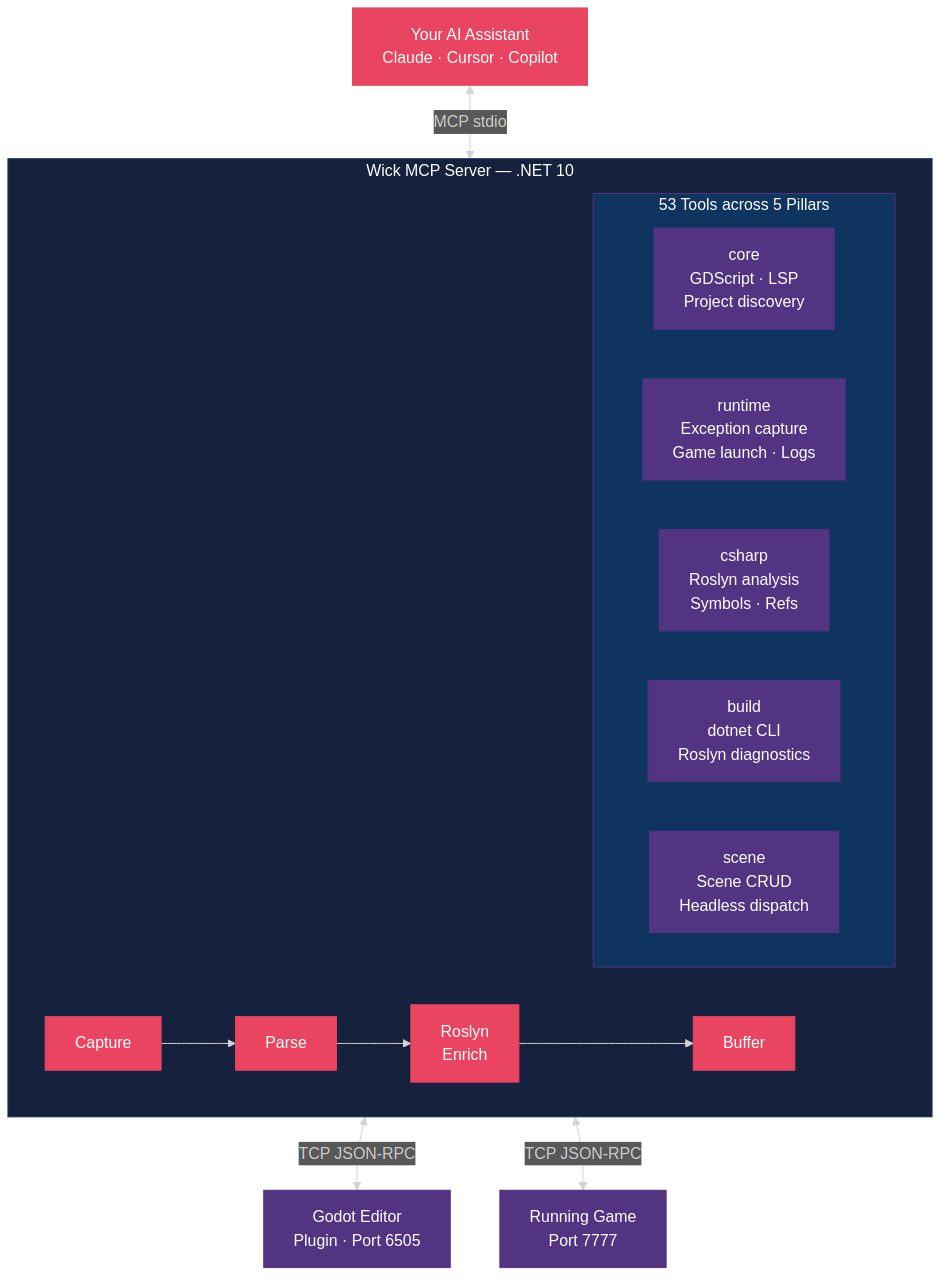
- 5-pillar tool group system -- activate only what you need: core, runtime, csharp, build, scene.
Getting Started
Prerequisites
- .NET 10 SDK (10.0.201 or later)
- Godot 4.6.1+ with .NET/Mono support
Installation
Wick has two parts: a Godot-side bridge addon (/addons/wick/) and the .NET MCP server.
Godot bridge — install via the Godot Asset Library in-editor (recommended), or copy /addons/wick/ into your project manually.
MCP server — clone and build:
git clone https://github.com/buildepicshit/Wick.git
cd Wick
dotnet build Wick.slnx --configuration Release
MCP Configuration
Add Wick to your AI coding assistant's MCP configuration:
{
  "mcpServers": {
    "wick": {
      "command": "dotnet",
      "args": ["run", "--project", "path/to/Wick/src/Wick.Server"],
      "env": {
        "WICK_GROUPS": "core,runtime,csharp,build",
        "WICK_GODOT_BIN": "/path/to/godot",
        "WICK_PROJECT_PATH": "/path/to/your/godot-project"
      }
    }
  }
}
Tool Groups
Activate tool pillars via WICK_GROUPS env var or --groups CLI flag:
| Pillar | What it includes | Default |
|---|---|---|
| core | GDScript tools, scene parsing, GDScript LSP, introspection | Always on |
| runtime | Exception pipeline, game launch/stop, log tail, runtime_diagnose | Opt-in |
| csharp | Roslyn analysis, find symbol, find references, member signatures | Opt-in |
| build | dotnet build/test/clean, NuGet management, build_diagnose | Opt-in |
| scene | Scene create/modify via headless Godot dispatch | Opt-in |
Example: WICK_GROUPS=core,runtime,csharp,build or --groups=all.
Optional: Wick.Runtime Companion
For in-process exception capture (async exceptions, TaskScheduler failures), add the Wick.Runtime NuGet to your Godot project:
// In your Godot project's autoload or entry point:
WickRuntime.Install();
This captures exceptions that stderr can't see and reports them to the Wick server via a TCP bridge.
Architecture
Wick runs as an external process -- it does NOT run inside Godot. Communication:
- stdio -- MCP protocol to the AI client
- TCP 6505 -- editor bridge (Godot plugin to Wick server)
- TCP 7777 -- runtime bridge (running game to Wick server)
- TCP 7878 -- Wick.Runtime companion bridge (in-process to Wick server)
This architecture lets Wick target .NET 10 even though Godot 4.6.1's runtime is stuck on .NET 8.
Attribution
Wick is a clean-room reimplementation inspired by GoPeak (MIT License, (c) 2025 Solomon Elias / HaD0Yun). See ATTRIBUTION.md for detailed credits.
Contributing
We welcome contributions! Please read CONTRIBUTING.md before submitting a PR.
Demo
Clone the repo and open docs/demo/player.html in a browser to watch the demo, or play the cast file directly:
asciinema play docs/demo/wick-demo.cast

License
Reviews (0)
Sign in to leave a review.
Leave a reviewNo results found