omnisession
Health Uyari
- License — License: MIT
- Description — Repository has a description
- Active repo — Last push 0 days ago
- Low visibility — Only 5 GitHub stars
Code Uyari
- process.env — Environment variable access in .github/workflows/provider-conformance.yml
Permissions Gecti
- Permissions — No dangerous permissions requested
Bu listing icin henuz AI raporu yok.
Find any coding-agent session and continue it in any agent. Local-first CLI and TUI for Claude Code, Codex, OpenCode, Pi, Grok, Cursor, Antigravity, and Hermes.

OmniSession
Find any coding-agent session. Continue it in any agent.
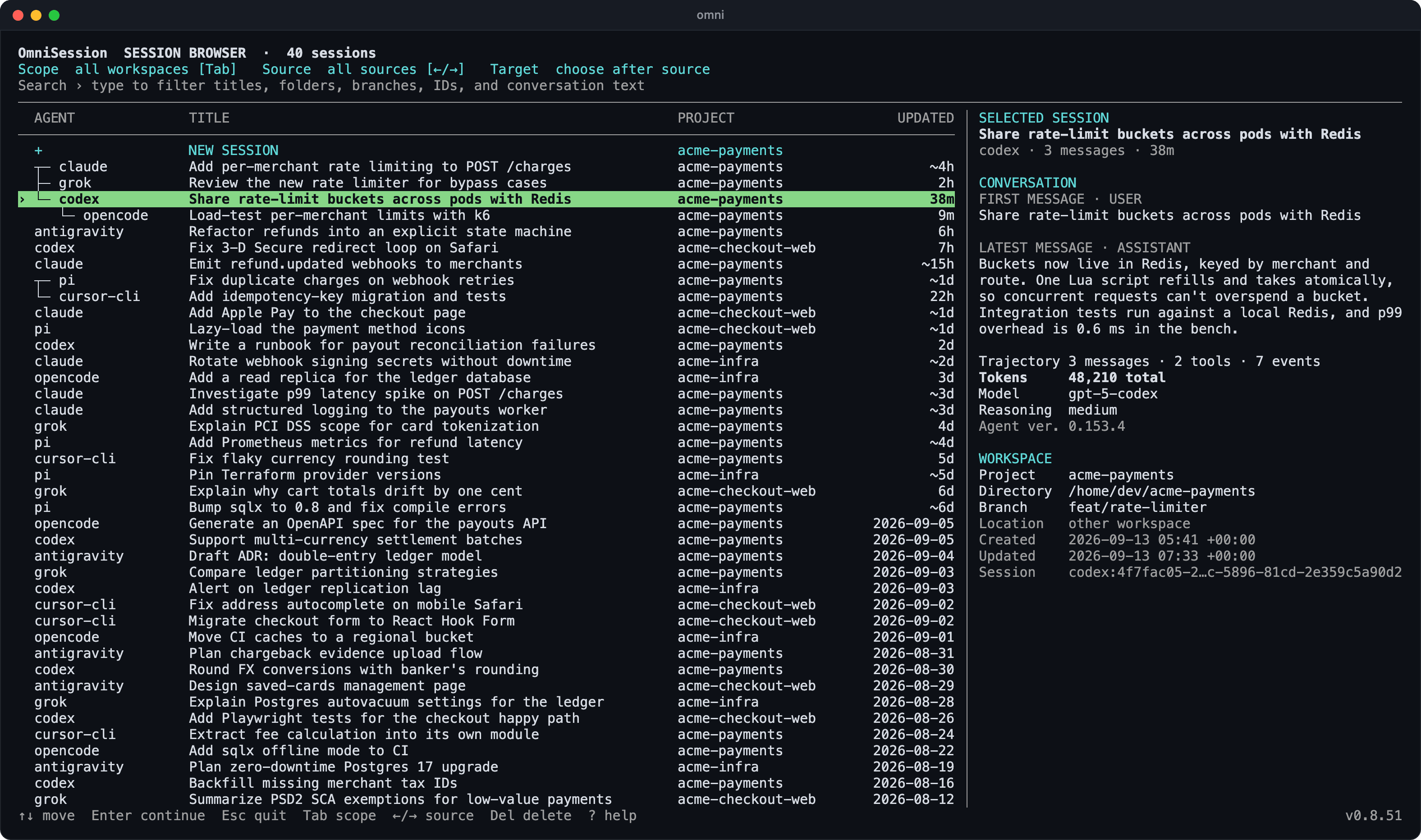
omni is a local-first CLI and terminal picker that searches your Claude Code, Codex, OpenCode, Pi, Oh My Pi, Grok, Cursor, Antigravity, and Hermes history, then continues the session you pick in the agent you want next.



Website · Quick start · Compatibility · Architecture · Docs
[!NOTE]
OmniSession is ready for everyday use and provided as is under the MIT license. Transfers leave the source session unchanged, create a separate target session, and verify imported history before launch. Provider fidelity is capability-specific and provisional where COMPATIBILITY.md says so, and native Windows is a preview.
Quick start
# Install on Linux or macOS: checksum-verified, adds `omni` and provider shims
curl -fsSL https://raw.githubusercontent.com/bvolpato/omnisession/main/install.sh | sh

# Browse every agent's sessions, pick one, choose where it opens
omni

# Search without opening the picker
omni search "rate limiter"

# Continue a Claude Code session in Codex
omni resume claude:<session-id> --in codex
On Windows x86-64 (preview), see Install.
Features
Continue any session in any agent
- Native imports where accepted. OmniSession writes a new session in the target agent's own format, through the provider's import interface or a native writer. Version-gated native writers and gated import interfaces (Codex, Grok, Hermes) require a minimum provider version, and private-format writers validate target structure first. OpenCode's official import has no version gate. Every native import is verified by read-back, and failures roll back exactly what was created.
- You decide when an import cannot run. On a terminal OmniSession says why and asks: retry (after closing the agent that blocked it, say), fork in the source agent instead, continue with a handoff file, or cancel. Routed shim commands ask too. It never quietly swaps the import you asked for.
- Semantic handoff as the fallback. A handoff starts a fresh target session from a private file that quotes redacted history as untrusted context. Scripts and pipes, where nobody can answer, fall back to it automatically.
- History, never replay. Tool calls and shell commands carry over as historical records and never run again. Approvals, hidden reasoning, and permission state stay out. Known provider authentication files are excluded, and recognized credential fields and patterns are redacted, but redaction cannot prove every secret is absent (security model).
- Same agent, native paths. Same-agent sessions resume in place or fork through the agent's own commands.
omni resume codex:<session-id> --in claude-code
omni fork <session> --in opencode
omni inspect <session> --target grok   # what gets preserved, summarized, or omitted
One picker for every agent's history
- Run
omni. Sessions from every installed agent appear in one list, current workspace first. Related sessions stay grouped as a tree across agents. - Fuzzy and full-text. Titles, folders, branches, and IDs match fuzzily as you type. Conversation text matches come from a local, redacted full-text index. Quoted text matches exactly.
- Delta indexing. The first run indexes every discovered session. Later runs index only sessions that changed since the last index.
- Scriptable.
omni searchworks without the picker, and--jsonreturns structured results.
omni search pagination --all-projects --provider codex --limit 50
omni --json search pagination
omni index                           # refresh cached metadata and conversation text
omni search pagination --cached      # search without reading provider stores
search --cached uses the metadata cache from omni index or the picker and the existing full-text index. It does not discover sessions, run provider commands, or read native transcripts. Results can include sessions changed or deleted since refresh. The command reports that freshness is unknown, and JSON sets cached to true and index.stale to null. Run omni index to refresh the cache.
If discovery is incomplete or unverified, omni index and the picker update the sessions they find and preserve unobserved cached sessions and their search history. Only an adapter that explicitly guarantees complete discovery across all projects can remove missing entries. Codex and Hermes provide that guarantee after successful discovery without warnings. Other adapters preserve unobserved entries, which can include deleted sessions.
Safe by design
Search indexing uses a 16 MiB full-read budget. Hermes measures active message content for the selected session, so unrelated data in its shared database does not force a preview. Larger sessions keep bounded previews and report partial coverage. The database snapshot limit still applies separately. This index reader version refreshes older cached documents once. Unchanged Hermes previews stay cached until the session's update time changes.
- Read-only provider stores. Discovery, search, and transfers never write source stores. The only source mutation is deleting the exact session you select and confirm.
- Guarded deletion. Private-store deletion validates exact paths and schemas, refuses while that agent runs, and verifies the session is gone.
- Redacted by default. The search index, handoffs, imports, Markdown exports, and bundles redact recognized credential fields and patterns.
- Quiet output. CLI output leaves out transcript text unless you ask for it with
show,markdown,export,search --show-text, or a transfer. Ctrl+Crolls back. Interrupting a native import started from the picker,omni resume,omni fork, or a provider shim rolls back the generated target and exits without launching.
Works where you work
- Linux and macOS release binaries for x86-64 and ARM64, with a checksum-verified installer and background update checks.
- Windows x86-64 preview with a checksum-verified PowerShell installer and compiled provider aliases.
- Provider shims.
claude --continue,codex resume, and other continuation commands route through omni once you select an OmniSession task for the workspace. Everything else passes straight through. - Portable bundles. Export a redacted bundle, import it on another machine, and continue it as
imported:<bundle-uuid>.
Open and rigorous
- Canonical event model. Every adapter maps native records onto one append-only event model with explicit replay policies (RFC 001).
- Specified in RFCs. Workspace identity, adapter protocol, transfer modes, threat model, native materialization, and deletion each have an RFC.
- Conformance matrix. Token-free conformance runs all 90 cross-agent import paths across ten agents in isolated homes, with installed-provider checks and synthetic private stores. Every cell must match the original trajectory.
- Compatibility manifest. One reviewed manifest drives version gates, capability checks, the website, and the compatibility table.
Supported agents
| Agent | Import route | Version gate | Read/index | Same-agent resume | Cross-agent import |
|---|---|---|---|---|---|
| Codex | Provider app-server import | >= 0.146.0 | Linux, macOS, Windows | Linux, macOS, Windows | Linux, macOS, Windows |
| Claude Code | Transactional native writer | >= 2.1.220 | Linux, macOS | Linux, macOS | Linux, macOS |
| OpenCode | Official import and export | Official API (tested 1.18.18) | Linux, macOS | Linux, macOS | Linux, macOS |
| Pi | v3 JSONL native writer | >= 0.79.3 | Linux, macOS | Linux, macOS | Linux, macOS |
Oh My Pi (omp) |
Pi-compatible v3 JSONL native writer | >= 18.2.10 | Linux, macOS | Linux, macOS | Linux, macOS |
| Grok | ACP session import | >= 0.2.114 | Linux, macOS, Windows | Linux, macOS, Windows | Linux, macOS, Windows |
| Cursor IDE | SQLite native writer | >= 3.12.17 | Linux, macOS | Linux, macOS | Linux, macOS |
| Cursor Agent | SQLite/protobuf native writer | >= 2026.07.23-e383d2b | Linux, macOS | Linux, macOS | Linux, macOS |
| Antigravity CLI | SQLite/protobuf native writer | >= 1.1.8 | Linux, macOS | Linux, macOS | Linux, macOS |
| Hermes | Provider session import | >= 0.19.1 | Linux, macOS | Linux, macOS | Linux, macOS |
| Antigravity IDE | None: read-only source (RFC 010 draft) | Read-only (surveyed 2.2.1) | Linux, macOS | Not guaranteed | Not guaranteed |
- Gated agents stay enabled on newer versions unless structural validation or read-back fails. Older versions cannot import natively (you decide what happens instead), and Cursor IDE builds below the gate are excluded from target choices. OpenCode imports through its official API without a version gate.
- Cursor IDE declares no clean start, so failed Cursor IDE imports stop with an error instead of handing off.
- The picker offers only runnable targets found on this machine. Session references use
provider:id, andclaudeandclaude-codeare interchangeable.
COMPATIBILITY.md has version signals, clean-start support, validation evidence per platform, and provider-specific transfer details.
Install
Linux and macOS
curl -fsSL https://raw.githubusercontent.com/bvolpato/omnisession/main/install.sh | sh
The installer verifies the release checksum, installs omni into ~/.local/bin, installs provider shims, and adds the shim directory to PATH in your shell profile. Restart your shell afterwards.
Set OMNI_INSTALL_DIR to an absolute path to install elsewhere, or OMNI_NO_MODIFY_PATH=1 to leave shell profiles alone:
curl -fsSL https://raw.githubusercontent.com/bvolpato/omnisession/main/install.sh | OMNI_INSTALL_DIR="$HOME/bin" sh
Linux archives contain static musl binaries without a host glibc dependency. WSL is a separate Linux environment; use the Linux installer inside WSL.
Windows x86-64 (preview)
From PowerShell:
irm https://raw.githubusercontent.com/bvolpato/omnisession/main/install.ps1 | iex
The Windows installer verifies the release checksum and installs omni only. To opt into compiled provider aliases, run this, then follow the printed PATH guidance:
omni shim install --bin-dir "$env:LOCALAPPDATA\OmniSession\bin"
- Aliases are hard links, so replacing
omni.exeleaves them on the old build. Rerunning the installer upgradesomniand relinks existing aliases. If you replaceomni.exeanother way, rerunomni shim installwith the same--bin-dir; it relinks only aliases whose content identifies an older OmniSession build (never runs them) and refuses any other file. - Windows packaging, installer, CLI, and shims run in native Windows CI. Codex and Grok declare read/index, clean start, same-agent resume, and cross-agent import on Windows. Installed Codex, OpenCode, and Grok checks run without credentials; broader provider fidelity remains provisional.
- Other agents do not declare cross-agent import on Windows. Picker targets without declared import continue through semantic handoff, while explicit
omni resume --instill attempts native import. Ctrl+Breakcounts asCtrl+Cduringomni index,omni search, and native imports, and import helpers run on a hidden console of their own, so neither key reaches them.- Native Windows and WSL provider stores are not interchangeable.
From source
Requires Rust 1.88 or newer.
git clone https://github.com/bvolpato/omnisession.git
cd omnisession
cargo build --release --locked -p omnisession-cli
# then copy target/release/omni onto your PATH
Check this machine
omni doctor
omni --json doctor
omni adapters
omni --json adapters
omni adapters --check-imports
omni doctor checks provider installations, session discovery, OmniSession state, and native import version gates. It runs installed CLI version probes (bounded to 15 seconds each); Cursor IDE uses static product metadata and is never launched. It reports old or unrecognized versions and probe failures as native-import blockers, and shows the minimum, recorded compatibility baseline, and its evidence source in native_import_check JSON (including synthetic stubs, which are not installed-agent evidence). A different installed version is an advisory, not proof of breaking compatibility and not an upper version limit. Passing the version gate does not certify the store format: schema, active-writer, rollback, and read-back checks still run when you request a transfer. Doctor never writes provider stores. Plain omni adapters remains a probe-free capability listing.
omni adapters --check-imports runs each installed agent's version command and shows whether its native import version gate passes (import=ready) or what blocks it (import=blocked), such as an agent older than its minimum version. A blocked import asks what to do on a terminal and falls back to semantic handoff in scripts, except Cursor IDE, which has no handoff. Schema, active-writer, and read-back checks still run at transfer time. When a transfer does fall back, the warning prints the full cause.
Usage
Pick a session
omni
NEW SESSIONstarts a clean session in any installed agent with a supported clean-session launcher.- Type to filter titles, folders, branches, and IDs fuzzily. Conversation text matches come from the local search index, with matching context and highlighted terms. Quoted text matches exactly, as in
omni search. - Current workspace sessions appear first.
Tabincludes every workspace; left and right arrows cycle source agents. - Select a session, then choose where it opens. When the target matches the source, you can resume in place or fork. On the target page, type to filter agents by name or any name
--inaccepts, such asgrok,agy, orcur;Escclears the filter.←and→change the permission mode the agent starts in, and the page shows the mode and the exact flags it adds. - The details pane shows workspace, branch, trajectory size, model, reasoning mode, token usage, and conversation lineage when recorded.
- Discovery warnings show as a footer badge, and
?opens help with every key and the full warning text.
| Key | Action |
|---|---|
↑ ↓ or Ctrl-P Ctrl-N |
Move selection |
PgUp PgDn Home End |
Jump through the list |
Enter |
Continue selected session |
Esc |
Clear search, then quit |
Tab |
Toggle current or all workspaces |
← → |
Change source agent |
Delete or Ctrl-D |
Delete selected session (y deletes, n cancels) |
Ctrl-U or Ctrl-W |
Clear search or last word |
Shift-↑ Shift-↓ |
Scroll preview |
? or F1 |
Show or hide help |
The mouse works too: click selects, double-click opens, and the wheel scrolls.
While the picker is open, it indexes conversation text for every discovered session in the background (whole transcripts up to 16 MiB, head and tail of larger ones), and the header shows progress. omni index builds the same index without opening the picker. Ctrl+C stops it after the current session, and the next run continues where it left off.
Unreadable sessions are skipped by later index runs until their source changes; omni index --retry-failed reads them again.
The picker checks for releases in the background. The footer shows the installed version and an update badge when an update is available; press ? then u to update. Confirmation shows the executable path. Package-manager installs still update through their manager.
If the picker looks empty, omni doctor reports this-workspace vs all-workspace counts and any discovery notes. Press Tab for every workspace, or list without the current-project filter:
omni list --provider codex
omni list --all-projects --provider codex
Search
omni search "rate limiter"
omni search '"qwen3.8"'   # exact phrase
omni search pagination --all-projects --provider codex --limit 50
omni --json search pagination
- Each run first indexes sessions that changed since the last index, in scope: current project by default, every workspace with
--all-projects.--no-indexsearches only what is already indexed. - Every word must match. Plain words match titles, folders, branches, and IDs fuzzily, and conversation text by prefix.
- Words with inner punctuation, like
qwen3.8,feat/rate-limiter, orapi_key, match without gaps: as a substring of a title, folder, branch, or ID, and as adjacent words in conversation text.qwen3.8findsqwen3-8, but notqwen3and8far apart. - Double quotes match exactly, ignoring case but keeping spaces and punctuation:
"qwen3.8"findsQwen3.8-Coder, but notqwen3 8orqwen3-8. An unterminated quote runs to the end of the query, empty quotes are ignored, and a query needs at least one letter or digit. In conversation text, a quoted phrase must start at the beginning of a word. - Title, folder, branch, and ID matches rank first; conversation matches follow.
- By default, output shows session reference, age, folder, and match kind. Titles often quote prompts, so titles, index coverage (
complete,head-tail, orpreview), and redacted conversation text around each match appear only with--show-text. JSON always reports coverage for conversation matches. - The first
Ctrl+Cduring indexing stops after the current session and searches what is indexed so far; a secondCtrl+Cexits immediately.
Continue or fork
omni resume <session> --in codex            # continue in another agent
omni resume claude:<session-id> --in codex  # qualify the provider when needed
omni fork <session>                         # fork, choosing the target interactively
omni fork <session> --in codex
- Bare session IDs work when unique. Add the provider prefix when needed.
omni resumewithout a session opens the picker.--from <provider>and--allset its starting filters.--materialize-onlycreates and verifies a supported native target session without launching it.--dry-runshows what would happen without launching.--mode default|accept-edits|auto|yolosets the permission mode the agent starts in.- Transfers across different workspace roots fail closed unless you pass
--allow-workspace-mismatch.
Permission modes
By default OmniSession passes no permission flags, so the target agent starts in its own default mode. To start it in a stronger mode, press → on the target page or pass --mode to omni resume, omni fork, or omni switch. Modes run from least to most permissive, and the arrows stop at either end.
| Mode | What the agent does | Claude Code | Codex | Grok | Cursor Agent | Antigravity CLI | OpenCode | Hermes |
|---|---|---|---|---|---|---|---|---|
default |
No flags: the agent's own settings decide | no flag | no flag | no flag | no flag | no flag | no flag | no flag |
accept-edits |
Edits apply without asking; commands still ask | --permission-mode acceptEdits |
--permission-mode acceptEdits |
--mode accept-edits |
||||
auto |
Safe actions run on their own; the agent's own review still stops risky ones | --permission-mode auto |
--approve-for-me |
--permission-mode auto |
--auto-review |
|||
yolo |
Nothing asks; every command runs | --dangerously-skip-permissions |
--dangerously-bypass-approvals-and-sandbox |
--always-approve |
--force |
--dangerously-skip-permissions |
--auto |
--yolo |
The built-in default is always
default.autoandyoloare choices you make each time, and the page drawsyoloin the danger color.OMNI_MODE=auto(or any mode) sets your own standing default where the agent has that mode.Pi has no permission prompts to configure, and the IDEs take no launch flags, so they show no mode.
Oh My Pi offers
default(no flags),always-ask(--approval-mode always-ask),accept-edits(--approval-mode write), andyolo(--approval-mode yolo). Its--auto-approvealias is full yolo, not a separate safer auto mode. OmniSession uses the advertised--approval-mode yolorather than the hidden--yoloalias so the installed-help check preserves your choice. The flag-free default preserves OMP settings, which may already allow yolo. Explicitalways-askfails closed if the installed help cannot validate it, instead of reverting to a potentially more permissive default.OmniSession uses a mode only when the installed agent's
--helplists its flag (and, where the help prints them, its value under that flag). An older agent steps down to the nearest mode it has, with a warning. The answer is cached per binary until the binary, OmniSession, or its mode definitions change; a probe that fails is never cached.--modealso preselects the mode on the target page and outranksOMNI_MODE. On a short terminal the page scrolls so the selected agent and its mode stay on screen.The launch line says which mode runs, for example
Codex permission mode: auto (--approve-for-me). Transferred history is still untrusted context, so review a session before continuing it inyolo.
Oh My Pi is a separate provider, not a Pi alias. Use omp, oh-my-pi, or ohmypi in the target filter or --in, and omp:ID for session references. Sessions are read from ~/.omp/agent/sessions, the environment-selected OMP_PROFILE (legacy PI_PROFILE) or an already-migrated $XDG_DATA_HOME/omp root. PI_CODING_AGENT_DIR and PI_CONFIG_DIR follow the provider's directory rules. OMP_SESSION_DIR overrides only OmniSession's OMP store and is passed to fresh OMP launches through --session-dir; it never redirects Pi. Native resume and fork pass the exact discovered JSONL path, avoiding ambiguous ID prefixes and store migrations. OMP v3 title-slot and legacy header-first sessions are supported; unknown format versions fail closed. Native deletion is not declared.
Export visible history for manual use:
omni markdown <session> -o session.md
Run omni --help for diagnostics and advanced commands.
Delete a session
Delete or Ctrl-D in the picker removes a supported session from its native source store. Every delete asks for confirmation: y deletes, n cancels.
- Codex, OpenCode, Grok, and Hermes delete through their own commands.
- On Linux and macOS, Claude Code, Pi, Cursor Agent, Cursor IDE, and Antigravity CLI use guarded private-store deletion, which refuses while that agent runs. Windows keeps command-based deletion only.
- Claude Code deletion removes the transcript and sidecars named by the session ID. Shared prompt history in
history.jsonlkeeps its lines.
Details: RFC 009.
Provider shims
Shims let familiar continuation commands pick up your OmniSession task, even when its latest session lives in another agent. The Linux and macOS installer adds them automatically.
- Unix aliases are
claude,codex,opencode,grok,hermes,agy,pi, andcursor-agent, symlinked into~/.omnisession/shims. - Routed forms are intentionally narrow, such as
claude --continue,codex resume --last, andgrok --resume. Everything else, including explicit native session IDs, passes through unchanged. RFC 005 has the full table. - Routing applies only when the workspace has a selected OmniSession task (
omni task start,omni task bind). Without one, commands pass through. - Set
OMNI_BYPASS=1to bypass shims for one provider command.
Install or remove shims yourself (--bin-dir must contain the installed omni):
omni shim install --bin-dir "$HOME/.local/bin"
omni shim uninstall --bin-dir "$HOME/.local/bin"
Portable bundles
omni export <session> -o session.omnisession
omni import session.omnisession
omni resume imported:<bundle-uuid> --in codex
Bundles are redacted, versioned JSON (RFC 008, schema). Imported bundles become durable local sources addressed by exact imported:<bundle-uuid> locators. They stay searchable and resumable after the original native store is unavailable, and keep original provider and session provenance. Import never writes a provider store.
How it works
flowchart LR
  stores[("Agent session stores<br/>read-only")] --> adapters["Adapters<br/>discover and canonicalize"]
  adapters --> ir["Canonical event model"]
  ir --> index[("OmniSession state<br/>redacted search index")]
  index --> ui["omni picker<br/>omni search"]
  ir --> planner{"Transfer planner"}
  planner -->|"same agent"| resume["Native resume or fork"]
  planner -->|"import accepted"| native["Native import<br/>new ID, read-back,<br/>exact rollback"]
  planner -->|"otherwise"| handoff["Semantic handoff"]
  resume --> target["Target agent"]
  native --> target
  handoff --> target
- Adapters read each agent's native store read-only and map visible records onto the canonical event model.
- The store keeps OmniSession state, lineage, and a bounded, redacted full-text index under
~/.omnisession. - The planner picks the safest available route: native resume or fork for the same agent, a documented import, a version-gated native writer, then semantic handoff (RFC 004). No transfer silently upgrades to a riskier mode.
- Native imports create a new session ID, read the result back before launch, and roll back only what they created on failure (RFC 007).
Read more in ARCHITECTURE.md and the RFC index.
Safety and privacy
- Local-first. No daemon, telemetry, or hosted session service. Background update checks contact GitHub; launched agents keep their own network behavior.
- Source stores stay read-only. Transfers do not write source provider stores. Deletion requires
Deleteplus confirmation and removes only data named by the selected native ID. Shared records, such as Claude Code prompt history, stay. - New IDs, verified targets. Cross-agent transfers create a new target session ID. OmniSession reads the target back before launch, and failed target writes roll back only records OmniSession created.
- Routing by identity. Workspace selection or an exact session ID decides routing. Recency does not.
- No credential files. Known provider authentication files are excluded.
- Bounded, redacted index. The local index stores bounded, redacted content from discovered sessions while the picker runs or
omni indexbuilds it. Oversized trajectories retain the first and last 1 MiB of visible UTF-8 context (2 KiB per tool payload edge) in overlapping chunks, with coverage reported as partial. - Redaction has limits. Conservative pattern and structured-field redaction reduces exposure but cannot prove every arbitrary secret is absent.
Full model: SECURITY.md and RFC 006.
Configuration
| Variable | Effect |
|---|---|
OMNISESSION_HOME |
Moves OmniSession state (default ~/.omnisession) |
OMNI_THEME |
light, dark, or mono picker palette |
NO_COLOR |
Any non-empty value selects the mono palette |
OMNI_NO_MOUSE |
1 turns off picker mouse capture |
OMNI_NO_UPDATE_CHECK |
1 turns off background release checks |
OMNI_BYPASS |
1 bypasses installed shims for one provider command |
OMNI_MODE |
Standing default permission mode instead of the agent's own: accept-edits, auto, or yolo, used where the agent has that mode. The target page and --mode still override it. |
OMNI_SNAPSHOT_MAX_BYTES |
Largest provider SQLite database plus WAL copied into a private temporary snapshot (default 4 GiB). Larger stores fail closed. |
OMNI_CLAUDE_BIN, OMNI_CODEX_BIN, OMNI_OPENCODE_BIN, OMNI_GROK_BIN, OMNI_HERMES_BIN, OMNI_ANTIGRAVITY_BIN, OMNI_PI_BIN, OMNI_CURSOR_AGENT_BIN |
Absolute path to a provider binary. An invalid override means not installed, never a PATH fallback. |
OMNI_INSTALL_DIR, OMNI_NO_MODIFY_PATH |
Linux and macOS installer: install directory, and 1 to skip shell profile changes |
Picker colors follow the terminal background. It reads COLORFGBG, then asks the terminal for its background color (OSC 11, at most about 100 ms), and falls back to the dark palette. Windows uses COLORFGBG only. OMNI_THEME overrides detection; non-empty NO_COLOR selects mono (bold, dim, underline, and reverse only).
FAQ
Does OmniSession change my original sessions?
No. Discovery, search, and transfers open provider stores read-only, and cross-agent transfers write a new session in the target. The only source mutation is deleting the exact session you select and confirm.
Does anything leave my machine?
OmniSession has no telemetry or hosted service. The picker's release check contacts GitHub. When you continue a session in another agent, that agent receives the transferred history and keeps its own network behavior.
What carries over, and will tool calls run again?
Ordered user and assistant messages plus bounded tool activity. Tool calls and shell commands stay historical and never replay; writers that support it store complete tool call and result pairs as finished native tool history. Approvals, hidden reasoning, and provider permission state stay out. Known provider authentication files are excluded and recognized credential fields and patterns are redacted, but redaction cannot prove every secret is absent, so review sensitive sessions before transferring them (SECURITY.md). omni inspect <session> --target <agent> reports fidelity for a specific route.
My agent is older than the version gate. What happens?
The native import cannot run, so on a terminal OmniSession asks whether to retry, fork in the source agent, continue with a handoff file, or cancel; scripts fall back to the handoff. omni adapters --check-imports shows this before you try. Cursor IDE builds below the gate are excluded from target choices. OpenCode has no version gate: its official import is validated by read-back and exact rollback.
Why is Windows a preview?
Windows packaging, installer, CLI, and shims run in native Windows CI, and Codex and Grok declare read/index, clean start, same-agent resume, and cross-agent import there. Other agents stay undeclared on Windows, and private-format writers are declared only on Linux and macOS. See Platforms.
The picker is empty. Now what?
Run omni doctor for this-workspace vs all-workspace counts and discovery notes, press Tab for every workspace, or run omni list --all-projects.
Is OmniSession affiliated with these agents?
No. OmniSession is independent and not endorsed by the owners of the agents it supports.
Contributing
Contributions are welcome. CONTRIBUTING.md covers setup, validation, testing policy, and PR expectations, and docs/README.md indexes all documentation. Design changes start as RFCs.
cargo fmt --check
cargo clippy --locked --workspace --all-targets --all-features -- -D warnings
cargo test --locked --workspace --all-features
Security
Report vulnerabilities privately through GitHub private vulnerability reporting. Never open a public issue containing secrets or transcript data. SECURITY.md describes scope and the security model.
License
Yorumlar (0)
Yorum birakmak icin giris yap.
Yorum birakSonuc bulunamadi