claude-starter-kit

agent
Guvenlik Denetimi
Basarisiz
Health Uyari
  • License — License: MIT
  • Description — Repository has a description
  • Active repo — Last push 0 days ago
  • Low visibility — Only 5 GitHub stars
Code Basarisiz
  • child_process — Shell command execution capability in bin/cli.js
  • spawnSync — Synchronous process spawning in bin/cli.js
  • fs.rmSync — Destructive file system operation in bin/cli.js
  • process.env — Environment variable access in bin/cli.js
  • fs module — File system access in bin/cli.js
  • rm -rf — Recursive force deletion command in claude-starter/eval/smoke-test.sh
  • rm -rf — Recursive force deletion command in claude-starter/hooks/guard-bash.sh
Permissions Gecti
  • Permissions — No dangerous permissions requested

Bu listing icin henuz AI raporu yok.

SUMMARY

A disciplined engineering team for Claude Code — not a prompt. 11 specialist agents auto-chain plan → build → audit → ship, with security/privacy gates and approval-guarded commits. Set up a fresh project or safely adopt an existing repo.

README.md

🛠️ Claude Starter Kit

An agentic working kit for Claude Code — a reusable scaffold that drives any project, at any stage, with the same engineering discipline.

plan → build → review → commit, where every critical rule is a gate, not a reminder.

Version
License
Agents
Skills
Claude Code

🇬🇧 English · 🇹🇷 Türkçe


Why this kit?

Most "agent setups" are a pile of suggestions — the rules sit in a file, and whether they're honored is left to the model. This kit is different: it drops a disciplined engineering team into Claude Code, where the rules that matter are gates, not reminders — it doesn't just tell the agent the rules, it makes breaking the critical ones impossible, and it installs safely onto the repo you already have.

👥 A team, not a prompt — 11 specialist agents auto-chain across plan → build → audit → ship; you don't wire them, the main thread does.
🛡️ Security & privacy are gates, not options — risk-critical changes must clear the security/privacy audit before they can close.
🚦 Every commit is yours to approve — no commit/push runs without your explicit OK, enforced at the tool level even in auto/bypass mode.
🌿 Safe on an existing repoadopt hands the kit over on a branch; main is never touched, and you review before you keep it.

🧠 The agents — the heart of the kit

11 agents, each a thin trigger — it says only who and when, and delegates the how to a skill. The main thread selects and chains them across five stages, escalating quality before anything is committed:

Agent orchestration across five stages

🧭 Understand  →  🔨 Produce  →  🔍 Audit  →  ✅ Close  →  🤝 Hand off

Agent Stage Fires when Model
planner-csk 🧭 Understand scope is ambiguous inherit
backend-expert-csk 🔨 Produce server / API / business logic inherit
database-expert-csk 🔨 Produce schema, migration, index, cache inherit
frontend-expert-csk 🔨 Produce UI, component, client work inherit
devops-expert-csk 🔨 Produce deployment, CI pipeline, incident inherit
security-expert-csk 🔍 Audit auth / IDOR / injection / secret · mandatory if security-critical sonnet
privacy-agent-csk 🔍 Audit personal data (KVKK / GDPR) sonnet
test-expert-csk 🔍 Audit tests, coverage, regression inherit
review-agent-csk ✅ Close pre-commit code-health review haiku
commit-agent-csk ✅ Close proposes the commit, waits for approval haiku
session-manager-csk 🤝 Hand off context fills / phase boundary haiku

Agent names carry a -csk suffix (Claude Starter Kit) so they never collide with the host project's own agents. Each agent is thin; the real method lives in a skill — the single source of truth.


Three principles

  1. Agent = thin trigger. An agent only says "who, when"; it stays short and leaves the "how" to a skill.
  2. Skill = single source of truth. The actual method and rule live in the skill; they are not copied into the agent.
  3. Rule → gate. The rule that matters is enforced at the tool level (hook · permission · eval). The model is not expected to remember it.

Install & run

Two entry points: start.sh sets up a fresh project; adopt (adopt.sh) hands the kit over to an existing one. Pick any channel — each runs the same two commands.

npx — nothing to install:

npx @byerlikaya/claude-starter-kit          # fresh project
npx @byerlikaya/claude-starter-kit adopt    # existing project
npx @byerlikaya/claude-starter-kit@latest update   # refresh a project that already has the kit

Homebrew:

brew install byerlikaya/tap/claude-starter-kit
claude-starter-kit          # fresh project
claude-starter-kit adopt    # existing project

Release tarball — no package manager:

gh release download --repo byerlikaya/claude-starter-kit -p '*.tgz' && tar xzf claude-starter-kit-*.tgz
bash start.sh               # fresh project
bash adopt.sh              # existing project

Just want the agents & skills inside your existing Claude Code (no scaffolding)? /plugin marketplace add byerlikaya/claude-starter-kit then /plugin install claude-starter-kit@byerlikaya.

Windows: the kit is bash-based — run it inside Git Bash (from git-scm.com) for the smoothest experience; WSL works as a fallback.

🌱 Fresh project — start.sh

bash start.sh [--backend|--frontend|--mobile|--fullstack] [--dotnet|--generic] [-h]

An install wizard. With no flags it walks each step (profile → backend stack → summary and approval); the flags are for silent/CI use, and -h / --help prints usage. Every choice shows what it will install before installing it.

After install, paste .claude/FIRST_PROMPT.md as your first Claude Code message — an optional kickoff that verifies the agents/skills and plans the first sprint. (CLAUDE.md loads the discipline every session regardless, so this is a one-time convenience, not a requirement.)

Profile Expert agents Highlighted skills
--backend backend · database db-migration · api-design · observability
--frontend frontend frontend · a11y · i18n-integrity
--mobile frontend (+ React Native/Expo layer) frontend-rn-expo · a11y
--fullstack all of them all skills — backend and web and mobile (RN/Expo)

There is no separate mobile agent: frontend-expert-csk covers web, mobile and desktop, and the mobile how lives in the frontend-rn-expo skill. --fullstack installs it too, so a fullstack project is ready for mobile without picking --mobile.

The backend stack is asked only for --backend/--fullstack: --dotnet brings the .NET / DevArchitecture pattern (MediatR CQRS · IResult · AOP) behind an approval gate; --generic installs the same expert without it — for Node, Go, Python, or a .NET project on a different pattern.

.NET — start proven, not from scratch. --dotnet clones the production-ready DevArchitecture foundation (CQRS · IResult · AOP · auth) and installs agents that already know it — so you skip the tokens an agent would burn regenerating a standard architecture; they go to your business logic, not boilerplate. Opinionated by default, not by force: the backend expert applies your project's pattern skill — DevArchitecture out of the box, or your own (Clean Architecture, Vertical Slice, Minimal API, plain layered) dropped into .claude/skills/. --generic stays stack-agnostic.

On --fullstack + --dotnet the DevArchitecture backend is placed in ./backend, ./frontend is reserved for your frontend, and the solution file is renamed to your project's name — so the project root stays clean instead of looking like a bare backend.

🔄 Existing project — adopt.sh

bash adopt.sh          # at the root of the target project

Applies the kit to a project already in motion, like one team handing a project over to another — the project is not broken, decisions already made are not lost, and the kit does not stay passive.

adopt.sh handover flow

All changes land on a separate git branch staged, not committed — so every added and changed file shows up in your editor's Source Control / Changes panel; you review it there, then git commit to accept (or reset to discard). main stays untouched. Kit agents install side-by-side (never colliding), the discipline is bound via a single @import, settings.json is merged schema-aware, and existing husky/lefthook chains run alongside the kit via a shim. It closes with a durable docs/HANDOVER.md and an ADR, so decisions live in version control, not in a chat.

🔁 Update an installed project

npx @byerlikaya/claude-starter-kit@latest update    # `update` is an alias of `adopt`; run it at the project root

At install time the kit stamps .claude/kit.conf with the profile, the backend stack and which installer ran, plus .claude/VERSION. The updater reads that stamp and refreshes the project in the shape it was installed in: a --backend project does not get frontend agents grafted back on, and a --dotnet project keeps its devarch-module pattern skill. Where the stamp is absent, the updater derives the shape from the installed files and writes it. Compare cat .claude/VERSION against npm view @byerlikaya/claude-starter-kit version to see whether an update is waiting.

On update
.claude/ agents · skills · commands · hooks · eval refreshed from the new version
.claude/DISCIPLINE.md overwritten — it is kit-owned, so keep nothing of your own in it
./CLAUDE.md never touched — your project rules stay exactly as you wrote them
.claude/settings.json merged schema-aware; your own hooks and permissions survive
your own agents and skills (no -csk suffix) untouched

Like adopt, an update needs a git repo and lands on a kit-adopt-<timestamp> branch, staged and uncommitted — review the diff, then commit to accept or reset to discard.

If a project's CLAUDE.md carries the discipline inline instead of importing it, discipline updates cannot reach that project. The updater detects this, shows which lines hold the inline block, and offers to replace them with the single @.claude/DISCIPLINE.md import — writing a backup first, on a branch you review. Decline and nothing is touched; your project section and your own rules survive either way.


What's inside

  • 11 agents — see the table above.
  • 28 skills — the single source of "how", one per area (full catalogue below).
  • 5 slash commands/plan · /review · /ship · /handoff · /simplify.
  • Hooksguard-bash.sh (tool-level gate), pre-commit + commit-msg (trace + secret scan), context-usage.sh and session-guard.sh (session measurement).
  • CLAUDE.md — behavior, the three principles, workflow, Definition of Done, token discipline, and prohibitions.
Full skill catalogue — all 28, generated from each skill
Skill What it does
a11y Frontend accessibility audit (WCAG): semantic HTML, keyboard access, focus management, contrast, ARIA, screen readers.
adr Architecture Decision Record: context-decision-consequences, for decisions that are expensive to reverse.
api-design API contract design: resource naming, error model, versioning, pagination, backward compatibility, OpenAPI.
ci-pipeline CI pipeline discipline: lint→build→test→quality→security, fail-fast, deterministic build, secret handling, PR gates.
code-review Code review discipline: severity-ranked, reasoned feedback on whether a change improves the system's overall code health.
commit-message Conventional Commits: reads the staged diff and proposes type(scope): summary, with body/footer when needed.
db-migration Apply schema migrations safely: detect the tool, classify the change by risk, gate destructive ones behind approval, back up in prod,…
dependency-audit Dependency audit: known CVEs, licence compliance, abandoned/outdated packages, lockfile integrity, and a justification for every new…
devarch-module DevArchitecture backend pattern: MediatR CQRS handler/command/query, IResult/IDataResult, Autofac AOP chain, FluentValidation, i18n.
docs-writer Keeps documentation in sync with the code: README, usage and related docs when a public API or behavior changes.
frontend-rn-expo OPTIONAL, stack-specific: React Native + Expo (prebuild).
frontend Stack-agnostic frontend discipline (web · mobile · desktop): component structure, state, data fetching, loading/empty/error states,…
handoff Session handover: when context fills, a phase closes, or the topic changes, write an action-oriented handover to docs/SESSION_STATE.md,…
i18n-integrity Translation integrity: every key present in every language, no hardcoded strings, consistent placeholders and plurals.
incident-runbook Production incident response: diagnose → mitigate → resolve, then a blameless postmortem and a repeatable runbook.
iterate Refine-to-Done loop: repeat until tests green + review clean + nothing deferred; bounded.
observability Stack-agnostic observability: structured logs, correlation ids, metrics and traces; no PII or secrets in logs.
performance Stack-agnostic performance: measure first, find the bottleneck, then optimise.
privacy-compliance KVKK/GDPR audit method: data inventory, purpose/basis/retention, minimisation, consent, transparency, data-subject rights, cross-border…
red-team Attacker's-eye test of LLM/agent defenses: instruction hijacking, data exfiltration and tool abuse through untrusted content; verifies…
release Versioning and CHANGELOG: SemVer mapped from Conventional Commits, Keep a Changelog format, tagging, pre-release gates.
security-scan Stack-agnostic security audit: map the attack surface, trace untrusted input to dangerous calls, surface dependency and configuration flaws.
sonarqube-check SonarQube quality gate (language-agnostic): 0 Bugs · 0 Vulnerabilities · 0 Security Hotspots · 0 Code Smells, build 0 warnings / 0…
spec-planning Spec-first planning: task breakdown, measurable acceptance criteria, dependency order, risk priority.
testing The how of testing: pyramid, AAA, isolation, risk coverage, determinism.
token-budget Context/token discipline: subagent isolation, output = summary, move-to-file, delegation threshold, lean skills.
trace-scan Trace scan (§4.1/§4.2): before a commit, scans the staged changes and the message for AI traces (co-author trailers, footers, robot…
vps-deploy Deploy to a VPS safely: runtime detection, reverse proxy + SSL, atomic swap, keep the previous version, post-deploy health gate,…

Session & token management

An assistant cannot run /context itself, so most setups guess the session fill. This kit measures it. context-usage.sh reads the real token count from the last turn's API usage in the transcript — the same figure /context shows. The UserPromptSubmit hook injects it every turn; the Stop hook (session-guard.sh) warns you the first time fill crosses 75%, and once more at 90% — one warning per threshold, and it never blocks your turn. The session-health line rests on a measurement, not a guess.

Token cost

DISCIPLINE.md and the agent/skill descriptions load into every session's context. That always-on material measures 9,198 tokens on a real turn — the price of the whole discipline layer, 11 agents and 28 skills.

smoke-test.sh enforces a byte budget per component (discipline · agent descriptions · skill descriptions), so the cost cannot drift upward unnoticed. A budget can be raised, but only by editing smoke-test.sh explicitly.

Profile pruning does not save tokens. A --backend install (10 agents, 25 skills) costs only ~640 tokens less than --fullstack (11 agents, 28 skills). Pick a profile to narrow the scope of the work.


Rule → gate

Rule Enforcing mechanism
Commit/push only with approval — in every permission mode guard-bash.sh (PreToolUse) raises an approval prompt only you can answer; approve once and Claude runs the commit. Fails closed under bypassPermissions; CLAUDE_GIT_OK=1 pre-authorises headless runs
Destructive op (reset --hard · force push · rm -rf · --no-verify) guard-bash.sh (blocked at the tool level)
No AI-authorship trace or external vendor name in a commit pre-commit + commit-msg git hook — scans your project's files; the kit's own .claude/ tree is exempt (it names the tool it configures), secrets never are
No API key / token / private key committed pre-commit secret scan (secret-blocklist.txt + .secret-allowlist.txt)
Session threshold context-usage.sh + session-guard.sh (Stop hook)
Always-on context stays lean smoke-test.sh byte budgets per component (discipline · agent descriptions · skill descriptions)
A running session never follows stale rules context-usage.sh compares .claude/VERSION against the version the session started with, and says so
Quality gate (SonarQube projects — language-agnostic) sonarqube-check + /ship

The gates are armed via settings.json and git core.hooksPath; smoke-test.sh verifies they are ready after every change.


Verification

bash .claude/eval/smoke-test.sh      # structure, frontmatter, gate integrity
bash .claude/eval/routing-eval.sh    # does an example prompt route to the right agent/skill

Workflow

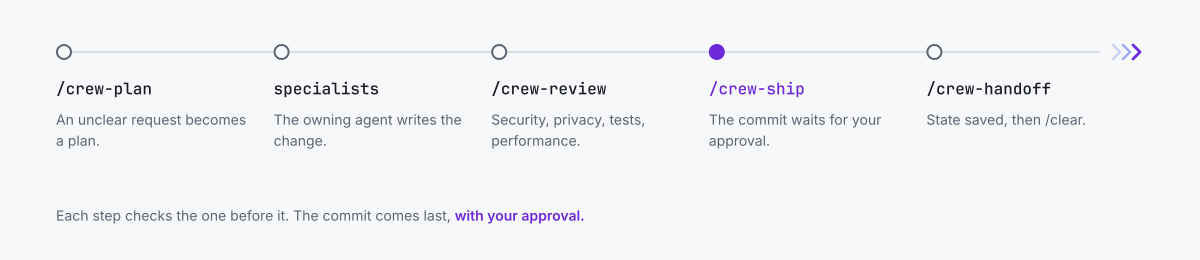
/plan (ambiguous scope) → expert agents build → /review (security · quality · test) → /ship (DoD gate; proposes the commit, waits for approval) → when context fills up, /handoff/clear.

Extending

When you add an agent or skill, follow the AGENT_TEMPLATE.md contract: frontmatter (name · description + Trigger phrases · least-privilege tools · model tier) and body (When → Expertise stance → How/skill → Coordination → DoD → Output & context → Errors/escalation → Example → Constraints).

License & attribution

MIT — see LICENSE. The discipline layer builds on these upstream sources:

Yorumlar (0)

Sonuc bulunamadi