aiui
Health Warn
- License — License: MIT
- Description — Repository has a description
- Active repo — Last push 0 days ago
- Low visibility — Only 5 GitHub stars
Code Fail
- rm -rf — Recursive force deletion command in .github/workflows/release-macos.yml
Permissions Pass
- Permissions — No dangerous permissions requested
No AI report is available for this listing yet.
Native desktop dialogs for Claude Code — macOS and Windows. Ask, confirm, collect input where you actually work.
|
aiuiClaude Desktop App can ask, confirm, and collect input — as real native desktop dialogs. |


The chat is sometimes the wrong place
When Claude Desktop App has a question that's really a pick between options, you
have to type the answer in prose. When it wants your go-ahead before
touching production, you get a blue Yes/No box — and nothing more
tailored.
There's a better way.
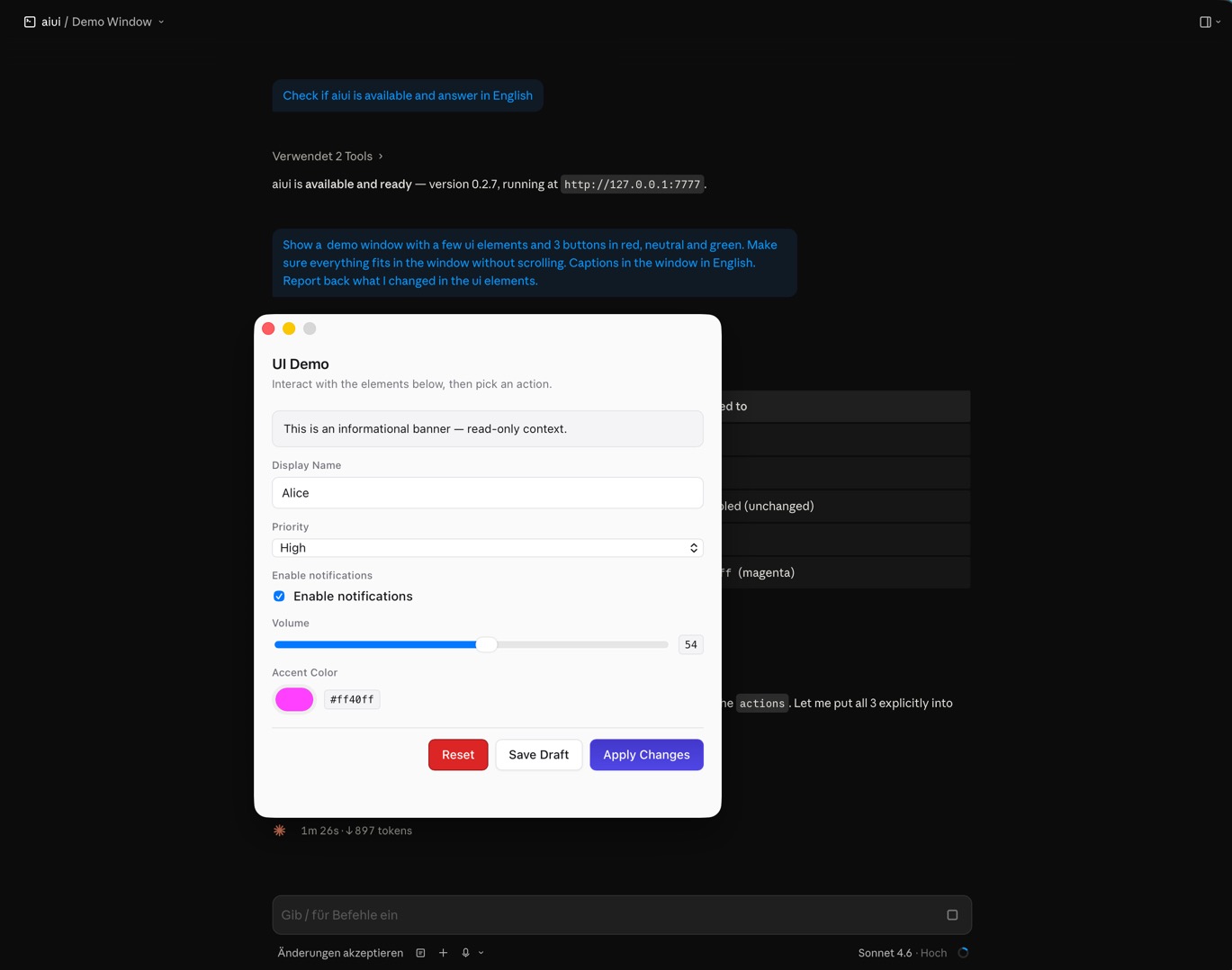
aiui lets Claude Desktop App open real, native dialogs on your machine —
macOS and, since 0.10.1, Windows:
- "Which of these three deploy strategies?" A window with three
cards, each with context. One click. Done. - "Shall I drop the production
orderstable?" A red destructive
button with a clear warning. One click. - "Fill in name, role, start date." A clean form instead of a
typing-heavy chat exchange. - "Rank these five tickets in the order you want them." Drag to
reorder, the order comes back as a clean list. - "Here's the flow I'm proposing — does it look right?" A real
diagram (Mermaid → SVG) instead of ASCII boxes-and-arrows that
collapse into nonsense in proportional fonts.
The agent gets your answer as structured data and keeps going. No side
conversations, no throwaway web dashboards cluttering your system — just
a familiar window from your own operating system that does what it looks like.

Works locally and remotely
Running Claude Desktop App directly on your Mac or Windows PC? aiui plugs in.
Running it over SSH on a remote machine (dev box, project VM)? aiui
automatically sets up a tunnel so the remote agent can pop dialogs right
on your own desktop. Register the host once in settings; from then on it
just works.
Install
No Terminal. No Homebrew. No Python. No uv.
macOS (Apple Silicon)
- Download aiui.app
(DMG, Apple Silicon). - Drag into
Applications. - Launch it once from Finder.
Windows (x64)
- Download the installer
—aiui_<version>_x64-setup.exe. - Run it. Windows will warn you: a blue "Windows protected your PC"
box appears, because the installer carries no Authenticode signature.
Click More info, then Run anyway. This is expected, not a sign
that anything is wrong — a code-signing certificate is on the list, and
until it lands every aiui installer triggers this. The download page
ships a signature file (.exe.sig) next to the installer; that is what
aiui's own updater verifies, and it is checked automatically. - Launch aiui once from the Start menu.
That's it, on either platform. aiui registers itself with Claude Desktop
App automatically. The MCP server ships inside the app itself as native
code, so you don't need a Python toolchain on your machine.
From now on aiui runs silently in the background — only while Claude
Desktop App is open. No dock icon, no menu-bar clutter, no lingering
daemons. aiui tools are available in every Claude Desktop App session
immediately; no per-project config needed.
Updates install themselves in the background. If you want to force a
check, use /aiui:update in Claude Desktop App, or open aiui's settings
window.
Quickstart
Open any Claude Desktop App session and try one of these — just write it as a
normal message:
"Ask me with aiui which of three deploy strategies we want today."
"Confirm with aiui before you delete the test files."
"Use aiui to collect a new user's name, role, and start date."
That's the whole idea. The agent picks the right kind of dialog —
yes/no, pick-from-options, or a multi-field form — opens it on your
Mac, you click, it carries on with your answer.
The first time you do this in a fresh project, run /aiui:teach once.
That briefs the agent on when to reach for aiui versus just typing
back in chat — without it, the agent might forget aiui exists.
What you get
| What annoys you today | With aiui |
|---|---|
| Typing answers that are really single clicks | A real native dialog |
| Destructive actions with a vague "please confirm" | Red-styled yes/no, unambiguous |
| Ad-hoc local web UIs for one-off tasks | No longer needed |
| Remote hosts where the agent has no way to ask you | Dialogs tunnel back to your desktop automatically |
| A long task finishes while you've tabbed away | A native OS notification — no dialog, nothing to click |
Privacy
aiui runs purely locally on your own machine. No telemetry, no usage data, no
content leaves your system. A local auth token lives in ~/.config/aiui/
(mode 0600) and is only scp'd to hosts you explicitly register in
settings.
Slash commands in Claude Desktop App
| Command | What it does |
|---|---|
/aiui:teach |
Briefs the agent on aiui — loads the full widget catalog and design rules into the session. Run once per project. |
/aiui:update |
Agent calls the update tool; aiui checks the release feed, silently installs any available update, and reports the version delta back. Responds before the background relaunch, so the agent always gets the answer. |
/aiui:version |
Reports the currently installed aiui version in one line. |
FAQ
Is it safe? aiui is open source (MIT), builds reproducibly, is Apple
Developer-ID signed and notarized. It never phones home. The auth token
stays under ~/.config/aiui/ on your machine and is only copied to
hosts you explicitly register in settings.
Do I need uv or Python? No. Since v0.3.0 the MCP server ships
inside the aiui.app bundle as native Rust code — drag-and-drop install
with no outside dependencies.
For the special case of a remote SSH host that doesn't have aiui.app
locally, the standalone Python package aiui-mcp is still on PyPI and
gets used via uvx aiui-mcp. aiui registers that automatically when you
add the remote in settings.
How much memory does it use? The companion idles around 30–50 MB.
The underlying WebKit view loads only while a dialog is on screen.
Does it work on Intel Macs? No — the macOS build is Apple Silicon
(arm64) only. Intel support isn't on the immediate roadmap — open an issue
if you need it.
Does it work on Linux or Windows? Windows: yes, since 0.10.1 — x64,
with an installer on the release page and in-app updates like on macOS.
The installer is not Authenticode-signed, so SmartScreen warns on first
launch (see Install). Linux: no, and not planned for now.
Can I use aiui without Claude Desktop? The companion is
auto-spawned by Claude Desktop via its MCP registration, so in the
default setup, no. You can launch aiui.app manually though — as long
as localhost:7777 is reachable, any MCP client can render dialogs.
Why not just use Claude Desktop's built-in AskUserQuestion? It's
great for single yes/no or single-choice questions, but doesn't cover
multi-field forms, sortable lists, colour pickers, date ranges, or
hierarchical pickers. aiui complements it.
Does aiui work in other MCP-capable clients? The aiui-mcp server
is a standard MCP server, so technically yes. The companion is Claude
Desktop-specific in how it auto-installs, but the HTTP protocol onlocalhost:7777 is client-agnostic.
What about Codex / ChatGPT? First-class Codex support — where aiui
registers itself into Codex's config the same self-contained way it does
with Claude Desktop and Claude Code, no manual setup — is in progress.
Follow #158 for status.
Known limitations
- macOS: Apple Silicon only (M1 and later), macOS 11 (Big Sur) or
later. Intel Macs are not yet supported. - Windows: x64 only, and the installer is not Authenticode-signed,
so SmartScreen warns on first launch. An ARM64 build and a signing
certificate are both still open. - One machine per companion. If you want dialogs on several
machines simultaneously, each needs its own aiui install; tokens and
tunnels are per-machine. - Password fields mask input while typing but return the value as
plaintext to the agent — see the widget catalog
for guidance. - No headless rendering. aiui needs an active desktop session;
it won't render dialogs on a server-style headless install.
Troubleshooting
| Symptom | What to do |
|---|---|
| No dialog appears | Open aiui (macOS: /Applications/aiui.app; Windows: Start menu) and check the status dot. The remote must show "connected". |
| "aiui companion not reachable" in chat | Claude Desktop isn't running, or your machine is asleep. |
| "Windows protected your PC" when installing | Expected — the installer isn't Authenticode-signed. "More info" → "Run anyway". See Install. |
| "token rejected (401)" | An old aiui process is holding the port on the remote. pkill -f aiui on the remote, then "Remove" and "Add" that remote again in aiui settings. |
Bugs or feature requests → open an issue.
The "Report issue" button in settings pre-fills version and build SHA.
Open source
aiui is MIT-licensed, hosted at byte5ai/aiui.
Pull requests and issues are welcome.
For developers & curious users
A bit more depth, in roughly increasing nerd-level:
docs/skill.md— the agent-facing widget catalog.
aiui installs this as a skill on first launch so Claude knows when
to use which dialog and how to write the labels. Worth a skim if you
want to understand what aiui can render.CONTRIBUTING.md— repository layout, build flow,
release pipeline, design principles.docs/strategy.md— the product thinking behind
aiui's V1/V2 split and what we deliberately don't build.aiui-mcpon PyPI — the Python
MCP server, used automatically for remote SSH hosts that don't have
aiui.app installed locally.
Reviews (0)
Sign in to leave a review.
Leave a reviewNo results found