reactifact
Health Uyari
- License — License: MIT
- Description — Repository has a description
- Active repo — Last push 0 days ago
- Low visibility — Only 5 GitHub stars
Code Gecti
- Code scan — Scanned 12 files during light audit, no dangerous patterns found
Permissions Gecti
- Permissions — No dangerous permissions requested
Bu listing icin henuz AI raporu yok.
Reactive, artifact-driven agent runtime: agents transform versioned, typed, provenance-aware artifacts inside an evolving context — no graphs to draw.
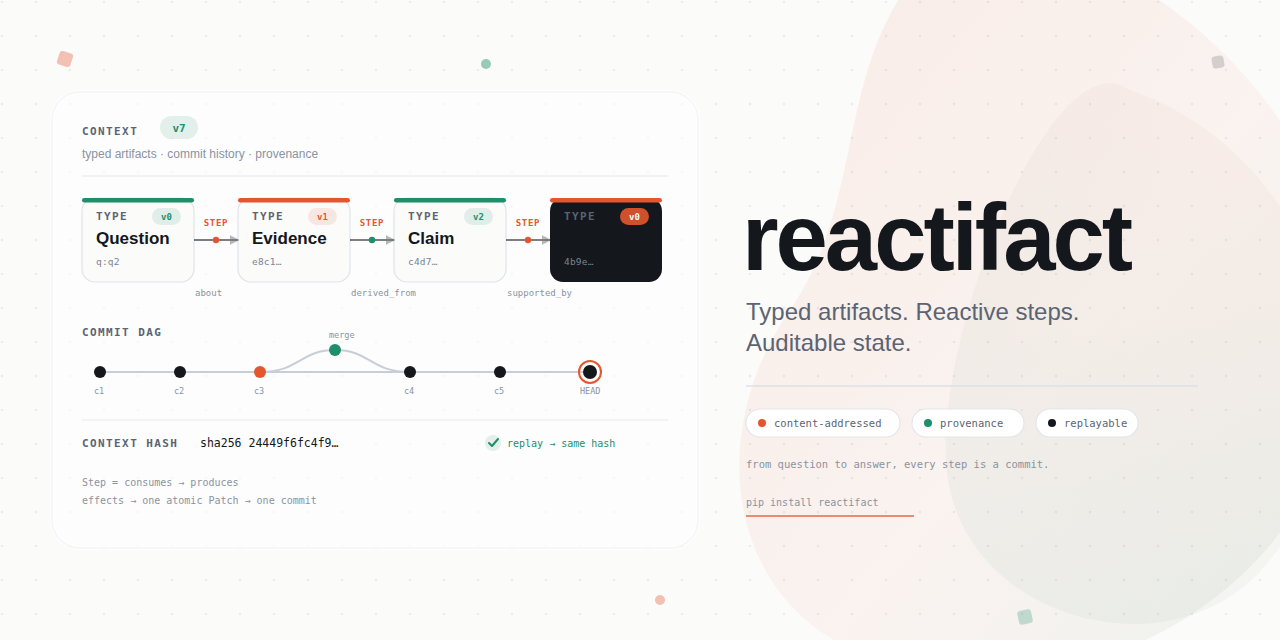
Auditable agents for Python. Build knowledge assistants over docs, spreadsheets and the web — where the path per question isn't a graph you can draw. Every answer is computed, versioned and reproducible — not a string you have to trust.






Is: a Python library (3 core deps) · single-process · typed, versioned artifacts with provenance · deterministic replay · runs offline, no API key
Isn't: a managed platform · a distributed task queue · a pre-built agent/tool marketplace
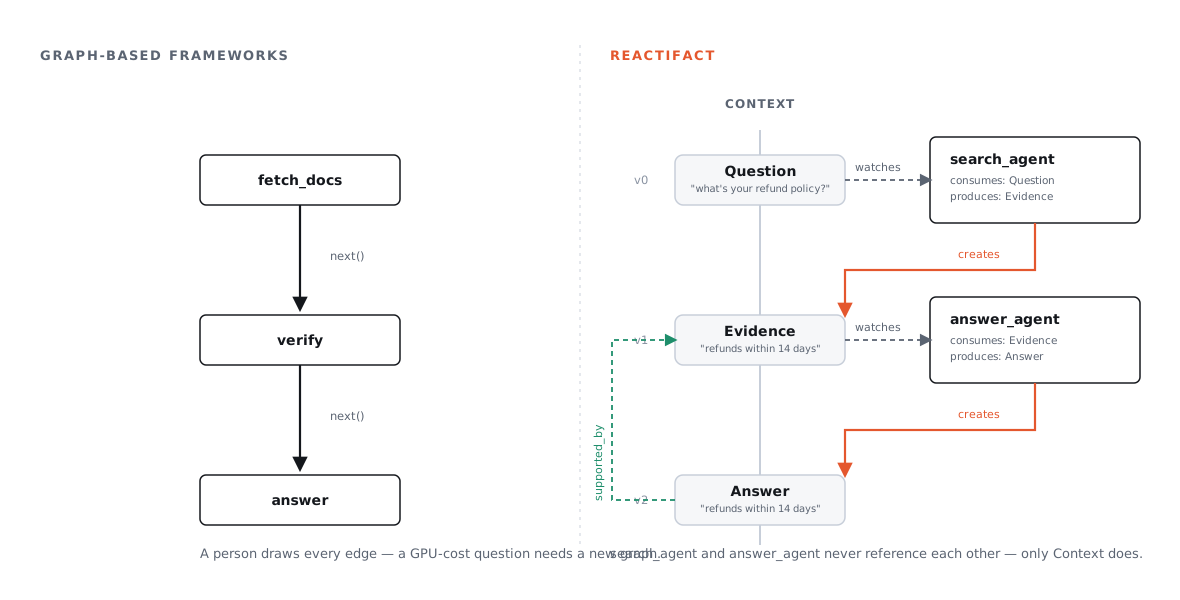
A question like "why did infra costs jump in Q2?" needs a spreadsheet, a policy doc and a page off the web — and the next question needs a different subset. That is not one graph you can draw up front. You declare what artifacts exist and what agents can do with them; the runtime derives the order — and the dependency graph — from state. You don't draw the graph.
Every derived artifact then links to what produced it
(Answer —supported_by→ Evidence —extracted_from→ Doc), so "why did it say
that?" is a query, not a guess — and the run is reproducible (context_hash)
and verifiable (reactifact replay --verify).
On top: a provable answer
examples/fintech_audit — a transactions CSV, a budget
CSV and a policy doc, no API key. The model never produces the number; plain
Python does, and the answer is linked to its evidence:
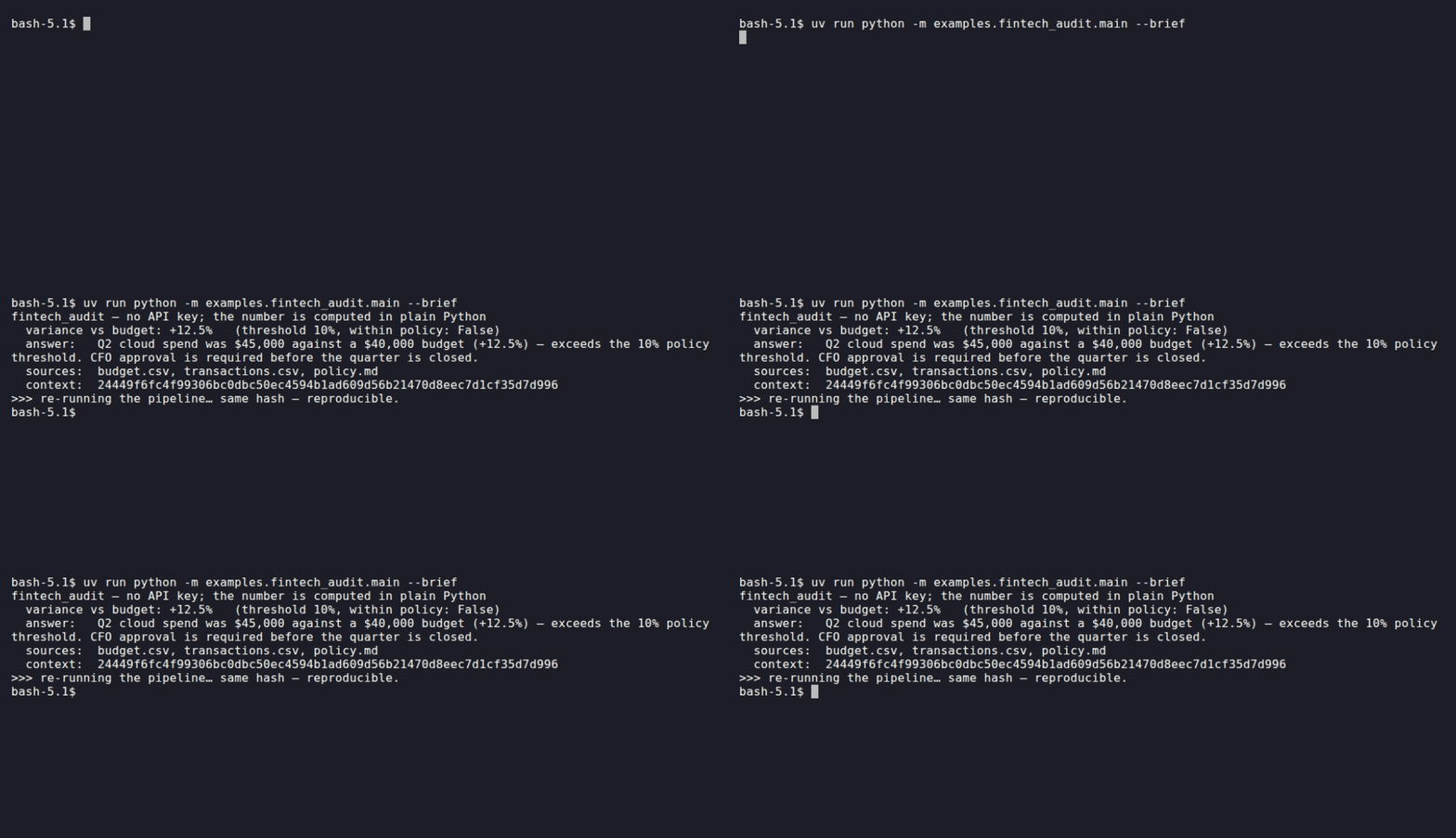
$ .venv/bin/python -m examples.fintech_audit.main

  cloud spend:        $45,000   (2026-04 $12k, 2026-05 $15k, 2026-06 $18k)
  variance vs budget: +12.5%    budget $40,000, policy threshold 10% → over

  answer:    Q2 cloud spend was $45,000 against a $40,000 budget (+12.5%) —
             exceeds the 10% policy threshold. CFO approval is required.
  citations: budget.csv, transactions.csv, policy.md
  audit:     Answer —supported_by→ {Variance, Spend, Table, Policy}
             answer sha256 5461290d…  ·  context sha256 24449f6f…

  >>> re-running the pipeline hashes identically — or verify a saved run:
  >>> reactifact replay <store> --session <id> --verify 24449f6f…
That hash is the whole point: the answer is reproducible and its provenance is
a queryable graph (context.related(answer.id, "supported_by")), not a log line.
The number is computed, and its provenance recorded, in plain Python — the model
is never the source of truth (trimmed fromexamples/fintech_audit/steps.py):
@step(produces=Variance, consumes=Spend)         # wakes when a Spend artifact exists
async def compute_variance(call: StepCall) -> None:
    spend = call.trigger                         # the artifact that triggered this run
    budget = cloud_budget(call.context)          # read from budget.csv
    pct = (spend.data.total - budget) / budget   # deterministic — never the model
    variance = call.effects.create_once_from(
        spend,                                   # stable id → idempotent re-runs (§42)
        Variance(actual=spend.data.total, budget=budget, pct=pct,
                 threshold=0.10, within_policy=abs(pct) <= 0.10),
    )
    variance.link("calculated_from", spend)      # provenance edge, queryable


answer = ctx.latest(AuditAnswer)
print(report_to_markdown(build_report(ctx, answer)))  # hash per artifact + edges
print(context_hash(ctx))                              # reproducible fingerprint
Knowledge assistants, live
The same shape over many sources, not a fixed path — theknowledge CLI answers a harder, multi-source question
(docs + a CSV) with a real computed number and its sources, no LLM key required:

Two agents explore independently on their own forks and merge back automatically
— and when they disagree, reactifact refuses to merge silently:

Python developers already know this model from Celery: define a task,
declare what triggers it, let the runtime run it. reactifact applies it to
agents — a task reacts to a typed, versioned artifact appearing in the
context, not to a queue message you push or a graph edge you draw. The runtime
derives what runs next from state.
| Celery | reactifact |
|---|---|
| a task | Step / @step(produces=Model, consumes=Input) — a unit of work that writes an artifact |
delay() / apply_async() |
you don't call it: creating the input artifact is the trigger |
| routing key / queue | Consume(Type) — which artifact type wakes the task |
| chain / group / chord | several step Consumes / produces; the runtime derives the order |
| result backend | the Context — typed, versioned artifacts |
| worker | Runtime |
Not inherited: a broker, a worker pool, acks_late/redelivery, cross-process
exactly-once. reactifact is a library with an in-process runtime — the model is
Celery-shaped, the deployment is not. (Session-backed runs do survive a restart;
see Durability & resume.)
pip install reactifact
Runs offline, no API key needed — paste this straight into a .py file. Two
agents, no graph edge declared between them — the second reacts because the
first one's output exists, and the answer carries proof of where it came
from:
from pydantic import BaseModel

from reactifact import Budget, Context, Runtime, RuntimeResources, create_agent, step


class Question(BaseModel):
    text: str


class Evidence(BaseModel):
    text: str


class Answer(BaseModel):
    text: str


DOCS = {
    "refund": "Refunds are available within 14 days of purchase.",
    "pricing": "The Pro plan is $49/month, billed annually.",
}


@step(produces=Evidence, consumes=Question)
async def find_evidence(call):
    question = call.trigger
    hit = next((v for k, v in DOCS.items() if k in question.data.text.lower()), None)
    if hit is not None:
        call.effects.create(Evidence(text=hit))


@step(produces=Answer, consumes=Evidence)
async def answer_from_evidence(call):
    evidence = call.trigger
    call.effects.create(Answer(text=evidence.data.text)).link("supported_by", evidence)


search_agent = create_agent("search", steps=[find_evidence])
answer_agent = create_agent("answer", steps=[answer_from_evidence])

ctx = Context(resources=RuntimeResources())
runtime = Runtime(ctx, agents=[search_agent, answer_agent], budget=Budget(max_runs=10))

ctx.create(Question(text="what's your refund policy?"))
runtime.run()  # search_agent and answer_agent both react — nobody wired them together

answer = ctx.latest(Answer)
evidence = ctx.related(answer.id, "supported_by")[0]
print(answer.data.text)                     # "Refunds are available within 14 days of purchase."
print("supported_by:", evidence.data.text)  # provenance you can trace, not just a string in a log
How it works
ARTIFACT CREATED / UPDATED
       │
       ▼
     AGENTS REACT ──effects──► Effects ──compile──► Patch
       ▲                                                      │
       └──────────────────────────────────────────────────────┘
                                                        Context v+1
A step writes what should change (effects.create/update/link/ask) and
returns None; the runtime compiles the effect set into one atomic Patch
and moves the context to the next version. The event that wakes an agent is
derived from that same change — the causal chain can never drift from the
actual state.
What makes it different
| Traditional agent (LangGraph / CrewAI / LangChain) | reactifact |
|---|---|
| A program follows a graph / plan | Agents react to state changes |
| Messages are strings | Typed, versioned artifacts (Claim, Evidence, Answer) |
| Orchestration is explicit wiring | Orchestration falls out of the state |
| A unit of work returns a change | An agent writes effects; the runtime compiles them |
| Retries/rollback are manual | Context is git-like versioned (diff, rollback, branch, merge) |
| "Who produced this?" is lost | Provenance links every derived artifact to its inputs |
| The model guesses the numbers | Calculations are calculated — the LLM is a reasoning component, not the source of truth |
| Tracing needs a SaaS add-on | Native trace store (SQLite + dashboard), exportable to Langfuse/Postgres |
| MCP via a framework adapter | MCP both ways built in — call any server, or expose your own Context as one |
| Pulls in a framework's dependency tree | 3 core deps: pydantic, httpx, python-dotenv |
Reactive. Deterministic. Accountable.
Full breakdown, including where reactifact is not the right choice:
docs/en/comparison.md.
Core primitives
- Context — versioned working state, git-like commits,
diff/rollback/merge. - Artifact — a first-class typed object (
Claim,Evidence,Answer), not a string blob. - Effects — an agent states its change via
effects.create/update/link/ask; the runtime compiles it. - Patch — the compiled, validated change-set applied as one atomic commit.
- Step — the unit of work: declares
consumes/produces, returns its output or writes effects. - Agent — a thin container of
steps; the runtime derives triggers from theirconsumecontracts. - Source — retrieval is a capability: vector search is one strategy, not the only one; filesystem, CSV, and the web are equally first-class today (direct API, keyword, and SQL sources are on the roadmap, not yet shipped).
- Provenance — every derived artifact links to what produced it
(Answer —supported_by→ Claim —derived_from→ Evidence —extracted_from→ Doc). - HITL — humans as
effects.ask(...)→PendingQuestion, answered viaeffects.resume(...)like any agent. - Outbox — outbound side effects as
effects.act(...)→PendingAction, performed once after the commit byRuntime(dispatcher=...); safe across replay, retries and merged branches.
In the box
- Deterministic by design — calculations over structured data, honest
None
fallbacks instead of hallucinated answers; the model reasons, never "knows". - Observability — every run traces agent spans, reads/writes, LLM calls,
tokens: SQLite store + web dashboard, exportable to Langfuse/Postgres (async sinks);
correlated logs (configure_logging(), silent until called) carryrun_id/session_id/agenton every line. - Lifecycle —
Budget.max_secondsis a hard deadline (a hung LLM call is
cancelled);request_stop()/ashutdown()stop at a generation boundary
(RunOutcome.STOPPED);active_runs()/in_flightgive a readiness view. - MCP, both ways — call any MCP server's tools as a
Tool
(mcp_stdio_tools/mcp_http_tools), or expose your ownTools and a liveContextas an MCP server (create_mcp_server) for Claude Desktop, Claude
Code, or another agent to call into (mcpextra). - Budgets & replanning — cap by runs/time/iterations/tool-calls, replan on decline.
- Branching & replay —
context.branch(), three-waymerge(), deterministicReplayLLM, all for audit and safe alternative states. - Sessions —
SessionStoreoverFileKVBackend/SQLiteKVBackend
(andPostgreSQLKVBackend) for durable chat memory. - Web layer —
ChatAssistant+create_chat_routermount a canonical SSE
chat on your FastAPI app; errors degrade to a logged fallback, never a 500. - Recipes —
find/find_all(typed lookup ininputs),fan_out_sources,materialize_doc,StatusMachine,WindowSummarizer/WindowPruner
(bounded conversation memory), change→rebuild rollback helpers,Skill/match_skills(Claude-Skills-shaped instructions, keyword-triggered)
— pure and LLM-free, except the summarizer, which takes your callback. - Viz & CLI — Mermaid
blueprint/context_to_mermaid/trace_to_mermaid;reactifactwithgraph/context/trace/replay/branch.
Agent Skills
reactifact ships official Agent Skills — reusable instructions that teach a
coding agent (Claude Code, Cursor, Codex, Copilot, …) how to build with
reactifact. They're bundled with the package, so they always match your version:
python -m reactifact skills list                    # what is available
python -m reactifact skills install                 # -> .agents/skills/
python -m reactifact skills install --target both    # + .claude/skills/
Skills: reactifact (mental model), reactifact-agents, reactifact-llm,reactifact-rag, reactifact-testing, reactifact-eval,reactifact-observability, reactifact-from-langchain — see
Agent skills.
Run a demo
Offline-capable, no API keys required (deterministic fallbacks):
uv run python ./examples/knowledge/web.py      # multi-source RAG + evidence + CSV calc
uv run python ./examples/repair/web.py         # room renovation: plan, estimate, CSV export
uv run python ./examples/devops/web.py         # HITL ops assistant + trace dashboard
uv run python -m examples.starter_app.app      # copy-pasteable FastAPI app
Prefer a notebook? 
— examples/quickstart.ipynb covers the four quick cases (agent/rag/tools_agent/chat_agent), offline by default.
Examples (in-repo, not shipped)
starter_app— copy-pasteable FastAPI app: structured call, RAG, tools, session chat.knowledge— multi-source chat: search → evidence → claim verification → answer, with CSV calculation.medic_lab— hypothesis laboratory: competing hypotheses scored, HITL steering, honest report.devops— HITL tool agents + LLM tool router + trace dashboard.repair— budget-aware replanning (chat/data in Russian by design).chat— minimal offline single-model multi-turn conversation (Conversation+ boundedChatMemory).forklab— deterministic branch & merge: two strategies on their own forks, three-way merge.fintech_audit— auditable, reproducible CSV answer with content hashes and provenance.
Documentation
- English · Русский — concepts, sources,
providers, recipes, patterns, observability, eval, branching, replay, viz/CLI, API. - Quickstart — the four
quickcases (structured call,
RAG, tools, chat) in a few lines; also as a
Colab notebook. - Migrating — from LangGraph / CrewAI / LlamaIndex /
plain Python: concept map, port-one-node, interop, checklist. - Why reactifact — the design argument: why effects, why the graph is derived rather than drawn, why determinism.
- Comparison — reactifact vs LangGraph/CrewAI, feature by feature, and when not to use reactifact.
- docs/constitution.md — the full design rationale and invariants.
- Roadmap — what's next, and what's deliberately out of scope.
Development
uv sync --extra dev --extra web
.venv/bin/python -m pytest
.venv/bin/mypy
.venv/bin/ruff check
Status & contributing
Active, 0.20.2, pre-1.0 — the API is stabilizing and 1.0 will freeze it
(see the roadmap); releases follow
Keep a Changelog. Questions and design discussion live in
GitHub Discussions; a star,
or a good first issue, helps more than you'd think.
License
MIT — see LICENSE.
Yorumlar (0)
Yorum birakmak icin giris yap.
Yorum birakSonuc bulunamadi