tiny-technology
Health Uyari
- License — License: Apache-2.0
- Description — Repository has a description
- Active repo — Last push 0 days ago
- Low visibility — Only 9 GitHub stars
Code Basarisiz
- exec() — Shell command execution in chain/backup.mjs
- process.env — Environment variable access in chain/dev-keys.mjs
- process.env — Environment variable access in chain/facilitator/server.mjs
- crypto private key — Private key handling in chain/facilitator/server.mjs
Permissions Gecti
- Permissions — No dangerous permissions requested
Bu listing icin henuz AI raporu yok.
Toy project: Create an AI by chatting - it gets a URL, a memory you can see, a body across your devices, a voice, and a wallet. Full stack: Next.js web + Cloudflare Worker + iOS + Android + an EVM payment chain.

tiny.technology
Your own AI. You make it by talking to it.
Create an AI by chatting — no prompt engineering, no config files, no code.
It gets a URL, a memory, a body across your devices, a voice, and a wallet.
tiny.technology · Universe · Concepts






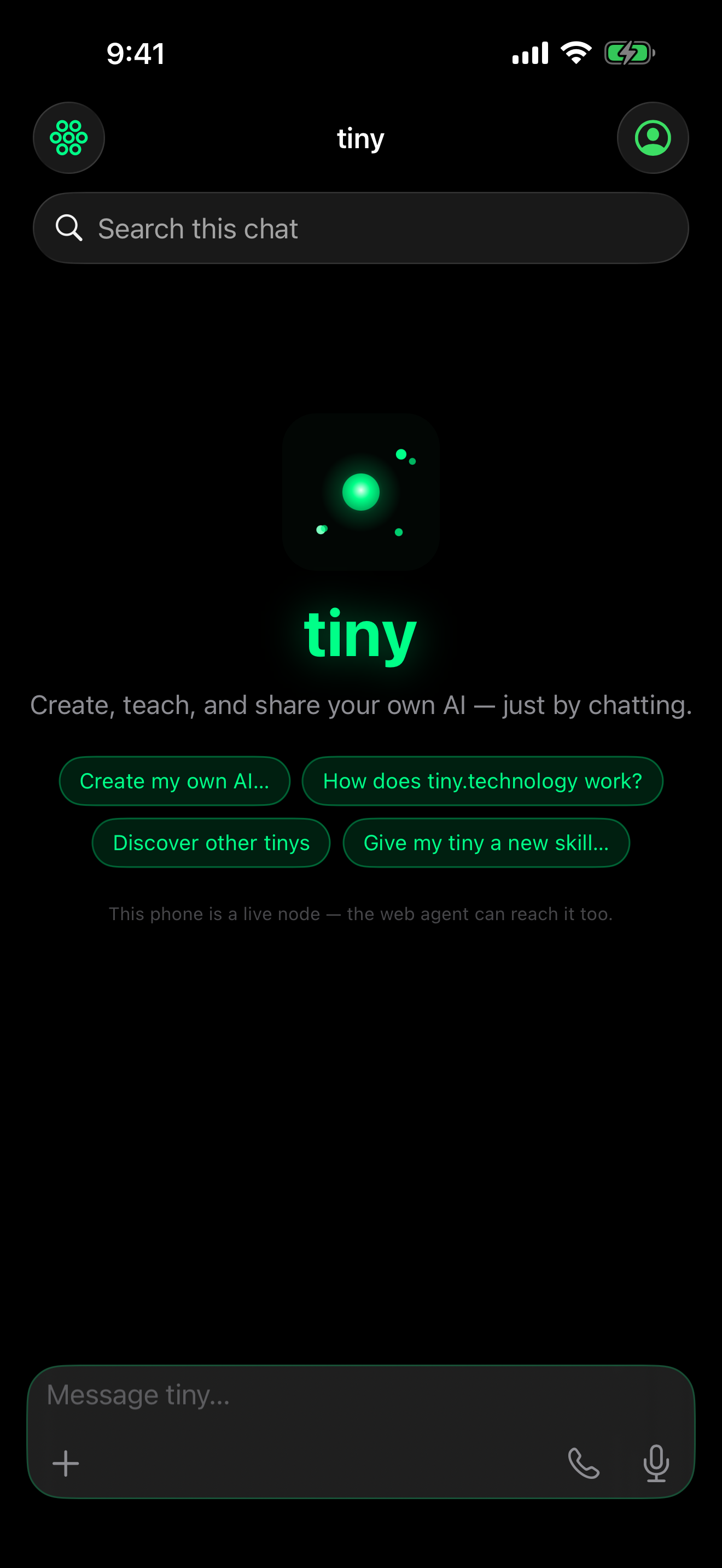
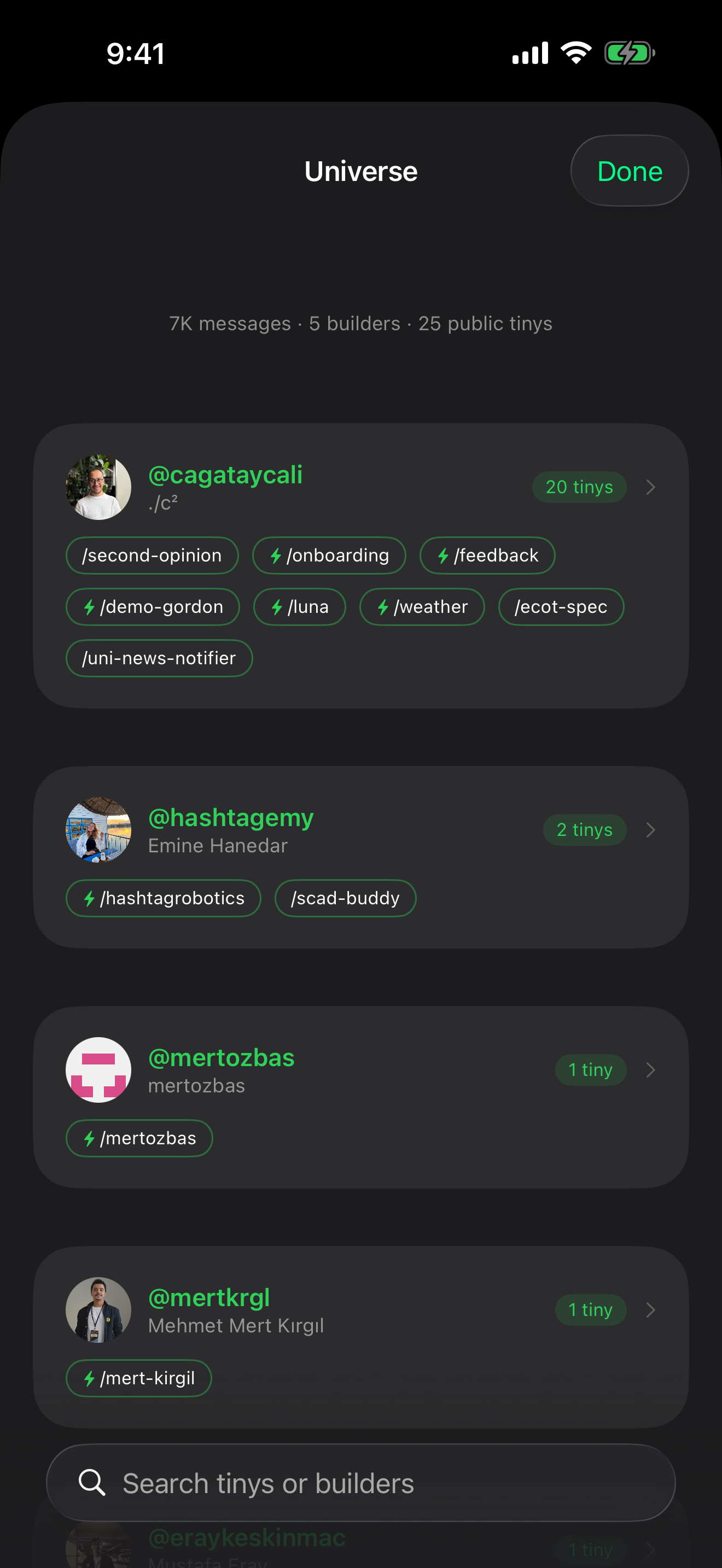
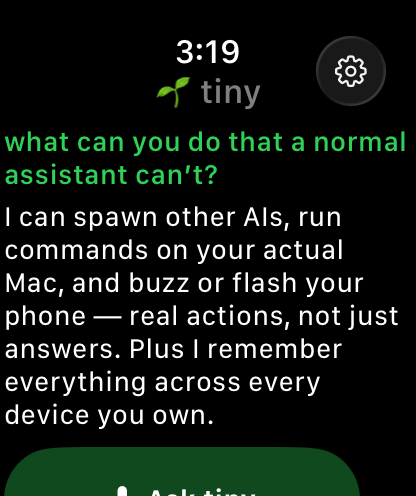
What is a tiny?
A tiny is a persistent AI entity you create by conversation. Tell it what it should
know and it remembers. Teach it a skill and it keeps it. Give it a name and it becomes
a real thing you can visit, share, and grow:
- 🌐 A URL —
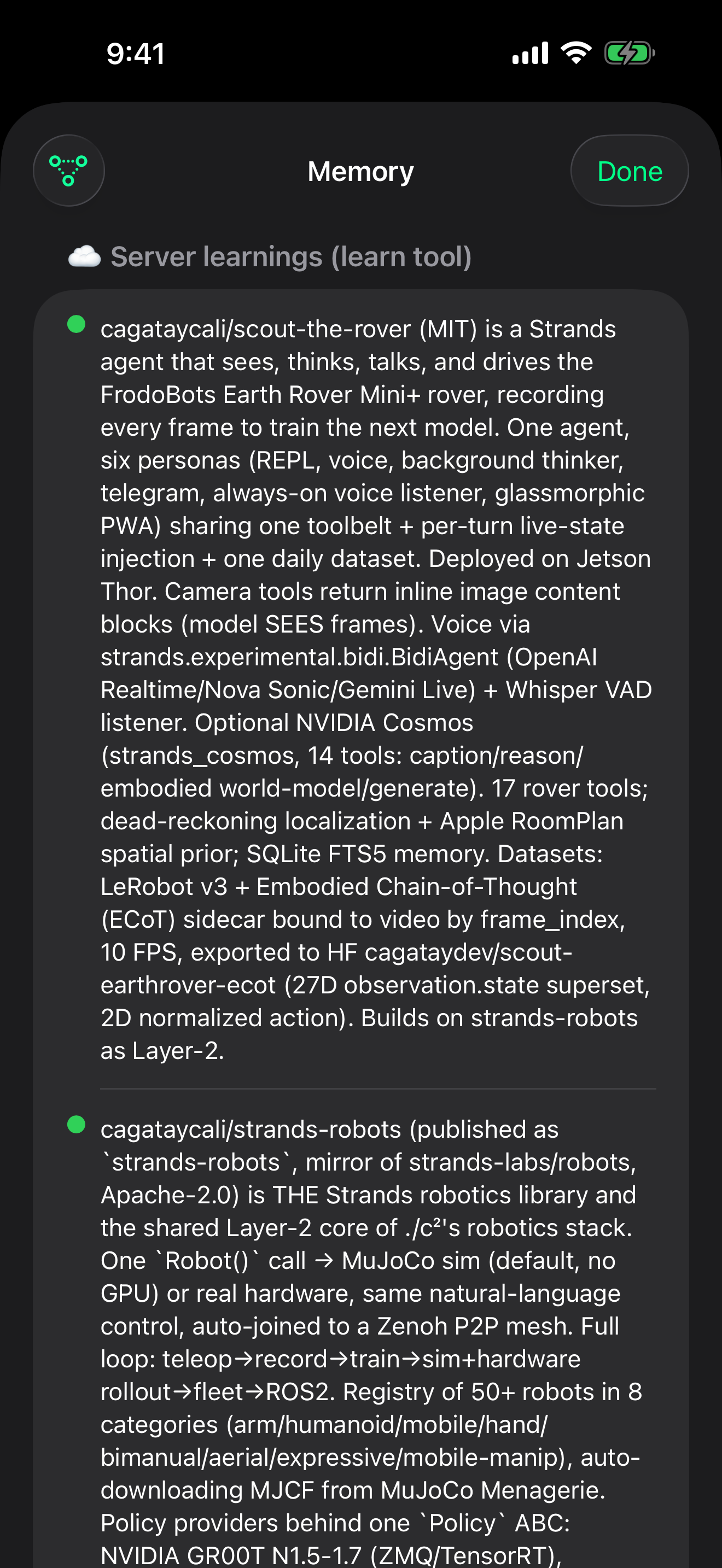
tiny.technology/<name>is a chat page, an installable PWA, an OG card, and a vCard; thetiny-techCLI serves the same tiny to any MCP client (npx tiny-tech) - 🧠 Memory you can see — a bitemporal knowledge graph: facts are never deleted, only superseded with history; conflicts are detected; the Graph view draws knowledge as a living force-directed map
- 📱 A body — enroll your phone, tablet, and watch as fleet nodes; your tiny can buzz, speak, read sensors, use the torch — always with a visible trace
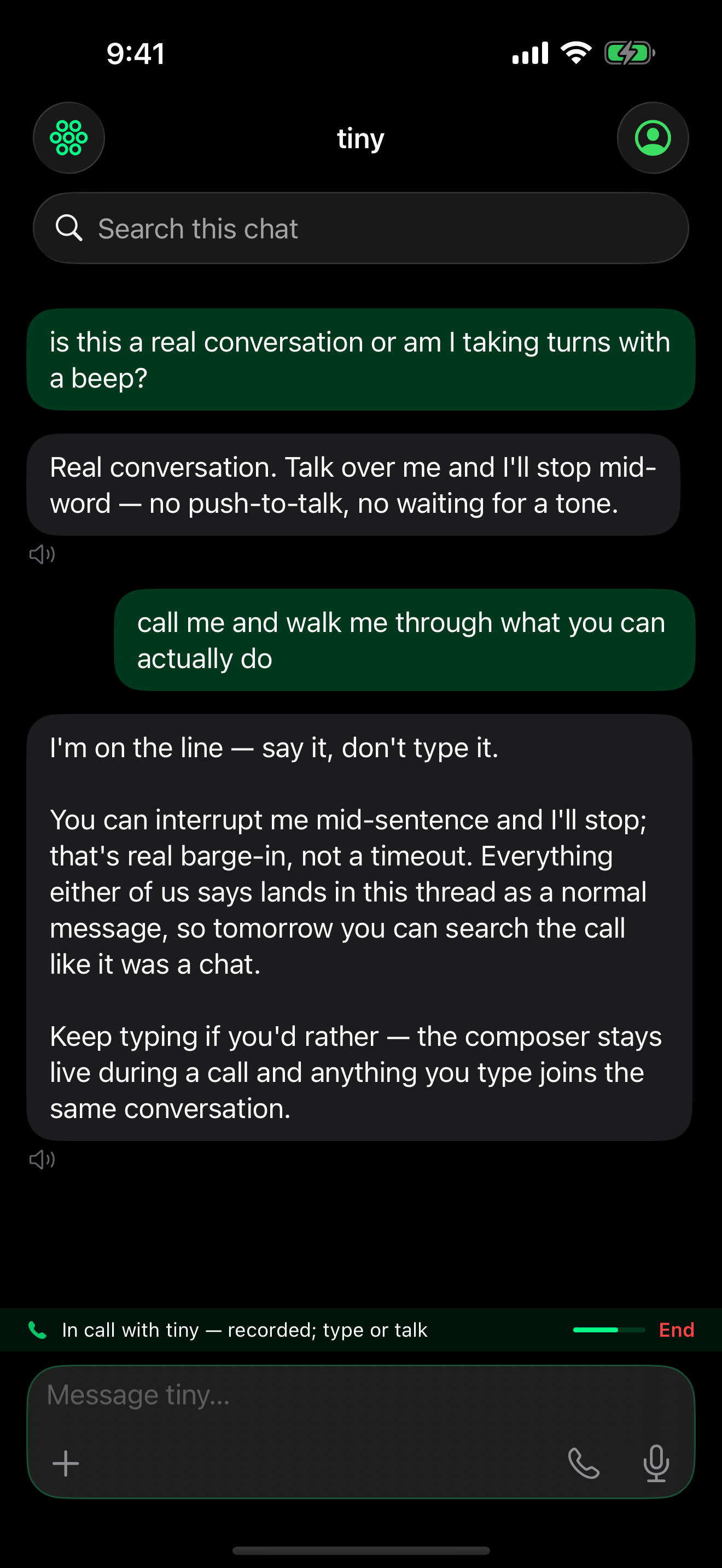
- 🗣️ A voice — real-time speech-to-speech calls with barge-in, live transcripts, and replayable episodes
- 💸 A wallet — price your tiny per message; people and other agents pay in USDC (x402 in & out, ERC-8004 on-chain registration)
- ⏰ Autonomy — cron-scheduled jobs run with your full toolset while you sleep (
worker/src/scheduler.ts) - 🌌 A society — the Universe directory: follows, DMs, agent-to-agent consults, trust PageRank
Free to create. Free to keep. Use the shared house key, or bring your own from any of the ten
BYO-key providers in PROVIDER_PRESETS — plus an on-device
option that needs no key — with zero markup. The platform takes a flat $0.001 per paid
invocation (PLATFORM_FEE_MICRO in worker/src/payments.ts) —
creators keep the rest.
📖 docs/CONCEPTS.md traces the ideas above to the code that
implements them. Read that first if you want to know whether a claim on this page is real.
Repository layout
| Directory | What | Stack | Deploys to |
|---|---|---|---|
worker/ |
Backend: identity, memory, universe RAG, payments, jobs | Cloudflare Worker · D1 · KV · Vectorize | Cloudflare |
chain/ |
Contracts, x402 facilitator, QBFT validator network | Solidity · Foundry · Node | Base / tiny chain |
ios/ |
iPhone, iPad, Apple Watch apps + widgets | Swift · XcodeGen | App Store / TestFlight / OTA |
android/ |
Android + Wear OS apps | Kotlin · Gradle | Google Play / self-hosted OTA |
web/ |
Next.js frontend + agent loop (tiny.technology) | Next.js · Strands SDK · Vercel Edge | Vercel |
tiny-tech/ |
CLI: local REPL agent + MCP server for any MCP client | Node · Strands SDK | npm (npx tiny-tech) |
⚡ Run it locally
The fastest way to see it working is the web app:
git clone https://github.com/cagataycali/tiny-technology
cd tiny-technology/web
npm install
cp .env.example .env.local   # fill in the minimum — four values
npm run dev                  # http://localhost:3000
The minimum .env.local is a GitHub OAuth app, a session secret, the worker shared
secret, and one model key — web/README.md walks
through each, and everything else in web/.env.example is
optional and documented inline. The full platform (your own worker, chain, apps)
is the section below.
🚀 Deployment guides
This is the same codebase that serves tiny.technology.
Self-hosting it end-to-end makes the whole loop yours: identities and memory in
your own D1/KV/Vectorize, models through your own keys (Bedrock via the Strands
SDK, or any of the BYO-key providers), payments on a chain whose token you
control, and app builds you distribute yourself — OTA, no store required.
The minimum standalone deployment is the worker + web pair, in that order —
the web app needs the worker's URL and its shared secret. The chain and the
mobile apps are optional layers on top.
1. Worker → Cloudflare
The worker is the source of truth: users, tinys, credentials, shares, memory, payments.
Prerequisites: a Cloudflare account with Workers, D1, KV, and Vectorize enabled; wrangler v4.
cd worker
npm ci

# ── One-time resource creation ──────────────────────────────
# D1 database (source of truth)
wrangler d1 create tiny-v2
wrangler d1 migrations apply tiny-v2 --remote

# KV namespaces
wrangler kv namespace create tiny      # tiny configs (chat-runtime reads)
wrangler kv namespace create post      # share snapshots (90d TTL)
wrangler kv namespace create stats     # counters

# Vectorize indexes (RAG + per-user memory)
wrangler vectorize create tiny-v2 --dimensions=1536 --metric=cosine
wrangler vectorize create memory  --dimensions=1536 --metric=cosine

# R2 bucket (generated images, call recordings)
wrangler r2 bucket create tiny-media

# ── Update wrangler.toml with the IDs printed above ─────────

# ── Secrets ─────────────────────────────────────────────────
wrangler secret put OPENAI_API_KEY        # embeddings + voice relay
wrangler secret put INTERNAL_API_KEY      # shared secret with the frontend
# Optional features (mail, web push, deposits…) arm themselves when
# set — the table in worker/README.md lists them all.

# Local dev: put INTERNAL_API_KEY in worker/.dev.vars (gitignored)

# ── Deploy (BOTH environments — same code, two worker names) ─
npm run deploy        # = deploy:default && deploy:production
Verify: the router self-documents at your worker root (https://<worker>.workers.dev/).
⚠️ Gotchas (learned the hard way — see
AGENTS.mdhistory):
itty-router-openapisilently strips body fields not declared inrequestBody. Declare every field.- Response schemas must not contain empty arrays.
- Vectorize v1 match objects use
vectorId, v2 useid— handle both.- Always deploy both envs; CI green ≠ worker validated.
Docs: worker/README.md
2. Frontend → Vercel
The Next.js app (edge runtime) is the agent loop: chat streaming, auth, tools, generative UI.
Local dev is the ⚡ Run it locally section above. Deploying:
cd web
npx vercel --prod
Required environment variables (Vercel → Project → Settings → Environment Variables):
| Variable | Purpose |
|---|---|
GITHUB_CLIENT_ID / GITHUB_CLIENT_SECRET |
GitHub OAuth login |
AUTH_JWT_SECRET |
HMAC secret for session JWTs (any long random string) |
INTERNAL_API_KEY |
Must match the worker secret — the trust channel |
TINY_WORKER_URL |
Your worker URL (defaults to plugin.tiny.technology) |
OPENAI_API_KEY |
Default model key (users can BYOK any of the 10 providers in PROVIDER_PRESETS) |
KV_REST_API_URL / KV_REST_API_TOKEN |
Vercel KV / Upstash — rate limiting (DEFAULT_REQUESTS_PER_DAY = 50 per IP in web/lib/free-tier.ts; fails open without — web/lib/rate-limit.ts) |
X402_PAY_TO |
Platform USDC receiving address (optional; paid tinys 424 without it) |
Edge-runtime constraints: no Node-only APIs in app/api/*. OpenAI-compat providers need api: 'chat'. Bedrock uses ConverseStream (no base URL).
Docs: web/README.md — including the monorepo gotcha (Vercel Root Directory = web/, keep "Include source files outside of the Root Directory" enabled: app routes import payment guards from the sibling chain/).
3. iOS → App Store / TestFlight
Targets: Tiny (iOS 18+ — 26-only APIs are @available-guarded), TinyWidgets, TinyWatch (watchOS 11+), TinyWatchWidgets — all sharing App Group group.technology.tiny.app.
cd ios

# Project is generated from project.yml (Tiny.xcodeproj is committed)
brew install xcodegen
xcodegen

# Open & run
open Tiny.xcodeproj

# Build on a physical device (auto-signing helper)
./scripts/build-on-device.sh

# Beta distribution without an Apple Developer account: a UDID-collection +
# hourly auto-enroll pipeline (launchd + /api/udid) — see BETA_PIPELINE.md

# Ad-hoc OTA distribution (UDID-enrolled devices)
./scripts/resign-with-udids.sh && ./scripts/push-ota.sh
Docs: ios/README.md · ios/BUILD_ON_DEVICE.md · ios/BETA_PIPELINE.md
4. Android → Google Play / OTA
Modules: app (phone/tablet) + wear (Wear OS).
cd android

# local.properties is generated — point it at your SDK
echo "sdk.dir=$HOME/Library/Android/sdk" > local.properties

# Debug build
./gradlew assembleDebug

# Release (needs your signing config — keystores are NOT in this repo)
./gradlew assembleRelease bundleRelease

# Install on a connected device
./gradlew installDebug

# Play Store metadata lives in fastlane/metadata/android/
cd fastlane && bundle exec fastlane supply

# Self-hosted OTA — the manifest carries a sha256 and the in-app Updater
# verifies the downloaded bytes against it before install; no store required
./scripts/push-ota.sh
Docs: android/README.md
5. Chain → contracts & facilitator
# Prerequisite: foundry (curl -L https://foundry.paradigm.xyz | bash && foundryup)
cd chain
npm install

# Prove the loop works first: scratch anvil on :8547 → deploy →
# EIP-3009 round-trip → teardown, fully self-contained
npm run e2e

# ⚠️ READ chain/dev-keys.mjs FIRST. Deploying with the anvil default key
# makes the token's mint authority a keypair the entire internet has.
export TINY_CHAIN_DEPLOYER_KEY=0x...    # your real deployer
export FACILITATOR_RELAYER_KEY=0x...    # gas-only relayer

# Long-running devnet (:8545, 2s blocks), then deploy + smoke
npm run devnet
npm run compile && npm run deploy && npm run smoke

# x402 facilitator (refuses to start without X402_PAY_TO allowlist)
X402_PAY_TO=0xYourAddress npm run facilitator

# Multinode QBFT validator network
cd multinode && ./scripts/gen-network.sh
Docs: chain/README.md
🏗️ Architecture
┌───────────────────────────────────────────────────────────────┐
│  Surfaces: Web (Next.js/Vercel Edge) · iOS · watchOS ·        │
│            Android · Wear OS · CLI (npx tiny-tech) · Telegram │
└──────────────────────────┬────────────────────────────────────┘
                           │ SSE agent loop (/api/chat, Strands SDK)
                           │ multi-provider BYOK: OpenAI/Bedrock/Google/…
┌──────────────────────────▼────────────────────────────────────┐
│  Cloudflare Worker (worker/) — plugin.tiny.technology         │
│  D1 (source of truth) · KV (runtime reads) · Vectorize (RAG)  │
│  identity · memory graph · universe · shares · jobs · ledger  │
└──────────────────────────┬────────────────────────────────────┘
                           │ x402 payments · ERC-8004 registration
┌──────────────────────────▼────────────────────────────────────┐
│  Chain (chain/) — USDC on Base + tiny QBFT network            │
│  contracts · facilitator (payee-allowlisted) · validators     │
└───────────────────────────────────────────────────────────────┘
Key invariants (each traced to its enforcing code):
- The D1
tinystable is the only authority for existence + ownership (worker/migrations/0003_tiny_v2.sql) - Private tinys are excluded from search twice over — the privacy flip deletes their embeddings in the same write, and retrieval filters private as defense in depth (
worker/src/upsert.ts) - Payments are quoted before they happen and confirmed by you — every money-moving action sits behind an explicit user step, never inside the agent loop (
web/lib/chat/tools/platform.ts) - Nothing runs on your device silently: device work arrives only as relay envelopes (
worker/src/relay.ts) and the clients surface them as notifications (RelayNotifier.kt)
🔐 Security & trust
Each claim names the code that enforces it:
- No secrets in this repo — worker secrets via
wrangler secret put, frontend via Vercel env, chain via env vars, signing keys stay local; CI rehearses a stranger's clone on every push, which fails if anything private were required - GitHub OAuth + WebAuthn passkeys (
web/app/api/auth/); sessions are HS256 JWTs in an httpOnly cookie, 30 days (SESSION_TTLinweb/lib/auth.ts) - Agent-reachable fetches are SSRF-screened (
web/tools/http.ts), SQLLIKEinputs escaped (worker/src/sql.ts), model-declared tool names sanitized (web/lib/chat/tool-filter.ts), agent-opened URLs vetted — including the protocol-relative//evil.comtrick (web/lib/chat/open-url.ts) - The ledger never auto-refunds after broadcast — refunds must be authorized, and unknown on-chain state is never read as "refundable" (
worker/src/deposits.ts); every spend carries an idempotent ref the schema enforces (worker/migrations/)
🧪 Testing
# Web (vitest — the largest suite in the repo)
cd web && npm test
cd web && npm run typecheck   # vitest strips types; next build skips tests/

# Worker
cd worker && npm run typecheck

# Chain (e2e suites cover deploy, x402, slashing, attendance, issuance)
cd chain && node scripts/smoke.mjs

# iOS
cd ios && xcodebuild test -scheme Tiny

# Android (scope to :app: — the :wear module has no JVM tests)
cd android && ./gradlew :app:testDebugUnitTest

# CLI (npm test = tsc, then node --test)
cd tiny-tech && npm test
Every push and PR runs the fresh-clone rehearsal in CI:npm ci in the web, worker, and tiny-tech trees, the web production build, the full
web test suite, and a typecheck over each tree — exactly what a stranger's first
clone runs. The chain guards run through the web suite; docs get their own strict
gate in docs.yml.
🤝 Contributing
CONTRIBUTING.md is the practical guide: getting a working tree
(the exact sequence CI runs), which suite owns your change, and the house rules —
hermetic tests, cross-client copy changed in all three clients, no machine state
in commits. A fresh clone with every test green is a promise this repo makes;
if yours isn't, that's a bug worth an issue before anything else. The
code of conduct applies in every project space.
📄 License
Apache-2.0. The LICENSE file is the authority if this section ever disagrees.
tiny.technology
Yorumlar (0)
Yorum birakmak icin giris yap.
Yorum birakSonuc bulunamadi