demoverse
Health Uyari
- License — License: MIT
- Description — Repository has a description
- Active repo — Last push 0 days ago
- Low visibility — Only 5 GitHub stars
Code Gecti
- Code scan — Scanned 12 files during light audit, no dangerous patterns found
Permissions Gecti
- Permissions — No dangerous permissions requested
Bu listing icin henuz AI raporu yok.
Grow a fake company's entire sales history across CRM, calls, email and Slack that moves every week. Synthetic demo-data engine for B2B products.
Demoverse
Grow a fake company's entire sales history across CRM, calls, email and Slack.
Then keep it moving, week after week.


Quick start · How it works · Docs · Connectors · FAQ · Status
Every B2B product demo dies the same death. The environment is empty,
half-populated, or obviously fake. Ten accounts and no contacts. Uniform
CRM notes. Every deal neatly debriefed. The same three phrases in every call
transcript. An audience smells generated data in seconds.
The deeper problem is that demo data is built once. Somebody seeds it before
a launch, and from that moment it is a photograph: every deal frozen at the
stage it was born in, no history behind it and no next week ahead of it. But
anything interesting about a sales org is a trend, not a snapshot: pipeline
building over a quarter, win rate recovering, a competitor showing up in more
deals than it did in March. A dataset with no past cannot show a trajectory, so
the charts stay flat and you end up narrating what the product would show if
the data were real.
Demoverse builds the alternative. You define a fictional company. The engine
keeps a deterministic ledger of accounts, buying committees, deals and
correlated win/loss outcomes, and advances it one week at a time, so history
accumulates the way it does in a real company. Steer the direction as you go and
the trends bend with it. On top of that ledger, your coding agent generates
the content: call transcripts, AE notes, email threads, Slack chatter,
win-loss interviews, each written from a prompt the engine grounds in the facts
it just recorded. Every artifact tells the same story as the CRM record it
belongs to. A curated cohort of deals gets pushed into Salesforce, HubSpot,
Google Drive and Slack, where your product ingests it like production data.
Works with


Claude Code · Codex · Cursor · any AGENTS.md-aware tool
the agent you already run is what generates the content: call transcripts, email threads, Slack messages, win-loss interviews
Pushes into Salesforce,
HubSpot,
Google Drive,
Slack, or
a connector you write yourself.
And there is nothing extra to pay for. Demoverse asks for no model API key.
Generation runs in the coding agent you already subscribe to, and everything
else runs locally. Connectors stay switched off until you hand them credentials,
and even then they only touch the sandbox org or workspace you point them at.
How it works
One split runs through the whole system: a deterministic engine owns every
fact, and your coding agent owns only the words. The engine decides what
happened; the agent writes it up from prompts that carry those facts, so it can
never invent one.
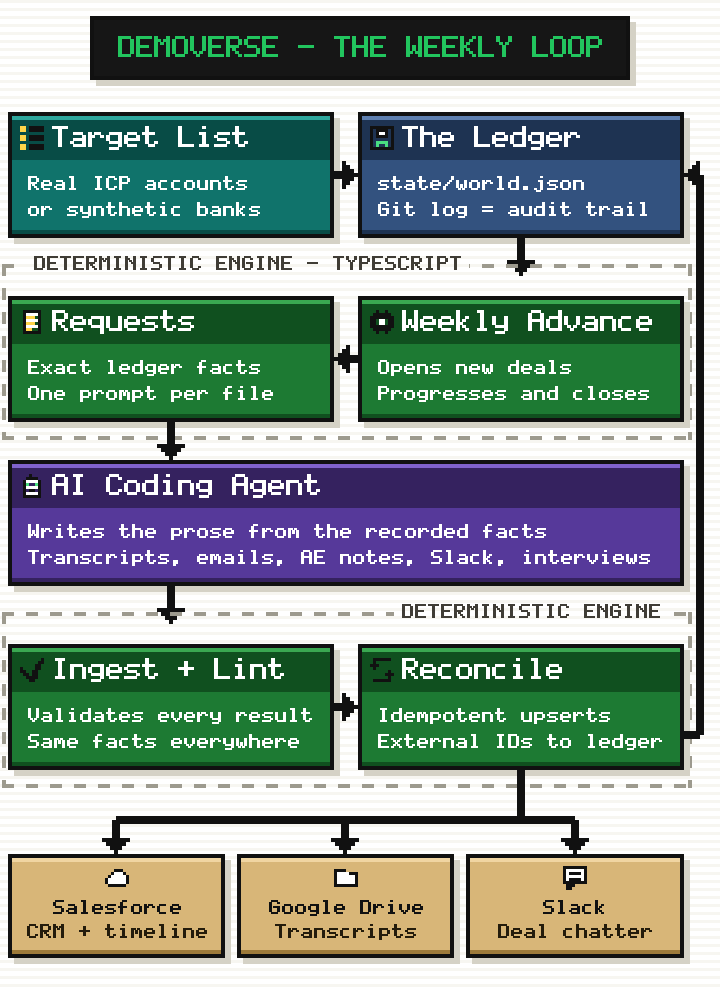
- You define a fictional company in plain YAML (
config/): product,
competitors, personas, sales team, market segments. The/setupwizard
interviews you and writes it for you. - A target list seeds the accounts. Point it at a CSV of real ICP companies
you want to see in the demo, or let the engine draw from its synthetic banks. - The ledger holds the world.
state/world.jsonis the single source of
truth for accounts, contacts, deals, outcomes and external ids: versioned
JSON committed to git, so the git log doubles as an audit trail. Nothing
hand-edits it. - The weekly advance moves the pipeline. It opens a couple of new deals,
progresses open ones a stage, and closes the ones whose cycle is up, all
seeded and deterministic. Outcomes correlate with ICP fit, competitor
strength and multi-threading, so dashboards built on it show real patterns. - It emits grounded prompts, one per touch point a deal actually earned.
Each carries the exact facts (people, competitors, recorded outcome) plus a
per-deal variety texture, so no two deals read alike. - Your agent writes the prose into result files: transcripts, emails, AE
notes, Slack posts, win-loss interviews. One subagent per deal keeps them
from blurring together. - Ingest and lint check the work. Ingest validates and files each result; a
coherence linter proves the transcript, the CRM record and the Slack thread
never contradict each other. Anything that fails stays unfiled and is simply
re-requested. - Reconcile pushes it out to Salesforce, HubSpot, Drive and Slack through
idempotent upserts, recording each external id back on the ledger. Re-runs
update. They never duplicate.
One deal, one week at a time
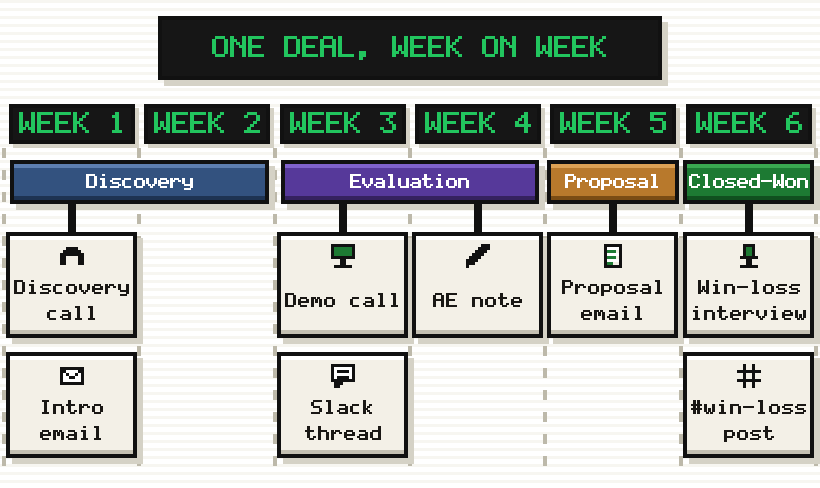
The engine never dumps a finished history. A deal opened this week gets one
discovery call, not a full paper trail. Run it again next week and the same deal
moves a stage and earns another one or two. That is what gives the dataset a
past to chart and a direction to steer. The six weeks below are one deal's
story, not the template. Another closes in a week; another sits in Evaluation
for a month without a word.
What makes it believable
- A deterministic world, an agent-written surface. The engine owns all
structure: ids, dates, amounts, referential integrity. The agent only ever
writes prose against recorded facts. Replays match. Nothing drifts. - Grounded, varied prose. Every prompt carries the deal's facts plus a
seeded texture: backstory, buyer tone, live objections, timeline pressure,
artifact shape, and a banned-phrase list. A repetition detector feeds phrases
back into the blocklist. You edit all of it inconfig/prose.yaml. - Living, not a dump. A typical deal runs about five weeks and earns one to
three touch points a week. Win-loss debriefs are deliberately scarce (~1 in 3
closed deals) and AE notes are terse and imperfect. Uniform diligence is what
makes synthetic data read as synthetic. - No two deals the same shape. Cycle length is drawn per deal, and the tails
are real: warm inbound deals close in a week with barely two touch points,
others grind through a quarter of procurement, others go dark for a month
before dying of "No decision". Short deals skip stages outright. Your demo
gets the edge cases a real pipeline has, not one archetype repeated three
hundred times. Tune or disable each inconfig/world.yaml. - Cohort-gated pushes. The ledger holds hundreds of deals so the statistics
are real. Only a curated ~50 ever reach external systems, each one fully
populated. Nothing leaves the repo by accident.
What Demoverse is not
- Not a faker/mock-data library. It doesn't generate random rows. It grows
one coherent company over time. - Not a load-testing dataset. Volume is intentionally demo-sized.
- Not for real people or production systems. Dedicated orgs and fictional
humans only. See DISCLAIMER.md. - Not a model wrapper. The content is AI-generated, just not by Demoverse.
The engine grounds the prompts and validates the results, and leaves the
generating to the coding agent you already run.
| faker-style generators | static demo-org snapshot | Demoverse | |
|---|---|---|---|
| Cross-record coherence (CRM ↔ calls ↔ Slack) | ✗ | ✓ | ✓ |
| Long-form prose artifacts | ✗ | ✓ | ✓ |
| Moves forward every week | ✗ | ✗ | ✓ |
| Steerable story ("competitor X gets tougher") | ✗ | ✗ | ✓ |
| Deterministic / reproducible structure | ✓ | ✗ | ✓ |
| Pushes into real SaaS orgs | ✗ | ✗ | ✓ |
Quick start
Zero credentials, about five minutes. The world runs entirely locally.
git clone https://github.com/calven-ai/demoverse
cd demoverse
npm ci
Then open the repo in Claude Code and run /setup. The wizard
interviews you, or invents a company from your one-line idea. It writes the
config, initializes the world, and walks you through your first weekly
increment. In Codex, Cursor, or any AGENTS.md-aware tool, say:
Follow the onboarding playbook in AGENTS.md.
Prefer doing it by hand? Copy config/templates/*.yaml → config/, fill them
in, then:
npm run init                      # scaffold the world from your config
npm run pipeline                  # advance one week, emit grounded prompts
# fill state/requests/<n>/results/ (your agent, or you)
npm run apply -- --ingest         # validate + file the prose
npm run lint                      # prove the story is coherent
Then let it run itself. Push the repo to a private GitHub repository, add
a Claude token as a secret, and the bundled workflow advances the world every
Sunday: Claude Code fills the week's touch points, the workflow pushes them to
your connectors and commits the result. Setup takes five minutes:
docs/automation.md. npm run pipeline and/pipeline-update remain for running a week by hand.
Connect real systems when you're ready. Each guide takes a few minutes with
a free account, and every connector stays off until you flip it on inconfig/connectors.yaml:
Salesforce ·
Slack ·
Google Drive ·
HubSpot
Full walkthrough: docs/getting-started.md.
FAQ
Do I need Claude Code? No, but you do need a coding agent. Any one that
reads AGENTS.md works (Codex, Cursor, Copilot, …). The agent is
what generates the transcripts, emails and Slack threads, so it isn't an
optional convenience.
Is the prose AI-generated? What does it cost? Yes, and nothing extra.
Transcripts, emails, Slack threads and win-loss interviews are written by a
language model, but Demoverse never calls one: no model key, no API call, no
metered token bill. Your coding agent does the writing on the subscription you
already have, which also means any writer can fill a request, including a script
of your own against whatever model API you prefer.
Will it touch my production CRM? Only systems you explicitly configure, and
it's designed for isolated ones (free Salesforce Developer Edition, throwaway
Slack workspace). Destructive commands are dry-run by default and require--confirm. See DISCLAIMER.md.
Is it reproducible? The structural world is fully deterministic from a seed.
Prose varies with whichever agent writes it. Grounding and lint keep it
consistent with the facts either way.
More in docs/faq.md, including why win-loss interviews are
scarce, why the AE notes are deliberately sloppy, and how to point it at a CRM
other than Salesforce.
Project status
Complete and maintained. The engine does what it set out to do: a
deterministic world simulation, the grounded-prompt protocol, the coherence
linter, the /setup wizard and tool-neutral onboarding, and connectors for
Salesforce, Google Drive, Slack and HubSpot. There is no feature backlog waiting
to land, because the scope was small on purpose. Maintained means dependency
updates, bug fixes, and repairs when a connector's vendor API changes underneath
it. Issues get answered.
New capability is meant to arrive through the two documented seams rather than
through this repo growing: the
connector contract for a new system, and
the request protocol for a new way of filling
prompts. Both are stable, both are roughly an afternoon of work, and neither
needs a fork. Ideas we would happily merge are listed in
CONTRIBUTING.md.
Contributing
Issues and PRs welcome. Start with CONTRIBUTING.md. Security
reports go through SECURITY.md, never a public issue. Community
standards live in CODE_OF_CONDUCT.md.
License
MIT. Built by the team at Calven, where a
private deployment of this engine powers the live product demo.
Yorumlar (0)
Yorum birakmak icin giris yap.
Yorum birakSonuc bulunamadi