minizinc-mcp
Health Uyari
- No license — Repository has no license file
- Description — Repository has a description
- Active repo — Last push 0 days ago
- Low visibility — Only 5 GitHub stars
Code Gecti
- Code scan — Scanned 4 files during light audit, no dangerous patterns found
Permissions Gecti
- Permissions — No dangerous permissions requested
Bu listing icin henuz AI raporu yok.
MCP server that exposes MiniZinc constraint solving and optimization to LLM clients like opencode, Claude Desktop, and Cursor
MiniZinc MCP Server

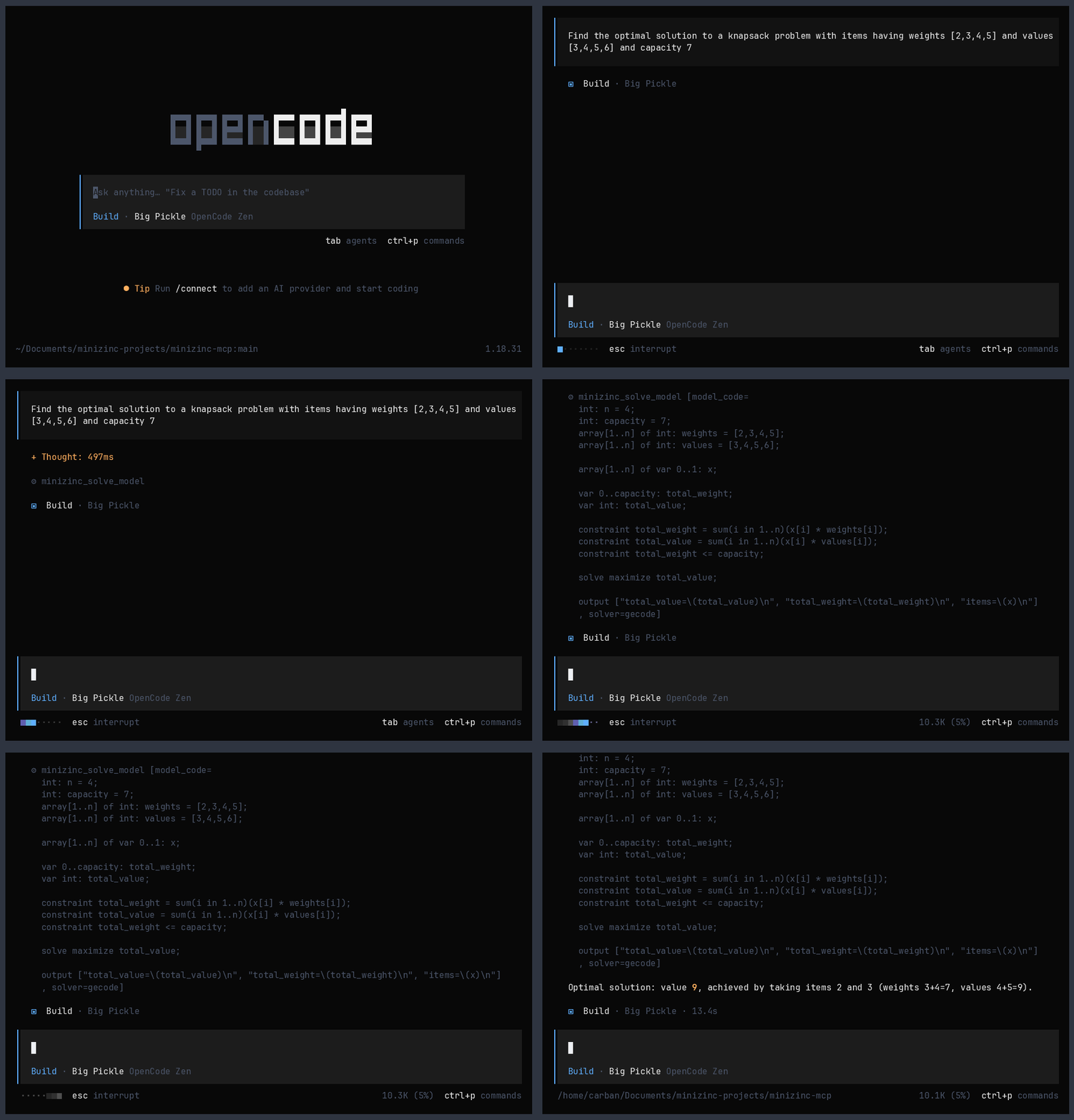
An MCP server that exposes MiniZinc constraint solving and optimization to LLM clients such as opencode, Claude Desktop, and Cursor. It lets an agent parse, type-check, and solve MiniZinc models directly from a chat session.
Built with the MCP Python SDK v2 and the MiniZinc Python binding.
Demo
Install it
1. Prerequisites
Only two things need to be installed, once per machine:
- uv —
curl -LsSf https://astral.sh/uv/install.sh | sh - MiniZinc 2.6+ with the
minizincexecutable onPATH(includes a default solver, Gecode)
Everything else is fetched automatically by uv — there is no clone, no venv setup, and no manual pip install on your side.
2. Install the server (pick one)
Install it globally (best if you use it in several projects):
uv tool install --from git+https://github.com/carban/minizinc-mcp minizinc-mcp
Or run it on demand each time, with nothing installed:
uvx --from git+https://github.com/carban/minizinc-mcp minizinc-mcp
3. Wire it into your MCP client
The server runs over stdio. Tell your MCP client to launch it:
opencode — project level (add this to opencode.jsonc in your project):
{
  "$schema": "https://opencode.ai/config.json",
  "mcp": {
    "minizinc": {
      "type": "local",
      "command": ["uvx", "--from", "git+https://github.com/carban/minizinc-mcp", "minizinc-mcp"]
    }
  }
}
opencode — global (add the same mcp.minizinc block to ~/.config/opencode/opencode.json):
{
  "mcp": {
    "minizinc": {
      "type": "local",
      "command": ["uvx", "--from", "git+https://github.com/carban/minizinc-mcp", "minizinc-mcp"]
    }
  }
}
Claude Desktop (claude_desktop_config.json):
{
  "mcpServers": {
    "minizinc": {
      "command": "uvx",
      "args": ["--from", "git+https://github.com/carban/minizinc-mcp", "minizinc-mcp"]
    }
  }
}
4. Verify it works
Restart your client. Six tools should now be available, prefixed with minizinc_:
minizinc_list_solversminizinc_validate_modelminizinc_solve_modelminizinc_solve_model_by_pathminizinc_get_model_infominizinc_get_flatzinc
Quick sanity check — ask your client: "list the available MiniZinc solvers". You should see gecode, chuffed, highs, and anything else installed on the machine.
What it does
| Tool | Description |
|---|---|
list_solvers |
Lists every MiniZinc solver installed on the machine. The returned tag names (e.g. gecode, chuffed, highs) can be passed to solve_model. |
validate_model |
Parses and type-checks MiniZinc model code without solving it. Useful for checking model syntax up front. Returns VALID or INVALID with an error message. |
solve_model |
Solves a MiniZinc model given as source code: once, exhaustively (all_solutions), or with a solution / time limit. Returns the status, solution(s), objective value (for optimization problems), and solver statistics. |
solve_model_by_path |
Same as solve_model but loads the model and its optional data (.dzn) file from paths instead of source code. |
get_model_info |
Inspects a model without solving it: returns its solve method (satisfy/minimize/maximize) and the declared input parameters and output variables with their types. Useful for an agent to know exactly which params a model expects. |
get_flatzinc |
Compiles a model (and optional data) to FlatZinc text without solving it. Returns the .fzn model, the .ozn output model, and flattening statistics. Useful for debugging and low-level inspection. |
solve_model arguments
| Argument | Type | Default | Description |
|---|---|---|---|
model_code |
str |
(required) | The MiniZinc source code (.mzn) of the model. |
params |
dict | str |
None |
Parameter assignments like a .dzn file: a JSON object mapping names to values (a JSON string encoding such an object is also accepted). |
solver |
str |
"gecode" |
Which solver to use (see list_solvers). |
all_solutions |
bool |
False |
Compute all solutions of a solve satisfy problem. |
max_solutions |
int | None |
None |
Stop after at most this many solutions. |
timeout_seconds |
int | None |
None |
Solver time limit in seconds. |
The result is a JSON object like:
{
  "status": "OPTIMAL_SOLUTION",
  "objective": 9,
  "solution": { "objective": 9, "x": 9, "y": 1 },
  "statistics": { "time": 0.204, "nodes": 3, ... }
}
status is one of SATISFIED, OPTIMAL_SOLUTION, ALL_SOLUTIONS, UNSATISFIABLE, UNKNOWN, or ERROR. validate_model and solve_model never raise in normal operation — errors are returned inside the result dict.
The tool descriptions also instruct the client agent to present solving results and model info to you as Markdown tables instead of raw JSON, so solve_model answers read like a table of output variables even though the tool itself always returns structured JSON.
Developing locally
Clone the repo, then:
uv sync # create the environment and install mcp + minizinc
The server speaks the MCP stdio transport, so it is launched as a subprocess by an MCP client. Run it with the SDK inspector:
uv run mcp dev server.py
that opens the MCP Inspector in the browser where every tool can be called interactively. A minimal programmatic smoke test:
uv run python -c "
import asyncio
from mcp import Client
from mcp.client.stdio import StdioServerParameters

async def main():
    params = StdioServerParameters(command='uv', args=['run', 'python', 'server.py'], cwd='.')
    async with Client(params) as client:
        result = await client.call_tool('solve_model', {
            'model_code': 'var 1..10: x; var 1..10: y; constraint x + y = 10; solve maximize x;'
        })
        print(result.content[0].text)

asyncio.run(main())
"
Running the tests
Install the test dependencies, then run the suite:
uv sync --group dev
uv run pytest -q
The tests in tests/ launch the server end-to-end over stdio and call every tool through the MCP protocol, solving the example model in example/. They need a working MiniZinc install (the same prerequisite as for developers).
Notes and limitations
paramsfollows JSON representation: JSON arrays map to MiniZinc arrays; numbers, strings, and booleans map to their native MiniZinc types. Exotic types like sets and enums are not fully expressible this way.- Do not combine
all_solutionswithmax_solutions; the MiniZinc driver rejects the combination. - MiniZinc requires a solver that supports the model (e.g.
chuffed/gecodefor CP,highs/cbcfor MIP models). Uselist_solversto see what is installed. - Solutions are returned inline in the tool result;
read_only_hintis set on all tools, so they do not modify your files or system.
Yorumlar (0)
Yorum birakmak icin giris yap.
Yorum birakSonuc bulunamadi