agent-memory-hub
Health Warn
- License — License: MIT
- Description — Repository has a description
- Active repo — Last push 0 days ago
- Low visibility — Only 5 GitHub stars
Code Pass
- Code scan — Scanned 12 files during light audit, no dangerous patterns found
Permissions Pass
- Permissions — No dangerous permissions requested
No AI report is available for this listing yet.
Shared persistent memory for AI coding agents (Claude Code), backed by your own Supabase. Cross-session, cross-machine, self-owned.
agent-memory-hub

🇧🇷 Leia em Português.
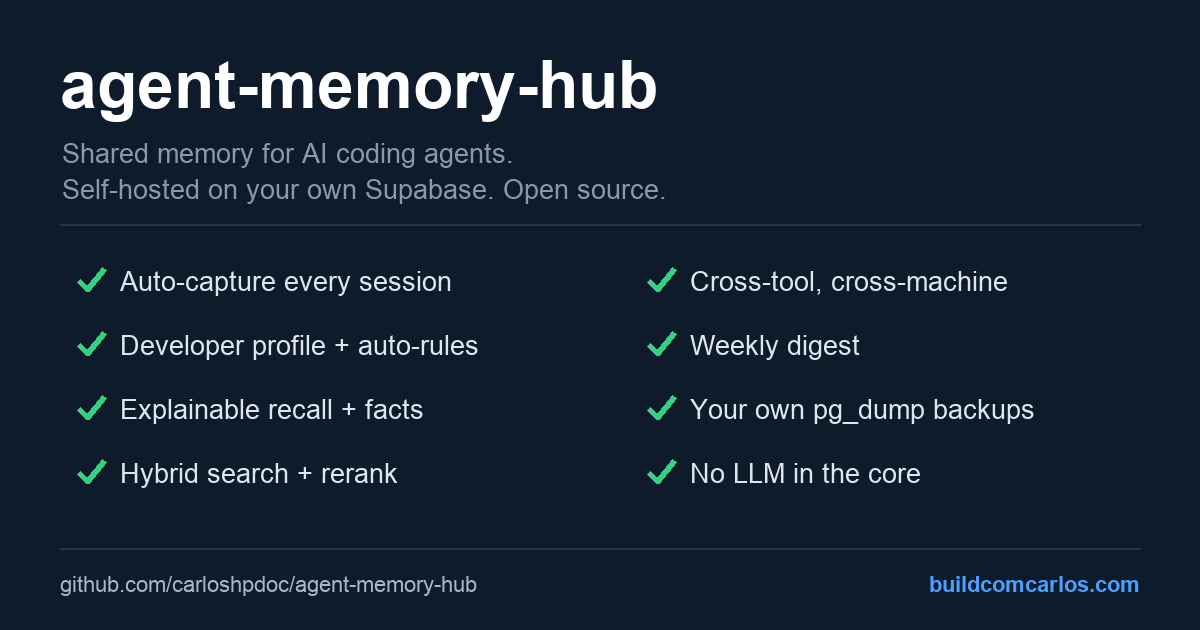
Persistent, shared memory for AI coding agents (Claude Code, and any MCP/REST-capable
tool), backed by your own Supabase. Every session is auto-saved to a Postgres table and
recalled at the start of the next one, across sessions, tool instances, and machines.
One stance sets it apart: memory you can trust, explain, and own. Not a black box.
- Explainable. Recall shows each item's provenance (a fact's confidence and age, a session's
session_id), and a fact's confidence decays with age, so stale memory fades on its own. - Human-gated. The cross-project developer profile and its rules are proposed, never
applied on their own. You approve or reject; nothing silently rewrites how your agent works. - Yours. Plain Postgres on your own Supabase.
pg_dumpanytime. No SaaS in the middle, no lock-in.
Why
Claude Code starts every session from zero. Tools like claude-mem or mem0 solve this, but either
store locally (no cross-machine) or run through a hosted service, and most auto-apply whatever they
extract. agent-memory-hub is the self-owned, auditable take: a Supabase table you own, optional
layers you switch on as you need them (semantic search, facts, a cross-project developer profile,
backups), and a human in the loop wherever memory changes how the agent behaves.
- Cross-session / instance / machine: any setup pointing at the same Supabase shares everything.
- Distilled, not dumped: recall injects compact, ranked, explainable context, not raw transcripts.
- Self-improving, on your terms: it learns how you work across projects and proposes rules; you decide.
vs. CLAUDE.md / AGENTS.md
They don't compete: CLAUDE.md (and Cursor's AGENTS.md) are static instructions you
write by hand; agent-memory-hub is dynamic memory captured automatically. One answers
"how I want you to work" (conventions, canonical commands, rules); the other answers "what we
already did, decided, and broke before" — episodic context that doesn't fit a hand-kept file
because it changes every session.
CLAUDE.md / AGENTS.md |
agent-memory-hub |
|
|---|---|---|
| Nature | Static instructions, written by hand | Dynamic memory, captured automatically |
| Source | You type and maintain it | Generated from your real session history |
| Kind of knowledge | Rules ("always do it this way") | Episodic ("what happened / was decided / was fixed") |
| Cross-session | Reloads the same text every time | Recalls specific past sessions, on demand |
| Cross-machine | Only if you version the file | Automatic (shared Supabase) |
| Evolves itself? | No | Yes — captures, and proposes rules (you gate them) |
| Upkeep | You maintain it manually | Maintains itself |
Where each wins. CLAUDE.md is deterministic and versioned: a hand-written rule always
loads, identically, in every PR — right for commit conventions, build commands, module rules,
and anything that must be fixed. Memory is ranked and probabilistic, and shines where a static
file structurally can't: remembering automatically, across every session/machine/tool, auditably
and self-owned — so you stop re-explaining the project every session.
They connect. The two aren't rivals — the hub feeds CLAUDE.md. Its cross-project profile
watches your patterns, proposes rules, you approve, and they land in a profile-rules.md
your CLAUDE.md imports (@~/.claude/profile-rules.md). That's the loop that turns episodic
history into the static rules a CLAUDE.md holds — closing the gap between what happened and
how to always work. Use both: rules for what must be guaranteed, memory for everything you'd
otherwise forget.
Features
- Auto-capture of every session, with a per-turn checkpoint that survives crashes.
- Secrets never persist: always-on redaction at capture masks private-key blocks, cloud/API
tokens andNAME=valuecredentials before anything reaches the database, and anything you wrap
in<private>...</private>in the conversation is never stored at all. - Recall at session start: a clean one-line summary per relevant session, plus the durable
facts for the current project. Each item carries its provenance (facts: confidence and
since-when; sessions: thesession_id) so recall is explainable. Fact confidence decays with
age (per-kind half-life), so stale facts fade from recall without being deleted. - Recall on a token budget: the injected context has a hard cap (
RECALL_MAX_TOKENS,
default 1500). Over budget it degrades gracefully — compact index first (full detail one MCPget_sessionaway), then lowest-priority items drop. Every injection is logged tohooks/recall.log(what went in, estimated cost, what was cut) — no blackbox memory, no
burned token budgets. - Search your whole history: hybrid (keyword + semantic via
pgvector), with an
optional LLM--reranksecond pass. - Facts layer (optional, bring-your-own-LLM): durable preferences / decisions / configs /
procedures (how-tos that worked) with temporal validity, deduped by meaning. A new fact
that contradicts an old near-match supersedes it at extraction time (valid_until+superseded_by, non-destructive) instead of piling up conflicting memories. - Defrag job (
scripts/defrag_facts.py, optional): periodic sleep-time pass with your local
LLM — supersedes duplicates, invalidates stale ephemeral facts. Non-destructive, conservative
by default ("keep" when unsure). - Developer profile (optional): distills how you work across all your projects into a profile,
and turns the patterns you approve into rules your agent follows. A self-improving loop, human-gated. - Rules → enforcement (
scripts/enforce_rules.py, optional): approved rules that are
mechanizable become a PreToolUse guard that blocks the violating shell command — a rule in
markdown is a wish list; a hook is a contract. Human-gated: dry-run shows every regex, and it
never edits yoursettings.jsonitself. - Cross-tool: Claude Code via hooks, Codex CLI and Cursor via adapters, any tool via the adapter template.
- MCP server (
scripts/mcp_server.py, pure stdlib): dedicated tools —recall_relevant,recent_sessions,get_facts,get_session— so any MCP agent (Claude Code, Cursor, Codex)
queries the memory on-demand, with the task in hand, not just the passive recall at boot. - Memory console (
scripts/memory.py): browse, search and inspect from the terminal —stats,recent,search,facts,show,profile, plusstandup(what you touched
today/this week),healthandlog(below). Installable as a globalmemcommand
(pipx install -e .). - Markdown export (
mem export): a human-readable, git-versionable dump of facts, session
summaries and approved rules — read, diff and commit what your agent knows. The database stays
the source of truth; the export is the audit copy. - Health & observability (
memory.py health/log): reconciles local transcripts against
Supabase and watches the capture error rate, so a silent capture failure surfaces instead
of going unnoticed — memory you can verify, not just trust. - Weekly digest (
scripts/weekly_digest.py): a 7-day summary across all projects (LLM-free),
with a hook into your content workflow. - Tested & measured: an offline pytest suite + CI (on every push/PR) pin the capture pipeline
so the silent-capture bugs can't return, and a recall eval harness (scripts/eval_recall.py,
hit@k / MRR) means recall quality is measured, not assumed — that's how we confirmed a recency
bias would hurt and kept the 1:1 hybrid fusion as the calibrated default. - Your own backups: daily
pg_dumpto a portable.sql. No lock-in. - No LLM in the core (the "semantic" part uses an embedded model, not a chat LLM); every
LLM-powered piece is optional and has a free option.
How it works
flowchart TD
    subgraph S["AI coding session (Claude Code)"]
        direction TB
        SS["SessionStart"] --> RECALL["recall_session.py<br/>injects a digest of relevant past sessions"]
        STOP["Stop (each turn)"] --> CAP["capture_session.py<br/>continuous checkpoint, background, upsert"]
        SE["SessionEnd"] --> SAVE["capture_session.py<br/>final save"]
    end

    RECALL -.->|reads| DB[("Supabase, your project<br/>table public.sessions")]
    CAP -->|writes| DB
    SAVE -->|writes| DB

    DB -->|optional| DUMP["pg_dump<br/>cron on an always-on host"]
    DUMP --> GZ([".sql.gz"])
    GZ --> PULL["pull to your machine"]
- Capture is idempotent (upsert by
session_id). TheStopcheckpoint means even an
abrupt kill keeps the session up to its last turn. - Recall injects only a compact digest (one extractive summary line per session, not raw
transcript). Full transcripts stay queryable on demand via the Supabase MCP or REST. - The summary is deterministic and LLM-free: the capture hook keeps the first substantive
user ask, the last one, and turn counts. Runsql/04-summary.sqlto add the column.
Requirements and supported tools
The memory itself is just Postgres, so what's tool-specific is only the automatic
capture/recall, which ships as Claude Code hooks.
- Auto-capture + recall (the hooks): Claude Code. The
hooks use itsSessionStart,Stop, andSessionEndevents. - Read and query the shared memory: any MCP or REST capable AI tool, for example Cursor,
Codex CLI, Gemini CLI, or ChatGPT, through the Supabase MCP or the REST API. - Capture from another tool: an adapter scans that tool's local transcripts and uploads
them. Codex CLI and Cursor ship as adapters (scripts/adapters/); see
Capture from other tools to add more.
Also needed:
- A free Supabase project.
python3(hooks and backup are pure stdlib, no pip needed).
Getting started (also: how to set it up on a machine)
Shortcut: after cloning and filling
.env, run./scripts/setup.sh. It applies the
SQL migrations and installs the Claude Code hooks in one idempotent step (it does not enable
the optional LLM facts layer). The manual steps below explain what it does.
1. Clone
git clone https://github.com/carloshpdoc/agent-memory-hub.git
cd agent-memory-hub
2. Create a Supabase project
At supabase.com: new project. Enable Data API and RLS.
Grab from Settings > API: Project URL, publishable key, secret key.
3. Apply the schema
Open SQL Editor in Supabase and run sql/01-schema.sql.
It creates the sessions table, the full-text index, and RLS.
4. Configure .env
cp .env.example .env
# edit .env with your SUPABASE_URL and SUPABASE_SECRET_KEY (and backup vars if used)
.env is gitignored. The hooks read it directly.
5. Wire the hooks into Claude Code
Add to your Claude Code settings.json (~/.claude/settings.json for user scope), using the
absolute path to your clone:
{
  "hooks": {
    "SessionStart": [
      { "matcher": "", "hooks": [
        { "type": "command", "command": "python3 /ABS/PATH/agent-memory-hub/hooks/recall_session.py", "timeout": 15 }
      ]}
    ],
    "Stop": [
      { "matcher": "", "hooks": [
        { "type": "command", "command": "payload=$(cat); printf '%s' \"$payload\" | python3 /ABS/PATH/agent-memory-hub/hooks/capture_session.py >/dev/null 2>&1 &" }
      ]}
    ],
    "SessionEnd": [
      { "matcher": "", "hooks": [
        { "type": "command", "command": "python3 /ABS/PATH/agent-memory-hub/hooks/capture_session.py", "timeout": 20 }
      ]}
    ]
  }
}
If you already have hooks for these events, add these entries to the existing arrays.
6. (optional) Add the Supabase MCP
Lets the agent query memories interactively:
claude mcp add --scope user --transport http supabase \
  "https://mcp.supabase.com/mcp?project_ref=<YOUR_PROJECT_REF>"
# then authenticate: /mcp > supabase
7. (optional) Backup module
On an always-on host with pg_dump at or above your Postgres major version, and the repo cloned:
- Put your pooler creds in
~/.pgpass(chmod 600):HOST:5432:postgres:postgres.<PROJECT_REF>:PASSWORD - Fill the
PG_POOLER_*vars in.env. - Cron:
30 3 * * * /ABS/PATH/agent-memory-hub/scripts/backup.sh >> .../backup.log 2>&1 - Pull copies locally with
scripts/pull-backups.sh(setREMOTE_SSHandSSH_KEYin.env).
Adding another machine
This is the whole point, and it's trivial:
- Clone the repo on the new machine.
- Copy the same
.env(same Supabase credentials). - Run
./scripts/setup.sh.
Done. That machine now writes to and reads from the same shared memory. The migrations are
idempotent (and skipped if it has no DB creds, since the schema is shared). The optional facts
layer stays off, so a weaker machine just captures and reads, while heavy fact extraction runs
only where you enable it.
To also upload that machine's prior Claude Code history (sessions from before the hooks),
run python3 scripts/backfill_sessions.py --dry-run to preview, then without the flag to upload.
It is idempotent (skips sessions already in Supabase).
Capture from other tools (adapters)
The Claude Code hooks are one capture path. Tools without lifecycle hooks are handled by an
adapter that scans their local transcripts and uploads new ones (idempotent), the same waybackfill_sessions.py works for Claude Code. Adapters run on a cron and write with tool=<name>,
so recall, search and facts treat all tools uniformly.
- Codex CLI (
scripts/adapters/codex.py) reads~/.codex/sessions/**/rollout-*.jsonl. Run with--dry-runto preview, then put it on a cron. - Cursor (
scripts/adapters/cursor.py) reads Cursor's chat from
its SQLite store (.../Cursor/User/globalStorage/state.vscdb), reconstructing each conversation
from its message bubbles. A settle guard skips chats still in flight.--dry-runto preview;
override the DB path withCURSOR_DB=...on another OS. Then put it on a cron. - Adding a tool: write a small adapter that maps the tool's transcripts to
(session_id, cwd, user/assistant turns)and upserts withtool=<name>. Usecodex.py(JSONL)
orcursor.py(SQLite) as the template. Gemini CLI is a good first contribution.
Configuration reference
| Var | Used by | Meaning |
|---|---|---|
SUPABASE_URL |
hooks, backup.py | https://<ref>.supabase.co |
SUPABASE_SECRET_KEY |
hooks | service_role key (writes, bypasses RLS) |
PG_POOLER_HOST, PG_POOLER_USER |
backup.sh | Session Pooler host, postgres.<ref> |
BACKUP_DIR, KEEP |
backup.sh, backup.py | output dir, how many to keep |
REMOTE_SSH, SSH_KEY |
pull-backups.sh | always-on host, SSH key |
EMBED_KEY |
embed_pending.py, search.py | guard for the embedding function (Phase 2) |
Querying your memory
- Console:
python3 scripts/memory.pyopens an interactive prompt, or use it as
subcommands:stats,recent [N],search [--project P] "<q>",facts [project],show <id-prefix>,standup [today|yesterday|week],health,log [N]. Pure stdlib,
no server, no key in a browser. Either alias it
(alias mem='python3 /ABS/PATH/agent-memory-hub/scripts/memory.py') or install a realmemcommand from your clone:pipx install -e .(orpip install -e .). Editable keeps
the files in the clone, so config andmem healthresolve as usual; config is read from$AGENT_MEMORY_HUB_ENV, then~/.config/agent-memory-hub/.env, then the repo.env. - MCP server (dedicated):
scripts/mcp_server.pyexposesrecall_relevant,recent_sessions,get_facts,get_sessionover stdio/JSON-RPC (pure stdlib, no deps), so any agent queries the
memory on-demand with the task in context — not only the passive recall at session start:claude mcp add --scope user agent-memory-hub -- python3 /ABS/PATH/agent-memory-hub/scripts/mcp_server.py - Supabase MCP: ask the agent. It runs SQL via the Supabase MCP.
- REST full-text:
GET /rest/v1/sessions?content_tsv=fts(simple).<term>with the secret key. - Filters: by
project,machine,started_at,session_id.
Semantic search (Phase 2)
Optional. Adds meaning-based recall on top of full-text search, using pgvector and thegte-small model running inside a Supabase Edge Function (free, no external API).
- Run
sql/02-phase2-pgvector.sql. It adds theembedding
column, the HNSW index, and thematch_sessionsRPC. Also runsql/03-hybrid-search.sqlfor thehybrid_searchRPC. - Set a guard secret and deploy the function:
Put the samesupabase secrets set EMBED_KEY=$(openssl rand -hex 24) supabase functions deploy embed --no-verify-jwt # new API keys are not JWTsEMBED_KEYin your.env. - Embed existing rows:
python3 scripts/embed_pending.py. Run it on a cron to keep new
sessions embedded (for example*/15 * * * *on your always-on host). - Search:
python3 scripts/search.py "how did we set up backups". It runs hybrid search
(keyword + semantic, fused with Reciprocal Rank Fusion), so exact terms that pure vector
search would miss still surface, and vice versa. Add--rerankfor an optional LLM
second pass that reorders the top candidates by relevance (needsFACTS_LLMset).
The Edge Function returns only vectors and counts, never session content.
Recall eval (verify recall, don't just trust it)
The same stance the tool takes on capture, applied to recall itself: measure whether it
surfaces the right past context, don't assume it. scripts/eval_recall.py
runs the real recall path and scores it with hit@k and MRR.
python3 scripts/eval_recall.py --auto 30            # retrieval regression check
python3 scripts/eval_recall.py --auto 60 --spread   # representative, corpus-spread sample
python3 scripts/eval_recall.py --gold tests/eval/recall_gold.example.json
--auto Nsamples N recent sessions, turns each session's own summary into a query, and
checks whether that session comes back near the top. It won't prove recall is smart, but it
screams when recall is broken (embeddings down, FTS misconfigured) — the silent failure this
project exists to catch. Add--spreadto sample across the whole corpus instead of the
most recent (deterministic, reproducible) — that's the representative measurement mode.--gold FILEscores curated{query, expect:{project?, contains?}}cases (gold cases are
your own; the shipped file is a format example).
Measured on the author's real corpus (267 sessions across 47 projects, hybrid recall,--auto 60 --spread, Jul 2026):
| metric | score |
|---|---|
| hit@1 | 46.7% |
| hit@3 | 58.3% |
| hit@5 | 68.3% |
| MRR | 0.540 |
i.e. given only a one-line summary of a past session as the query, the exact session comes
back in the top 5 two times out of three, against 266 distractors. Your numbers will vary
with your corpus — the point is that you can measure yours with one command. (The harness
also killed a plausible "improvement": recency weighting, measured at −27 to −45 pp hit@1,
rejected. See docs/00-design-decisions.md.)
Facts and preferences (optional, Phase 4)
Everything above needs no LLM (the "semantic" part uses the embedded gte-small, not a
chat model). This optional layer is the only part that uses an LLM, and it is
bring-your-own-LLM with free options, so it never forces a cost or a specific provider.
When enabled, an optional cron distills each session into durable atomic facts (preferences,
decisions, configs) with temporal validity, deduped by meaning. Recall then injects the
relevant facts (current project + global) at the top of the digest.
- Run
sql/05-facts.sql(facts table, validity model,match_factsRPC). - Pick a provider in
.envviaFACTS_LLM:ollama: local, free, private (needs Ollama running).gemini: Google AI Studio free tier (GEMINI_API_KEY).openai: OpenAI or any OpenAI-compatible endpoint (Groq, OpenRouter, local).off(default): disabled; the rest of the tool is unaffected.
- Run
python3 scripts/extract_facts.py(put it on a cron to process new sessions).
Deduping facts (optional, manual). Over time, facts can overlap. sql/06-find-fact-dupes.sql
plus scripts/consolidate_facts.py let an LLM judge near-duplicate pairs and supersede the
redundant one (non-destructively, via valid_until). Run it with --dry-run and review:
this is deliberately not automated, because a weak judge can over-merge useful specifics, so a
human should approve. Some redundancy is fine; only prune what you've checked.
Developer profile and self-improving rules (optional, Phase 9)
Most memory tools store facts per project. Because this hub holds every session across
all your projects, it can do something they can't: distill a profile of how you work
and turn the high-confidence patterns into rules your agent then follows. The loop is: the
more you use it, the better-tuned the agent's own instructions get, with you as the gate.
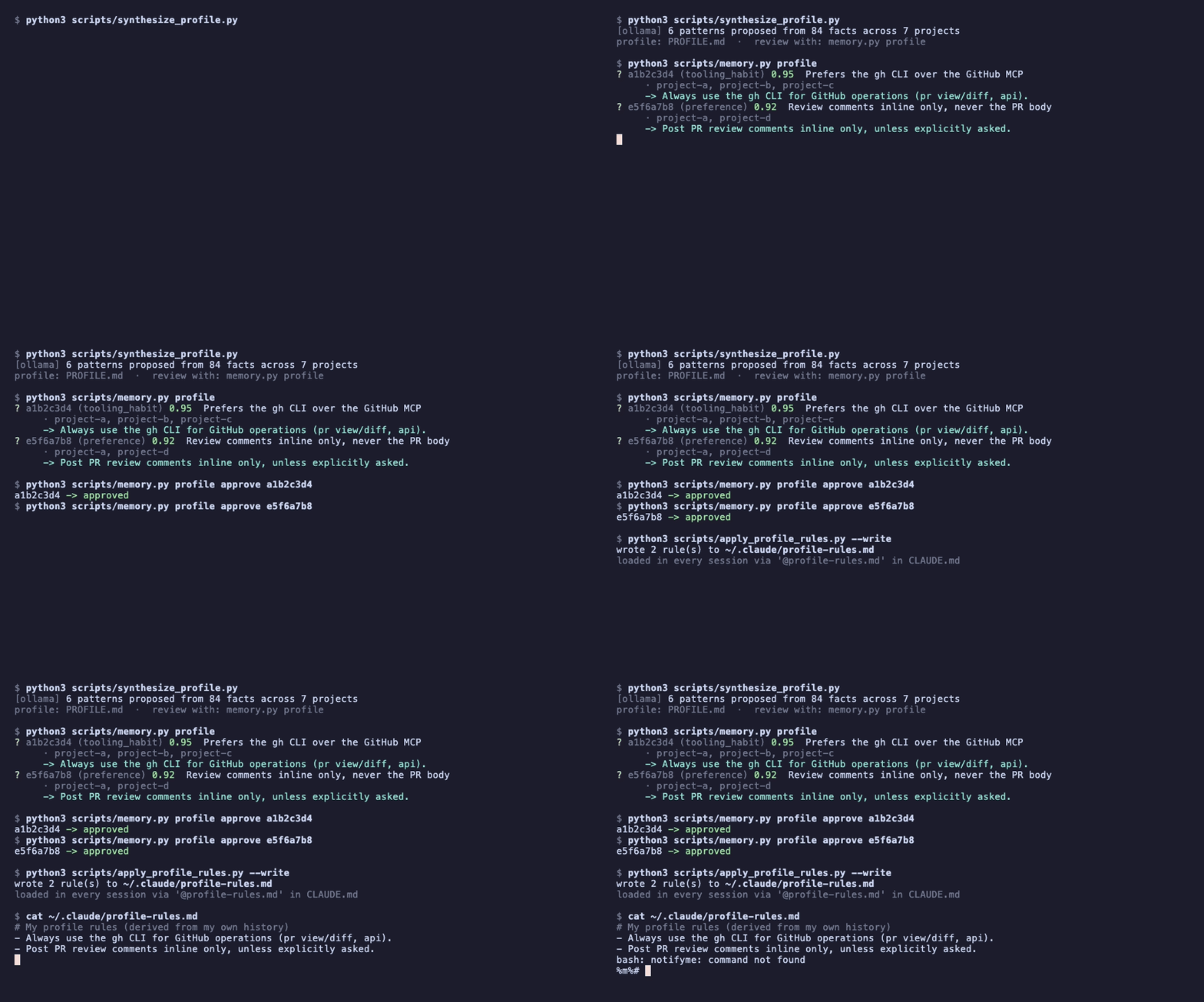
Illustrative run with generic data. The loop: synthesize a profile, review each pattern,
approve, and the approved rules land in a file yourCLAUDE.mdimports.
- Run
sql/07-profile.sql(theprofile_patternstable). - With
FACTS_LLMset (same providers as above), runpython3 scripts/synthesize_profile.py.
It reads your durable facts, keeps only patterns with evidence in 2+ different projects,
and writes a human-readablePROFILE.md. High-confidence patterns get a proposed rule. - Review with
python3 scripts/memory.py profileand approve or reject each
(profile approve <id>/profile reject <id>). Curation is deliberately human. - Run
python3 scripts/apply_profile_rules.py(dry-run) then--write. It writes the
approved rules to a separate file (~/.claude/profile-rules.md), never touching your
hand-writtenCLAUDE.md. Load them once by adding@~/.claude/profile-rules.mdtoCLAUDE.md.- Add
--per-projectto instead write one file per project
(~/.claude/profile-rules/<project>.md), each with the rules whose evidence includes that
project. Import the relevant one from that repo'sCLAUDE.md, so project-specific rules
don't load in unrelated sessions.
- Add
Recall also proactively surfaces any detected-but-unreviewed patterns at the start of a
session (with their confidence and project count), so the loop closes itself instead of waiting
for you to remember to run the review.
Like the facts layer, this is optional, bring-your-own-LLM, and gated by human review: a weak
judge over-merges, and "newer" is not always "better", so nothing is applied without your sign-off.
Security
- Secrets live only in
.envand~/.pgpass(gitignored, chmod 600). Never commit them. - RLS is on. The public (anon) key can't read without a policy. Hooks use the secret key.
- The secret key is powerful. Treat it like a password.
Files
scripts/setup.sh            one-shot setup/update: migrations + hooks (idempotent)
scripts/migrate.py          apply sql/*.sql to Supabase
scripts/install_hooks.py    add the hooks to settings.json
scripts/backfill_sessions.py  upload this machine's prior Claude Code history (one-time)
scripts/adapters/codex.py   capture adapter for Codex CLI (JSONL template)
scripts/adapters/cursor.py  capture adapter for Cursor (SQLite template)
scripts/memory.py           memory console: browse/search/inspect/standup/health (Phase 8)
scripts/memory_client.py    shared Supabase access + read queries (used by console + MCP server)
scripts/mcp_server.py       MCP server (stdio/JSON-RPC, pure stdlib): recall_relevant, get_facts, ...
scripts/weekly_digest.py    7-day cross-project digest, LLM-free (Phase 10)
hooks/capture_session.py    capture (Stop + SessionEnd)
hooks/recall_session.py     recall  (SessionStart)
sql/01-schema.sql           table + full-text + RLS
sql/02-phase2-pgvector.sql  pgvector + match_sessions RPC (Phase 2)
sql/03-hybrid-search.sql    hybrid_search RPC: keyword + semantic via RRF (Phase 3)
sql/04-summary.sql          summary column (extractive, LLM-free)
sql/05-facts.sql            facts/preferences layer + match_facts RPC (Phase 4, optional)
supabase/functions/embed/   gte-small embedding Edge Function (Phase 2)
scripts/backfill_summaries.py  fill summary for existing rows (one-time)
scripts/extract_facts.py    distill sessions into facts via your LLM (Phase 4, optional)
scripts/consolidate_facts.py  review/merge duplicate facts via LLM (Phase 5, manual)
sql/06-find-fact-dupes.sql  find near-duplicate fact pairs (Phase 5)
sql/07-profile.sql          developer-profile patterns table (Phase 9, optional)
scripts/synthesize_profile.py  distill a cross-project dev profile via LLM (Phase 9, optional)
scripts/apply_profile_rules.py  write approved profile rules to ~/.claude/profile-rules.md (Phase 9)
scripts/backup.sh           pg_dump backup (cron on an always-on host)
scripts/pull-backups.sh     rsync backups to this machine
scripts/backup.py           portable logical backup (REST/NDJSON, no pg client)
scripts/embed_pending.py    embed sessions missing a vector (Phase 2)
scripts/search.py           semantic search CLI (Phase 2)
scripts/eval_recall.py      recall eval harness: hit@k / MRR (auto + gold modes)
scripts/mem_cli.py          console entry point for the installed `mem` command
tests/                      offline pytest suite (capture, cursor adapter, eval) + CI
docs/                       architecture and design decisions
License
Star, share, contribute
If this saved you from re-explaining your project to your agent for the tenth time today,
give the repo a star. It genuinely helps other people find it.
Ideas, rough edges, or a capture adapter for your tool (Gemini CLI, Windsurf, Zed...)? Open an
issue or a pull request — see CONTRIBUTING.md for the dev setup and the adapter
guide, and ROADMAP.md for what's planned (including some good first issues). If you
build something on top of agent-memory-hub, I would love to see it.
Built by
Made by buildcomcarlos.com: articles and open tools on AI
agents, iOS, and shipping software solo. If this project was useful, the site is where the
deep dives and the next experiments live. Come say hi.
Reviews (0)
Sign in to leave a review.
Leave a reviewNo results found