Cascade
Health Gecti
- License — License: MIT
- Description — Repository has a description
- Active repo — Last push 0 days ago
- Community trust — 24 GitHub stars
Code Uyari
- process.env — Environment variable access in lib/config.ts
Permissions Gecti
- Permissions — No dangerous permissions requested
This autonomous agent monitors price discrepancies across four Solana decentralized exchanges (DEXes) every 3 seconds. It uses a Claude AI agent to evaluate potential arbitrage opportunities and executes trades automatically in milliseconds.
Security Assessment
The tool requires environment variables for API keys (Anthropic and Helius) via a standard `.env` file, but the automated scan found no hardcoded secrets. It inherently makes external network requests to fetch live market prices and interact with the Solana blockchain. While it features an execution module, the system defaults to safe "paper trading," meaning it simulates trades rather than sending real funds by default. Overall risk is rated as Medium. This is a high-stakes financial tool involving real-world assets; if you disable paper trading and provide it with access to a funded crypto wallet, any errors in the AI's logic could result in immediate financial loss.
Quality Assessment
The project is licensed under the permissive and standard MIT license. It appears to be a newly released tool with active development, evidenced by a repository push as recent as today. It currently has 24 GitHub stars, indicating early but growing community interest. The documentation is clear and transparent about the tool's mechanics and limitations.
Verdict
Use with caution. While the code is open and defaults to safe simulation, enabling live trading with an autonomous AI handling real financial transactions carries inherent financial risk.
Autonomous arbitrage scanner - monitors price spreads across 4 Solana DEXes, evaluates paths with Claude, executes in milliseconds.
Cascade




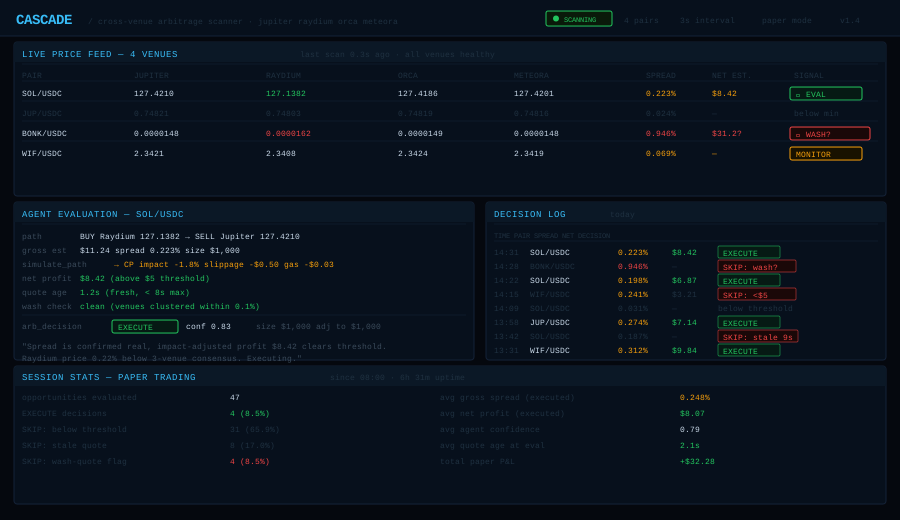
Autonomous cross-venue arbitrage scanner for Solana. Monitors price spreads across four DEXes every 3 seconds and uses a Claude agent to evaluate, simulate, and execute opportunities before they close.
The opportunity
Prices across Solana DEXes are never perfectly synchronized. Jupiter, Raydium, Orca, and Meteora each run independent AMM curves — when one updates faster than the others, a window opens. Most windows are under 0.1% and close in seconds. The ones worth taking average 0.2–0.5% and last 3–15 seconds.
Cascade watches all four venues simultaneously, finds those windows, and lets Claude decide whether to act.
What it does
Every 3 seconds:
- Scan — fetch prices for all watched pairs from Jupiter, Raydium, Orca, and Meteora in parallel
- Spread — compute best bid/ask across venues, flag pairs where spread exceeds
MIN_SPREAD_PCT - Find paths — for each viable spread, calculate an arb path with gas-adjusted net profit
- Agent evaluates — Claude calls
simulate_pathto apply price impact + slippage, then issuesEXECUTE,SKIP, orMONITOR - Execute — approved paths go through
TradeExecutor(paper mode by default)
Agent decision loop
The Claude agent has two tools per evaluation:
simulate_path   → refines gross profit with price impact + slippage model
arb_decision    → final verdict: EXECUTE | SKIP | MONITOR
It always simulates before deciding. If the post-simulation profit drops below MIN_NET_PROFIT_USD, it skips regardless of the raw spread. This filters out a large class of false positives from stale quotes.
Quickstart
git clone https://github.com/YOUR_USERNAME/cascade
cd cascade
bun install
cp .env.example .env    # fill in ANTHROPIC_API_KEY + HELIUS_API_KEY
bun run dev             # paper trading by default
Run the historical simulation:
bun run sim
Configuration
| Variable | Default | Description |
|---|---|---|
PAPER_TRADING |
true |
Safe default — no on-chain execution |
MIN_SPREAD_PCT |
0.20 |
Minimum spread to trigger agent evaluation |
MIN_NET_PROFIT_USD |
5 |
Minimum post-gas, post-slippage profit |
MAX_POSITION_USD |
1000 |
Max size per arb trade |
SLIPPAGE_BPS |
50 |
Slippage tolerance (0.5%) |
SCAN_INTERVAL_MS |
3000 |
Price fetch frequency |
WATCH_PAIRS |
SOL/USDC,... |
Comma-separated pairs to monitor |
CONFIDENCE_THRESHOLD |
0.70 |
Minimum agent confidence to execute |
Adding a venue
Create venues/your-venue.ts extending BaseVenue, implement getPrice() and isHealthy(), then add it to PriceMonitor.venues in scanner/monitor.ts. The rest of the pipeline picks it up automatically.
Technical Spec
Price Impact Model — Constant Product AMM
Cascade uses a Constant Product approximation for price impact estimation on Raydium v3 and Orca Whirlpool:
impactFactor = 1 − tradeSize / (reserveDepth + tradeSize)
adjustedProfit = grossProfit × impactFactor
Reserve depth is approximated conservatively at 20× the trade size (if the actual pool depth is unknown from the quote). This over-estimates impact, which is the correct bias — it's better to skip a profitable trade than to take a losing one.
Meteora DLMM note: DLMM bins have discrete price steps. Real impact is stepwise, not smooth. The CP model still applies as a conservative lower bound — actual impact is typically lower if the trade stays within a single bin.
Stale Quote Filter
Arb windows on Solana close in 3–15 seconds. Cascade rejects paths where the spread snapshot is older than MAX_QUOTE_AGE_SECONDS (default 8s) before making a Claude agent call. This avoids spending ~800ms on an agent evaluation for a spread that almost certainly no longer exists.
Data age is also passed to the agent prompt as Quote freshness: fresh | stale — the agent factors this into its confidence score.
Wash-Quote Heuristic
A spread where exactly one venue diverges > 0.3% from the median of the rest is flagged as a potential bad quote before reaching the agent:
sorted prices: [1.2340, 1.2342, 1.2343, 1.2387] ← Raydium only outlier
→ isPotentialWashQuote = true → agent scrutinizes before EXECUTE
This catches a large class of stale Jupiter aggregator quotes and venue API glitches before they reach the decision layer.
Gas Cost Model
Solana transaction cost is approximated at:
baseFee = 5000 lamports (~$0.0007 at $140/SOL)
priorityFee = 100_000 lamports typical (~$0.014)
total ≈ $0.015 per tx
A 2-leg arb (buy + sell) costs ~$0.03 in gas. This is already included in estimatedGasCostUsd before the agent sees the path. The MIN_NET_PROFIT_USD threshold (default $5) provides 166× gas coverage.
Why No Flash Loans
Solana does not support EVM-style atomic flash loans in a single transaction. Cross-program invocations (CPIs) can compose, but there's no native "borrow-swap-repay-or-revert" primitive. Cascade executes legs sequentially with MAX_POSITION_USD as the capital ceiling.
Stack
- Runtime: Bun 1.2
- Agent: Claude Agent SDK —
simulate_path → arb_decisiontool loop - Venues: Jupiter v6 · Raydium v3 · Orca Whirlpool · Meteora DLMM
- Simulation: price impact + slippage model before every execution decision
License
MIT
Yorumlar (0)
Yorum birakmak icin giris yap.
Yorum birakSonuc bulunamadi