mcp-erpnext
Health Gecti
- License — License: MIT
- Description — Repository has a description
- Active repo — Last push 0 days ago
- Community trust — 101 GitHub stars
Code Basarisiz
- process.env — Environment variable access in .github/workflows/copilot-agent-quota.yml
- process.env — Environment variable access in .github/workflows/publish.yml
- fs module — File system access in .github/workflows/publish.yml
- network request — Outbound network request in docker-compose.yml
- network request — Outbound network request in mod.ts
- rm -rf — Recursive force deletion command in scripts/build-node.sh
Permissions Gecti
- Permissions — No dangerous permissions requested
Bu listing icin henuz AI raporu yok.
Let AI agents operate your ERPNext — documents, workflows, and interactive viewers
English | 繁體中文
@casys/mcp-erpnext


[!IMPORTANT]
Installing the 3.1 beta: for npm/Node usenpx -y @casys/mcp-erpnext@next; for Deno usedeno run -A jsr:@casys/mcp-erpnext@^3.1.0-beta/server. Both follow the
current prerelease — JSR has no dist-tags, hence the range there. Exact
versions are in the CHANGELOG. The beta adds the generic
document viewer and attachment workflows, so test it with the MCP host your
users actually run before replacing a stable deployment.
Let any MCP-compatible AI agent operate your ERPNext /
Frappe instance — documents, workflows, and interactive viewers inside the host
(Claude Desktop, Claude Code, VS Code Copilot, or custom).
Works with self-hosted and ERPNext Cloud (frappe.cloud) instances.
Built on @casys/mcp-server — the
MCP server framework (concurrency, auth, MCP Apps, observability) that powers
this project.
Screenshots
Interactive viewers rendered inside an MCP host, driven entirely by tool
results.
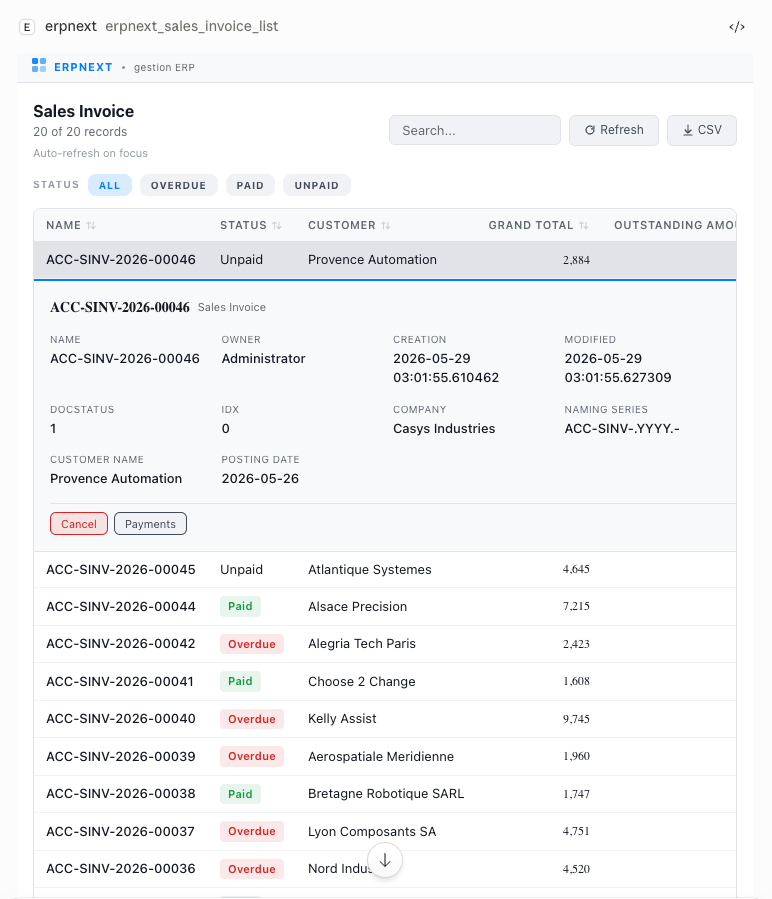 doclist-viewer — any DocType as a sortable table with chip filters and an inline detail panel |
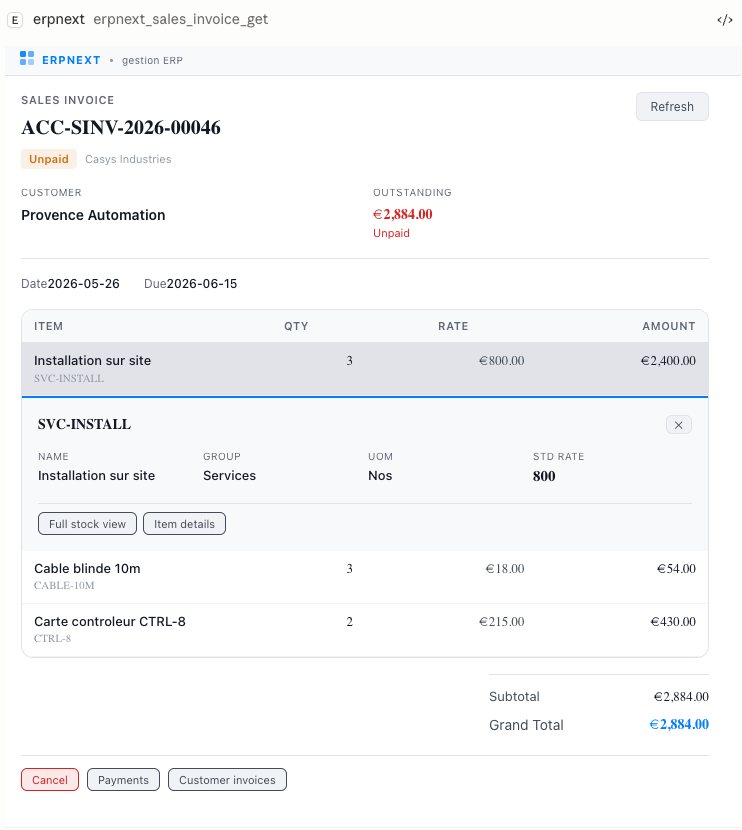 invoice-viewer — invoice with parties, line items, item drill-down and Submit/Cancel/Payments |
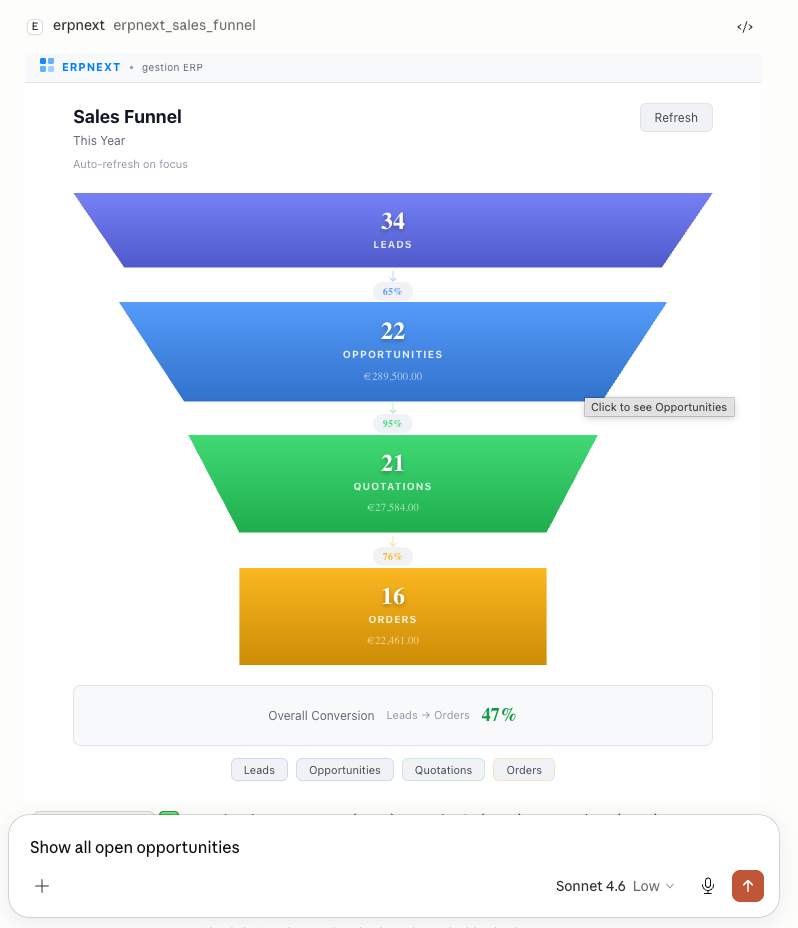 funnel-viewer — Lead → Opportunity → Quotation → Order with conversion rates |
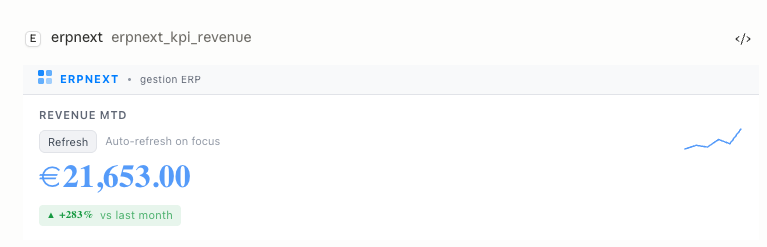 kpi-viewer — big-number KPI with delta vs last period and a sparkline |
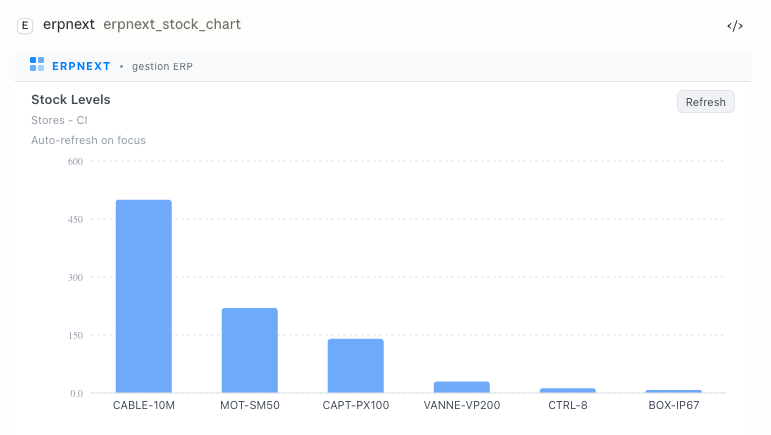 chart-viewer — universal Recharts renderer (here: stock levels) |
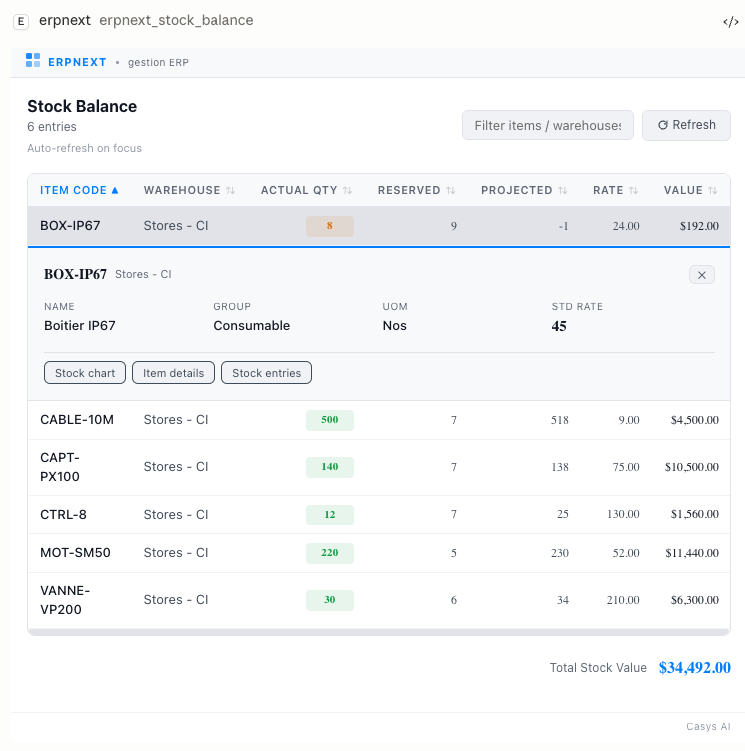 stock-viewer — stock balance with color-coded quantity badges |
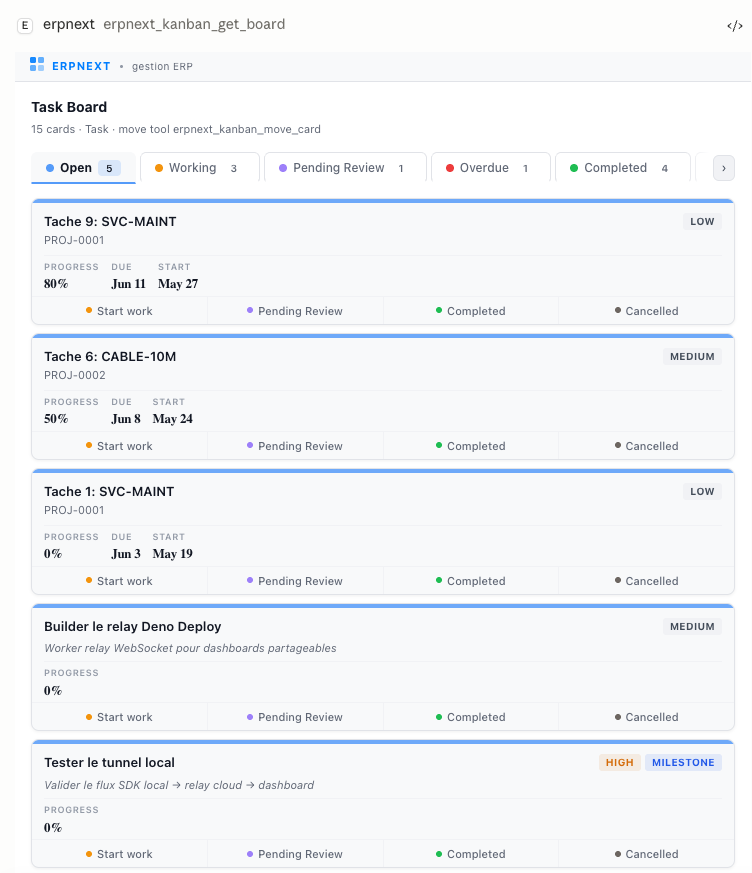 kanban-viewer — read-write board (Task / Opportunity / Issue) with inline edit |
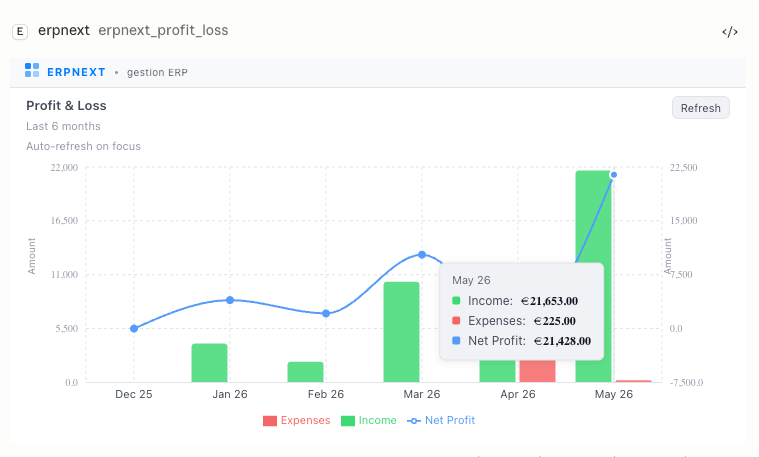 chart-viewer — composed dual-axis chart (here: profit & loss) |
What's New
See the CHANGELOG for the full release history, or the
latest release for
the current version's highlights.
3.1 beta preview: the beta keeps the 3.0 tool surface and adds a generic
document viewer, child tables, document attachments, in-view navigation, and
active context. 3.1.0-beta.11 adds reversible context selection, compact
Kanban details with distinct Timesheet counts, exact selected-document
navigation, five more host languages, and correct generic Company columns. It
also retains bounded metadata for unpriced Buy lines and adds offline demo
import plans. Features remain capability-gated by the MCP host; Buy evidence
does not purchase or qualify a live ERP.
Documentation
Organised by what you are doing, following Diátaxis:
| Learning — never used this before | Your first tool call — from nothing to a working response in four steps |
| Doing — you have a specific goal | Seed a blank ERPNext instance · Run the HTTP server · Set up OAuth · Migrate to 2026-07-28 |
| Looking something up | Tools · Environment variables · DocType coverage |
| Understanding why | Concepts — link resolution, transports, MRTR, and which cache does what · ERPNext quirks |
Quick Start
Prerequisites
Generate API credentials in ERPNext:
- Login to ERPNext → top-right menu → My Settings
- Section API Access → Generate Keys
- Copy
API KeyandAPI Secret
Claude Desktop / Claude Code (npm)
{
  "mcpServers": {
    "erpnext": {
      "command": "npx",
      "args": ["-y", "@casys/mcp-erpnext"],
      "env": {
        "ERPNEXT_URL": "http://localhost:8000",
        "ERPNEXT_API_KEY": "your-api-key",
        "ERPNEXT_API_SECRET": "your-api-secret"
      }
    }
  }
}
Works with ERPNext Cloud — set
ERPNEXT_URLto your Frappe Cloud URL
(e.g.https://mycompany.erpnext.comorhttps://mysite.frappe.cloud). API
key authentication works the same way on self-hosted and cloud instances.
VS Code Copilot
Add to .vscode/mcp.json:
{
  "servers": {
    "erpnext": {
      "type": "stdio",
      "command": "npx",
      "args": ["-y", "@casys/mcp-erpnext"],
      "env": {
        "ERPNEXT_URL": "http://localhost:8000",
        "ERPNEXT_API_KEY": "your-api-key",
        "ERPNEXT_API_SECRET": "your-api-secret"
      }
    }
  }
}
Deno (stdio)
{
  "mcpServers": {
    "erpnext": {
      "command": "deno",
      "args": ["run", "--allow-all", "server.ts"],
      "env": {
        "ERPNEXT_URL": "http://localhost:8000",
        "ERPNEXT_API_KEY": "your-api-key",
        "ERPNEXT_API_SECRET": "your-api-secret"
      }
    }
  }
}
HTTP mode
For a shared, always-on server rather than one process per client:
how to run the HTTP server. Note it is breaking for
pre-2026 HTTP clients in 3.0.0.
Category filtering
Load only the categories you need:
npx -y @casys/mcp-erpnext --categories=sales,inventory
Fresh Instance Setup
A blank ERPNext instance has no master data, so business tools fail validation
until it exists. See
Seed a blank ERPNext instance.
UI Viewers
Nine interactive MCP Apps
viewers, registered as ui://mcp-erpnext/{name}:
| Viewer | Description | Interactive Features |
|---|---|---|
doc-viewer |
Generic ERPNext document with fields and child tables | Capability-gated attachments, typed navigation, guarded Submit/Cancel, and raw JSON fallback. |
doclist-viewer |
Generic document table with sort, filter, pagination, CSV export | Inline details, typed nested navigation, Submit/Cancel, and compact status filters. |
invoice-viewer |
Sales Orders, Sales Invoices, and Quotations with line totals | Item, stock, party, and payment navigation plus guarded Submit/Cancel actions. |
stock-viewer |
Stock balance table with color-coded qty badges | Item details, recent movements, stock charts, and stock-entry navigation. |
chart-viewer |
Universal chart renderer (12 types via Recharts) | Exact point/series navigation and active-context selection across simple and composed charts. |
kanban-viewer |
Read-write kanban for Task, Opportunity, Issue | Drag-and-drop, inline editing, serialized saves, and typed related-document navigation. |
kpi-viewer |
Big number card with delta, sparkline, trend | Number and trend navigation with bounded active-context selection. |
funnel-viewer |
Trapezoid sales funnel with conversion rates | Period-aware stage navigation and bounded active-context selection. |
buy-evidence-viewer |
Immutable sealed Buy evidence (recorded session only) | Complete, partial, unresolved, and unavailable projections; no live ERP refresh or mutation. |
Navigation and active context
Viewers progressively select the best interaction supported by the host:
serverToolsopens typed list, record, and chart targets inside the current
viewer throughapp.callServerTool(). Back and breadcrumb navigation restore
the state of each level.downloadFilelets the host confirm and save an attachment returned as a
bounded embedded resource. The viewer never opens an ERPNext file URL
directly.updateModelContextlets chart, KPI, and funnel selections join a bounded
active-context snapshot. The compact context chip keeps up to eight items and
lets users remove one item or clear them all. The snapshot contains selected
values, never hidden instructions for the model.message.textkeepsapp.sendMessage()as a conversational fallback when
direct navigation or context replacement is unavailable.- Without these capabilities, local inspection remains available and unsupported
remote actions are omitted. - The Buy evidence viewer is recorded-session only. It does not call server
tools, refresh live documents, or mutate ERP state.
The server supplies typed navigation metadata and the exact _availableTools
allowed for each viewer, so category-filtered deployments do not expose tools
that are not loaded.
Refresh model
Read-only viewers revalidate on focus and through their refresh control.
Mutations use an explicit read-only request to fetch committed state; a mutating
tool is never replayed automatically. Overlapping or stale responses are ignored
when a newer host payload or mutation has already won. A confirmed document
change marks every potentially derived snapshot in the current navigation stack
as stale; each marker is removed only when that surface has actually been read
again. Separate MCP Apps are not synchronized automatically in the 3.1 beta.
Building UI viewers
cd src/ui
npm ci
node build-all.mjs
Buy evidence capture
One read-only tool and one recorded App. They do not purchase, create a
BOM/RFQ/PO, refresh live documents, replace generic ERP viewers, or qualify a
live ERPNext instance.
- Tool:
erpnext_buy_capture. Closed DocTypes only (Item, BOM, Item Price,
Supplier Quotation, Supplier, Price List, UOM, Currency Exchange). TwoskipCachereads must agree onmodifiedand the closed projection
fingerprint. Return is ephemeral canonical JSON + SHA-256 + byte count. The
caller cannot passsourceInstance, URL, credentials,capturedAt, or a
digest. Digital Thread stores those bytes in its own CAS; this server does not
keep a second CAS. - App:
io.casys.mcp-erpnext.buy-evidence3.1.0-beta.11, resourceui://mcp-erpnext/buy-evidence-viewer(text/html;profile=mcp-app), manifestui://mcp-erpnext/buy-evidence-manifest(application/json),acceptedActions=viewer.session.applyonly. Complete, partial,
unresolved, and unavailable projections stay labelled. No live DocViewer
refresh, mutation, orapp.callServerTool. Sessionanchoris the sealed
Digital Thread artefact (provenance.bundleRef), not a hash of the displayed
projection. - Schemas:
io.casys.mcp-erpnext.buy-source-capture/1.0,io.casys.mcp-erpnext.buy-recorded-result/1.0and/2.0,io.casys.mcp-erpnext.buy-recorded-session/1.0. - Result
/2.0carries boundedexcludedLinesmetadata for selected lines
absent from pricedlines: exact line ID, quantity, unit, and stated reason.
It carries no amount, currency, or price source; covered subtotals remain
sealed values and unresolved lines remain visible. - The viewer is built with the other MCP Apps
(cd src/ui && npm ci && node build-all.mjs). Published JSR/npm artifacts
includesrc/ui/dist/and the Buy TypeScript module; the HTML resource and
generated manifest are what a published installation serves.
Digital Thread owns configuration/seal (buy-configuration/1.0,buy-cost-bundle/1.0, buy.capture-configuration-cost@1,buy.seal-configuration-cost@1). A qualifiedcommerce.read-erpnext-buy-source@1 binding is required before dispatch.
Tools
Record _list tools return interactive results via the doclist-viewer with row
click, inline detail, and cross-viewer navigation. The attachment-specificerpnext_file_list tool does not render doclist-viewer. Generic and dedicated
document reads use doc-viewer, except Sales Order, Sales Invoice, and
Quotation, which retain the specialized invoice surface.
- Sales — Customers, Sales Orders, Invoices, and Quotations with full CRUD,
Submit, and Cancel. - Purchasing — Suppliers, Purchase Orders, Purchase Invoices, Receipts, and
Supplier Quotations. - Inventory — Items, Stock Balance, Warehouses, and Stock Entries.
- Accounting — Chart of Accounts, Journal Entries, and Payment Entries.
- HR — Employees, Attendance, Leave Applications, Salary Slips, Payroll
Entries, and Expense Claims. - Project — Projects, Tasks (with native assignment), and Timesheets.
- Delivery — Delivery Notes and Shipments.
- Manufacturing — BOMs, Work Orders, and Job Cards.
- CRM — Leads, Opportunities, Contacts, and Campaigns.
- Assets — Assets, Movements, Maintenance records, and Categories.
- Operations — Generic CRUD, native assignment, attachment listing, upload,
host-mediated download, and deny-by-default Frappe method calls
(erpnext_doc_*,erpnext_file_*,erpnext_method_call). - Kanban — Read-write boards for Task, Opportunity, and Issue with
drag-and-drop. - Analytics — Charts (bar, area, treemap, radar, scatter, P&L…), KPIs with
sparklines, and a sales funnel. - Buy — Read-only sealed capture of closed commercial documents
(erpnext_buy_capture) and an immutable recorded-session evidence viewer. Not
a purchase, BOM/RFQ/PO, or live ERP qualification. - Setup — Company creation and assignable user listing.
Full per-tool reference with parameters: docs/tools.md.
Environment Variables
| Variable | Required | Description |
|---|---|---|
ERPNEXT_URL |
Yes | ERPNext base URL — self-hosted (e.g. http://localhost:8000) or cloud (e.g. https://mycompany.erpnext.com) |
ERPNEXT_API_KEY |
Yes | API Key from User Settings |
ERPNEXT_API_SECRET |
Yes | API Secret from User Settings |
ERPNEXT_MAX_UPLOAD_BYTES |
No | Maximum decoded file-upload size in bytes (positive integer; default: 10 MiB) |
ERPNEXT_MAX_DOWNLOAD_BYTES |
No | Maximum attachment-download size in bytes (positive integer; default: 10 MiB) |
ERPNEXT_METHOD_ALLOWLIST |
No | Comma-separated exact method paths or prefix.*; unset means erpnext_method_call denies every method, while * allows all |
MCP_MRTR_SIGNING_KEY |
No | Exactly 64 lowercase hex characters; enables signed ambiguous-link elicitation. Single-instance deployments only — see below |
MRTR is opt-in. Without this key, or when the client does not advertise
elicitation, ambiguous links keep returning the existing actionable ambiguity
error instead of prompting for a selection.
Do not run MRTR behind a load balancer with this configuration. The
signing key proves a retry token is authentic; it does not make it single-use.
That is the job of a replay store, and the default one is process-local. Share
the key across two instances and the same signed retry validates on both —
creating the purchase order, leave application or expense claim twice,
irreversibly once submitted.A multi-instance deployment must pass a shared atomic
mrtr.replayStoretoMcpApp(Redis satisfies the contract withSET key 1 NX EXAT). The
framework logs a warning at startup whenever MRTR is enabled without one —
that warning is not noise, it is this paragraph.
Architecture
Tools are grouped by business domain under src/tools/, the Frappe REST client
is dependency-free, and each UI viewer is a separate build under src/ui/. Full
layout: repository layout.
npm Package
The npm package (@casys/mcp-erpnext) is a single self-contained bundle with
zero runtime dependencies. UI viewers are embedded. Requires Node >= 20.
Contributing
Contributions are welcome — see CONTRIBUTING.md to get
started, and AGENTS.md for the full architecture and conventions.
License
MIT
Viewers and Buy result fields use the host locale: English, French, Simplified
Chinese, Traditional Chinese, Hindi, Bengali, Tamil and Urdu. Chinese script
tags take precedence over region tags; zh-TW, zh-HK and zh-MO select
Traditional Chinese when no script is specified. Urdu uses right-to-left
document direction, and a later host locale change updates the language and
direction without reloading the viewer. App-level waiting and rejection screens
retain English labels in this beta; host-context support for those shared
surface screens remains an upstream MCP View follow-up.
Yorumlar (0)
Yorum birakmak icin giris yap.
Yorum birakSonuc bulunamadi