punctual
Health Gecti
- License — License: MIT
- Description — Repository has a description
- Active repo — Last push 0 days ago
- Community trust — 35 GitHub stars
Code Uyari
- fs module — File system access in package.json
- network request — Outbound network request in src/adapters/email/index.ts
Permissions Gecti
- Permissions — No dangerous permissions requested
Bu listing icin henuz AI raporu yok.
Scheduling that shows up on time — an open, edge-native Calendly alternative on Cloudflare Workers. MIT, no seat limits, ever.



Scheduling that shows up on time.
Punctual is an open, edge-native scheduler — a full single-team alternative to
Calendly that runs entirely on Cloudflare Workers. Booking pages render at the
edge; self-hosting is one wrangler deploy into your own Cloudflare account,
$0 on the free tier.
Status: v0.1.1
released and live. Pre-1.0, so interfaces may still change.
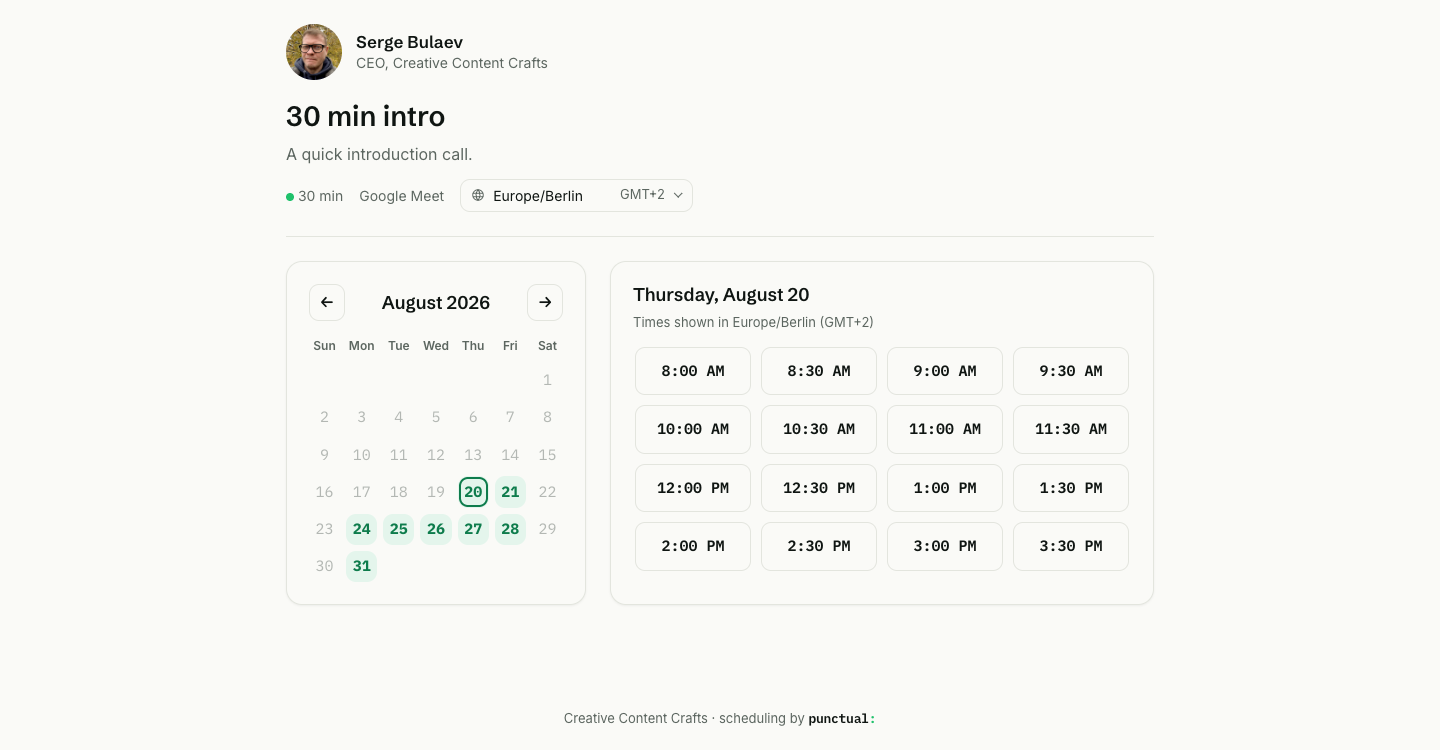
What it looks like
A booking page, rendered at the edge — no client-side spinner between the
guest picking a day and seeing open times.
The pledge
The open-source version is complete for a single team — forever. No seat
limits, no gated scheduling features, no "non-production use" clauses.
MIT makes this promise irrevocable: what we ship can never be taken back.
Quick start
git clone https://github.com/CCCrafts/punctual.git
cd punctual && npm install
npx wrangler login

npx wrangler d1 create punctual          # put the id in wrangler.toml
npx wrangler kv namespace create CACHE   # put the id in wrangler.toml
npx wrangler r2 bucket create punctual-avatars   # put the name in wrangler.toml

openssl rand -base64 32 | npx wrangler secret put ENCRYPTION_KEY_V1
openssl rand -base64 32 | npx wrangler secret put SIGNING_KEY

npm run migrate
npm run deploy   # prints your Worker URL — put it in wrangler.toml's BASE_URL
npm run deploy   # again, so emailed links point at the real URL
Full walkthrough, including connecting Google and Microsoft calendars:
docs/self-hosting.md.
What's here
- Booking pages rendered and streamed from the edge
- Google Calendar and Microsoft 365 sync, using your own OAuth app
- Event types with buffers, notice windows, horizons, daily caps, custom
questions - Teams — round-robin and collective scheduling
- Emails with .ics invites, reschedule and cancel links, 24 h and 1 h
reminders - REST API, HMAC-signed webhooks, embed widget
- A built-in MCP server — your calendar as a tool an AI agent can call
How it works
Three decisions shape everything else.
Double-booking is impossible at the storage layer, not by convention.
Every booking writes one row per five-minute bucket per host into aslot_locks table whose primary key is (host_user_id, bucket_start), in the
same D1 batch() as the booking itself. A conflicting bucket violates the
constraint and the whole batch rolls back. Range overlap can't be expressed as
a SQL constraint; discretised buckets can — that substitution is the design.
Durable Objects serialise attempts and re-check external calendars, but they
are the fast path, not the guarantee: if they misbehave the worst outcome is a
409.
All time is UTC internally; wall-clock exists only at the edges. Daylight
saving is handled by explicit rules rather than by hope — a wall-clock time
inside a spring-forward gap clamps forward, an ambiguous time during
fall-back takes the first occurrence, and both rules apply uniformly to window
starts and ends. The test matrix covers Kyiv, New York, Lord Howe (a
30-minute DST shift), Chatham (+12:45), Kolkata and the southern hemisphere,
because whole-hour assumptions fail silently rather than loudly.
The engine takes everything through ports. Storage, calendars, email,
crypto, cache, clock and queue all arrive as interfaces, so the same engine
runs single-tenant for you and multi-tenant for a hosted service without a
fork. There is deliberately no "limits" or "plan" interface anywhere in this
repository — see the pledge.
Development
npm test              # 525 tests
npm run test:core     # pure domain only — no Workers runtime, runs in ~150ms
npm run typecheck
npm run dev
The domain layer has zero Cloudflare imports and runs under plain Node, which
is what lets the timezone and slot-engine suites stay exhaustive and fast.
Adapters, Durable Objects and HTTP are tested against the real Workers runtime
with Miniflare.
License
MIT. A hosted version with managed OAuth apps, custom domains and
zero setup is a separate commercial service running on this same engine.
Yorumlar (0)
Yorum birakmak icin giris yap.
Yorum birakSonuc bulunamadi