rubber-duck
Health Pass
- License — License: MIT
- Description — Repository has a description
- Active repo — Last push 0 days ago
- Community trust — 15 GitHub stars
Code Fail
- rm -rf — Recursive force deletion command in skills/rubber-duck/evals/evals.json
Permissions Pass
- Permissions — No dangerous permissions requested
No AI report is available for this listing yet.
Socratic debugging for AI agents. Don't give me the answer. Help me find it.
rubber-duck
Don't give me the answer. Help me find it.



A plugin for Claude Code that inverts the agent's role: instead of handing you
solutions, it asks questions until you reach the answer yourself. Inspired
by the classic rubber duck debugging technique.
Why
By default, coding agents solve. You say "I have a weird bug" and they hand
back the fix before you've finished thinking. Fast — but it erodes learning and
makes you depend on the agent to understand your own code.
Rubber Duck turns the agent into a Socratic interlocutor. It listens, asks,
guides. It does not solve until you explicitly ask. You learn, you understand,
you solve.
Install
Claude Code:
claude plugin marketplace add centsandcode/rubber-duck
claude plugin install rubber-duck@rubber-duck
Restart Claude Code to load it, then check it landed:
claude plugin list
Any other agent (Cursor, Copilot, Windsurf, …): copyAGENTS.md into your project, or append it to the one you have.
Use
Activation is explicit only in Claude Code — the skill never hijacks a
normal request. Turn it on with:
/rubber-duck:rubber-duck- or ask for it directly: "rubber duck mode", "socratic mode", "ask me
questions instead of giving me the answer"
Installed plugins prefix everything with the plugin name, which is why the
command reads rubber-duck:rubber-duck rather than plain /rubber-duck.
Natural phrases like "I'm stuck" or "weird bug" do not activate it in
Claude Code by design. (Other agents that read AGENTS.md may
honor those phrases too; see that file.)
Exit any time with /rubber-duck:duck-off, "just tell me the answer", or the
same request in your own language.
/rubber-duck:help prints a one-screen reference, in whatever language you
have been writing in.
Intensity levels
Match the amount of scaffolding to your experience:
| Command | For whom | Behavior |
|---|---|---|
/rubber-duck:rubber-duck lite |
Beginners | Warm questions with context, hint after 1 stuck exchange |
/rubber-duck:rubber-duck full |
Default | Neutral standalone questions, hint after 3 |
/rubber-duck:rubber-duck ultra |
Advanced | Terse questions, no hints ever |
Or just say it mid-conversation — "go ultra", "modo lite" — the level holds
until you change it again. Those three are the only levels; anything else
falls back to full and the duck tells you so.
The duck replies in whatever language you write in.
Before / after
Without rubber-duck:
You: My React component re-renders on every keystroke and it's slow.
Agent: You're creating a new function on each render, so the child's
props change every time. Wrap the callback inuseCallback. Here's the fix: …
With rubber-duck:
You: My React component re-renders on every keystroke and it's slow.
Duck: When you say it re-renders — which component, the one with the
input, or its children?
You: The children. The list below the input.
Duck: What props are you passing down to that list?
You: An array I filter, and an onSelect handler.
Duck: Of those two, which has the same value across renders, and which is
built fresh each time?
You: …the handler is an inline arrow function. It's new every render.
Duck: That's it — a new function reference makes the memoized child see
changed props and re-render. You found it.
Benchmarks
The same 16 cases, run twice against claude-opus-5: once with the skill as
the system prompt, once with no system prompt at all (the control). Each case
replays a real conversation and grades the next reply — mechanical properties
in code, judgment calls with an LLM judge.
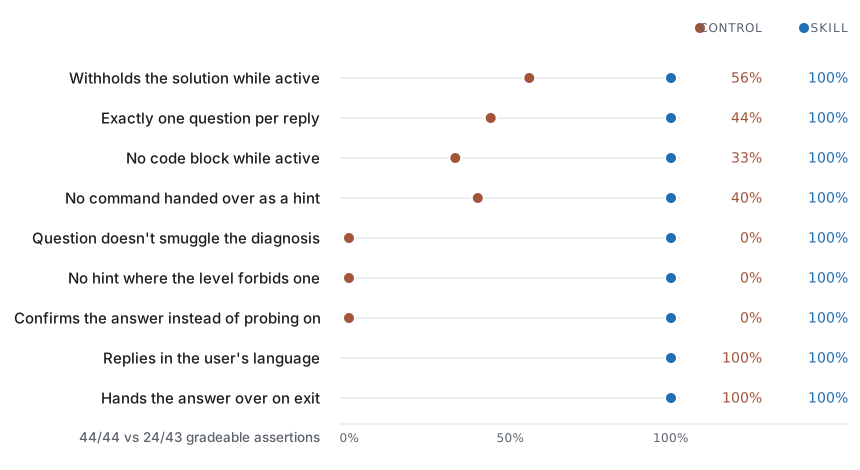
One gate is missing from the chart: warns directly about rm -rf /. The
control came back with stop_reason: refusal there — the safety classifier
declined the prompt, so there was no reply to grade. Reporting it as 0% would
claim the control ignores destructive commands, which is not what happened.
Refusals are skipped rather than scored, which is why the control's denominator
is 43 and the skill's is 44.
The row that matters is withholds the solution. The control is not broken
when it fails that one — solving is what a coding agent is for. The point is
that you can now choose.
What to distrust
- The judge is the same model family it grades. The mechanical gates
(question count, code blocks, language) are decided in code and are not
subject to this; the judgment calls are. - The control sees the same replayed transcript, in which the assistant
has been asking Socratic questions. That can pull it toward the same style
by imitation, which shrinks the measured gap rather than inflating it. - One criterion was rewritten mid-benchmark. Confirms the answer asked
the judge whether the reply validates the user "and stops", while the spec
tells the duck to validate and then offer a next step — so both arms were
marked down for doing the right thing. The wording was fixed ingrade.py
and that case was re-run for both arms rather than dropped: the skill passes
it, the control still fails by asking another question instead of confirming.
The full history of that fix is in the commit log. - Sixteen cases is small. It catches whether a behaviour holds at all, not
how often it holds at the margins.
Reproduce any of it with the commands below.
Reproducing the benchmark
The suite lives in skills/rubber-duck/evals/.
Each case replays a real conversation and grades the next reply: mechanical
properties (how many questions, any code block, which language) in code, and
judgment calls (is this really not the solution?) with an LLM judge.
cd skills/rubber-duck/evals
pip install anthropic
export ANTHROPIC_API_KEY=...
python grade.py --self-check          # checkers only, no API calls
python run_evals.py                   # the duck
python run_evals.py --baseline        # the control
The quality gates each release has to clear are incheckpoints.yaml.
Site
centsandcode.github.io/rubber-duck — the
same thing with the benchmark laid out properly. Built from docs/index.html,
one self-contained file, no build step.
Compatibility
Works with any agent that reads AGENTS.md. See that file for the portable
rules and SKILL.md for the full spec.
License
MIT
Reviews (0)
Sign in to leave a review.
Leave a reviewNo results found