munder-difflin
Health Gecti
- License — License: NOASSERTION
- Description — Repository has a description
- Active repo — Last push 0 days ago
- Community trust — 11 GitHub stars
Code Basarisiz
- exec() — Shell command execution in blog/eleventy.config.js
- rimraf — Recursive directory removal in blog/package-lock.json
- rimraf — Recursive directory removal in blog/package.json
Permissions Gecti
- Permissions — No dangerous permissions requested
Bu listing icin henuz AI raporu yok.
local multi-agent harness
Munder Difflin
Local multi-agent harness for Claude Code.
Autonomous agents that message, route, and remember — coordinated by a GOD orchestrator
you talk to, and visualized as avatars at work on a shared office floor.
Electron · React · TypeScript · Pixi.js · xterm.js · node-pty




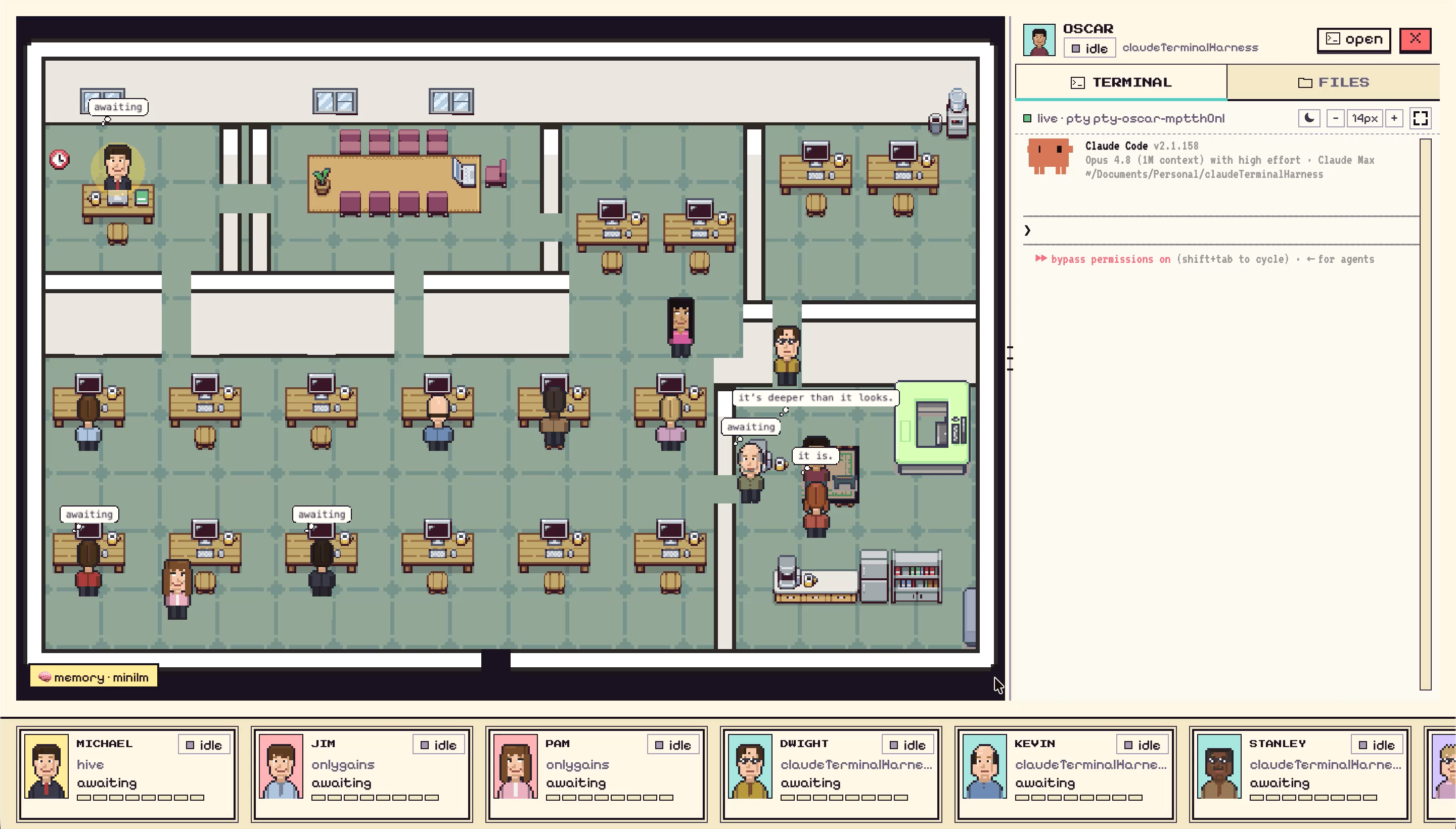
▶ Watch the floor — Munder Difflin running a hive of Claude Code agents
[!NOTE]
The world's best agents. The world's worst paper company.
Munder Difflin takes theclaudeCLI sessions you already run in your terminal and turns them
into a self-coordinating team: each agent gets long-term memory, a mailbox, and a desk on a 2D
office floor — and a GOD orchestrator agent routes work between them while you watch.
What it is
Munder Difflin is a desktop app that wraps real Claude Code terminals as fully-capable agents,
wires them into a hive mind, and puts a GOD orchestration agent in charge — the one agent
you talk to in order to get things done. Under the hood it runs the fastest memory layer in the
world so every agent remembers what it learns and recalls it instantly.
- Every terminal is an agent. Each
claudesession runs as a real process in a pseudo-terminal
(node-pty), byte-for-byte authentic, rendered with xterm.js. - Every agent is an avatar. Sessions appear as characters on a Pixi.js office floor — they walk
to stations as they work, and envelopes fly desk-to-desk when they message each other. - The hive coordinates them. Agents read their memory and drain a mailbox; the router moves
messages between inboxes; the GOD agent adjudicates, assigns, and escalates only when it needs you. - Memory that's instant. A markdown-first memory layer with a semantic recall index means agents
remember across sessions and recall in milliseconds.
How it works
            you ── talk to ──►  ┌─────────────┐
                                │  GOD agent  │  orchestrator / supervisor
                                │ (Michael's  │  roster · routing · adjudication
                                │   office)   │  blackboard · task ledger
                                └──────┬──────┘
                                       │ assigns · routes · escalates
              ┌────────────────────────┼────────────────────────┐
              ▼                         ▼                         ▼
        ┌───────────┐            ┌───────────┐            ┌───────────┐
        │  agent A  │  message   │  agent B  │  message   │  agent C  │
        │  claude   │ ─────────► │  claude   │ ─────────► │  claude   │
        │  + memory │            │  + memory │            │  + memory │
        └───────────┘            └───────────┘            └───────────┘
              └──────── shared hive: memory · mailbox · blackboard · log ───────┘
- You spawn agents — each is a normal
claudeprocess with its own working directory,
identity, and hook lifecycle. - Agents collaborate through the hive — a local git repo of plain files. They write to their own
outbox/; the harness's router delivers into recipients'inbox/. No agent ever touches git
(single-committer design avoidsindex.lockcorruption). - The GOD agent runs the floor — it reads every request, resolves routine ones itself (keeping
the system fully autonomous), and only escalates critical items (spend, destructive ops, scope
changes) into an approvals queue you act on. - Everything is visible — you watch avatars move, envelopes fly, and the live terminal stream;
you can type back into any session, browse its files, and read its git history.
See HIVE.md for the full multi-agent design, SPEC.md for the
terminal/event plane, and DESIGN.md for the visual system.
Features
| Area | What works today |
|---|---|
| Real terminals | Spawn any command (default: claude) in a node-pty PTY. Full read/write/resize/kill, live streaming over IPC, multi-agent. |
| The hive | On-disk multi-agent layer: per-agent identity + long-term memory, atomic-file mailboxes, a shared blackboard, append-only event log, single-committer git. |
| GOD orchestrator | An always-on supervisor agent that adjudicates traffic, routes tasks, scribes the blackboard, and escalates only critical items to you. |
| Memory layer | Markdown-first long-term memory per agent, mined into a shared semantic palace for instant recall; searchable from the UI. Degrades gracefully when the index isn't installed. |
| Office floor | Pixi.js scene with a Tiled office map, camera, recolored cast, pathfinding, seat assignment, and tool-bubble overlays. |
| Message handoffs | When the hive routes a message, an envelope flies from sender to recipient (tinted by speech-act; escalations fly to the door) and pops an arrival sparkle. |
| Per-agent panel | Live terminal, command bar to type back, fullscreen terminal, sandboxed file browser + CodeMirror editor, and a git tab (status, log, commit graph, branches). |
| Approvals & memory panels | Human-in-the-loop approval queue for escalations; a memory search panel over the shared palace. |
| Onboarding wizard | First-run setup: harness home, registered repos, default command, auto-mode. |
| Design system | Fully tokenized SNES / Animal-Crossing aesthetic — pixel panels, buttons, badges, hand-drawn icons. See DESIGN.md. |
[!IMPORTANT]
Status: working prototype. The Electron shell, office floor, real PTY terminals, the hive
(memory/mailbox/router/GOD agent), and the file/git tooling are functional. Wiring avatar movement
fully to real Claude Code tool events is the headline next milestone (today it falls back to a
synthetic event loop where hooks aren't attached).
Getting started
Prerequisites
- macOS (macOS-first; Windows/Linux untested).
- Node.js 18+ and npm.
- A C/C++ toolchain for
node-pty's native addon — on macOS, install Xcode Command Line Tools:xcode-select --install - Claude Code on your
PATHso agents can runclaude
(the default command). Any other command works too. - Optional: the semantic memory index for instant cross-session recall (the app works without it —
markdown memory still functions).
Install & run
git clone https://github.com/chaitanyagiri/munder-difflin.git
cd munder-difflin
npm install        # postinstall rebuilds node-pty against Electron's ABI
npm run dev        # launches the Electron app with hot reload
On first launch you'll go through the onboarding wizard, then land on the floor. Use Add agent to
spawn your first session — the GOD agent seats itself in Michael's office automatically.
Other scripts
npm run build      # production build via electron-vite
npm run preview    # preview the production build
npm run typecheck  # type-check the node (main/preload) and web (renderer) projects
If
node-ptyfails to load after an Electron upgrade, re-runnpm install(thepostinstallhook
runselectron-rebuildagainst the current Electron ABI).
Architecture
Two data planes feed one renderer:
┌───────────────────────────────────────────────────────────────┐
│                     Electron Renderer (React)                  │
│   ┌──────────────────┐    ┌──────────────────────────────┐    │
│   │ Office Floor      │    │ Terminal + Command Bar       │    │
│   │ (Pixi.js)        │    │ Files + Git tabs (xterm.js)  │    │
│   └─────────▲────────┘    └────────────▲─────────────────┘    │
│             │ avatar state             │ pty bytes / fs / git  │
└─────────────┼──────────────────────────┼───────────────────────┘
              │ IPC (contextBridge: window.cth)
       ┌──────┴──────────┐        ┌──────┴─────────────┐
       │  Event Plane    │        │  Terminal Plane    │
       │  hooks / hive   │        │  node-pty PTYs     │
       │  router + GOD   │        │  + fs + git        │
       └────────▲────────┘        └──────▲─────────────┘
                │ hook payloads          │ stdin / stdout
                └─────────┬──────────────┘
                   ┌──────┴──────────────┐
                   │  claude (or any cmd)│
                   └─────────────────────┘
- Terminal plane. The main process owns a
PtyManagerthat spawns each agent as anode-pty
process and streams output over per-id IPC (pty:data:<id>). The renderer talks only through a
typedwindow.cthbridge (src/preload/index.ts), which also exposes
sandboxed filesystem and git helpers. - Hive / event plane.
hive.tsis the on-disk multi-agent layer;hooks.tsruns a Unix-socket
server that the per-agentcth-hookshim POSTs Claude Code hook payloads to (PreToolUse,PostToolUse,Stop, …);memory.tswraps the semantic memory CLI. The router delivers messages,
the GOD agent adjudicates, and aStop-loop keeps idle agents draining their inboxes.
Project structure
src/
  main/                      Electron main process (Node)
    index.ts                 window, IPC handlers, quit guard
    pty.ts                   node-pty manager (spawn/write/resize/kill/stream)
    hive.ts                  on-disk multi-agent layer (memory, mailboxes, router)
    hooks.ts                 UDS hook server + cth-hook shim + Stop-loop
    memory.ts                semantic memory layer (CLI wrapper, degrade-to-noop)
    config.ts                harness config persistence + home setup
    fs.ts / git.ts           sandboxed filesystem + git bridges
  preload/                   contextBridge → typed window.cth API
  renderer/src/
    App.tsx                  top-level layout + wiring
    design/                  tokens.css / tokens.ts / global.css (design source of truth)
    components/              PixelPanel, AgentDetailPanel, CommandBar, ApprovalsPanel, MemoryPanel, …
    scene/office/            Pixi office floor: OfficeFloor, Character, Camera, cast, pathfinding, …
    store/ · hooks/          zustand store, event loop, PTY parser, typewriter
    assets/                  tilesets, maps, character sheets (see ATTRIBUTION.md)
docs/                        `logo.png`, `banner.png`, landing page (GitHub Pages → munderdiffl.in)
docs/media/                  `og.png` (social previews) + rendered Remotion clips
landing-remotion/            Remotion project that renders the landing page's "how it works" clips
HIVE.md · SPEC.md · DESIGN.md   multi-agent · terminal/event · visual design
Design system
The aesthetic is Animal Crossing × Earthbound × SNES menu UI — pixel-snapped, chunky, friendly.DESIGN.md is canonical; every component derives from its tokens. The Munder Difflin
brand layers a Dunder-Mifflin maroon (#6E1423) and gold (#F4D35E) on top for logo and
chrome. The 15 avatars are the cast of The Office, differentiated by hair/skin/shirt recipes.
Roadmap
- Full real event plane — every avatar move driven by Claude Code hook events.
- Add-agent flow — command picker + per-project hook-install consent.
- Config drawer — per-agent goal, model, permission mode, skills, MCP.
- Memory reflection — summarize/bound per-agent
memory.mdover time. - Persistence — durable agents/layout/command history (SQLite).
- Packaging — signed
.dmg; revisit Linux/Windows later.
Contributing
Contributions are welcome — this is an early prototype with a lot of surface area. Start withCONTRIBUTING.md. The short version: fork, npm install && npm run dev, keepnpm run typecheck green, and derive any new UI from DESIGN.md tokens. Good
first areas: wiring real hook events, the add-agent flow, the config drawer, and cross-platform work.
License
[!IMPORTANT]
Asset licensing. The bundled pixel art (tilesets, maps, and the base character sheets the
Office cast is recolored from) comes from LimeZu viashahar061/the-officeunder the LimeZu FREE VERSION
license — non-commercial use only. The recolored sprites inherit that restriction. Seesrc/renderer/src/assets/ATTRIBUTION.md. To
commercialize, replace these assets or obtain a paid LimeZu license.
The source code is licensed under the MIT License — see LICENSE. The MIT grant
covers the code only; the non-commercial asset restriction above is carved out in the LICENSE scope
note. Munder Difflin is an affectionate parody and is not affiliated with NBC's The Office or
Dunder Mifflin.
Acknowledgements
- LimeZu — pixel-art tilesets and character base sheets.
shahar061/the-office— office tileset/map vendoring.- Pixi.js · xterm.js · node-pty · electron-vite · CodeMirror — the libraries this is built on.
- Remotion — the landing page's animated "how it works" clips (
landing-remotion/). - The Office (US) — for Munder Difflin, Inc.
Yorumlar (0)
Yorum birakmak icin giris yap.
Yorum birakSonuc bulunamadi