Piumy
Health Gecti
- License — License: AGPL-3.0
- Description — Repository has a description
- Active repo — Last push 0 days ago
- Community trust — 15 GitHub stars
Code Gecti
- Code scan — Scanned 12 files during light audit, no dangerous patterns found
Permissions Gecti
- Permissions — No dangerous permissions requested
Bu listing icin henuz AI raporu yok.
A tiny ARM board (or your PC) that routes your WhatsApp and connects your AI over MCP, and grows into a secure personal gateway. Open-source, with an e-paper face.
Piumy 🦉
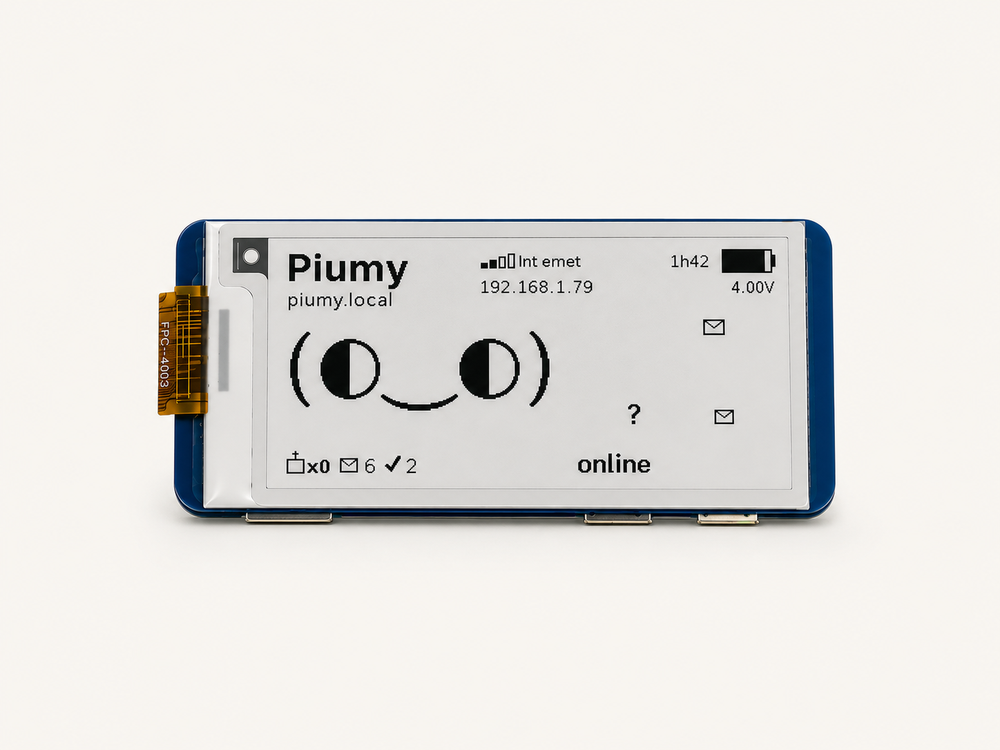
A distributed, portable WhatsApp assistant for ARM64 boards. A tiny board
routes and stores (the switchboard); the brain (AI) connects over MCP
from a machine with RAM. Everything hardware-specific lives behind configurable
adapters, so the same code runs on any ARM64 board.
(⌐■_■) pwnagotchi has pwned hehehe
Piumy's e-paper face is a homage to pwnagotchi
by @evilsocket. The expressions are inspired by its
e-ink faces — original code, borrowed affection. 🫡
Idea
WhatsApp (dedicated number)
      │
      ▼
  SWITCHBOARD (Go, tiny board) ── e-paper (Python adapter) → face
   · receives / stores (SQLite)     └ reads status.json
   · per-chat mode: auto | dedicated
   · anti-ban governor · whitelist
   · exposes MCP ──────────────┐
        │ auto                 │ dedicated (queue, pull)
        ▼                      ▼
   cheap API             AGENT over MCP (another machine with RAM)
   (optional)             Claude / Opus / OpenCode + tools
The switchboard does not reply — it routes and stores. Replies come from
whoever connects over MCP. The seams are data contracts: status.json
(core ↔ display) and MCP/HTTP (core ↔ agent).
The face — real pwnagotchi kaomoji
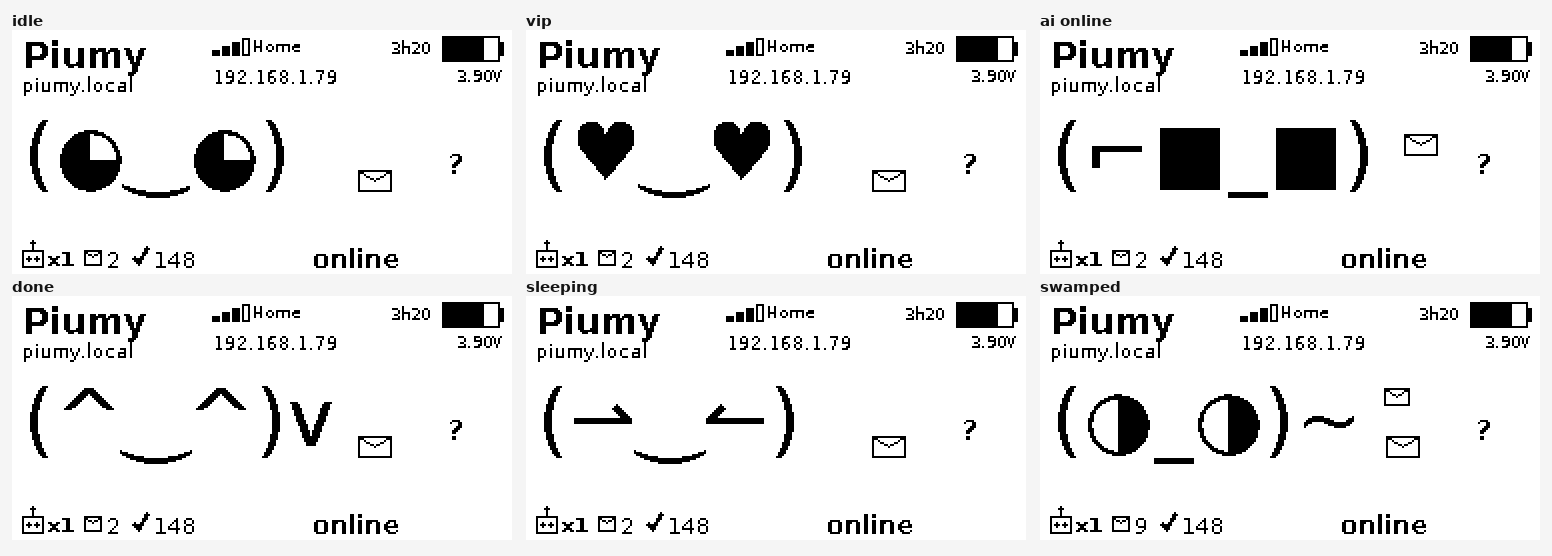
Real pwnagotchi kaomoji faces (not vectors), rendered 1-bit on the e-paper.
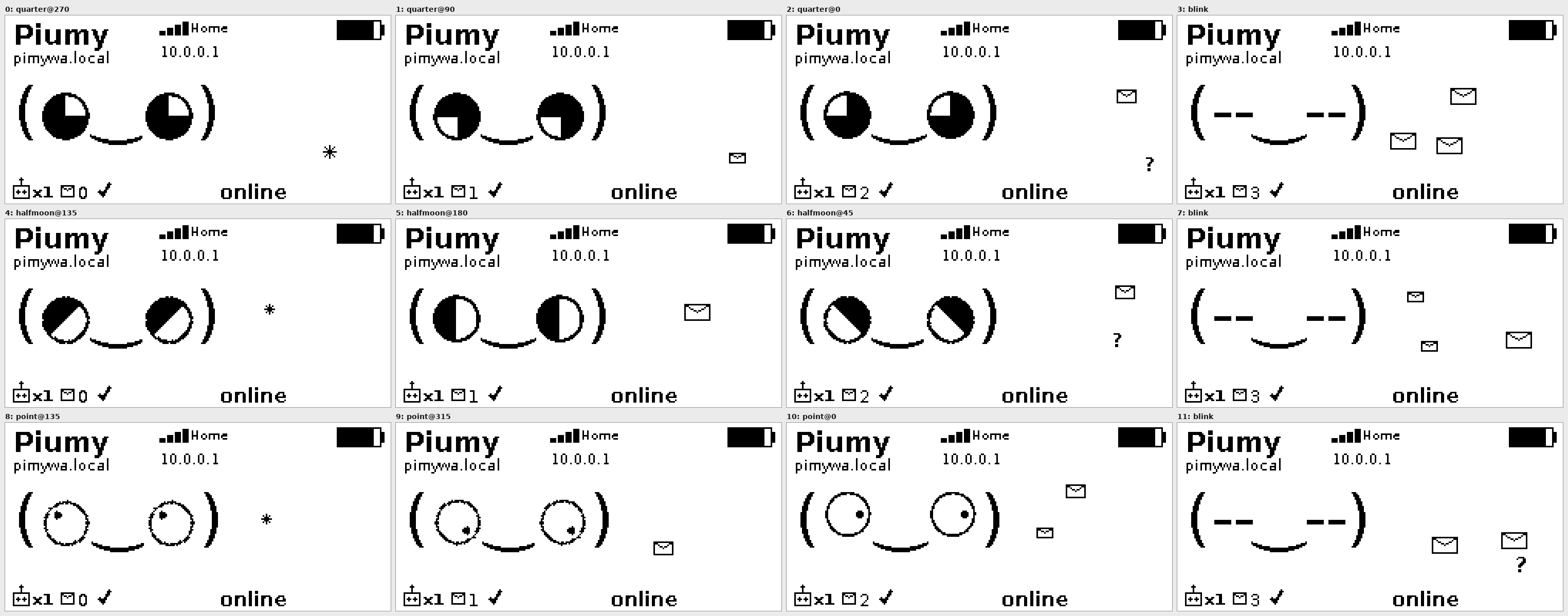
Big eyes that actually look around — three eye styles rotating in a gaze
loop — blink, and react to what's happening (a new message, the agent
connecting, the battery draining). It moves when there's something to react to
and settles into a calm, low-power idle when quiet.
Battery intelligence
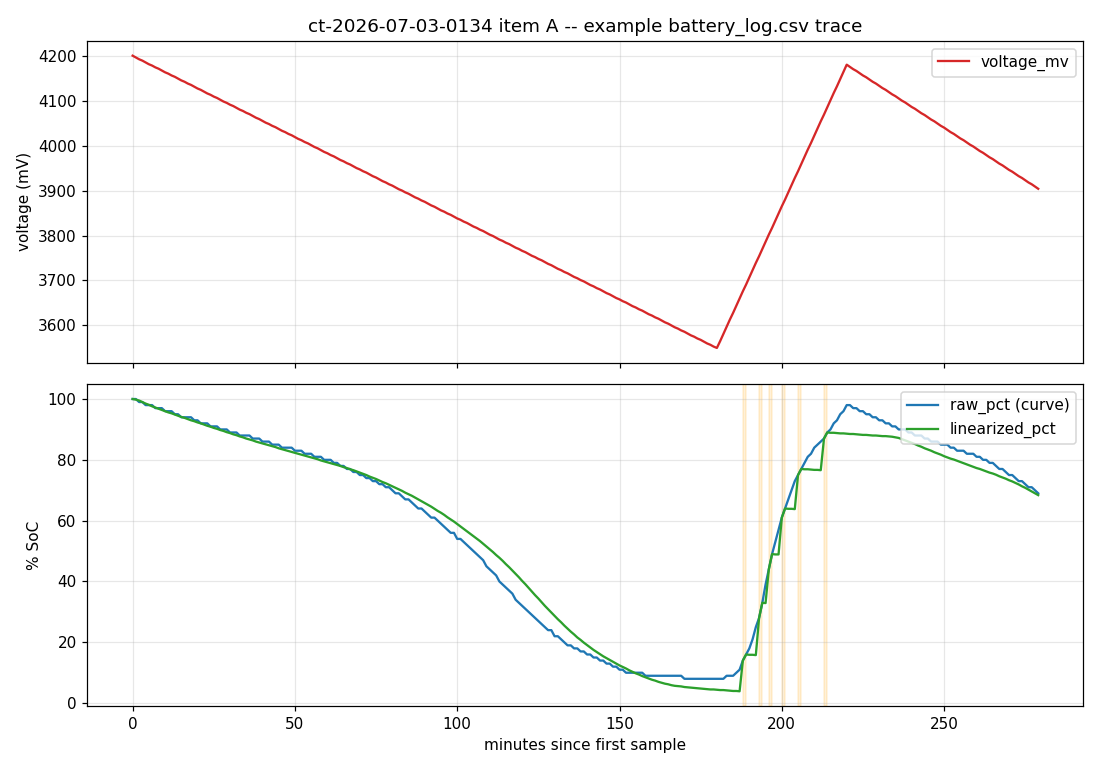
A self-calibrating fuel gauge (CW2015 over I2C): reads the raw cell voltage,
learns this pack's real full→empty span from actual discharges, and reports an
even, linear level (voltage alone is famously jumpy) with an adaptive
time-remaining. A per-minute discharge log makes voltage traceable over time.
Dashboard
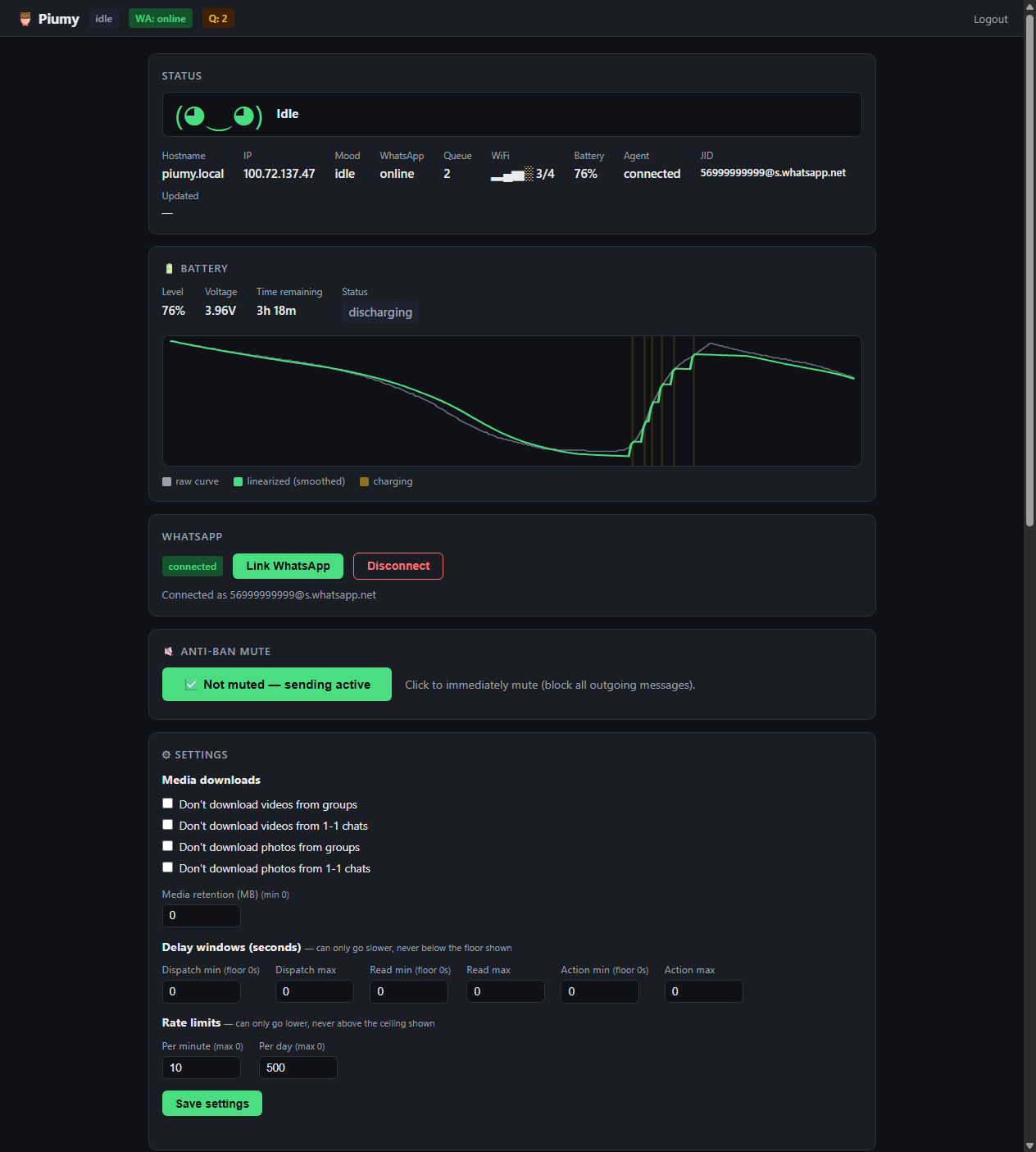
A lightweight web dashboard, served by the same Go binary (LAN-only, login): the
live face, a battery chart (raw vs. linearized + charging bands), WhatsApp
link/QR, anti-ban mute, per-chat rules, rate limits, and router/whitelist.
Stack
- Core (switchboard): Go —
whatsmeow(MPL-2.0) +mcp-go(MIT) + SQLite. Single, lightweight binary. - Display adapter: Python + Pillow. Backends:
file(PNG, dev) ·epaper-waveshare·none. - Power adapter: Python — CW2015 over I2C. Backends:
cw2015-i2c·none. - Brain: any agent that speaks MCP (it does not live on the board).
Try it now (no hardware, no WhatsApp) — Contract #001
The core writes status.json; the file adapter draws it as a face.
# 1) the core (Go) writes a state
cd core && go run . responding

# 2) render the face
cd ../adapters/display/file
pip install -r requirements.txt
python render.py            # -> generates display.png
Valid states: idle thinking responding sleeping working alert error qr.
Connecting the brain (MCP)
The MCP endpoint (:8081) is fail-closed: it rejects every request
until a token is configured — an open MCP endpoint has no trust boundary at
all (any tool, including the owner-scoped ones, would be reachable by
anyone on the LAN).
On a real install, install.sh runs this automatically and prints the
token once. To do it manually (or to rotate an existing token):
sudo /opt/pimywa/pimywa auth setup     # generates + saves one if none exists yet (idempotent)
sudo /opt/pimywa/pimywa auth rotate    # always generates a NEW one, invalidating the old
Both print the exact client config to paste into your MCP client
(Claude Code / OpenCode's .mcp.json):
{"mcpServers": {"piumy": {"url": "http://<host>:8081/mcp",
  "headers": {"Authorization": "Bearer <token>"}}}}
The token is shown once — save it (a password manager, or hand it to
whoever runs the agent). It's stored in /opt/pimywa/pimywa.env asPIMYWA_MCP_KEY, never committed to git. Restart pimywa-core afterrotate for the new token to take effect.
Portability
Hardware is touched only through generic Linux interfaces (spidev / libgpiod /i2c-dev), never through vendor-locked libraries. To port to another ARM64 board,
see HARDWARE.md.
Status
MVP feature-complete and running on a Raspberry Pi Zero 2 W: core switchboard
(WhatsApp gateway, router, anti-ban governor, MCP server), the e-paper kaomoji
face + eye engine, self-calibrating battery intelligence, the web dashboard,
MCP token auth, and the client skill. See the full
feature map — done / in progress / planned — in ROUTEMAP.md.
Support
Piumy is free and open-source — and donations are the cornerstone that keep it going. WhatsApp is only the kickoff; the plan is a secure personal gateway for everyone. If it is useful to you, chip in what you want (even $0):
Built with
Piumy stands on excellent open-source work — the Go core is mostly glue around these:
- whatsmeow by Tulir Asikainen — the WhatsApp Web multidevice library (MPL-2.0) that actually talks to WhatsApp.
- mcp-go by mark3labs — the Model Context Protocol server (MIT) the brain connects through.
- modernc.org/sqlite by Jan Mercl (cznic) — a pure-Go SQLite (BSD-3) so the core cross-compiles to ARM with no CGO.
- go-qrcode by skip2 — the QR that links your phone (MIT).
- golang.org/x/crypto & google.golang.org/protobuf by the Go Authors and Google (BSD-3).
…and their transitive dependencies. Thank you. 🙏
License
AGPL-3.0 (network copyleft). You are free to use, modify, and
distribute; your version — even if you run it as a service — must also be AGPL-3.0.
Commercial license / dual-license: want to use Piumy in a closed-source
product, without the AGPL obligations? The author can grant a commercial license —
open an issue to coordinate.
Made by Camilo Brossard · clever.cat 🐱 · community: r/Piumy
Yorumlar (0)
Yorum birakmak icin giris yap.
Yorum birakSonuc bulunamadi