chancery
Health Gecti
- License — License: Apache-2.0
- Description — Repository has a description
- Active repo — Last push 0 days ago
- Community trust — 11 GitHub stars
Code Basarisiz
- rm -rf — Recursive force deletion command in scripts/demo.sh
Permissions Gecti
- Permissions — No dangerous permissions requested
Bu listing icin henuz AI raporu yok.
The identity provider for AI agents — registry, scoped delegation, in-path MCP enforcement, instant revocation, tamper-evident audit.
Chancery
The identity provider for AI agents — the neutral, self-hosted system
of record for what every agent is, who it acts for, what it can do, and
what it has done.
Agents get their identities from Chancery, their credentials through it
(never holding real secrets), and every action attributed by it — by
construction, not log forensics. In-path enforcement: register, scope,
delegate, revoke — instantly, at the identity or instance level. Audit is
metadata-only as a structural invariant: prompts and payloads are never
stored.
Single Go binary. Apache-2.0. MCP-first, then HTTP, shell, browser.
Try the 60-second story: make demo.
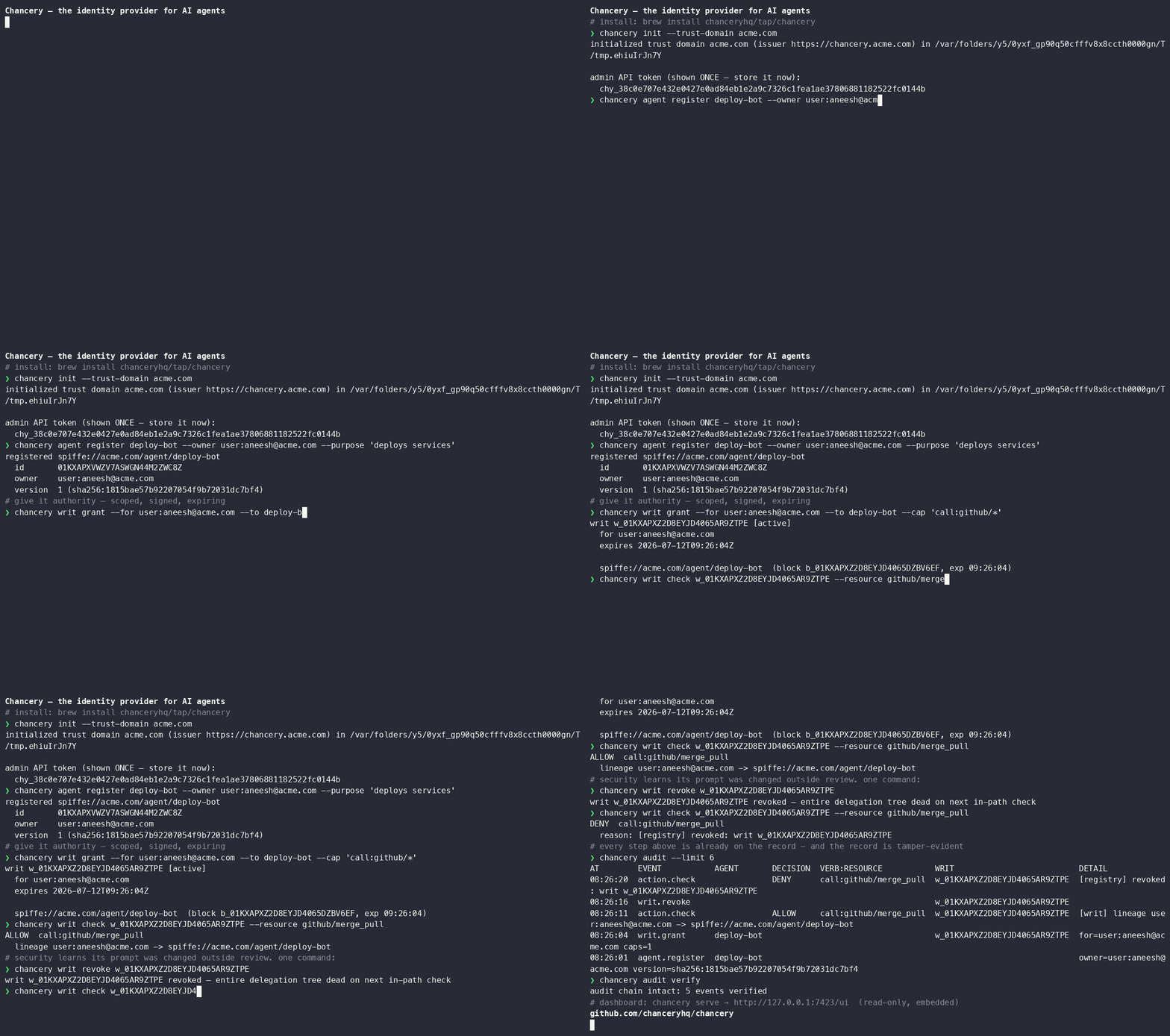
MCP-first, not MCP-only. The registry, writs/delegation, policy,
sealed credentials, and audit govern any agent in any language today
(LangGraph, CrewAI, a cron job, a shell script) via the decision API —
see Governing any agent. What's MCP-
specific today is the unbypassable, in-path enforcement (mcp wrap);
for other runtimes you use advisory checks now and switch to in-path
enforcement as those PEPs land (HTTP → shell → browser), with the same
writs.
Two promises (RFC-011): what
ships open source stays Apache-2.0 — no license flip, ever; and
security is never paywalled — every gap in SECURITY.md
closes in the open core. The boundary test: whatever makes a single
trust domain secure and operable is open source; value that exists
only at organizational scale (SSO/SCIM, multi-tenancy, SIEM exporters,
compliance packs, HA orchestration) is enterprise.
Install
brew install chanceryhq/tap/chancery          # macOS / Linux
# or: docker run --rm -v chancery:/data ghcr.io/chanceryhq/chancery --help
# or: download a signed binary from the Releases page
# or from source:
go build -o chancery ./cmd/chancery
Release binaries and checksums are cosign-signed (keyless, via GitHub
OIDC) and ship with an SBOM; verification instructions are in each
release's notes.
Try it (pre-alpha)
./chancery init --trust-domain acme.com
./chancery agent register deploy-bot --owner user:[email protected] \
    --purpose "deploys services" --prompt ./prompt.md --model claude-fable-5
./chancery writ grant --for user:[email protected] --to deploy-bot --cap "call:github/*"
./chancery writ delegate <writ-id> --to test-runner --caveat "call:github/get_*"
./chancery writ check <writ-id> --resource github/get_pull_request   # ALLOW + lineage
./chancery writ revoke <writ-id>
./chancery writ check <writ-id> --resource github/get_pull_request   # DENY: revoked
./chancery audit                                                     # the timeline
Every action is attributed to a specific agent, version, and delegation
chain — and a delegated writ can only ever narrow: the block format has
no field for widening.
Orchestrators that create agents at runtime don't need the admin
token: spawning is itself writ-governed
(RFC-012). A human locks a
template (capability ceiling + max lifetime) once; the orchestrator's
writ carries admin:spawn/<template>; every spawned worker is
registered, delegated a narrowed block, owner-attributed, and expires
on its own:
./chancery template create researcher --purpose "reads github" \
    --max-cap "call:github/get_*" --max-ttl 30m
./chancery writ grant --for user:[email protected] --to orchestrator \
    --cap "call:github/*" --cap "admin:spawn/researcher"
./chancery agent spawn worker-1 --writ <writ-id> --agent orchestrator \
    --template researcher --ttl 10m      # or POST /v1/spawn — no admin token
Enforce it live on any stdio MCP server (per-call policy, sealed
secrets injected server-side only, revocation on the next call):
./chancery secret put github-token --from-file ./token
./chancery mcp wrap --agent deploy-bot --writ <writ-id> \
    --secret GITHUB_TOKEN=github-token -- npx @yourorg/some-mcp-server
Browser agents (RFC-013):
the human's session is sealed and custodied — the agent never holds a
cookie — and granting net:… capabilities scopes every navigation
per-URL, in-path, fail-closed:
./chancery secret put github-session --from-file storage-state.json
./chancery writ grant --for user:[email protected] --to web-bot \
    --cap "call:browser/*" --cap "net:github.com/*"
./chancery mcp wrap --agent web-bot --writ <writ-id> \
    --secret-file STATE=github-session \
    -- npx @playwright/mcp@latest --isolated --storage-state=chancery-file:STATE
# github.com/* navigations pass; mail.google.com is a -32001 denial;
# instance revoke is the session kill switch. See examples/browser-agent.
The gate guards both directions. The callee side: the first wrap
pins the server binary's hash and every later wrap refuses to
start if it drifted (RFC-016) —chancery mcp repin is the deliberate, audited upgrade path. The
caller side goes beyond capabilities when you want it to: grant with--task "review PR #123" and plug any external detector into the
per-call decision (--intent-check ./checker.sh — veto-only,
advise-or-enforce, arguments never stored;
RFC-017). And --lease stamps every
admitted call with a short-lived signed lease a cooperating server
verifies via POST /v1/leases/verify right before committing — so a
revocation that lands mid-flight fails at the server instead of
landing (RFC-015). The audit
trail distinguishes admitted from committed either way.
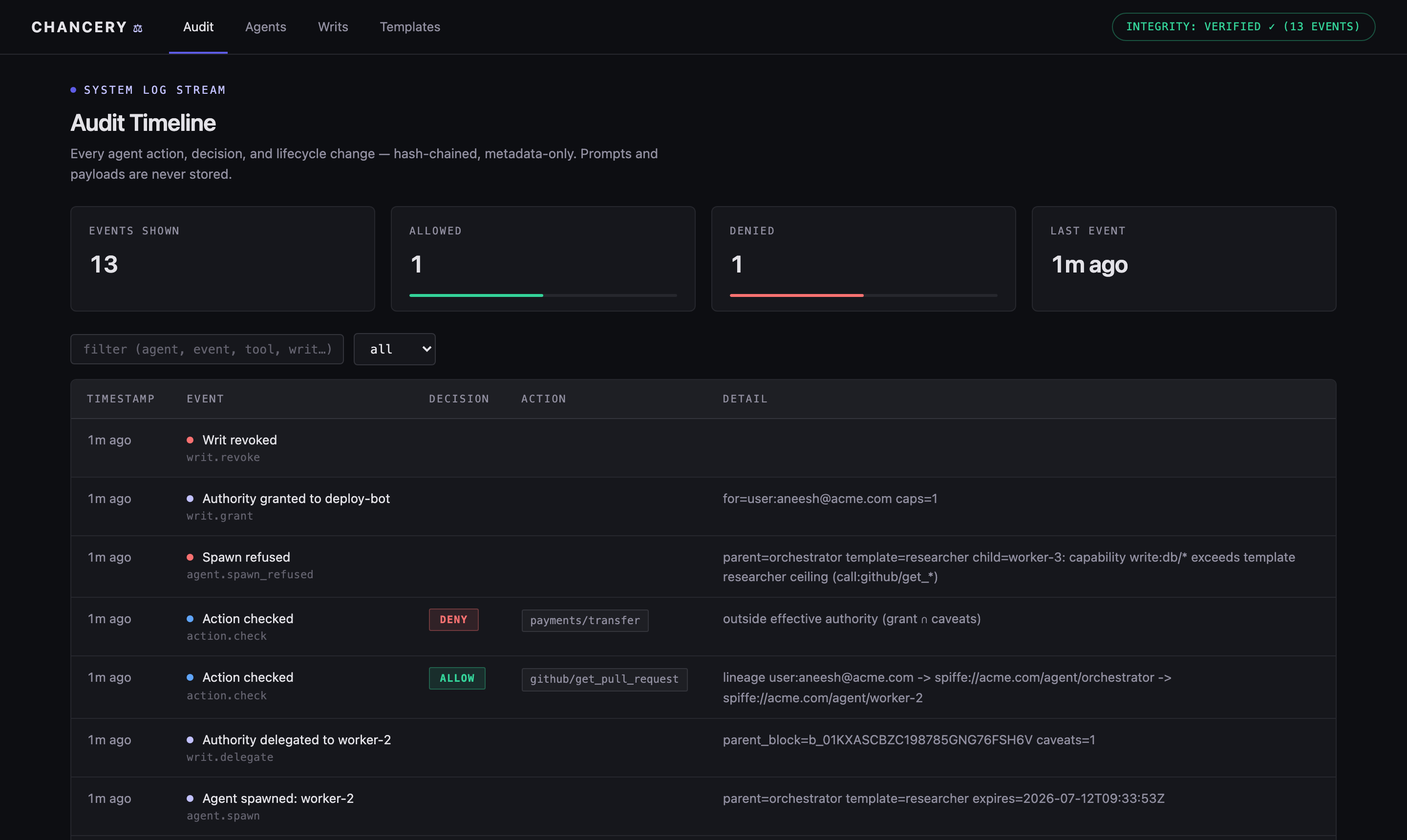
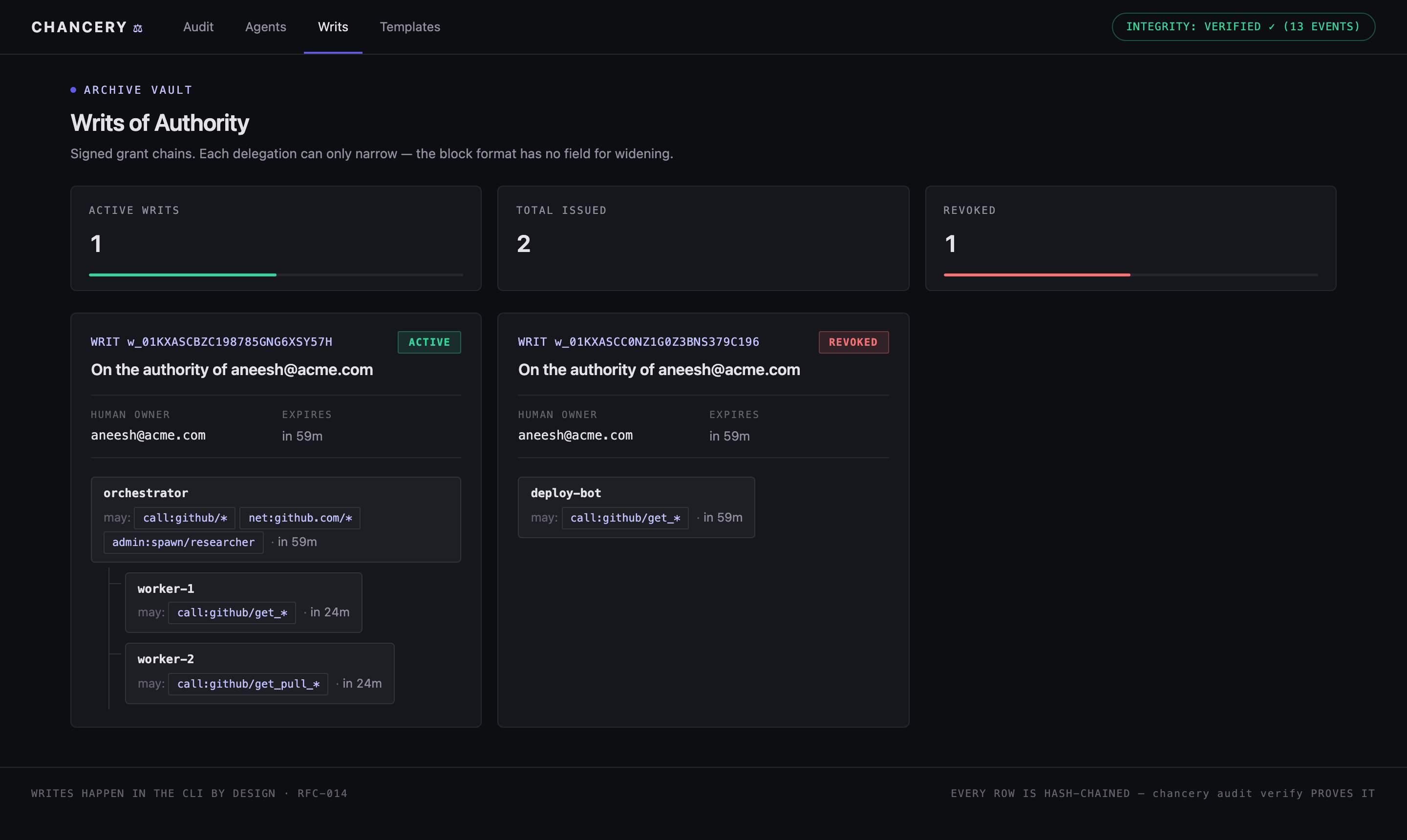
Run the control plane as an HTTP API with ./chancery serve
(REST/JSON under /v1; the admin token is printed once at init) —
and open http://127.0.0.1:7423/ui for the embedded read-only
dashboard (RFC-014): the live
audit timeline with a permanent integrity badge, the agent roster
with spawn provenance, and the delegation tree rendered as a tree.
Writes (grant, revoke, seal) deliberately stay in the CLI/API.
The audit timeline is hash-chained — ./chancery audit verify detects
any edit, deletion, or reorder. Known MVP gaps are published in
RFC-009 §5.
Guides
- Quickstart (MCP) — govern the real filesystem MCP server in 5 minutes
- Governing any agent — the non-MCP path: identity, policy, revocation, audit for any job in any language
- Testing playbook — one guided ~20-minute run through every feature (001–014), with expected output at each step
- Verify every claim yourself — hands-on, by-hand checks that each RFC does what it says
- Concepts — agent, version, instance, writ
- Browser agents — custodied sessions + scoped navigation for Playwright MCP
- Claude Code / MCP client setup — the
.mcp.jsondrop-in - Go SDK and example agent — advisory in-process checks over the API
- LangGraph / Python agents — the deployment-shaped integration
The SDK is advisory — a client-side convenience. The enforcement
boundary is always the out-of-process proxy (chancery mcp wrap), which
a prompt-injected agent cannot talk its way around.
Build & test from source
git clone https://github.com/chanceryhq/chancery && cd chancery
make build      # -> ./chancery  (Go 1.26+, no CGO, single static binary)
make test       # go vet + 89 tests across 10 packages, in seconds
make demo       # the 60-second enforcement + audit arc, end to end
See CONTRIBUTING.md for the repo layout, how the tests
map to each RFC, and how to propose changes.
Design RFCs
Design happens as a series of locked decisions, one RFC at a time
(template).
| RFC | Title | Status |
|---|---|---|
| 000 | Vision and plan | In Review |
| 001 | Agent identity model | In Review |
| 002 | Lineage and delegation | In Review |
| 003 | Credential broker | In Review |
| 004 | Policy and authorization | In Review |
| 005 | Runtime enforcement (MCP → HTTP → shell → browser) | In Review |
| 006 | Audit and attribution | In Review |
| 007 | Lifecycle and revocation | In Review |
| 008 | Data model and APIs | In Review |
| 009 | Threat model | In Review |
| 010 | MVP scope (the 90-day build) | In Review |
| 011 | Open-core boundary | In Review |
| 012 | Dynamic agent creation (writ-gated runtime spawn) | In Review |
| 013 | Browser sessions and tokens as governed credentials | In Review |
| 014 | Read-only dashboard (/ui) |
In Review |
| 015 | Call lifecycle and capability leases | In Review |
| 016 | Server pinning (callee trust, phase 1) | In Review |
| 017 | Task-bound grants and the intent socket | In Review |
Yorumlar (0)
Yorum birakmak icin giris yap.
Yorum birakSonuc bulunamadi