ronce-racine
Health Uyari
- License — License: MIT
- Description — Repository has a description
- Active repo — Last push 0 days ago
- Low visibility — Only 7 GitHub stars
Code Basarisiz
- exec() — Shell command execution in .claude/hooks/skill-reminder.mjs
- process.env — Environment variable access in .claude/hooks/skill-reminder.mjs
- spawnSync — Synchronous process spawning in .claude/hooks/truncate-bash-output.mjs
- process.env — Environment variable access in .claude/hooks/truncate-bash-output.mjs
- process.env — Environment variable access in .claude/hooks/truncate-output.mjs
- execSync — Synchronous shell command execution in .claude/scripts/subscription-leak-scan.ts
- execSync — Synchronous shell command execution in .claude/skills/commit-readiness-review/scripts/precommit-scan.ts
Permissions Gecti
- Permissions — No dangerous permissions requested
Bu listing icin henuz AI raporu yok.
Project-agnostic Claude Code config that takes root in any repo ; always-on rules + on-demand skills, with a smart installer.

Ronce Racine


A personal Claude Code config, packaged so it
installs into any repository and stays up to date there.
npx ronce-racine plan . # read-only: what fits this repo, and why
It is a set of habits I use every day, written down once and shipped by a CLI:
- 13 rules, always on, injected by file type. The standing constraints an
agent should never need to be reminded of. - 36 skills, on demand. Procedures the agent loads when what you asked for
matches, from modeling a domain to triaging a bug. - 6 hooks (9 scripts), wired into
settings.jsonfor you. Small automatic
behaviors on Claude Code events. - 2 agents and 1 detection script, for the jobs that deserve their own
context.
Not a framework and not a team product. One person's working setup, made
installable so twelve repositories cannot quietly become twelve different
configurations.
If you work across several repositories and keep telling Claude the same things,
this should save you the repeating. If you are looking for a team standard to
adopt wholesale, this is not one: take the parts you agree with.
Quickstart · What you get · How it is proven · Staying in sync · Install options · Contributing
Why it is packaged at all
Copy-pasted .claude/ config rots. You write a good rule in one project, paste
it into the next two, improve it in the third, and six months later no two
repositories agree. Nobody remembers which version came from where, and the CI
agent works from a config nobody has read since the day it landed.
So the config is a package: an installer that proposes only what a project's
stack justifies, a lockfile so a repository that drifts says so, and detach
for the artifacts you customized on purpose.
Quickstart
npx ronce-racine plan .      # 1. read-only: what fits this repo, and why
npx ronce-racine install .   # 2. apply, then review the diff before committing
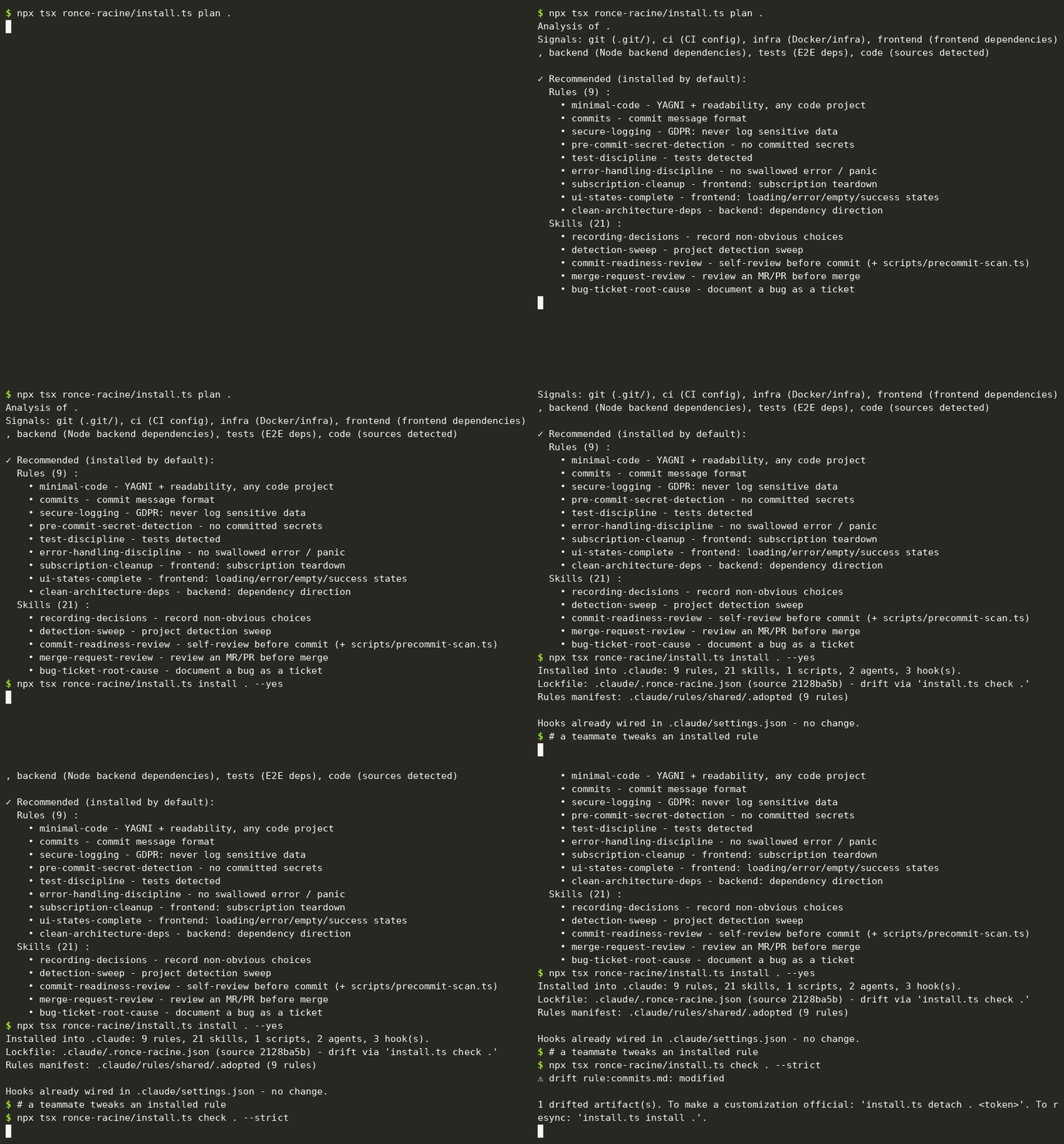
Nothing is written by plan. Here is a real run on a full-stack repository,
abridged:
$ npx ronce-racine plan ./my-app
Analysis of ./my-app
Signals: git (.git/), ci (CI config), infra (Docker/infra), frontend (frontend dependencies), backend (Node backend dependencies), tests (E2E deps), code (sources detected)

✓ Recommended (installed by default):
  Rules (10) :
    • minimal-code - YAGNI + readability, any code project
    • secure-logging - GDPR: never log sensitive data
    • subscription-cleanup - frontend: subscription teardown
    • clean-architecture-deps - backend: dependency direction
    [... 6 more]
  Skills (23) :
    • recording-decisions - record non-obvious choices
    • commit-readiness-review - self-review before commit (+ scripts/precommit-scan.ts)
    • bug-triage-structured - full triage of a bug
    [... 20 more]
  Scripts (1) :
    • subscription-leak-scan.ts - detects subscriptions/listeners/timers without teardown
  Hooks (3) :
    • skill-reminder.ts - suggests the relevant skills for the prompt
    [... 2 more]
  Agents (2) :
    • code-reviewer - diff review agent
    • qa-tester - E2E testing agent

• Optional (add with --all):
  Rules (1) :
    • detection-gap-protocol - P0 found by user = detection failure
  Skills (12) :
    • audit-industrialisation - maturity audit orchestrator
    [... 11 more]
  Hooks (3) :
    • readme-freshness.ts - re-reads the README against what a push changes
    [... 2 more]
(The [... n more] lines mark where this transcript is abridged; a real run
prints every entry, then the exact install command to copy.)
Then git add .claude && git commit: the config travels with the repository, so
your teammates and your CI agent work from the same one you do.
The installer runs code on your machine and wires hooks into your
settings.json.SECURITY.mdsays exactly what runs and when.
Worth two minutes before you install anything, here or anywhere else.
Requirements: Node 18 or later in the target repo, and nothing else. Hooks
ship pre-built, rules and skills are plain Markdown. Only the optional detection
scripts need npx tsx.
What you get
Rules: the constraints that are always on
Rules are injected automatically based on the files in play, so they cost you
nothing to remember. Each one exists because forgetting it produced a real
defect.
| Rule | Applies to | What it prevents |
|---|---|---|
commits.md |
always | commit messages that nobody can scan six months later |
pre-commit-secret-detection.md |
always | a key or token reaching a commit, where a revert no longer saves you |
minimal-code.md |
code (rs/ts/tsx/vue/py/go) | speculative code, and its opposite: unreadable one-liners written to save a line |
error-handling-discipline.md |
code (ts/js/vue/py/go/rs/php/java) | swallowed errors, and a panic/unwrap on a fallible path |
doc-code-parity.md |
README.md, docs/** |
a documented command that no longer matches the code, which the reader trusts anyway |
clean-architecture-deps.md |
code (ts/py/go/rs/php/java) | business logic leaking into handlers, dependencies pointing away from the domain |
no-raw-sql-interpolation.md |
code (ts/js/py/go/rs/php/java) | a query built by string concatenation, which is an injection |
sql-migrations-discipline.md |
**/migrations/** |
a migration edited after it shipped, or one that cannot be replayed |
secure-logging.md |
*.rs, *.ts |
an email, IP or token in the logs, which is a GDPR problem |
subscription-cleanup.md |
frontend (ts/tsx/js/jsx/vue) | subscriptions, listeners and timers with no teardown, and the leaks they cause |
ui-states-complete.md |
components (tsx/jsx/vue/svelte) | a screen that handles the happy path and shows nothing while loading or failing |
test-discipline.md |
*.spec.ts, *.test.ts |
tests that pass without ever having been seen to fail |
detection-gap-protocol.md |
docs/postmortems/** |
treating a P0 found by a user as a bug rather than as a detection failure |
Skills: the procedures, loaded on demand
There is nothing to type. Each skill's description carries trigger phrases, and
the agent loads the one that matches what you asked for, in English or in
French. Five that show the character of the set:
| You say | What runs | What you get |
|---|---|---|
| "this is broken: ..." | bug-triage-structured |
a reproduction, the root cause with file:line, then an argued fix-now-or-open-a-ticket decision |
| "commit this" | commit-readiness-review |
the staged diff scanned for secrets, debug leftovers and disabled tests before anything is written |
| "is it really ready?" | adversarial-feature-challenge |
the feature attacked from several personas; zero flaws found means a bad challenge, not a perfect feature |
| "three names for the same thing here" | domain-glossary |
one name per concept in a GLOSSARY.md, the rejected synonyms recorded so a search for the wrong word still lands right |
| "why is this slow?" | performance-profiling |
the noise floor measured before anything else, then a profile, with "inconclusive" as a valid answer |
The full set, grouped by intention:
| Group | Skills | For example |
|---|---|---|
| Designing, before code | 5 | domain-modeling-design, comprehensive-test-strategy |
| Implementing | 6 | ddd-backend-implementation, api-contract-versioning |
| Testing and validating | 4 | writing-robust-tests, visual-regression-check |
| Fixing a bug | 5 | bug-triage-structured, production-incident-diagnostic |
| Reviewing and shipping | 4 | merge-request-review, ci-pipeline-orchestration |
| Sweeping and auditing | 12 | detection-sweep, and the opt-in audit-* family |
What each one is for, in full: docs/catalog.md.
Hooks: the small automatic behaviors
| Hook | Event | Why it is there |
|---|---|---|
skill-reminder.ts |
UserPromptSubmit |
surfaces the skills matching your prompt, so a relevant one is not missed. Self-maintained, silent when nothing matches |
bash-npm-silent.ts |
PreToolUse / Bash |
appends --silent to setup npm install / npm ci, which otherwise burn context on noise |
truncate-output.ts (+ truncate-bash-output.ts) |
PreToolUse / Bash |
caps verbose command output past a threshold, always preserving it on error |
session-writer + session-inject + session-precompact |
Stop / SessionStart(compact) / PreCompact |
a per-branch session memo: persists the context at session end and re-injects it after a compaction |
worktree-env-setup.ts |
SessionStart |
symlinks the main repo's .env into the current worktree, so a worktree session is not born broken |
readme-freshness.ts |
PreToolUse / Bash |
before a git push, has Claude re-read the README against the diff and report the claims it contradicts. Opt-in, warns without blocking |
Every hook fails open: it runs on every session of every repository that
installed it, so an error ends in a silent exit 0 rather than blocking you.
The two to scrutinize before installing (worktree-env-setup symlinks your.env, the session-memo trio writes to disk) are documented inSECURITY.md.
Agents and scripts
code-reviewer: architecture, reliability and correctness review of a diff.
Read-only, and it ends on an actionable verdict.qa-tester: runs and writes E2E tests, favoring stable locators over timing
hacks.subscription-leak-scan.ts: scans a staged frontend diff for subscriptions,
listeners and timers with no teardown.
A project-specific agent or skill, coupled to your stack and your tracker, takes
precedence over its generic version here. Every generic skill says so up front.
Why you should not trust the tables above
A skill nobody can trigger does not exist, and prose cannot be unit-tested. So
two things are mechanical here rather than hoped for.
Routing is linted. Ten realistic sentences must reach the right skill ahead
of the ones it is confusable with. When that lint was introduced, five of the
ten failed, which is what a catalog looks like before anyone checks it.
Every skill is evaluated against a real agent run. Each carries aneval.yaml: a fixture, a realistic prompt, gates derived from its own exit
conditions, and a judge for what stays subjective. It regularly says no.
What that costs and what else it caught:docs/quality-bar.md.
Staying in sync
npx ronce-racine check <repo>            # drift vs the canonical source
npx ronce-racine check <repo> --strict   # same, but fails CI
npx ronce-racine detach <repo> <token>   # exempt an artifact you customized on purpose
The lockfile records what was installed, check --strict turns drift into a
failing job, and detach keeps a deliberate local customization from having to
lie to the gate. Drop in the
anti-drift CI job and the config can no
longer rot silently.
Mechanics (the settings.json merge, the two distribution layers, the lockfile
states): docs/distribution-model.md ·docs/architecture.md.
Install options
The CLI (recommended)
npx ronce-racine plan    <repo>              # proposes, read-only
npx ronce-racine install <repo> [--all]      # applies (--all = + optionals)
npx ronce-racine install <repo> --rules-only # rules + lockfile only
npx ronce-racine check   <repo> [--strict]   # drift vs canonical (warns, or fails CI)
npx ronce-racine detach  <repo> <token>      # exempt a customized artifact from control
npx ronce-racine uninstall <repo> [--dry-run] # remove what it installed, nothing else
It copies into <repo>/.claude/ and merges the hook wirings intosettings.json without disturbing what is already there. Full procedure:docs/adopting-a-repo.md.
Changed your mind? uninstall reverses it, driven by the lockfile so it removes
what it installed and nothing else:
npx ronce-racine uninstall <repo> --dry-run   # what would go
npx ronce-racine uninstall <repo>             # remove it
It unwires its own hooks from settings.json and leaves the rest of that file
alone, keeps anything you detached, and gives you back any file it overwrote
on the way in.
Try it against throwaway repositories first withplayground/setup.ts.
Or as a Claude Code plugin
/plugin marketplace add ChariereFiedler/ronce-racine
/plugin install ronce-racine@ronce-racine
The skills and the agents, subscribed rather than copied: they update when you
update the plugin, and nothing lands in your repository. The rules, the hooks
and the drift control are deliberately not in it, because always-on context and
code that runs on your machine belong in a reviewed diff. Reasoning:docs/distribution-model.md.
Contributing
An artifact lives here only if it is truly generic: no crate, script, path or
identifier tied to a project, no imposed tracker, no imposed stack. If a
workflow is useful but coupled, split it: the generic protocol here, the tooled
specifics in your own repository.
CONTRIBUTING.md for the bar and the workflow ·docs/writing-a-rule.md ·docs/writing-a-skill.md ·docs/evaluating-skills.md ·docs/developing.md for working on the toolkit itself ·docs/decisions.md for why things are the way they are ·AGENTS.md if you are the agent reading this.
The name
Ronce Racine is French for "bramble root", a plant that roots deep, spreads
everywhere and refuses to die. A fitting name for a layer of engineering
discipline meant to take hold in every repository, with just enough thorns to
remind you it says "discipline".
MIT licensed. Built by Cedric Chariere Fiedler.
Yorumlar (0)
Yorum birakmak icin giris yap.
Yorum birakSonuc bulunamadi