datakeel
Health Gecti
- License — License: Apache-2.0
- Description — Repository has a description
- Active repo — Last push 0 days ago
- Community trust — 122 GitHub stars
Code Gecti
- Code scan — Scanned 12 files during light audit, no dangerous patterns found
Permissions Gecti
- Permissions — No dangerous permissions requested
Bu listing icin henuz AI raporu yok.
Auditable, local-first data & AI dataset workbench: multimodal evidence, traceable metric Q&A, and human-approved Agent/MCP actions.

Datakeel
An auditable, local-first data and AI dataset workbench — unifying multimodal evidence proofreading, traceable metric Q&A, and human-approved Agent/MCP actions.




English · 简体中文 · 10-Minute Tour · Documentation · API Reference · Architecture · Deployment · Changelog
Proofreading workspace
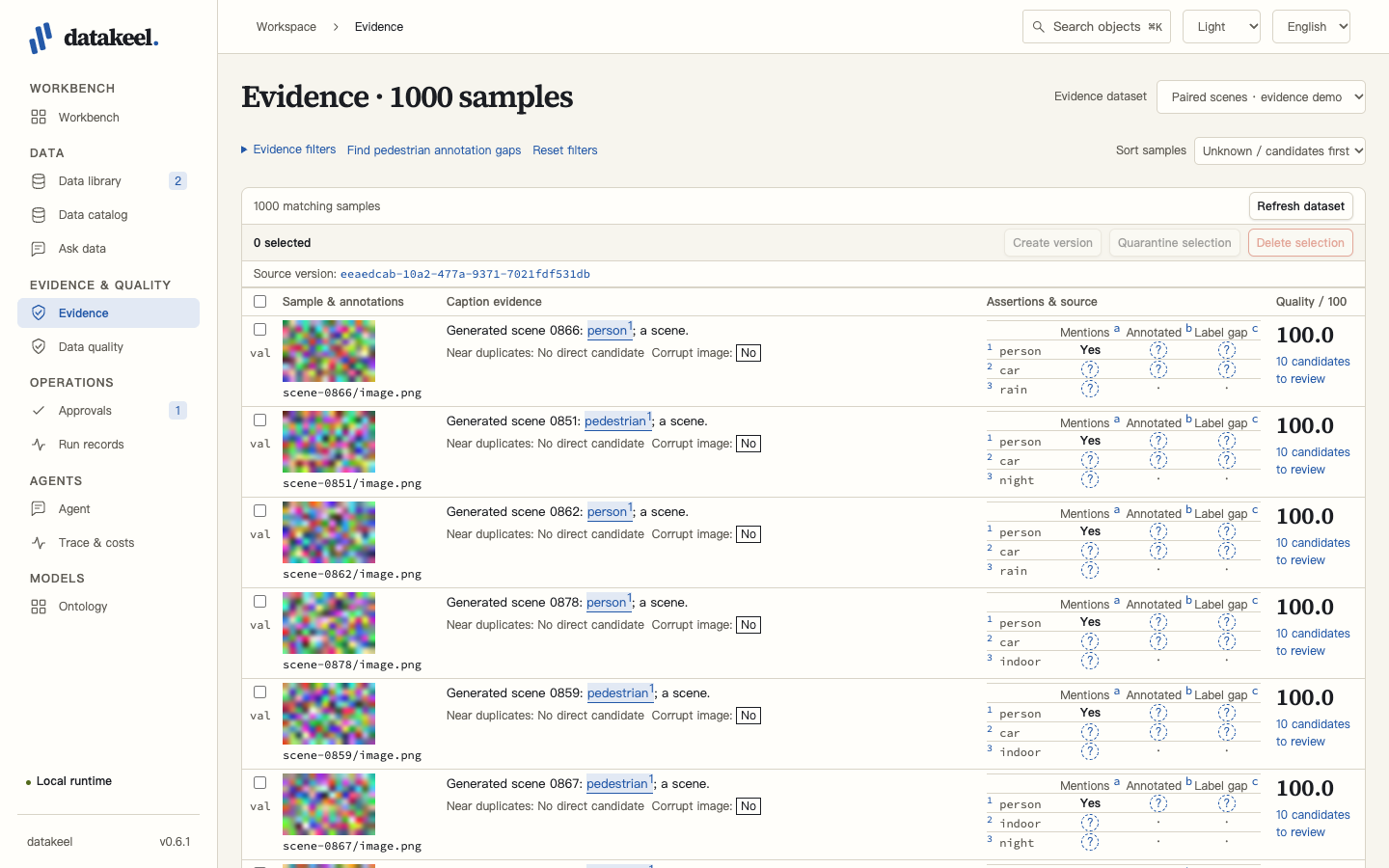
Datakeel organizes data engineering and AI dataset workflows into six workspace groups: Workbench, Data, Evidence & quality, Operations, Agents, and Models. Eight object types share a unified archive view with facts, relationships, evidence, and history where every number traces back to its source:
- Three-state evidence & anchors: Distinguish
present,absent, andunknownevidence (a dot means no assertion); hover or usej/k,a/r, andEscto inspect aligned caption spans, image boxes, and concept rows while keeping human review separate from extracted assertions. - Source footnotes & approval sheets: Metric answers bind their definition version, owner, parameterized SQL, source columns, and time range; irreversible or outbound changes pause on an explicit digest-bound approval sheet before execution.
- Fast navigation & proofreading Copilot: Press
⌘K / Ctrl+Kto jump across datasets, files, versions, actions, tables, columns, metrics, and terms (full UUIDs shorten to 8 chars; business IDs stay intact), or⌘J / Ctrl+Jto open the contextual Copilot drawer and inspect or replan action chains. - Offline-ready UI: Bilingual English/Chinese UI with three contrast-verified palettes (
pencil,ochre,graphite) and locally bundled OFL fonts (third-party notices) making zero external requests in demo mode.
Why Datakeel
- Immutable manifests & traceable numbers: File versions freeze SHA-256 manifests; metric Q&A compiles deterministic read-only
SELECTSQL from registered YAML definitions with half-open time windows (unanswerable/clarificationstates never guess numbers); seven-chapter datasheets enforce sentence-level citations against frozen facts. - Honest evidence (
present/absent/unknown): Missing annotations or sidecars stayunknownrather than false negatives; image quality, point-cloud cleaning, near-duplicate hashing, and knowledge-graph extraction preserve immutable provenance. - Frozen plans & human-in-the-loop safety: State changes prepare a digest-bound plan with expiry, target scope, outbound transfer disclosure, and reversibility. Built-in Agents (LangGraph-checkpointed) and FastMCP servers can prepare plans, never approve or execute irreversible actions on their own.
- Local-first to small-team deployment: Runs offline out of the box on SQLite + local files with bundled React assets; scales to PostgreSQL + S3 behind an authenticating reverse proxy with optional Rust acceleration (
datakeel-accel).
Quick start
Install uv, then run the offline demo from a checkout (.python-version selects Python 3.12; Node, Docker, external databases, and model credentials are not required):
uv sync --locked
uv run datakeel demo
# Web UI:   http://127.0.0.1:8765
# API docs: http://127.0.0.1:8765/api/docs
# Stop both API and worker processes with Ctrl+C
The demo starts both api and worker locally and seeds deterministic fixtures:
- Field notes · generated demo (400 PNG/text files across 11 operators and 2 immutable versions),
- Paired scenes · evidence demo (1,000 image/caption/annotation samples with 50 conflicts, 30 missing sidecars, and 10 corrupt images across 5 evidence operators),
- Fictional Kitchen Co. (4 SQLite sources, 24 tables, 128 fields, 13 metrics, 12 dimensions, 32 terms, 51,992 rows, and 6 classified data assets), plus
- Business notes · knowledge graph demo (24 passages, 3 long documents, and recorded image transcriptions).
Follow the 10-Minute Guided Tour for a full walkthrough, or exercise the non-interactive CLI right away:
uv run datakeel demo --once
uv run datakeel ask '上个季度华东区零售额是多少' --reference-instant 2026-10-01T00:00:00Z
uv run datakeel ask '退货率为什么上升' --reference-instant 2026-10-01T00:00:00Z
uv run datakeel ask '上个季度营业额是多少' --reference-instant 2026-10-01T00:00:00Z
uv run datakeel export --format openlineage --output events.json
uv run datakeel export --format croissant --output croissant.json
Both Chinese and English business questions share the same deterministic time parser, metric/alias normalization, dimension breakdown rules, and refusal guardrails. See Ask charts and follow-ups and API & pipeline reference.
What's included
| Area | Capabilities | Deep dives |
|---|---|---|
| Multimodal evidence & media | Five-operator evidence DAG (phash, caption mentions, annotations, label gaps, 64-bit dHash near-duplicates with optional Rust datakeel-accel), image usability & PLY/PCD point-cloud quality, ffmpeg audio/video slicing, text & image knowledge graphs, sandboxed custom Python operators |
Media Quality · Audio & Video · Knowledge Graphs · Custom Operators · Rust Accel · Fake Vector Kernel |
| Production, splits & LLM data | Label-set publishing, immutable annotation revisions, EXIF-upright workbench, team cockpit (leases, skill dispatch, AI prelabel & pre-review), offline QA agreement, seeded/stratified training splits with leakage checks & COCO/YOLO/HF/JSONL export, SFT/preference dry-run cleaning, cited datasheets, reproducible delivery & datakeel reconcile |
Production · Workbench · Annotation QA · Training Sets · LLM Data · Datasheets · Releases & Delivery |
| Enterprise catalog & Ask data | SQLite reflection, sqlglot field derivation, dbt / Airflow REST v1 / OpenLineage imports, versioned metric YAML (update_metric / rollback_metric), traceable Q&A + chart selection + document claims, portable field standards & code lists, table quality rules & alerts, classified data assets & access grants, time-series profiling |
Ask Data · Metadata Imports · Standards · Quality Rules · Data Assets · Time-Series |
| Actions, Agent, workflows & Copilot | Digest-bound approval sheets, LangGraph-checkpointed Agent with fake-demo offline mode, nested read-only subagent delegation, canary & prompt-injection guards, redacted cross-conversation memory, persistent token/USD budgets, deterministic YAML workflows, beta one-sentence action chains (⌘J), registered actor roles |
Controlled Actions · Workflows · Agent & Memory · One Sentence (Beta) · Identity & Access |
MCP server & model providers
uv run datakeel mcp exposes 102 FastMCP tools (37 audited reads + 65 plan-preparation actions). Approval and execution stay exclusively in the Web UI or CLI; any approve_plan or execute_plan call over MCP is refused and audited.
For Claude Desktop (claude_desktop_config.json) or Cursor (.cursor/mcp.json), replace the absolute paths and keep DATAKEEL_HOME aligned with your demo workspace:
{
  "mcpServers": {
    "datakeel": {
      "command": "/absolute/path/to/uv",
      "args": [
        "--directory",
        "/absolute/path/to/datakeel",
        "run",
        "datakeel",
        "mcp"
      ],
      "env": {
        "DATAKEEL_HOME": "/absolute/path/to/datakeel/.datakeel"
      }
    }
  }
}
Or run an isolated loopback SSE server with uv run datakeel mcp --transport sse --host 127.0.0.1 --port 8766:
{
  "mcpServers": {
    "datakeel": {
      "url": "http://127.0.0.1:8766/sse"
    }
  }
}
- Optional live LLM providers: Set
DATAKEEL_OPENAI_API_KEYorDATAKEEL_ANTHROPIC_API_KEY(and optionalDATAKEEL_OPENAI_BASE_URL/DATAKEEL_ANTHROPIC_BASE_URL) as environment secrets outside the repository; models must have entries incontracts/model-prices.yaml. Without keys, the UI runs on the offlinefake-demoprovider. - OpenTelemetry trace export: Export sanitized OTLP/HTTP protobuf spans (no prompts, completions, payloads, or credentials) to OTLP collectors, Phoenix, or Langfuse with
uv run datakeel export-traces [--conversation-id <id>](details in API & pipeline reference).
Architecture
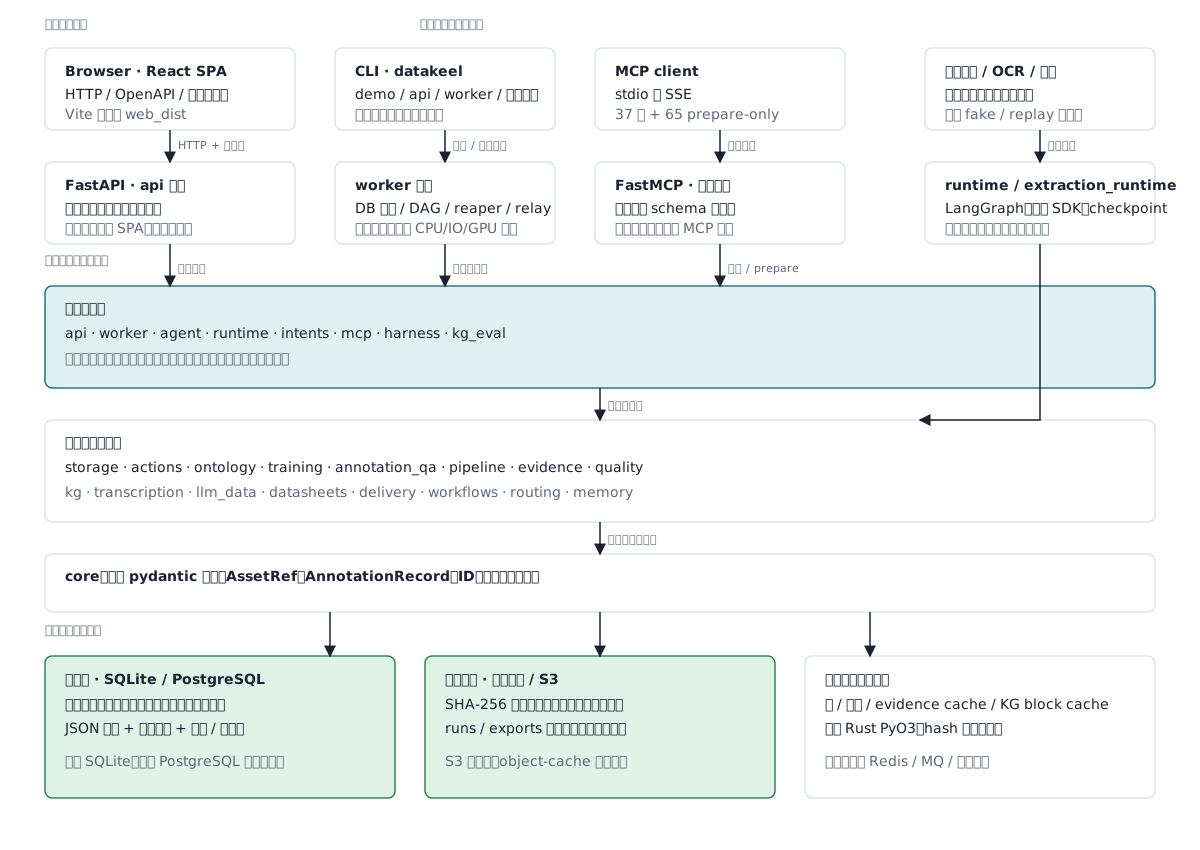
Datakeel is a modular monolith of two stateless/fenced processes (api and worker) over a single SQLite or PostgreSQL fact store and local or S3-compatible object storage. File versions are immutable SHA-256 manifests, lineage graphs rebuild deterministically from append-only events, and PostgreSQL workers claim shards via FOR UPDATE SKIP LOCKED (BEGIN IMMEDIATE on SQLite) with heartbeats, lease fencing, and a transactional terminal-event outbox.
datakeel/       Core domain, semantic resolver, operators, evidence, kg, catalog, metrics, ask,
                pipeline, quality, lineage, governance, storage, worker, api, ontology, actions,
                agent, runtime (LangGraph), harness, FastMCP server, and CLI
accel/          Optional Rust PyO3/maturin extension (datakeel-accel)
web/            React + TypeScript + Vite source (compiled assets shipped in datakeel/web_dist)
contracts/      Semantic file-format, operator, evidence, semantic-layer, workflow, and golden specs
sandbox/        Hardened container runtime image for reviewed custom operators
docs/           Architecture, guides, API/verification references, and capacity benchmarks
tests/          Mirrored unit, integration, contract, and repository regression suites
See Architecture decisions, Persistence schema, and API & pipeline reference.
Deployment & local builds
Run roles separately
uv run datakeel db upgrade          # Explicit schema upgrade (db status checks read-only)
uv run datakeel api --port 8765
# In a second terminal with the same DATAKEEL_HOME / DATAKEEL_DATABASE_URL / DATAKEEL_S3_* settings:
uv run datakeel worker
Build local wheel or Docker image
From a source checkout (requires Python 3.12, uv, Node.js 22, and Rust 1.96 to build; runtime wheels and containers do not need Node):
make build-wheel                    # Pure-Python wheel + hashed requirements in dist/
make build-image                    # Builds local non-root image tagged datakeel:local
docker run --rm -p 127.0.0.1:8765:8765 -v datakeel-data:/data datakeel:local
Neither command pushes or uploads artifacts to PyPI or Docker Hub.
Local PostgreSQL stack with Docker Compose
After make build-image, run api, worker, migrate, and postgres:17-alpine together on a loopback-only binding (127.0.0.1:8765):
docker compose up -d
# Optional one-shot demo seeding into the Compose Postgres + /data volume:
docker compose run --rm api demo --once
For multi-user small-team access behind Caddy or nginx + oauth2-proxy, see Small-team deployment and SQLite database maintenance.
Development & verification
uv sync --locked
(cd web && npm ci)
uv run pre-commit install
make check                          # Public scan, Rust, Ruff ALL, Pyright strict, import-linter,
                                    # size/schema guards, pytest (>=85%/90% cov), web checks, license audit
uv run python scripts/check_readme.py
bash scripts/ci-check.sh            # Full local CI: make check + README verification + 856 mutations
Dual-stack CI runs the complete gate, four pytest shards, and two mutation shards on both SQLite and PostgreSQL. See Contributing, Code standards, Offline evaluation & quality gates, and Test execution speed.
Community, security & license
- Questions & support: Read SUPPORT.md or browse the Documentation Hub.
- Security: Report vulnerabilities privately via SECURITY.md — never in public issues.
- Code of conduct: Follow CODE_OF_CONDUCT.md.
- Citation: Metadata for academic or technical citation is provided in CITATION.cff.
- License: Apache-2.0. Complete runtime license inventory and approved exceptions (
certifi,orjson,regex, and bundled OFL-1.1 fonts) are audited offline and recorded in THIRD_PARTY_NOTICES.md andweb/public/THIRD-PARTY-LICENSES.txt. No ELv2, BSL, AGPL, or SSPL runtime dependency is included.
Yorumlar (0)
Yorum birakmak icin giris yap.
Yorum birakSonuc bulunamadi