proofpress
Health Warn
- License — License: Apache-2.0
- Description — Repository has a description
- Active repo — Last push 0 days ago
- Low visibility — Only 5 GitHub stars
Code Pass
- Code scan — Scanned 12 files during light audit, no dangerous patterns found
Permissions Pass
- Permissions — No dangerous permissions requested
No AI report is available for this listing yet.
Trust infrastructure for RSI. An open Intelligence Ledger for agent-native workflows—verify, govern, and compound agent-produced learnings.

Proofpress




Trust infrastructure for RSI.
Proofpress is the Intelligence Ledger for agent-native organizations. It
turns agent-produced learnings into organization-owned intelligence with
evidence, evaluation, scope, human authority, declared use, and outcomes.
Own your intelligence. Verified. Governed. Cumulative.
Website · Quick start ·
Product thesis · Remote MCP
Agent output is growing faster than organizations can trust—or retain
Every run can produce findings, decisions, failures, and learnings that should
change future work. Two failures prevent that intelligence from compounding:
| Unverified | Scattered |
|---|---|
| Output scales. Verification does not. | Agents learn. Organizations forget. |
| Claims travel without durable evidence, scope, review, or authority. | Useful learnings disappear into runs, traces, chats, files, tools, and people. |
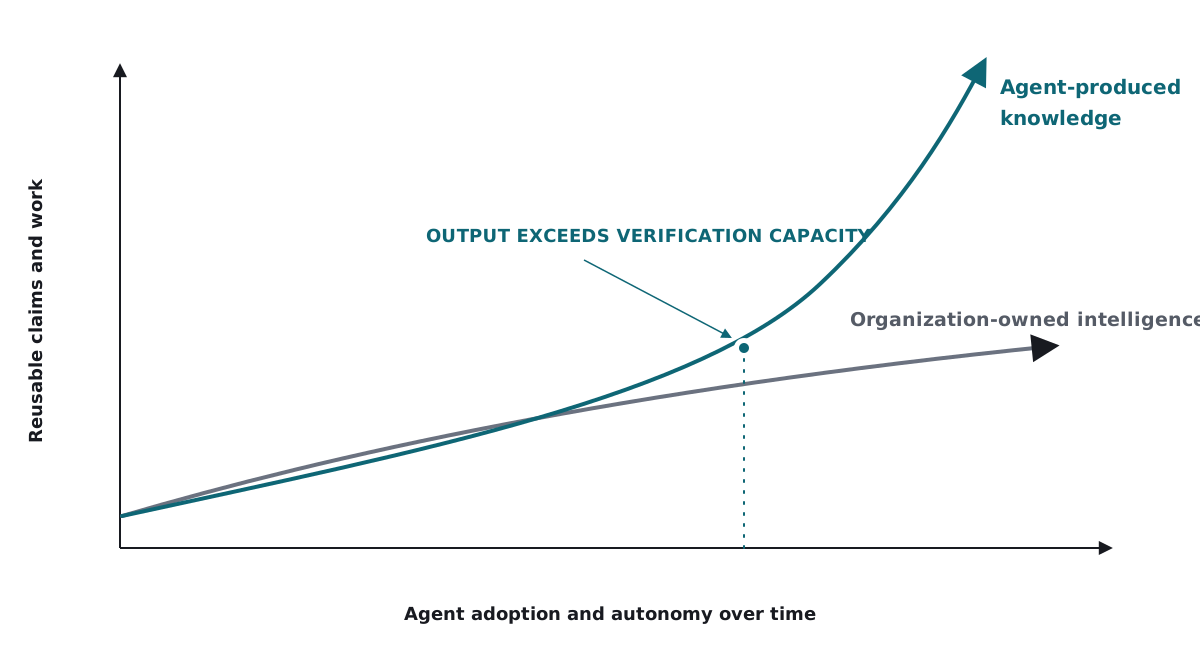
Illustrative model, not measured data. Without a trusted learning loop,
the gap keeps widening.
Today's stack captures pieces—not trusted intelligence
| Layer | Primary role | What remains unresolved |
|---|---|---|
| Observability | Records activity | Activity is not reusable knowledge. |
| Memory | Recalls history | Recall is not durable learning. |
| Knowledge graphs and ontologies | Map relationships | Structure is not verified knowledge. |
| Proofpress | Governs agent-produced learnings and reliance | What may future agents trust and reuse? |
These systems are complementary. They can provide evidence to Proofpress or
consume governed context from it. Proofpress supplies the governed record of
what agents learned, why it is trusted, and where it may be reused.
The Intelligence Ledger
Any agent can propose a learning with evidence through MCP, CLI, Python, or
HTTP. Proofpress records the exact version, evaluates its support and scope,
and routes it through Human Admission. Only admitted, current, in-scope
knowledge becomes governed context for future work.
- Propose with evidence. Preserve the source, version, and intended scope.
- Evaluate. Apply deterministic checks and optional model or external
assessments. - Govern. An authenticated human admits, rejects, or requests revision.
- Reuse deliberately. Record the exact governed context presented and the
claim versions an agent explicitly relied on. - Connect outputs and outcomes. Keep artifact hashes, tests, feedback, and
later observations attached to the work. - Improve through governance. Use new evidence and outcomes to propose the
next review without silently rewriting organizational truth.
Agents may submit, propose, evaluate, and retrieve. They may never admit their
own claims or administer owner authority.
An open intelligence layer
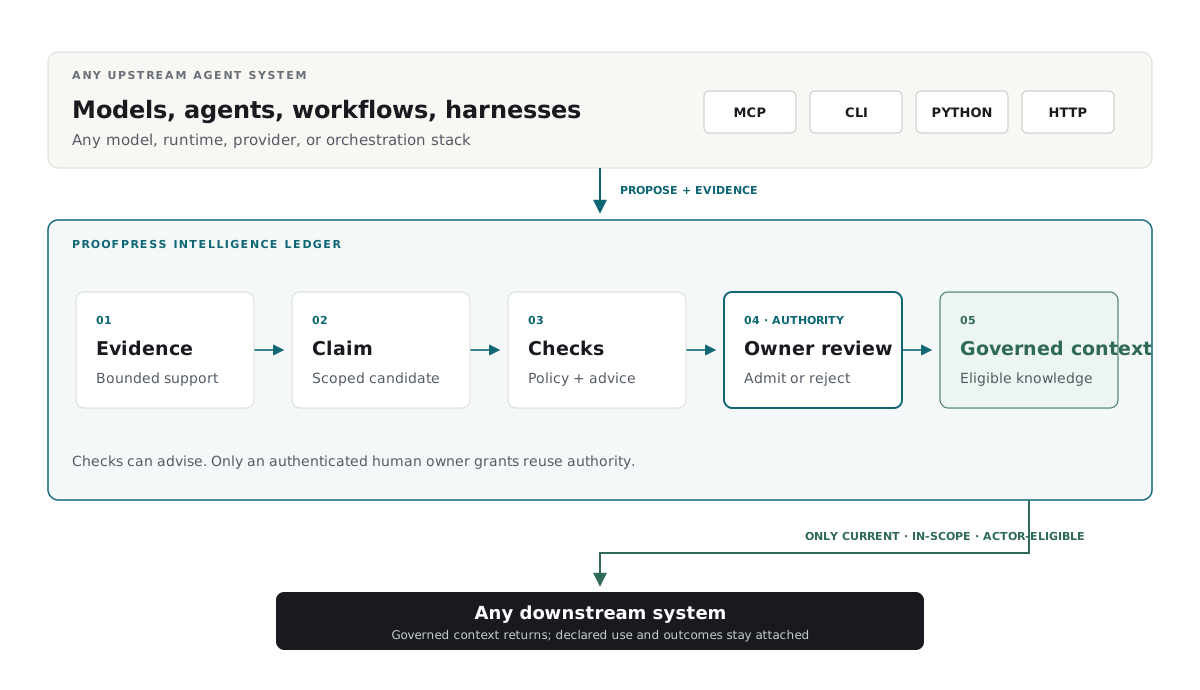
MCP, CLI, Python, and HTTP call the same versioned lifecycle. Models, agents,
workflows, and harnesses can change while the Intelligence Ledger stays with
the organization.
The ledger records the relationship between a task, the governed context it
received, declared reliance, external outputs, and later observations. This is
the foundation for continuous organizational learning; it does not collapse
evaluation, real-world outcomes, and Human Admission into one score.
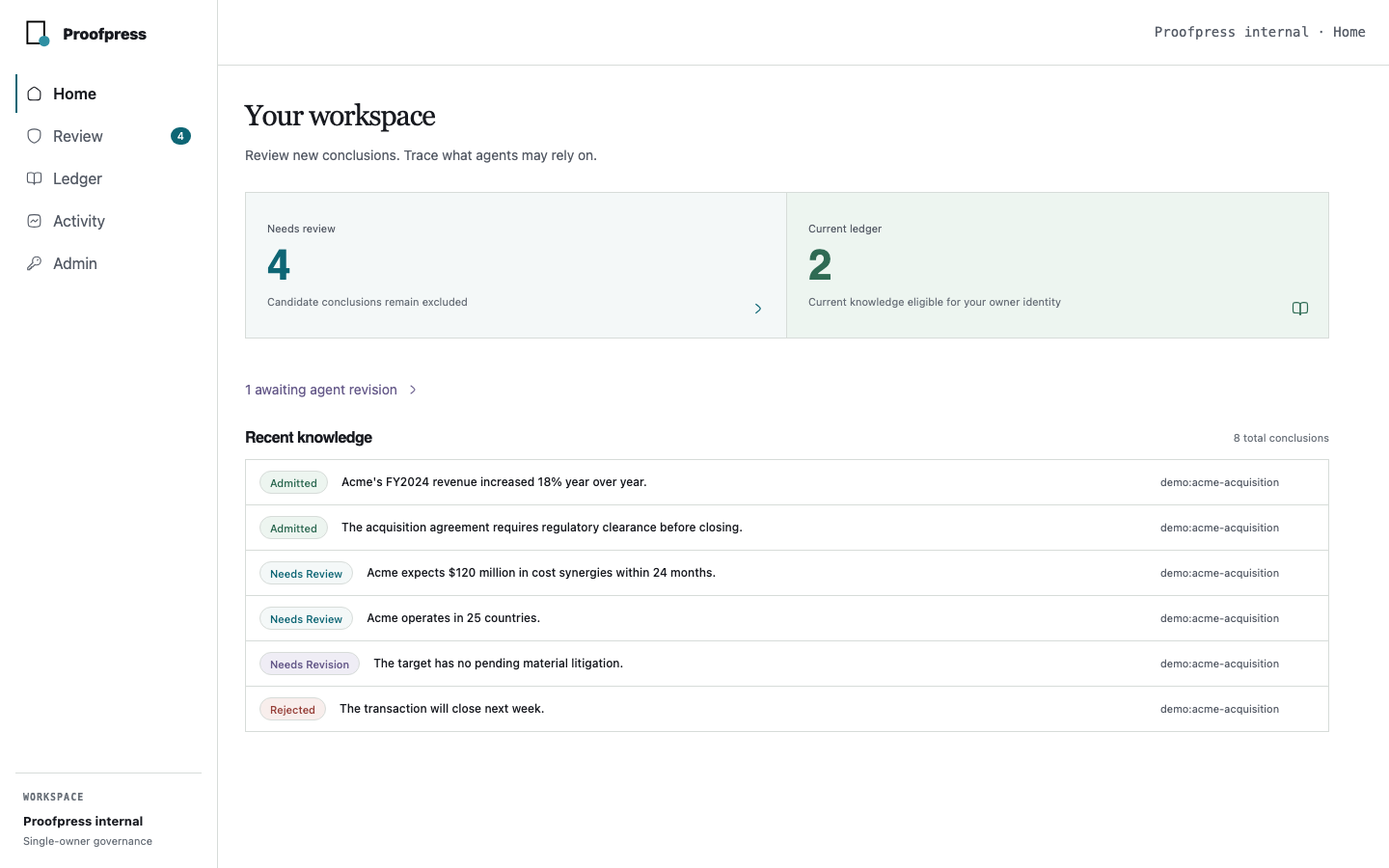
The Owner workspace is the human authority layer: review the candidate and its
support, inspect lineage, then admit, reject, or request revision.
Task run tracking documents the append-only Run,
ContextReceipt, Reliance, Output, and Observation contracts.
Quick start
Agent plugin (recommended)
The public proofpress plugin packages the
governed-context workflow, its default repository policy, and the OAuth-protected
Hosted MCP server. It is a distribution layer: the hosted service remains the
authority for workspace access and Human Approval.
Connection prerequisite: installing the plugin does not create a ledger or
a Hosted Proofpress workspace. It connects an agent to an existing Proofpress
workspace. The checked-in default MCP endpoint is the maintainer's private
reference service, not a public multi-tenant cloud; an unprovisioned user must
not use it. Use either a separately provisioned Hosted workspace and its
agent-specific authorization, or replace the MCP URL with a self-hosted
Proofpress /mcp endpoint.
- Codex / ChatGPT: add this repository's
.agents/pluginsmarketplace,
then installproofpressfrom the Plugins Directory. - Claude Code: add this repository as a plugin marketplace, then install
proofpress@proofpress-plugins. - Cursor: install the portable Agent Plugin from the Cursor Marketplace
after its listing is approved, or loadplugins/proofpresslocally while
evaluating the package.
The source package is public now; third-party marketplace listings are pending
their independent review. See the plugin release checklist
for the exact publication state and fallback installation paths.
Manual skill and MCP setup
Proofpress requires Python 3.11 or newer. Install both the project-level agent
skill and the local MCP/CLI in the repository where the governed work happens.
- Install the governance skill. It tells compatible agents when to retrieve,
propose, and stop for Human Approval.
mkdir -p .agents/skills/proofpress-governed-context
curl -fsSL \
  https://raw.githubusercontent.com/chenmingtang830/proofpress/main/.agents/skills/proofpress-governed-context/SKILL.md \
  -o .agents/skills/proofpress-governed-context/SKILL.md
- Add a repository policy. Edit and commit it to define what this workflow
should and should not propose.
mkdir -p .proofpress
curl -fsSL \
  https://raw.githubusercontent.com/chenmingtang830/proofpress/main/.agents/skills/proofpress-governed-context/assets/context-policy.yaml \
  -o .proofpress/context-policy.yaml
- Install the local MCP and CLI.
uv tool install --with "mcp>=2,<3" "git+https://github.com/chenmingtang830/proofpress.git"
- Create a governed demo workspace.
proofpress quickstart
- Creates a new
./proofpress-demoGit repository with synthetic evidence. - Prints a ready-to-copy local
proofpress-mcp.json. - Requires no account, token, hosted service, or model call.
- Add
--uifor local review, or--no-browserto keep it terminal-only. - Configure the optional LM Judge separately with the
evidence-support criteria. - Building Proofpress itself? Use the contribution guide.
Use the Python client
Run the same lifecycle in-process or over HTTP:
from proofpress import ProofpressClient, ProofpressError

client = ProofpressClient.in_process(".")
evidence = client.import_evidence("run.otlp.json", idempotency_key="run-001")
candidate = client.propose_claim(
    "The bounded result is ready for review.",
    evidence["evidence"],
    scope="experiment:demo",
    proposer="agent:runner",
    idempotency_key="proposal-001",
)

# A human authorizer reviews through the owner surface. A successor agent reads:
context = client.context(scope="experiment:demo", actor="agent:successor")
Connect an MCP client
- The quickstart prints this local stdio configuration with absolute paths filled in.
- For another workspace, point
--workspaceat the Git repository Proofpress should govern.
{
  "mcpServers": {
    "proofpress": {
      "command": "/absolute/path/to/proofpress/.venv/bin/proofpress",
      "args": ["mcp", "--transport", "stdio", "--workspace", "/absolute/path/to/workspace"],
      "env": {"PROOFPRESS_MCP_PRINCIPAL": "agent:your-client"}
    }
  }
}
- Hosted: open
/connectand use its secret-free remote MCP URL. - Authentication: OAuth with PKCE binds each client to a separate agent credential.
- Details: Remote MCP.
Choose a deployment
- One local repository: use the in-process client or localhost HTTP for a
Git-backed ledger, local review, and governed-context reads. - One owner across devices or agents: use
proofpress hostedfor durable
storage, scoped credentials, owner review, and HTTP/MCP access. - Workflow-specific evidence: use a profile or integration for typed
validation without changing the authority model. - Owner UI preview: run
npm run preview:localfromweb/owner; it reuses
one ignored, mode-0600local credential and synthetic workspace. - Hosted boundary: the reference deployment is private, single-owner, and
single-instance—not a multi-tenant Proofpress cloud. See Self-hosting.
Self-host in three steps
Deploy this repository with
render.yaml, or use the
provider-neutral examples indeploy/self-hosted/.In a private server shell, bootstrap one owner workspace:
proofpress hosted --database /var/data/proofpress.db \
  bootstrap --workspace-id workspace:personal \
  --owner-principal human:owner
Store the one-time owner credential and recovery secret outside Git, then
issue a distinct credential for each agent or device. Configure backups
before relying on the instance.
- The Blueprint contains no Proofpress credentials or customer data.
- A fork uses the operator's own account, storage, domain, and billing.
- Submitting evidence or proposing a claim never admits it.
- Agent credentials identify and constrain callers; they do not carry owner authority.
- Governed-context reads return only admitted, current, in-scope, actor-eligible claims.
Integrations and deployment
proofpress.profiles.experimentvalidates bounded metric, table-cell, and derivation evidence.proofpress.integrations.repositorybinds one repository change to Git and check receipts for self-dogfood.proofpress.integrations.matter_catalogandproofpress.integrations.document_extractionare optional evidence-entry integrations. Their output remains candidate evidence.proofpress hostedruns the single-owner hosted control plane and web review surface. See Self-hosting.
Read this next
- Understand the product: Thesis → claims and governed context → FAQ.
- Connect an agent: trace integration → content-addressed receipt adapter → spreadsheet cell evidence → MCP and WebMCP → repository dogfood.
- Run it privately: self-hosting guide →
render.yaml→ deployment examples. - Explore prior experiments: study catalog. Research evidence is separately scoped; it is not a blanket product-efficacy claim.
- Python-first and single-owner today.
- No multi-owner workspaces or customer VPC packaging.
- No Notion or multi-repository knowledge ingestion.
- Not a universal OCR, RAG, memory, or search platform.
Compatibility
Python is the supported SDK and CLI installation path. Older Python imports,
console aliases, and portable top-level commands remain deprecated forwarding
shims; new integrations should use ProofpressClient, proofpress, andproofpress legacy ... for the portable artifact ledger. Browser tooling is
used internally to build the landing page and Owner workspace; it is not a
customer integration surface.
See the documentation index, study catalog, and GitHub Releases.
Reviews (0)
Sign in to leave a review.
Leave a reviewNo results found