kw-engine
Health Warn
- License — License: MIT
- Description — Repository has a description
- Active repo — Last push 0 days ago
- Low visibility — Only 6 GitHub stars
Code Warn
- network request — Outbound network request in src/kw_engine/cli.py
Permissions Pass
- Permissions — No dangerous permissions requested
No AI report is available for this listing yet.
Methodology evolution engine — distill transferable principles from literature, search by problem structure
kw-engine
Stop re-reading papers. Start reusing the why.
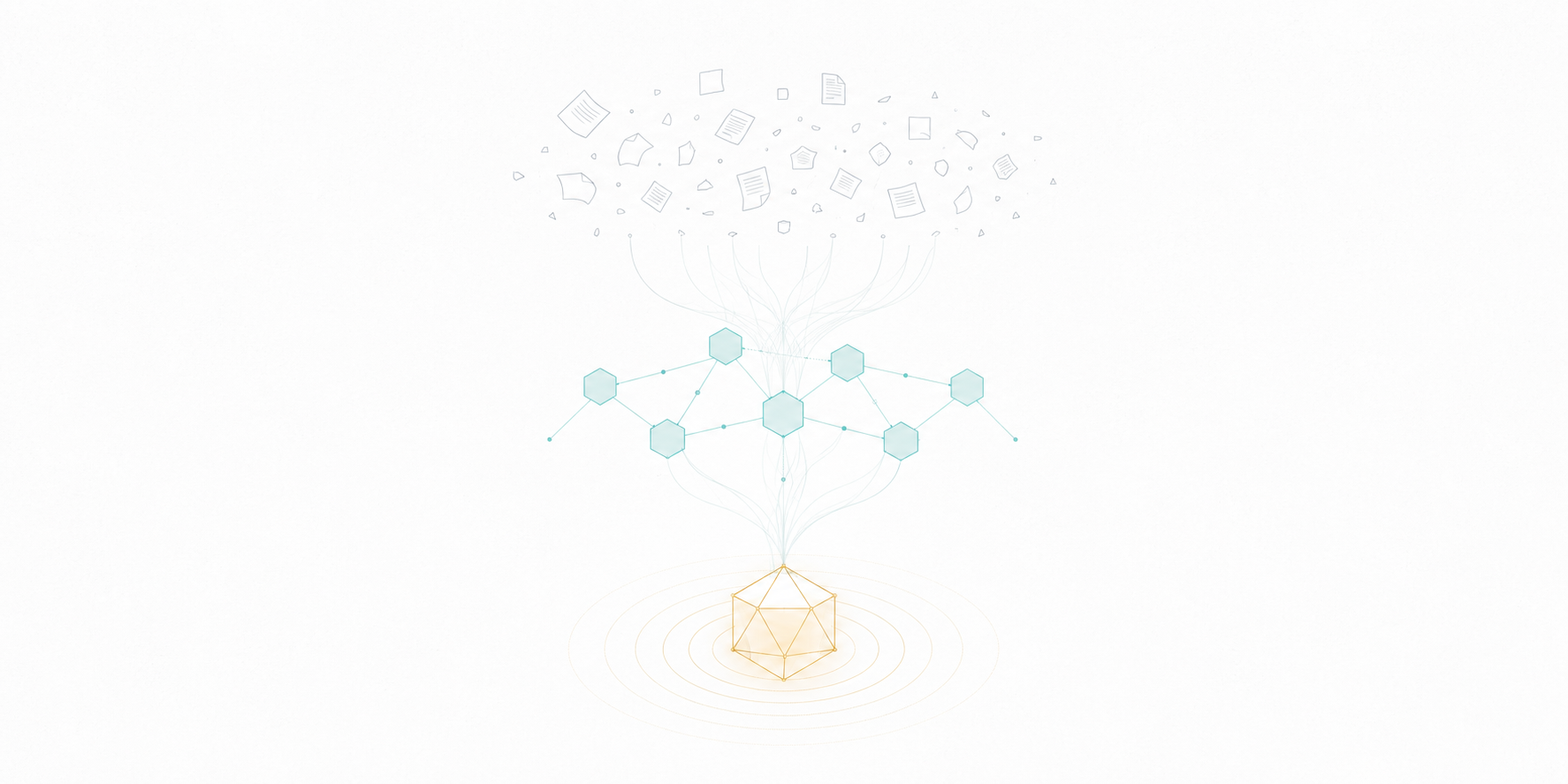
A methodology evolution engine that distills transferable problem-solving principles from literature — so when you hit a new problem, you search by its structure and get back a mechanism that works, plus the reason it works.





English · 简体中文
The problem
You read a paper, extract a clever trick, and forget it. Six months later you face a problem that the same trick would solve — but it was in a different field, used different words, and your notes are a pile of PDFs. Your bottleneck was never finding papers. It was reusing the underlying method across domains.
kw-engine treats that as the actual problem.
What it does
It distills literature through three layers, stripping away the domain and keeping the transferable logic:
 Paper PDF
   │
   ├─  L1  faithful extraction   what the paper says, with section locators — no interpretation
   │
   ├─  L2  abstraction           strip the biology/domain, keep the transferable core:
   │                               problem-signature   ·  WHEN it applies (problem structure)
   │                               ↔ mechanism + math  ·  WHAT to do
   │                               ↔ rationale         ·  WHY the structure↔mechanism mapping holds
   │
   └─  L3  synthesis             cluster principles into a design-space map; surface
                                  contradictions and GAPS — where the knowledge evolves
Then the payoff:
New problem arrives → search by its structure → matched mechanism + rationale + when-it-breaks
Why it's different
| What it retrieves | Indexed by | |
|---|---|---|
| RAG / vector search | text chunks | surface semantics |
| Zotero / citation managers | references & PDFs | metadata, tags |
| Skill libraries (e.g. Voyager) | executable task code | task name |
| kw-engine | mechanism + why-it-works + when-it-fails | problem structure |
It's not a search index over text — it's a compiler from empirical results to reusable problem-solving strategies.
Why it self-evolves
Three ingredients let the loop pick its own next move instead of waiting for a human to choose what to read.
1 · Distillation is a quotient map. L2 abstraction strips the domain — it maps a concrete method m to an equivalence class under "same problem structure, same mechanism":
φ : concrete method ──► ( problem_signature , math_basis , mechanism , rationale )
Two methods from unrelated fields with the same structure map to the same class. That's exactly why a microbiome trick and a diffusion-model trick can land in one cluster: φ collapses domain distance and exposes structural distance. Transfer is the quotient working as designed.
2 · The known set induces a coverage map — and therefore gaps. Given the current principle set P, L3 synthesis partitions it over a design space whose axes are the recurring structural properties. A gap is a region that is under-populated, or where rationale / falsifiable_prediction is weak. Crucially a gap is computed from P itself — an endogenous objective, not an external prompt.
3 · The loop is closed and monotone.
P_n ──synthesize──► gaps(P_n) ──acquire + distill──► P_{n+1} = P_n ⊕ new principles
⊕ is a dedup-and-link merge: a new principle either extends P or attaches to an existing one as added provenance / generalizes / contrasts. So the graph only accumulates — it never forgets — and re-synthesizing over a richer P_{n+1} yields sharper gaps. That feedback (knowledge state → next objective → richer state) is the "self" in self-evolving.
In spirit this is active learning over a design space: gaps play the role of coverage/uncertainty sampling, and each round acquires the evidence that most reduces an under-covered region.
Honest note. The map φ and the gap judgment are performed by LLM reasoning, not a closed-form operator; the engine's job is to maintain the structured, deduplicated state that makes the loop closeable and reproducible. There is no convergence theorem here — the monotone accumulation + dedup is the mechanism, not a proof of it.
Highlights
- 🧪 Structure-indexed retrieval — query by the shape of your problem, not keywords
- 🧬 Domain-stripped principles — a microbiome trick and a diffusion-model trick land in the same cluster when their math structure matches
- 🔁 Knowledge that evolves — L3 synthesis surfaces real gaps, which become your next reading list
- 🪶 Markdown is the source of truth — git-diffable, reviewable records; SQLite + JSON are rebuildable indices
- ⚛️ Deterministic & atomic — every mutation is temp-file-rename + file-locked; no half-written state
- 🤖 Two-tier by design — LLM agents do the reasoning; a typed Python CLI does the bookkeeping (cheap model reads, strong model abstracts)
- 🔌 Ships as a Claude Code plugin —
/kworchestrates the whole loop; or drive thekwCLI yourself - ✅ Production-grade substrate — 41 tests,
mypy --strict,ruff, CI on Python 3.11–3.13
Install
# As a CLI tool (recommended — gives you the `kw` command)
uv tool install git+https://github.com/chenpg2/kw-engine

# Or as a project dependency
uv add git+https://github.com/chenpg2/kw-engine

# Or clone for development
git clone https://github.com/chenpg2/kw-engine
cd kw-engine && uv sync
Install as a Claude Code plugin
Run these in your terminal (not inside a Claude Code session):
claude plugins marketplace add chenpg2/kw-engine
claude plugins install kw-engine@kw-engine
This registers the /kw and /kw-init skills plus the five sub-agents. Then install the CLI substrate they call:
uv tool install git+https://github.com/chenpg2/kw-engine
The plugin provides the reasoning (skills + agents); the
kwCLI provides the deterministic substrate. You want both.
Quick start
# 1. Initialize a workspace in any repo
kw init
kw status                                  # 0 papers, 0 principles — empty engine

# 2. Acquire a paper (multi-source open-access fallback + PDF validation)
kw fetch 2304.04740

# 3. Register and distill (agents fill these after reading; or do it by hand)
kw add-paper 2304.04740 --title "Flow Matching for Generative Modeling"
kw add-principle \
  --title "Reduce hard dynamics optimization to static coupling + regression onto bridges" \
  --abstract "When a theorem identifies the dynamic optimum as a mixture of simple conditional bridges, replace path optimization with a coupling + closed-form regression." \
  --sig "unpaired marginal snapshots" --sig "continuous-time generative process" \
  --math "optimal-transport" --math "conditional-flow" \
  --mechanism "Solve a static coupling, then regress a vector field onto closed-form conditional bridges." \
  --rationale "The dynamic least-action optimum decomposes into per-pair bridges, so the hard part collapses to a coupling problem." \
  --regime "needs paired or OT-coupleable marginals; N large enough to estimate the coupling" \
  --prediction "straightening the coupling reduces sampling steps without retraining" \
  --boundaries "fails if the bridge family doesn't match the true conditional process" \
  --prov "2304.04740 §3.2"

# 4. The payoff — search by problem structure
kw search "optimal transport dynamics"

# 5. Keep it honest
kw verify                                  # checks provenance, links, required fields
Or let Claude Code drive it
Installed as a plugin, just run the skill — it orchestrates fetch → read → distill → synthesize → verify across sub-agents, with the right model on each step:
/kw          # detects state, offers a menu, runs the loop — you never hand-edit a file
/kw-init     # scaffold a workspace from natural language
CLI reference
| Command | Purpose |
|---|---|
kw init [dir] |
Scaffold a workspace (memory/, .kw/, process/, paper/) |
kw fetch <id|doi|title> |
Acquire a PDF via OA fallback chain + validate + register |
kw add-paper <id> |
Register a paper (scaffold record + index entry) |
kw add-principle … |
Allocate P-####, write the principle, update index + SQLite |
kw add-link <from> <to> <type> |
Link principles (generalizes/contrasts/composes/…) |
kw search "<query>" |
Retrieve principles by problem-signature / math-basis |
kw reindex |
Rebuild index.json + SQLite from markdown |
kw verify |
Check integrity invariants (provenance, links, required fields) |
kw status |
Counts, pending papers, synthesis staleness |
Architecture
 memory/papers/*.md          ┐
 memory/principles/*.md       ├─ source of truth (git-tracked, human-readable)
 memory/synthesis/*.md        ┘
        │  kw reindex
        ▼
 memory/index.json     (diffable catalog projection, committed)
 .kw/index.db          (SQLite query index, gitignored, rebuildable)
- Markdown is truth. Indices are derived — delete and rebuild any time.
- Atomic writes. Temp-file rename +
flockon the index; no pid collisions, no torn writes. - No silent fallback. Validation errors raise; the engine never writes a placeholder record.
Honest scope
kw-engine is a tool and a method, not a benchmarked research claim. It does not (yet) prove that structure-indexed retrieval beats RAG on a downstream task — that would need a controlled evaluation. What it does give you today is a disciplined, reproducible substrate for building and querying a transferable-methodology library, with the LLM reasoning cleanly separated from deterministic storage.
Development
uv sync
uv run pytest -v          # 41 tests
uv run ruff check .       # lint
uv run mypy src/          # strict type check
License
MIT © 2026
Reviews (0)
Sign in to leave a review.
Leave a reviewNo results found