thoughtdag
Health Pass
- License — License: MIT
- Description — Repository has a description
- Active repo — Last push 0 days ago
- Community trust — 118 GitHub stars
Code Fail
- network request — Outbound network request in functions/api/[[path]].js
- process.env — Environment variable access in scripts/smoke.mjs
- network request — Outbound network request in scripts/test-memory-judge.mjs
- execSync — Synchronous shell command execution in server.mjs
- fs.rmSync — Destructive file system operation in server.mjs
- process.env — Environment variable access in server.mjs
- network request — Outbound network request in server.mjs
Permissions Pass
- Permissions — No dangerous permissions requested
No AI report is available for this listing yet.
Your thinking deserves a map: an infinite canvas where LLM conversations grow into an editable thought graph. Wires are the context.

ThoughtDAG
Your thinking deserves a map. An infinite canvas where LLM conversations grow into an editable thought graph.



▶ Try it live
no install, no signup; the example canvas needs no key
中文 · Quick start · More capabilities · Models · Cost & privacy
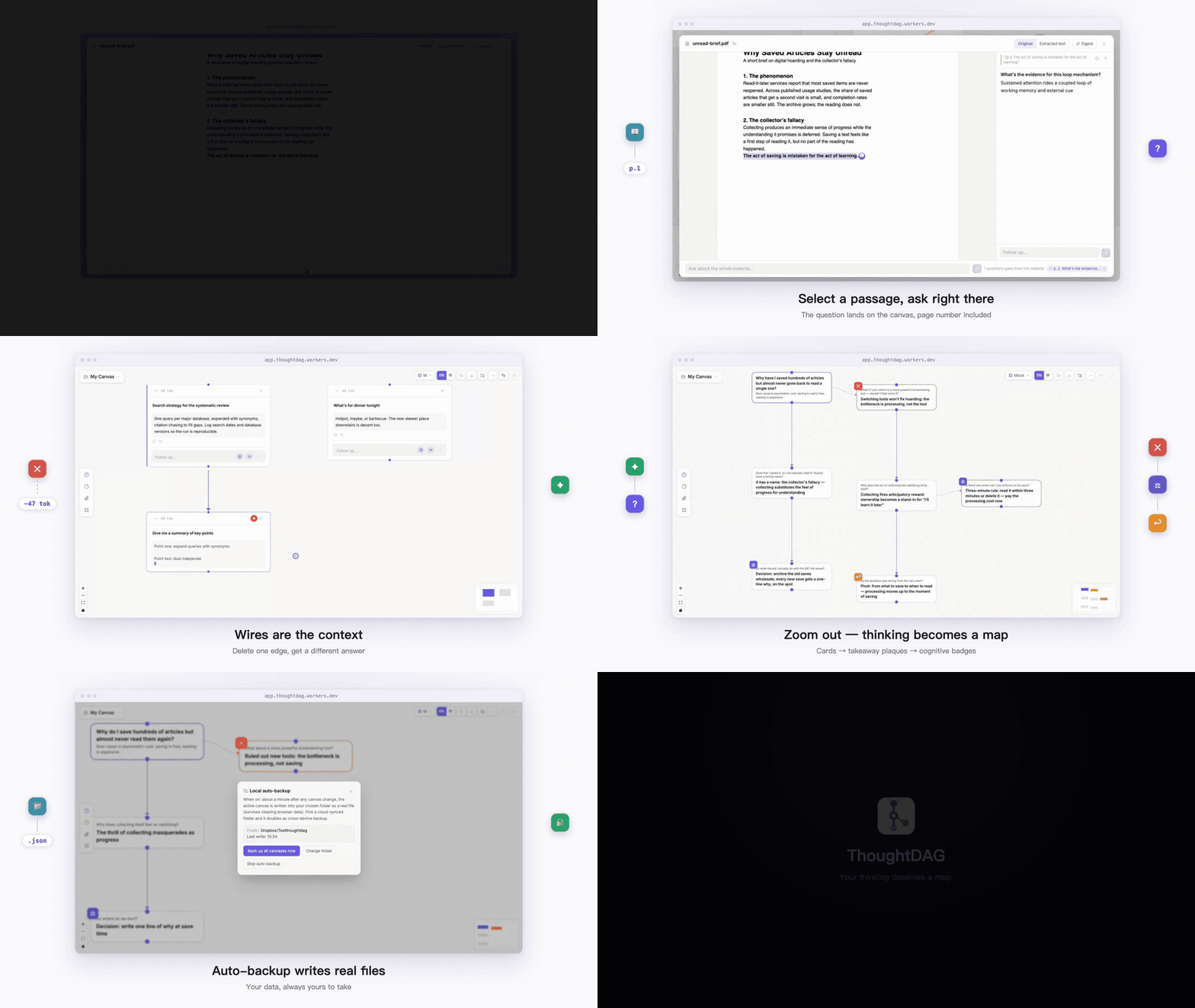
The one rule
Wires are the context. What the model sees is exactly what wires into the node. Editing the graph edits the model's memory.
In action
One principle behind every gesture: the human in the loop, the model on the wires. No autonomous agent redraws your graph.
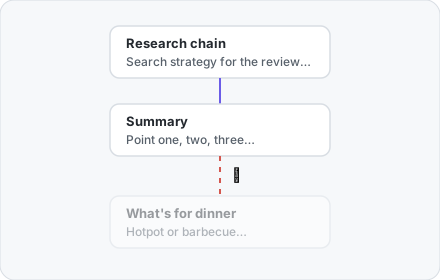 |
✂️ Delete one edge, get a different answerThe model sees only what wires in. Delete the noise edge, ask again, and the same prompt returns a clean answer. Reproduce it in chapter ③ of the example canvas. |
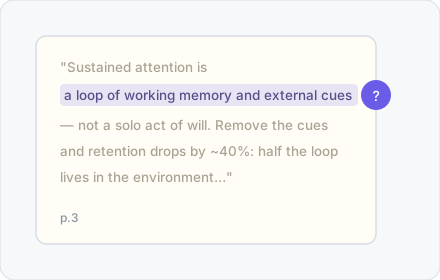
📖 Read a paper into a mapSelect a passage, ask right there. The answer lands on the canvas with its page number, and the p.N chip jumps back to the page. Finish the paper, and the map is drawn. |
 |
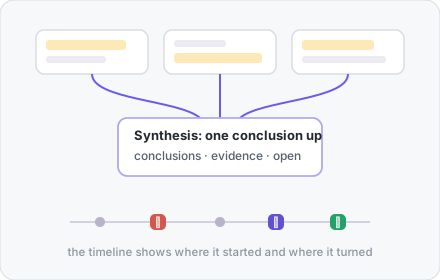 |
💎 Thinking condenses in your handsMerge nodes into one higher conclusion; weave highlights into a summary. The graph folds inward instead of sprawling. The human refines in the loop. |
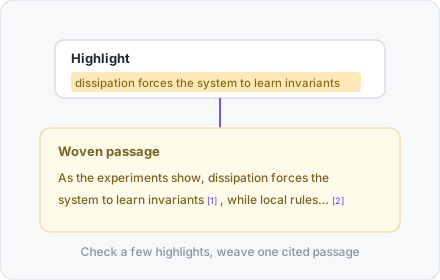
🖍️ The passages you marked, woven into cited proseHighlights are your judgment, not the model's. Check any subset and weave one passage where every sentence traces back. |
 |
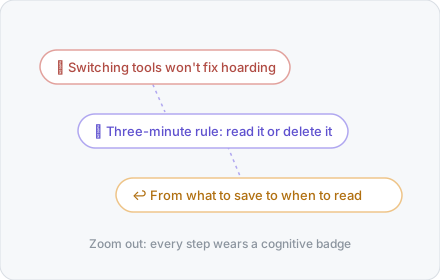 |
🗺️ Zoom out: thinking becomes a mapFull cards, takeaway plaques, an icon skeleton: three semantic tiers, every step badged ✕ ⚖ ↩ ?. The detours are part of the map. |
Quick start
# Online: app.thoughtdag.workers.dev (example canvas needs no key)
# Local:
npm install
npm run server    # LLM proxy :3001
npm run dev       # → localhost:5173
# No .env? Connect any OpenAI-compatible endpoint inside the app
The first launch opens a seeded example canvas: four chapters around one everyday question (why saved articles stay unread), including a reading loop with a real embedded PDF. Environment variables, free keys and configuration details → docs/setup.md
More capabilities
| Capability | What it does |
|---|---|
| 📤 Read-only share | One link carries the whole graph: no account, no server storage |
| 🧭 Staleness & replay | Upstream edits mark the answers they invalidate; replay in dependency order, token estimate first |
| 🧪 Paradigms | Human-machine workflows saved as files; change the input, replay the experiment |
| 🔌 Any model | Per-node pins that follow the line; image requests reroute to vision models automatically |
| 🔒 Local-first | Automatic folder backup writes real files; point it at a synced folder for cross-device |
Full feature list (60+, grouped by area) → docs/features.md
Supported models
Zhipu · Qwen · OpenAI · Anthropic · Google · DeepSeek · Kimi · OpenRouter · Ollama, or any OpenAI-compatible endpoint. Requests with images reroute to vision models automatically. Environment variables and default models → docs/setup.md
Cost & privacy
- The free model tier covers every feature; a local Ollama runs fully offline
- On the hosted demo, model traffic runs browser-direct: keys never touch the server
- PDFs never leave your machine; only extracted text travels when you ask
- The backup format stays backward compatible; Markdown export is the permanent escape hatch
Reviews (0)
Sign in to leave a review.
Leave a reviewNo results found