n2-arachne
Health Gecti
- License — License: NOASSERTION
- Description — Repository has a description
- Active repo — Last push 0 days ago
- Community trust — 52 GitHub stars
Code Basarisiz
- fs module — File system access in package.json
- exec() — Shell command execution in src/lib/backup.ts
- fs.rmSync — Destructive file system operation in src/lib/backup.ts
- process.env — Environment variable access in src/lib/config.ts
- exec() — Shell command execution in src/lib/dependency.ts
- network request — Outbound network request in src/lib/embedding.ts
Permissions Gecti
- Permissions — No dangerous permissions requested
This tool optimizes AI workflows by scanning a codebase and automatically extracting the most relevant code context. It assembles targeted snippets to fit within an AI's context window, eliminating unnecessary noise and reducing token usage.
Security Assessment
Overall Risk: High
This tool executes arbitrary shell commands and performs destructive file system operations (fs.rmSync) inside its backup and dependency modules. It accesses environment variables and makes outbound network requests, likely for downloading packages or generating code embeddings. While no hardcoded secrets or dangerous OS-level permissions were found, the ability to silently execute system commands and delete files presents a significant security risk. If prompted by a malicious AI actor or given a poisoned instruction, it could severely damage your local file system or run arbitrary malware.
Quality Assessment
The project is highly maintained and actively developed, with its most recent push occurring today. It has gained a solid amount of community traction for a niche tool, boasting 52 GitHub stars. The codebase has been recently refactored into strict TypeScript with native Rust and C++ integrations for better performance. However, its license is marked as NOASSERTION at the repository level (though the README claims Apache-2.0), meaning legal usage terms remain somewhat unclear.
Verdict
Use with caution — While efficient and well-maintained, developers should strictly review or sandbox the environment before allowing this tool to run, due to its destructive file operations and shell execution capabilities.
Optimize AI workflows with Arachne. Automatically assembles the perfect code context (Tree, Target, Deps, Semantic) to fit context windows without noise. Built for efficiency and scale.
️ Arachne (n2-arachne)




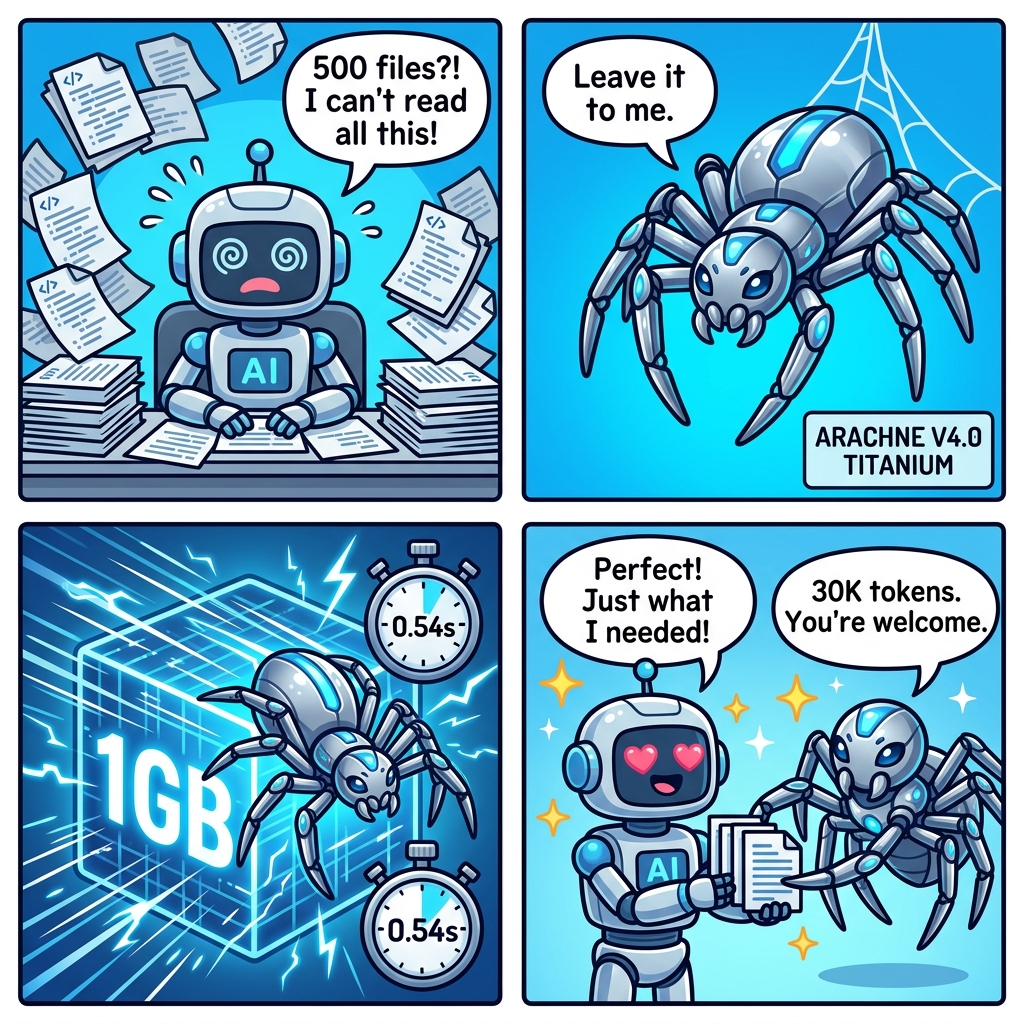
ARACHNE V4.0.0 TITANIUM EDITION
1GB (1,000,000,000 Bytes) Codebase Search in 0.54 Seconds.
Powered by Zero-Marshaling Architecture. 0 Bytes JS Heap Bloat. No OOM Crashes.
Weave your codebase into the perfect context for AI
What's New in v4.0 (Titanium Edition)
Arachne has been completely rewritten from JS to strict TypeScript, with heavy computational paths natively rewritten in C++ SIMD (sqlite-vec) and Rust (napi-rs).
TypeScript (Strict): 100% type safety with zero runtime regressions.Rust Acceleration: BM25 1.3x faster (memchr SIMD + rayon parallel); BatchCosine 19.9x faster (96ms → 4.8ms).C++ SIMD Search: sqlite-vec scans 10,000 × 768D vectors in just 25ms natively.KV-Cache Integration: Soul-bridge incremental re-indexing enables sub-second history load on start.
— like Arachne, the greatest weaver of Greek mythology. ️
The Problem — Why AI Gets Your Code Wrong
Imagine going to a doctor and saying "I have a headache."
- Bad doctor: reads your entire 500-page medical history, gets confused, prescribes the wrong medicine
- Good doctor: looks at relevant records only — recent symptoms, medications, allergies — and nails the diagnosis
AI coding assistants are like that bad doctor.
When your project has 500 files, AI can't read them all. So what happens?
 Your Project (500 files, 2M tokens)
│
├── auth/login.ts        ←  The bug is HERE
├── auth/session.ts      ←  login imports this
├── api/http.ts          ←  session imports this
├── utils/config.ts      ← ️ timeout settings live here
│
├── pages/home.tsx       ←  completely irrelevant
├── pages/about.tsx      ←  completely irrelevant
├── components/Button.tsx ←  completely irrelevant
└── ... 493 more files    ←  all irrelevant
| Approach | What AI receives | Result |
|---|---|---|
| Dump everything | 2,000,000 tokens | Exceeds context window, AI confused |
| Random files | ~50,000 tokens | Misses critical code, wrong fix |
| Arachne | 30,000 tokens (4 relevant files) | Precise fix, every time |
Tokens = units of text AI reads. More tokens = more cost, slower, less accurate.
AI has a limited "context window" — like a desk that can only hold so many papers.
Real-World Benchmark (N2 Browser — 3,219 files)
| Metric | Value |
|---|---|
| Project size | 3,219 files, 4.68M tokens |
| Arachne output | 14,074 tokens |
| Compression | 333x (99.7% reduction) |
| Index time | 627ms (incremental: 0ms) |
| DB size | 24 MB |
Measured on a real production project. Arachne delivered exactly what AI needed — 333x less data, same accuracy.
️ The Solution — Arachne Picks Exactly What AI Needs
Arachne is a local MCP server that acts like that good doctor. It reads your entire codebase once, understands the structure, and only sends what's relevant to AI.
You: "Fix the login timeout bug"
                │
                ▼
┌──────────────────────────────────────────────────────┐
│  ️ Arachne: "I'll find exactly what you need"      │
│                                                      │
│  L1  Project tree (so AI knows the structure)      │
│  L2  login.ts (the file you're working on)         │
│  L3  http.ts, session.ts (found via search +       │
│        dependency chain: login → session → http)     │
│  L4 ️ config.ts (frequently accessed, has timeout)  │
│                                                      │
│  → 30,000 tokens of perfectly curated context        │
└──────────────────────────────────────────────────────┘
                │
                ▼
        AI generates accurate fix
No manual file selection. No prompt engineering. Just ask.
Why Arachne?
- 98.5% token savings — 30K instead of 2M tokens. Real money saved on API calls
- Beats "Lost in the Middle" — Smart output ordering (L1→L3→L4→L2) keeps critical code where AI pays attention (research-backed)
- Zero external deps — No Docker, no cloud, no API keys. Just
npm installand go - Blazing fast — 21 files indexed in 12ms. Incremental updates in sub-second
- Ultralight — Only 3 deps:
better-sqlite3,sqlite-vec,zod. No bloat - Free for personal/OSS — Apache-2.0 for individuals and open-source projects. No telemetry
- Plug & play — Add MCP config → done. Zero code changes to your project
- Multi-language — Follows import chains across JS/TS, Python, Rust, Go, Java
- Ollama optional — Works perfectly without Ollama (BM25 search). Add Ollama for bonus semantic search
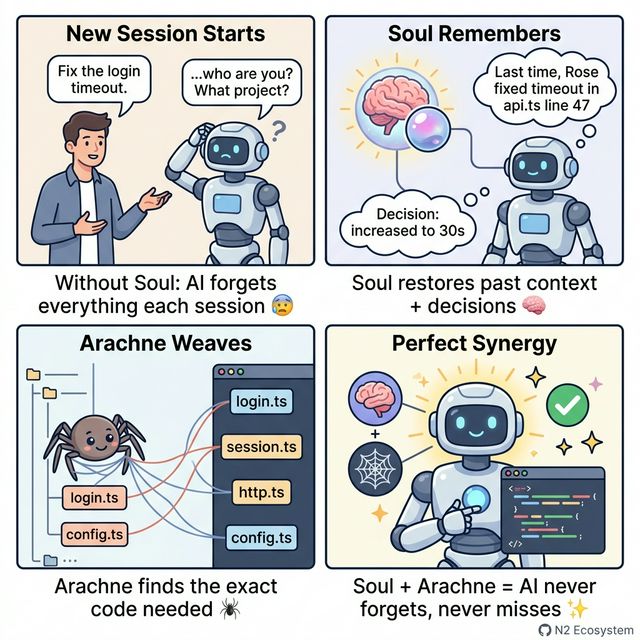
Arachne in 4 Panels — Titanium Edition
Soul + Arachne Synergy
Key Features
| Feature | Description |
|---|---|
| MCP Standard | Works with Claude, Gemini, GPT, Ollama — any AI provider |
| Local-First | All indexing in local SQLite. Zero data leaves your machine |
| Incremental | Only re-indexes changed files. Sub-second updates |
| Hybrid Search | BM25 keyword + semantic vector search (Ollama embeddings) |
| ️ 4-Layer Assembly | Smart context paging within token budget |
| Dependency Graph | Follows import chains across JS/TS, Python, Rust, Go, Java |
| ️ Backup & Restore | SQLite online backup with in-backup search |
️ Architecture: 4-Layer Context Assembly
┌─────────────────────────────────────────────┐
│              Token Budget (e.g. 30K)        │
├────────────┬────────────────────────────────┤
│ L1: Fixed  │ File tree overview (10%)       │
│ (always)   │ Project structure snapshot     │
├────────────┼────────────────────────────────┤
│ L2: Short  │ Current file + recent (20%)   │
│ (context)  │ What you're working on now     │
├────────────┼────────────────────────────────┤
│ L3: Assoc  │ Search + dependencies (50%)  │
│ (relevant) │ BM25 + semantic + dep chain   │
├────────────┼────────────────────────────────┤
│ L4: Spare  │ Frequently accessed (20%)     │
│ (backup)   │ Files you use most            │
└────────────┴────────────────────────────────┘

Output order: L1 → L3 → L4 → L2  (mitigates "Lost in the Middle")
Semantic Search (Optional, Zero Lock-in)
When Ollama is available, Arachne upgrades from keyword-only to hybrid search:
BM25 Score (keyword) ──┐
                       ├── Weighted Merge (α=0.5) → Best Results
Cosine Similarity ─────┘
(nomic-embed-text 768D)
- sqlite-vec for SIMD-accelerated (AVX2/SSE2/Neon) KNN vector search
- 768-dimensional embeddings via Ollama
nomic-embed-text— runs 100% local - Graceful degradation: No Ollama? Falls back to BM25-only. Zero crashes. Always works.
- Enable in config:
embedding.enabled = true - Vector storage: ~3KB per chunk. 5000 chunks = just 15MB on disk
Benchmark (v4.0)
All benchmarks run on AMD Ryzen 5 5600G, Node v24, Windows x64.
Three engines: TypeScript (V8 JIT), Rust (napi-rs), sqlite-vec (C++ SIMD).
Search Performance (10,000 chunks / 768D vectors)
| Search Mode | Engine | Performance | Notes |
|---|---|---|---|
| Keyword | 🦀 Rust BM25 (memchr + rayon) | 4.98 ms / query | 1.3x faster than TS |
| Keyword | SQLite LIKE | 0.021 ms / query | DB index, fastest |
| Semantic KNN | sqlite-vec (C++ SIMD) | 29.52 ms / query | 10K × 768D in-DB native scan |
| Batch Cosine | 🦀 Rust (napi-rs) | 4.91 ms / query | Legacy: 22.3x faster, but triggers IPC heap spikes |
Architecture Pivot: 1GB+ Scale Stability
While Rust BatchCosine achieved blazing speeds (4.9ms), loading millions of vectors across the Node.js FFI boundary triggered massive V8 Garbage Collection (GC) pauses and Heap OOM crashes on 1GB+ codebases.
To achieve 100% stability on large-scale datasets, Arachne v4.0 enforces a Zero-Marshaling Policy:
- Semantic Search: Delegated 100% to sqlite-vec. It takes ~29ms (slightly slower than Rust), but memory overhead is 0 bytes in JS. The Node event loop remains completely unblocked.
- Keyword Search: Powered by the Rust BM25 Cache. Chunk data is cached heavily in the Rust heap, crossing the FFI boundary only for small queries and resulting IDs.
npm run build && node test/bench-hybrid-engine.js   # Raw engine comparison
npm run build && node test/bench-10mb.js             # Memory scale impact
Results saved to data-hybrid-bench/benchmark-report.json.
Java Support — Built for Enterprise
Arachne provides first-class Java support, designed for large-scale enterprise codebases (5M+ LOC):
| Feature | Description |
|---|---|
| Smart Chunking | Detects class, interface, enum, method, @interface (annotations) |
| Large Class Splitting | Classes over 500 tokens are automatically sub-chunked into individual methods |
| Import Resolution | Parses import com.example.Service and import static org.junit.Assert.* |
| Access Modifiers | Handles public, private, protected, abstract, final, synchronized |
| Generics | Correctly processes <T extends Comparable<T>> and complex generic types |
| Spring/JUnit | Tested with Spring Boot @RestController, JUnit5 static imports, Mockito |
| Binary Exclusion | Automatically ignores .class, .jar, .war, .ear files |
How Large Class Sub-Chunking Works
// 500+ token class → automatically split into methods
public class UserService {       // ← detected as container
    public User findById() {}    // ← sub-chunk 1
    public List<User> findAll()  // ← sub-chunk 2
    public User save() {}        // ← sub-chunk 3
    // ... fields, constructor   // ← remainder chunk
}

// Small class (<500 tokens) → kept as single chunk (no overhead)
public class TinyDTO { ... }     // ← single chunk, efficient
Why this matters for 5M LOC projects: A single Java class can have 50+ methods spanning thousands of lines. Without sub-chunking, AI would receive the entire class as one blob. With Arachne, AI gets individual methods — enabling precise, targeted code generation.
Token Impact: Less Is More
Without sub-chunking:
  AI asks: "Fix the findById bug"
  → BM25 hits UserService class
  → Entire class sent: 6,000 tokens

With sub-chunking:
  AI asks: "Fix the findById bug"
  → BM25 hits findById() method only
  → Just the method sent: 80 tokens    75x savings!
Sub-chunking doesn't cost extra — it saves tokens by sending only what's relevant instead of entire classes.
️ Stability: 128 Tests, Zero Failures
Arachne is built for production. Every edge case is tested:
| Category | What's Tested |
|---|---|
| SQL Injection | 5 attack patterns including Bobby Tables |
| ️ Null/Empty Input | null, undefined, empty string → safe return |
| Huge Input | 10KB queries → no crash |
| Special Characters | Unicode, emoji, regex chars → handled |
| Ollama Disconnect | Bad endpoint → graceful BM25 fallback |
| Idempotency | Triple re-indexing → same result |
| Extreme Budgets | Budget 0, 1, 1M → all safe |
| Edge topK | topK = -1, 0, 99999 → no crash |
| Schema Safety | Triple init → data survives |
Phase 1 (Indexing/Search):    15/15
Phase 2 (Assembly/Deps):      26/26
Phase 2 (KV-Cache Bridge):   33/33
Phase 3 (Semantic/Hybrid):    10/10
Stability (Reddit-proof):     44/44
─────────────────────────────────────
Total:                       128/128
Installation
Pro tip: The best way to install? Just ask your AI agent: "Install n2-arachne for me." It knows what to do. ️
npm install n2-arachne
MCP Config (Claude Desktop / Cursor / etc.)
{
  "mcpServers": {
    "n2-arachne": {
      "command": "node",
      "args": ["/path/to/n2-arachne/dist/index.js"],
      "env": {
        "ARACHNE_PROJECT_DIR": "/path/to/your/project"
      }
    }
  }
}
Configuration
Create config.local.js in the Arachne directory:
module.exports = {
    projectDir: '/path/to/your/project',
    dataDir: './data',

    indexing: {
        autoIndex: true,
        maxFileSize: 512 * 1024,    // 512KB max per file
    },

    // Enable semantic search (requires Ollama)
    embedding: {
        enabled: true,              // default: false
        provider: 'ollama',
        model: 'nomic-embed-text',
        endpoint: 'http://localhost:11434',
    },

    assembly: {
        defaultBudget: 30000,       // tokens
    },
};
Usage (MCP Tool)
Arachne registers a single MCP tool n2_arachne with these actions:
| Action | Description |
|---|---|
search |
BM25 keyword search (+ semantic if enabled) |
assemble |
4-Layer context assembly within token budget |
index |
Index/re-index project files |
status |
Show indexing stats + embedding status |
files |
List indexed files |
backup |
Create/list/restore backups |
Example: Assemble Context
{
  "action": "assemble",
  "query": "HTTP request timeout error handling",
  "activeFile": "lib/executor.js",
  "budget": 20000
}
Connect with Soul / QLN
Arachne works great standalone, but becomes far more powerful with Soul (session memory) and QLN (tool routing).
Setup is simple — just register them together in your MCP config:
Soul + Arachne Together
{
  "mcpServers": {
    "n2-soul": {
      "command": "node",
      "args": ["/path/to/n2-soul/index.js"]
    },
    "n2-arachne": {
      "command": "node",
      "args": ["/path/to/n2-arachne/dist/index.js"],
      "env": {
        "ARACHNE_PROJECT_DIR": "/path/to/your/project"
      }
    }
  }
}
Zero extra config needed! Register both servers in the same MCP config and AI automatically uses both tools.
Soulremembers past session work and decisionsArachnefinds the exact code and delivers it to AI- Result: AI picks up right where you left off — no "what was I working on?"
Full N2 Stack (Soul + Arachne + QLN)
{
  "mcpServers": {
    "n2-soul": {
      "command": "node",
      "args": ["/path/to/n2-soul/index.js"]
    },
    "n2-arachne": {
      "command": "node",
      "args": ["/path/to/n2-arachne/dist/index.js"],
      "env": {
        "ARACHNE_PROJECT_DIR": "/path/to/your/project"
      }
    },
    "n2-qln": {
      "command": "node",
      "args": ["/path/to/n2-qln/index.js"]
    }
  }
}
Add QLN and even with 100+ MCP tools, AI automatically finds and uses only what it needs via QLN's semantic routing.
N2 Ecosystem — Better Together
| Package | Role | npm | Standalone |
|---|---|---|---|
| QLN | Tool routing (1000+ tools → 1 router) | n2-qln |
|
| Soul | Agent memory & session management | n2-soul |
|
| Ark | Security policies & code verification | n2-ark |
|
| Arachne | Code context auto-assembly ️ | n2-arachne |
Every package works 100% standalone. But when combined, magic happens:
Synergy: How They Work Together
User: "Fix the login timeout bug"
     │
     ▼
┌─── QLN (Router) ──────────────────────────────────────┐
│ 1000+ tools → Semantic routing finds:                 │
│   → n2_arachne.assemble (context)                     │
│   → n2_arachne.search (code search)                   │
│ Token cost: 2 tool defs instead of 1000+              │
└────────────────┬──────────────────────────────────────┘
                 │
                 ▼
┌─── Arachne (Context) ─────────────────────────────────┐
│ L1: Project tree overview                              │
│ L2: auth/login.ts (current file)                       │
│ L3: BM25 + semantic search → timeout-related code      │
│     + dependency chain: login.ts → api.ts → http.ts    │
│ L4: Frequently accessed config files                   │
│ → 30K tokens of perfectly curated context              │
└────────────────┬──────────────────────────────────────┘
                 │
                 ▼
┌─── Soul (Memory) ─────────────────────────────────────┐
│ "Last session, Rose fixed a similar timeout in         │
│  api.ts line 47. Decision: increased to 30s."          │
│ → Past context + decisions + handoff notes             │
│ → KV-Cache: instant session restoration                │
└────────────────┬──────────────────────────────────────┘
                 │
                 ▼
┌─── Ark (Security) ────────────────────────────────────┐
│  No hardcoded credentials in generated code          │
│  Timeout value from config, not magic number         │
│  Error handling follows project conventions           │
│ → Code verification before commit                      │
└───────────────────────────────────────────────────────┘
Solo vs Combined
| Scenario | Solo | Combined |
|---|---|---|
| Token usage | AI sees all 1000+ tools | QLN routes → AI sees 2-3 tools |
| Context quality | AI guesses which files matter | Arachne provides exact relevant code |
| Memory | AI forgets everything each turn | Soul remembers past sessions + decisions |
| Code safety | No guardrails | Ark validates before deploy |
| Setup | Each tool works independently | Zero extra config — auto-detection |
Real-World Impact
- QLN + Arachne: QLN routes the request to Arachne → Arachne provides perfect context → AI generates accurate code on the first try. No more "which file was that in?"
- Soul + Arachne: Soul remembers what you worked on last session → Arachne indexes those files with higher priority → continuity across sessions
- Ark + Arachne: Arachne provides code context → AI generates code → Ark validates it follows project patterns. Catch bugs before they ship.
- All 4 together: The AI becomes a team member who remembers everything, finds anything, uses the right tools, and follows the rules.
License
This project is dual-licensed:
| Use Case | License | Cost |
|---|---|---|
| Personal / Educational | Apache 2.0 | Free |
| Open-source (non-commercial) | Apache 2.0 | Free |
| Commercial / Enterprise | Commercial License | Contact us |
See LICENSE for full details.
Star History
No coffee? A star is fine too
Arachne — the greatest weaver. Your code, perfectly woven. ️
Yorumlar (0)
Yorum birakmak icin giris yap.
Yorum birakSonuc bulunamadi