tokenforge
Health Uyari
- License — License: MIT
- Description — Repository has a description
- Active repo — Last push 0 days ago
- Low visibility — Only 5 GitHub stars
Code Gecti
- Code scan — Scanned 12 files during light audit, no dangerous patterns found
Permissions Gecti
- Permissions — No dangerous permissions requested
Bu listing icin henuz AI raporu yok.
A Claude Code plugin that trims what every request re-sends. Same work, same quality, about half the tokens.
TokenForge

TF?! Where the fuck did all my tokens go?








Build big things with Claude Code for a fraction of the tokens.
A long Claude Code session re-sends its whole context on every turn. A build that runs for 150 turns at an average of 80k tokens of context reads about 12M input tokens, even though the code it writes is a tiny part of that. tokenforge changes the shape of the work so that context stays small, without lowering code quality.
- Plan once. Your session writes the contracts (shared types and signatures), short library cheat sheets, and a task plan with a check command for every task.
- Build with disposable workers.
tforgeruns each task in a fresh, minimalclaude -pworker. A worker has no hooks, plugins, MCP servers or skills, and onlyRead,WriteandEdit. It sees the contracts, its own files and nothing else, then exits. - Tests decide when a task is done. The driver runs each task's check itself. A failure goes back to the worker condensed: runtime stack frames are dropped. The last retry escalates to a stronger model. A final project-wide check runs integration workers.
- Measure it.
tforge metershows where the tokens went, per session.
Where it helps, measured
Against clean Claude Code. Every benchmark run uses Claude Opus 5.5 (claude-opus-5-5) on Claude Code 2.1.293, on both sides. This is verified from the model field of every API response in the saved transcripts, not just the --model flag. bench/ runs the same task on the same repo commit in sandboxed sessions, once with clean Claude Code (no plugins, skills, hooks, MCP or CLAUDE.md) and once with tokenforge 0.7.0 at its defaults, and scores quality with hidden tests.
Across all 36 tasks, tokenforge used about half the tokens: median −52%, mean −50%, pooled −52%. It was cheaper on 36 of 36 tasks, with equal or better quality on all but two. Weighted by price, which is roughly what usage limits count (cache reads cost 0.1×, and most of the savings are cache reads), the median is −26%. Median tool calls: −49%.
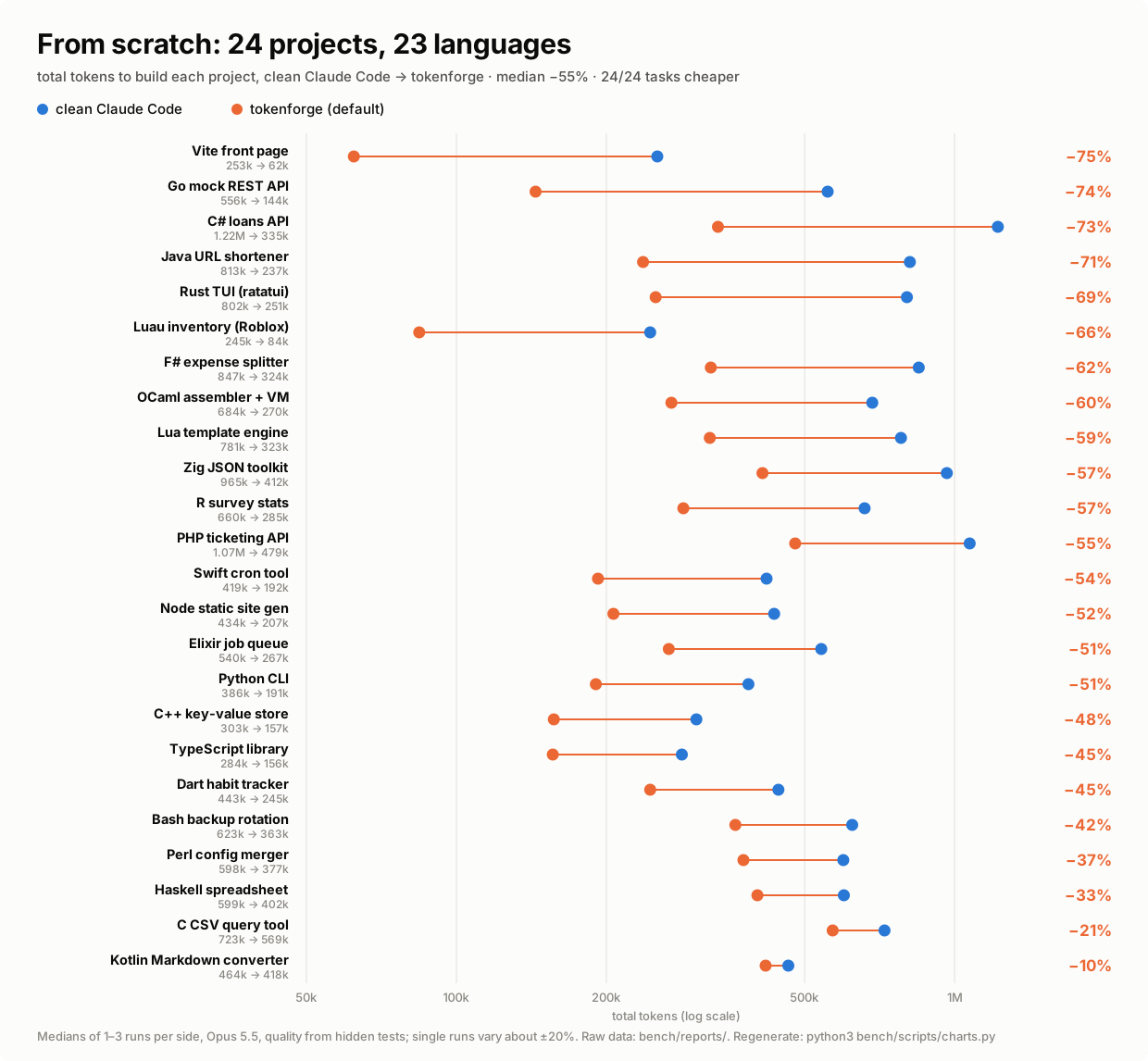
| Built from scratch | Clean Claude Code | tokenforge | Saved | Quality |
|---|---|---|---|---|
| Vite front page | 253k | 62k | −75% | 100 → 100 |
| Go mock REST API | 556k | 144k | −74% | 97.5 → 100 |
| C# loans API (ASP.NET Core) | 1.22M | 335k | −73% | 100 → 100 |
| Java URL shortener (JDK HTTP) | 813k | 237k | −71% | 100 → 100 |
| Rust TUI (ratatui) | 802k | 251k | −69% | 100 → 100 |
| Luau inventory (Roblox-style) | 245k | 84k | −66% | 100 → 100 |
| F# expense splitter (.NET) | 847k | 324k | −62% | 97.5 → 100 |
| OCaml assembler + VM (dune) | 684k | 270k | −60% | 97 → 100 |
| Lua template engine | 781k | 323k | −59% | 100 → 100 |
| Zig JSON toolkit | 965k | 412k | −57% | 97.07 → 97.07 |
| R survey statistics | 660k | 285k | −57% | 97.07 → 97.07 |
| PHP ticketing API (SQLite) | 1.07M | 479k | −55% | 100 → 100 |
| Swift cron tool (SwiftPM) | 419k | 192k | −54% | 100 → 100 |
| Node static site generator | 434k | 207k | −52% | 100 → 100 |
| Elixir job queue (GenServer) | 540k | 267k | −51% | 96.94 → 100 |
| Python CLI | 386k | 191k | −51% | 100 → 100 |
| C++ key-value store (CMake) | 303k | 157k | −48% | 100 → 100 |
| TypeScript library | 284k | 156k | −45% | 100 → 100 |
| Dart habit tracker | 443k | 245k | −45% | 100 → 100 |
| Bash backup rotation | 623k | 363k | −42% | 100 → 100 |
| Perl config linter + merger | 598k | 377k | −37% | 100 → 97 |
| Haskell spreadsheet evaluator | 599k | 402k | −33% | 100 → 100 |
| C CSV query tool (Make) | 723k | 569k | −21% | 100 → 100 |
| Kotlin Markdown converter | 464k | 418k | −10% | 100 → 100 |
Median −55% over 24 projects in 23 languages. Perl config merger: every hidden test passes, but tokenforge scores 97 on the structural checks (the entry script is longer than the 30 lines the spec asks for). The agent gets a spec and an empty repo, and hidden black-box tests check the result (CLI, HTTP contract, headless browser, scripted TUI, lune for Luau). A Ruby log analyzer was also run once per side and is left out of these results: tokenforge used 14% more tokens on it (443k vs 390k), quality 96.25 vs 96.83. bench/benchmark.config.json lists the exclusion and the runs are kept.
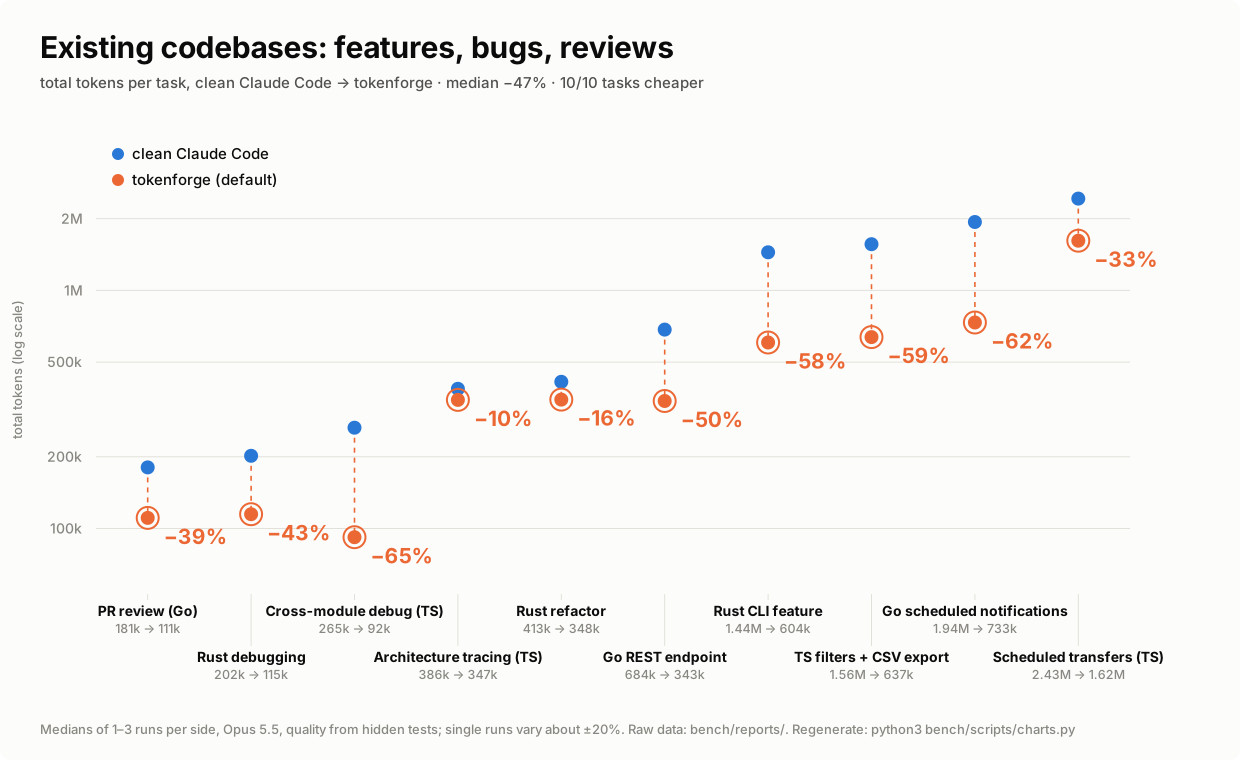
| In an existing codebase | Clean Claude Code | tokenforge | Saved | Quality |
|---|---|---|---|---|
| Cross-module debugging (TS) | 265k | 92k | −65% | 100 → 100 |
| Go scheduled notifications | 1.94M | 733k | −62% | 100 → 100 |
| TS filters + CSV export | 1.56M | 637k | −59% | 100 → 100 |
| Rust CLI feature | 1.44M | 604k | −58% | 100 → 100 |
| Go REST endpoint | 684k | 343k | −50% | 100 → 100 |
| Rust debugging | 202k | 115k | −43% | 88.5 → 100 |
| PR review (Go) | 181k | 111k | −39% | 96.67 → 100 |
| Scheduled transfers (TS, multi-layer) | 2.43M | 1.62M | −33% | 100 → 94 |
| Rust refactor | 413k | 348k | −16% | 100 → 100 |
| Architecture investigation (TS) | 386k | 347k | −10% | 100 → 100 |
Median −47%. Scheduled transfers: every hidden test passes, but tokenforge scores 94 on the structural design checks (9/15), as in every tokenforge run of that task.
| Academic work | Clean Claude Code | tokenforge | Saved | Quality |
|---|---|---|---|---|
| Answer questions from a 15-page PDF paper | 274k | 138k | −50% | 100 → 100 |
| Proofread a LaTeX manuscript (19 planted errors) | 239k | 157k | −34% | 95.3 → 97.8 |
Two runs per side. Proofreading: 19 errors planted across a 12-page LaTeX manuscript, scored by how many are found (recall) with a small penalty for false alarms. PDF Q&A: 10 questions answered from a 15-page two-column paper, one of them only from a figure. The PDF task hides pdftotext, poppler, Ghostscript and Python PDF libraries on both sides, as on a typical Windows machine; with them installed, both sides simply convert the PDF and the comparison says little.
Each row is the median of 1–3 runs per side, and single runs vary by about ±20%, so read per-task numbers as rough and the overall result as solid. bench/reports/ has the raw data, and bench/scripts/charts.py redraws these charts from it. bench/ reruns everything.
Why it works. Every request re-sends Claude Code's tool and skill definitions, and re-reads everything said so far:
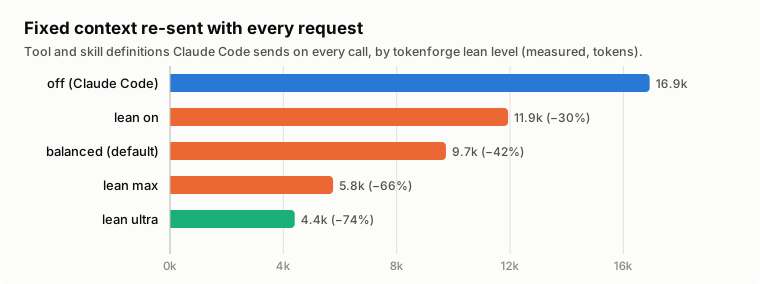

- Fixed context: 16.9k tokens per request by default, 9.7k at tokenforge's default lean level. On short tasks this floor is most of the cost.
- Fewer round trips: each call re-reads the whole context. Batching (several files per call, one-call code reads with
tread) built whole projects in 3–9 calls where clean Claude Code took 7–22. - Smaller tool results: they are 80–95% of context growth in existing codebases, and every one is re-read by every later call. Broad dumps fold, long lines are cut, build and test output is compacted.
- Less code: "every stated requirement, nothing extra", written concisely but readably.
The older measurements below are about tforge workers, not the hooks.
Numbers come from tforge meter (Claude Code 2.1.292, Opus main model). "Input-equivalent" weighs each token type by its relative price: cache writes 1.25×, cache reads 0.1×, output 5×.
Where the tokens really go. In one real 11-hour Rust session, the main thread used 1.4M input-equivalent tokens and its 15 subagents used 17.1M (93%):
- 1,253 calls, each re-reading about 80k of context;
- about 570 of their 900 Bash calls were
sed,greporcat, exploring code; - their total output was only 29k tokens.
Long-lived workers that explore and keep re-reading a growing context are the pattern tokenforge replaces:
- the planner explores once and hands workers exact line ranges;
- every check cycle starts a fresh worker with condensed errors;
- the foreman is a script that costs zero tokens.
Worker overhead. A tokenforge worker carries 2.5k tokens of fixed context per call. A default claude -p with typical plugins carries 26.2k (10×). Shared context is cached across workers. For haiku tasks, thinking is off by default: on a test-writing task that cut output from 10.6k to 4.3k tokens with the same quality.
Small greenfield builds: not worth it. On a browser image editor of about 1–1.6k lines:
| input-equiv | cost | result | |
|---|---|---|---|
| one Opus session | 174k | $0.78 | all checks pass, 35 tests |
| tokenforge 0.1 (before the thinking fix) | 532k | $1.14 | all checks pass, 81 tests |
A strong model writes a fresh small app in a handful of big batches, so the code's own output is most of the cost and there is little context re-reading to remove. The forge skill tells Claude to work inline in that case.
Install
Inside Claude Code:
/plugin marketplace add chteau/tokenforge
/plugin install tokenforge@tokenforge
Requirements: Claude Code and Node.js 18 or newer. Subscription (OAuth) logins and API keys both work. tmap needs a release binary for your platform, or Rust to build one.
Updates
tokenforge is a normal plugin. It never patches Claude Code, wraps the claude binary or edits your settings files, so Claude Code's own auto-update keeps working as usual. To update tokenforge itself automatically, open /plugin, go to Marketplaces, select tokenforge and enable auto-update. Otherwise run /plugin marketplace update tokenforge whenever you like.
To uninstall, run /plugin uninstall tokenforge@tokenforge. Nothing is left behind except .forge/ folders in the projects where you used it.
Use
Nothing to learn: once installed it works on its own, in the terminal and in Claude Desktop.
- Every new session starts with
TokenForge: active · lean balanced · replies full · dashboard http://127.0.0.1:7878/, plus a three-line walkthrough for the first three sessions. It is shown to you only, never sent to Claude (TFORGE_BANNER=0hides it). - After
/clearit says what survived:TokenForge: checkpoint saved (2 min ago, .forge/snapshots/). If there is no fresh handoff, a compact version of the last checkpoint (last two requests, files changed, start of the last reply; at most 900 characters, about 250 tokens per call) is reloaded so Claude continues without re-exploring (TFORGE_CLEAR_RELOAD=0turns it off). - Updates: once a day, in the background, it checks GitHub for a newer version and shows
TokenForge 0.7.2 is available…with the command to run (TFORGE_UPDATE_CHECK=0turns it off). - Papers, notebooks and LaTeX.
tkit pdfgives a PDF's text with page markers (opt-in for every Read withTFORGE_DOCREAD_PDF=1: Claude Code's own PDF reading, ~1.3k tokens a page, was cheaper on a table-heavy paper and keeps figures, so it stays the default). Notebooks are read as cells, with long outputs trimmed and images left out. LaTeX builds print only errors with file:line, undefined references and citations, and a box summary.TFORGE_DOCREAD=0turns the notebook reading off. - No permission prompts for its own tools. TokenForge's read-only tools (
tread,tview,tkit ctx/diff/debug/deps/check/test,tforge recall) are approved automatically, alone or chained with read-only commands likegrepandsed -n. Network and remote tools (tkit http/web/ssh) still ask; the multi-file edit tools (tkit edit/patch/fmt) go through only when the session already accepts edits without asking. Without this, every lookup by name asked for permission, so Claude fell back tocatandsed.TFORGE_AUTO_ALLOW=0turns it off.
/tokenforge:forge build a browser image editor with layers, three filters, undo/redo and PNG export
The skill scaffolds the project with the ecosystem's generator, writes src/contracts.ts, the .forge/cheats/*.md notes and .forge/plan.json, then runs the workers and reports the result. For small jobs (under about 5 files) it tells you to work inline instead, because planning would cost more than it saves.
Other skills:
| Skill | What it does |
|---|---|
/tokenforge:handoff |
Writes .forge/HANDOFF.md (done, decisions, next steps, file map). Run /clear afterwards: the handoff reloads automatically, and the conversation continues at a fraction of the context. |
/tokenforge:meter |
Token usage of your recent sessions and worker runs. |
/tokenforge:terse |
Reply style: full (default), lite or off. |
/tokenforge:dashboard |
Opens the local dashboard and prints its address. |
Terse replies (built in, replaces caveman-style plugins)
On by default. At session start, and again after compaction, tokenforge adds one reply-style rule of about 60 tokens. Nothing is added per prompt. Answers lead with the result and skip background nobody asked for. Code, paths, commands, numbers and negations stay exact. Security warnings and irreversible steps stay in full sentences. Files Claude writes keep their normal style.
Measured with Sonnet on three everyday questions (output tokens):
| fixed context per call | EADDRINUSE | rebase vs merge | rm -rf lockfile in prod |
|
|---|---|---|---|---|
| no style plugin | 0 | 937 | 761 | 599 |
| caveman 3.1.0 | +1.2k | 408 | 259 | 389 |
| tokenforge terse | +0.2k | 353 | 256 | 182 |
The fixed context is re-read on every API call, tool calls included, so the smaller rule matters most in long, tool-heavy sessions.
Switch with /tokenforge:terse full|lite|off. lite keeps short full sentences. The choice is saved in ~/.config/tokenforge/config.json. The env var TFORGE_TERSE overrides it. If you also run another reply-style plugin, disable one of them: both rules would load.
Lean tools
Every request carries the definition of every enabled tool and skill. Lean levels hide the ones a coding session rarely needs. Measured fixed context per request:
| Level | Hides | Per request |
|---|---|---|
off |
nothing | 16.9k |
on |
agent-orchestration tools: Workflow, Monitor, Cron*, ScheduleWakeup, RemoteTrigger, PushNotification, SendMessage, ListAgents, TaskStop, DesignSync, ReportFindings, worktrees, NotebookEdit | 11.9k |
balanced (default) |
also Claude Code's 19 built-in skills, marked user-invocable-only: Claude no longer sees them, but you can still type them as slash commands. Your own and plugin skills, subagents and web tools stay. |
9.7k |
max |
also the Skill tool, subagents (Task), WebFetch/WebSearch and Claude Code's git instructions |
5.8k |
ultra |
also Read/Edit/Write: Claude reads and edits files with Bash (sed -n, cat > file, scripts). No image or PDF viewing. |
4.4k |
On first start, tokenforge sets balanced once and tells you so in a message shown to you, not to Claude. It writes only its own entries to ~/.claude/settings.json (permissions.deny and skillOverrides), because plugins cannot set permissions themselves. It never re-applies after you choose a level. To skip it, set TFORGE_LEAN_DEFAULT=off (or on, max, ultra) before the first start.
Change the level on the dashboard's Settings page, with /tokenforge:lean <level>, or with tforge lean <level>. The Settings page also picks which built-in skills Claude may still use on its own. tforge lean off removes exactly the entries tokenforge added, never your own. Changes apply to sessions started afterwards.
Dashboard (local web UI)
A local dashboard starts in the background with your first session. Open it with /tokenforge:dashboard, or with tforge ui in a terminal. The address is http://127.0.0.1:7878/, or the next free port.
- Settings (sidebar): health first (how many recent sessions actually loaded tokenforge, which run an older build, which still fire hooks of removed plugins; plugins load only when Claude Code starts, and
/cleardoes not reload them), then the lean level, which built-in skills Claude may use on its own, and terse replies. The overview shows a one-line banner when something needs attention. - Overview:
- usage limits, with the time left until each reset;
- today, 7-day and 30-day totals;
- a 30-day chart split by token type;
- the last 48 hours;
- 5-hour windows over the last week;
- usage per model.
- Projects: every folder Claude Code ran in, with sessions, calls and subagent share. Open a session to see its context-per-call curve: every point is re-read by the next call, so the area under the curve is what the session cost. Compactions show up as drops. Below the curve, Where the tokens went ranks the session's tool results by estimated cost (size × later calls that re-read it), so you can see which reads were expensive.
- Memory: the project's past sessions as a graph of sessions, files they edited and recurring keywords, with the same search Claude gets through
tforge recall. Click a session for its prompts, commits, files and last reply. - Code graph: folders and files as a force-directed graph, colored by language. Pan, zoom and drag nodes, hover to light up neighbors, switch on call links between files, filter by path or symbol, and click a file for its callers, callees and outline.
Savings in your status line. On first start, if you have no status line, TokenForge sets one that shows an estimate of what it saved today, e.g. TF −45% today (~1.2M saved), and says so once in the startup notice. If you already have a status line it is never replaced; tforge statusline --setup appends the segment to yours (your command keeps running and printing as before). tforge statusline --remove restores exactly what was there; TFORGE_STATUSLINE=0 turns the automatic setup off. The estimate (lib/estimate.mjs) adds up, for sessions shown in the status line: fixed context the lean level removes from every API call (16.9k tokens at off minus your level's measured size, 0 for sessions started before the last lean change), tkit output kept out of context (re-sent on each later call until compaction when it can be tied to the session, otherwise counted once), and prompts the answer cache answered with 0 tokens (one call at the context size before). Percent = saved / (used + saved), in tokens processed (cache reads count fully). Subagents are not counted. The dashboard overview shows the same estimate.
Limits and resets. Exact 5-hour and weekly usage and reset times only exist in the status-line data Claude Code passes to a status-line command, so the same status line records them (tforge statusline --setup if you kept your own). tokenforge edits your Claude Code settings only for lean tools (once on first start, the default level, see Lean tools, and when you change the level: its own deny and skill entries, plus includeGitInstructions at max/ultra) and for the status line above. Without it, the dashboard estimates the 5-hour window from your session timestamps and labels it as an estimate.
Privacy. The server listens on 127.0.0.1 only and rejects other Host headers, which blocks DNS rebinding. It answers GET requests, plus one POST for the Settings page (lean level, skills, terse), accepted only from its own page (same-origin Origin and a JSON body). It loads nothing from the internet. It reads your transcripts incrementally: only new bytes, with a cache in ~/.cache/tokenforge/. From transcripts it keeps and serves numbers only, never prompt, reply or file text. Three exceptions: the session page's "Where the tokens went" table, which shows the command or file path behind each costly tool result (read on demand, never cached); the Memory page, which shows prompt and reply snippets and file names from that project's sessions (the index behind it, in ~/.cache/tokenforge/memory/, holds those snippets); and a project's own .forge/snapshots/, shown on its project page so you can see what /clear will reload; only files listed in that folder can be requested. TFORGE_UI=0 disables the auto-start, and tforge ui --stop stops it.
tmap: code map (built in, replaces CodeGraph-style indexers)
tmap is a small Rust indexer bundled with the plugin. It parses Rust, TypeScript/TSX, JavaScript, Python and Go with tree-sitter and keeps an index in ~/.cache/tokenforge/tmap. Every command refreshes the index first, re-parsing only changed files. It respects .gitignore and skips dependency and build folders even without one.
tmap find <words>        ranked definitions: path:start-end  signature
tmap tree [dir|file]     folders, files and their top-level symbols; a file gives its outline
tmap sym|callers|callees <name>
tmap slice <name>        path:start-end, ready for a forge plan's "reads"
Measured on a 1,228-file Rust workspace:
- full index from scratch: 0.9s;
- each later command: about 25 ms;
- one CodeGraph query: 3.4s.
Output for "where is orbit speed handled":
| output | |
|---|---|
grep -n orbit |
~5,100 tokens |
codegraph explore |
~6,200 tokens |
codegraph query |
~220 tokens |
tmap find orbit speed |
~70 tokens, with the right definition and its line range |
Where it pays off: the forge skill uses it to hand workers exact line ranges, and tmap tree is a fast map for you. In A/B runs of normal Sonnet sessions, a session hint did not get the agent to use tmap. Redirecting Grep and Read to it was mixed: two small wins, and one run where the agent worked around it and used more tokens. Both are therefore opt-in:
TFORGE_MAP=1adds a one-line hint at session start;TFORGE_REDIRECT=1answers identifier-like Grep calls, Bash greps for one code identifier, and whole-file reads of large source files from the index. Repeating the identical call always goes through.
First use: the launcher downloads the prebuilt binary for your platform from this repo's releases and checks it against the published SHA-256. If no release binary fits, it builds once with cargo (one to two minutes). TMAP_BIN points to your own binary.
tkit: token-saving tools (built into tmap)
tkit <tool> (same as tmap kit <tool>) replaces multi-step shell work with one call whose output is short and shaped for the model. The tools are ported from token-surgeon and use the tmap index wherever it needed CodeGraph. Every tool has --help.
| Tool | Instead of | Does |
|---|---|---|
diff [BASE | --pr N] |
git diff + reading files |
stat, touched symbols with callers, affected tests, whole-function diff; degrades to -U3, then a hunk index |
debug [-- test cmd | --trace FILE] |
rerun + grep + read frames | failures, top-frame code, code under test, recent diff |
analog 'literal' |
grep + opening neighbours | where the literal lives, analog files, one import hop |
ctx SYM [--refs | --outline] |
grep + Read | definition slice, calls, callers |
patch (JSON on stdin) |
Edit turn + test turn | atomic find/replace edits, then the narrowest tests |
distill -q "question" -- cmd |
reading a huge log | Haiku reads it; only the answer comes back (lossy: never for code you edit) |
check [--fast] [--changed] [-e] |
cargo/tsc/go vet/dotnet build/... |
build + lint, one line per diagnostic |
test [FILTER] |
raw test output | summary + failures only |
deps ls|where|api|why PKG [SYM] |
browsing node_modules, ~/.cargo/registry, ... |
a dependency's API or source location |
proj, fmt [--check] |
reading manifests, formatting by hand | stack facts; format changed files only |
edit [-n] [-d] [-t CMD [--keep]] |
several Edit calls | atomic multi-file <<< old === new >>> edits; a failing -t test rolls them back |
jx, tab, tally |
ad-hoc python | JSON/JSONL/TOML queries and edits, SQL over CSV/JSON, counting and stats |
img, http, port, ssh, web |
screenshots at full size, curl, lsof, interactive ssh, whole web pages | shrink/crop images before reading, compact HTTP, who holds a port, capped non-interactive ssh, page outlines and sections |
check, test, deps, proj and fmt detect the stack at the nearest manifest: Rust, Go, TS/JS, C#, Luau, Dart, Python, Java/Kotlin, C/C++, PHP, Ruby, Swift, Elixir, Zig, Scala. Linux, macOS and Windows are supported.
Hooks (automatic):
- Context budget. Every API call re-reads the whole context from the cache, so cache reads grow with calls × context size. The budget is 50k tokens of context per call, or the session's fixed part (system prompt, tools, skills, hook text, measured on its first call) plus 15k if that is larger.
- The warning is shown to you; it reaches Claude's context only with
TFORGE_WATCH_INJECT=1(an injected "stop and /clear" note ended unattended tasks halfway). - Over the budget, your messages are never held. You get one alert per 10k step, and
.forge/HANDOFF.mdis written automatically from this session's snapshots (recent requests, every file changed, the last reply; no model call), so/clearat any moment loses nothing: the next session continues from it. A handoff you wrote yourself (/tokenforge:handoff) is never overwritten.TFORGE_AUTO_HANDOFF=0turns the automatic one off.
- The warning is shown to you; it reaches Claude's context only with
- Snapshots. After every reply, the session is saved in chunks to
.forge/snapshots/: each chunk holds its requests, changed files, last reply and context size. A chunk closes after 6 requests or at a compaction, and each session starts its own. Hooks write them from the transcript, not Claude, so they cost no tokens and are current even when no handoff was written. The last 50 per project are kept. The dashboard's project page lists them. - Memory.
tforge recall <words>searches the project's past sessions, built from your Claude Code transcripts: prompts, commit messages, files edited and read, and how each session ended. It returns the few matching sessions and files (--session IDgives one session in full). On startup and/clear, Claude gets one line instead of the old snapshot dump: how many earlier sessions exist and the newest one's first prompt, with a pointer totforge recall. Past work then costs tokens only when the task needs it, not ~2k re-read on every call. The index lives in~/.cache/tokenforge/memory/and refreshes incrementally.TFORGE_RECALL=injectrestores the old snapshot loading;TFORGE_RECALL=0turns the hint off. Inbench/'s two-session task (a follow-up on the previous session's feature), recall used a median of 234k tokens against 263k with injected snapshots and 413k for clean Claude Code, at full quality (two runs each; rough). - Repeated questions. If you ask a question you already asked in this project, that earlier turn changed no files, and no project file changed since, the prompt is not sent to Claude: you see the earlier answer and its date, at zero tokens. Send the same message again to ask Claude anyway. A closely similar earlier question ("I forgot the dev admin password") is not blocked: Claude gets the earlier answer as one short hint instead of searching for it. Answers come from your transcripts and are not re-checked. Requests whose point is a fresh look (review, proofread, verify, check, "relis", "vérifie", "sans contexte", "from scratch"…) always go to Claude. Off:
TFORGE_ANSWER_CACHE=0. - Handoff reload. On startup or
/clear,.forge/HANDOFF.md(if under 72 hours old) is loaded into the session, because writing one is a deliberate "continue from here". - Terse rule. Injected on startup,
/clearand after compaction (see above). - Efficiency policy (SessionStart, SubagentStart). Three lines, about 210 tokens: results are re-read on every call, so read code in one call (
tread NAME path:40-80 "path:/regex/"instead of grep then sed), batch, edit each file in one call, and run checks once and only after code changes. Scope: every stated requirement and nothing extra (no unasked features, docs, refactors, dependencies or abstractions), reuse existing code, concise but readable code without boilerplate, dead code or comments that restate it, fix shared code once, infer instead of asking, and stop once the checks pass. That is "lazy, not negligent", adapted from ponytail without its challenge-the-requirement mode, which skips requirements.TFORGE_LAZY=0drops the scope line. Subagents get only this. Off:TFORGE_KIT_POLICY=0. - Bash router (PreToolUse
Bash|Read). Raw build and test commands whose flags it fully understands are rewritten totkit check/tkit test(cargo, go, tsc, vitest/jest, npm/pnpm/yarn/bun test, dotnet, pytest, dart/flutter, mvn, gradle, mix, zig, swift, ctest, rspec, phpunit/pest, sbt;.exe/.cmdnames included).ssh HOST CMDandscpbecometkit ssh. A plaincatof project files totalling 12k+ characters goes throughtview: bodies longer than 8 lines fold to their signature plus the exactsed -n a,bpcommand that prints them, in any language (tmap's parser where it has one, an indentation-based fallback for Luau, Lua, Ruby, Java, C#, Kotlin, C/C++ and the rest), and lines over 400 characters are cut; smaller, focused reads print unchanged. A rewrite happens only when every segment becomes a tkit/tview call or is read-only (grep,sed -n,ls,git status…), or the session already bypasses permissions; otherwise the line runs unchanged, so a rewrite never adds a prompt. Lines with a heredoc are never touched. Refused, with the tkit command to use instead: interactivessh HOST, reading a 8k+ saved tool output (tool-results/*.txt) whole, and whole-file dumps (cat,less, whole-file Read) insidenode_modules,~/.cargo/registry, Gopkg/mod,~/.m2,~/.nuget, wally and pub caches (tkit deps api); focusedgrep/sed -n/headslices there go through. Anything else runs unchanged. Escape hatches: prefix one command withTFORGE_RAW=1(orTS_RAW=1; anexportdoes not count), or repeat the identical call. WithTFORGE_REDIRECT=1, a Bashgrep/rg/git grepfor one code identifier is answered bytkit ctxthe same way. Off:TFORGE_KIT_ROUTE=0. - Prompt router (UserPromptSubmit). Keywords pick review, debug, write or inspect, and that mode's first context is pre-loaded:
tkit difffor a review (for a PR, Claude is told to runtkit diff --pr N: hooks make no network calls), a pasted stack trace resolved bytkit debug --trace,tkit analogforbacktickedliterals when writing,tkit ctxforbacktickedsymbols when inspecting. Silent for slash commands, short prompts, prompts that match no mode and folders outside git. At most 300 lines (TFORGE_ROUTE_MAX_LINES), 8 s per tkit call (TFORGE_ROUTE_TIMEOUT_MS). Opt-in since 0.7.0 (TFORGE_KIT_PROMPT=1): its mode guess misfired on feature work and its pre-load is re-read on every call. - MCP distill (PostToolUse
mcp__.*). An MCP result over 6000 bytes is read by Haiku (tkit distill) and Claude gets only the facts. Put#rawin the tool input for the exact text. Small results, a missing tmap binary, or a failed or timed-out model call leave the result unchanged. Off:TFORGE_KIT_DISTILL=0.
TFORGE_KIT_HOOKS=0 turns off the last four at once.
The tforge command
The plugin puts tforge on Claude's PATH. You can also run it yourself with node <plugin dir>/bin/tforge.
tforge init                 example .forge/plan.json
tforge validate             check the plan, print task order
tforge run [--only a,b] [--force a,b] [-j N] [--dry-run] [--detach]
tforge wait                 wait for a detached run (up to 9 min per call), print its summary
tforge status               task states and spend
tforge prompt <id>          the exact prompt a worker receives
tforge meter [--last N | --all | files...] [--json]
Plan format
{
  "version": 1,
  "goal": "Browser image editor",
  "context": ["src/contracts.ts", ".forge/cheats/konva.md"],
  "verify": "npx tsc --noEmit && npx vitest run && npx vite build",
  "defaults": { "model": "sonnet", "retries": 2 },
  "tasks": [
    { "id": "history-test", "spec": "Vitest tests for History in contracts.ts ...", "files": ["src/history.test.ts"], "model": "haiku" },
    { "id": "history", "spec": "Implement History from contracts.ts ...", "files": ["src/history.ts"],
      "reads": ["src/history.test.ts"], "deps": ["history-test"], "verify": "npx vitest run src/history.test.ts" }
  ]
}
| Field | Meaning |
|---|---|
context |
Files every worker sees. They go into the system prompt, so after the first worker they come from the prompt cache at about a tenth of the price. |
verify |
Final project-wide check. If it fails, integration workers fix it, up to retries times. |
tasks[].files |
Files the task owns. Every file has exactly one owner. Writes outside them are recorded in the ledger. |
tasks[].reads |
Extra files inlined for this task only. |
tasks[].deps |
Tasks that must pass first. A failed dependency blocks its dependents. |
tasks[].verify |
The task's check. Without one, the task passes as soon as its files exist. |
tasks[].model |
haiku, sonnet or opus. |
defaults |
model, integrateModel, tools, maxTurns (12), retries (2), escalate (true), budgetUsd (1.5 per attempt), timeoutMin (20), verifyTimeoutMin (10), inlineMaxChars (60000). |
A task reruns only when its definition (or a dependency's) changes. Use --force after changing a contract.
.forge/state.json, .forge/ledger.jsonl (one line per worker attempt: model, turns, tokens, cost, outcome) and the run files are git-ignored automatically. Commit plan.json and the cheat sheets if you like.
Safety
Workers run with --permission-mode acceptEdits and only Read, Write and Edit by default. They cannot run commands. Check commands come from your plan and run on your machine, so read a plan before running it, as you would a Makefile. Run builds on a branch or a git worktree. The workers do not load your settings, hooks, CLAUDE.md or MCP servers. Put project rules that workers must follow into a context file.
Environment
| Variable | Default | |
|---|---|---|
TFORGE_CLAUDE |
claude |
Claude Code binary used for workers |
TFORGE_BUDGET |
50000 |
Context budget per call, in tokens |
TFORGE_BUDGET_FLOOR |
15000 |
Room always left above the session's fixed context |
TFORGE_WATCH |
0 disables the context budget |
|
TFORGE_WATCH_INJECT |
1 also puts the budget notes into Claude's context |
|
TFORGE_VIEW_CHARS / TFORGE_VIEW_FOLD / TFORGE_VIEW_LINES |
12000 / 8 / 40 |
tview: dump size that folds, body lines that fold, file lines that fold |
TFORGE_CHECKPOINT |
0 stops writing snapshots |
|
TFORGE_SNAPSHOT_PROMPTS / TFORGE_SNAPSHOT_KEEP |
6 / 50 |
Requests per snapshot chunk; chunks kept per project |
TFORGE_HANDOFF_MAX_AGE_H |
72 |
Ignore older handoffs |
TFORGE_TERSE |
full, lite or off; overrides the saved choice |
|
TFORGE_MAP |
1 adds the tmap hint at session start |
|
TFORGE_REDIRECT |
1 answers identifier Grep calls, identifier greps in Bash, and big whole-file reads from tmap |
|
TFORGE_KIT_HOOKS |
0 disables all tkit hooks (policy, Bash router, prompt router, MCP distill) |
|
TFORGE_KIT_POLICY / TFORGE_KIT_ROUTE / TFORGE_KIT_DISTILL |
0 disables that one hook |
|
TFORGE_KIT_PROMPT |
1 enables the prompt router (off by default) |
|
TFORGE_RAW |
TFORGE_RAW=1 cmd runs a Bash command unchanged (TS_RAW=1 works too) |
|
TFORGE_ROUTE_MAX_LINES / TFORGE_ROUTE_TIMEOUT_MS |
300 / 8000 |
Prompt router: lines pre-loaded, time per tkit call |
TFORGE_DISTILL_MCP_BYTES |
6000 |
MCP results at least this large are distilled |
TFORGE_DISTILL_MODEL / TFORGE_DISTILL_TIMEOUT |
haiku / 120 (60 in the MCP hook) |
Model and seconds for tkit distill |
TMAP_BIN |
Use this tmap binary | |
TFORGE_AUTO_ALLOW |
0 makes TokenForge's own read-only tools ask for permission like any other command |
|
TFORGE_CLEAR_RELOAD |
0 stops reloading the compact checkpoint after /clear |
|
TFORGE_UPDATE_CHECK |
0 stops the daily background check for a newer version |
|
TFORGE_AUTO_HANDOFF |
0 stops writing .forge/HANDOFF.md automatically over the context budget |
|
TFORGE_DOCREAD |
0 reads notebooks in their original form (raw outputs and images) |
|
TFORGE_DOCREAD_PDF |
1 reads PDFs as extracted text (cheaper on plain prose, dearer on table-heavy papers, no figures) |
|
TFORGE_BANNER |
0 hides the "TokenForge: active" line at startup and the checkpoint line after /clear |
|
TFORGE_UI |
0 stops the dashboard from starting with your first session (it never auto-starts in headless claude -p, SDK or CI sessions) |
|
TFORGE_UI_PORT |
7878 |
Dashboard port (the next free one is used if taken) |
TFORGE_NO_DOWNLOAD |
1 never downloads tmap; build with cargo instead |
|
TFORGE_DISTILL_MODEL / _TIMEOUT / _MAX_BYTES |
haiku / 120 / 480000 |
Model, timeout (s) and input cap for tkit distill and web --ask |
Benchmark
bench/ holds a reproducible A/B benchmark: clean Claude Code against Claude Code with tokenforge only, on the same model, tasks, repo commits and toolchains. It has 10 tasks in existing codebases (Rust, Go, TypeScript; features, debugging, PR review, architecture tracing, refactoring) and 25 from-scratch projects in 24 languages, each with hidden tests or a hidden answer key and a validated reference solution. Every run is sandboxed: an empty HOME and config dir, no MCP, and a preflight contamination audit. Token counts come from the API usage in every transcript, tokenforge's own overhead and nested calls included.
cd bench
python3 runner/bench.py env build && python3 runner/bench.py doctor
python3 runner/bench.py run --smoke
python3 runner/bench.py run --all
Results go to bench/reports/benchmark-report.md. See bench/README.md for the method, metrics and scoring.
Experiments that did not ship (TokenForge-only variants, one run per task, kept apart from the main results):
| Variant | Tasks | Total tokens vs default | Quality | Verdict |
|---|---|---|---|---|
TFORGE_PLAN=brief (policy line: plan briefly) |
C, Kotlin, Java, Swift | −13% (−22%, −28%, +13%, +15%) | one drop (Kotlin 100 → 96) | mixed; opt-in only |
PDFs read as extracted text (TFORGE_DOCREAD_PDF=1) |
PDF Q&A without PDF tools, 2 runs | +37% vs clean Claude Code (376k vs 274k median) | unchanged, but extra calls to recover a figure the text dropped | opt-in only |
CLAUDE_CODE_EFFORT_LEVEL=medium |
C, Kotlin, Java, Swift, PHP, Go feature | −5% (−36%, −12%, +5%, +23%, −9%, +17%) | unchanged | within run-to-run noise; not shipped |
Where output tokens go, across all default TokenForge runs: about 51% thinking, 46% code and commands Claude writes, 2% visible replies. Replies are already short, and the code is the work itself, so planning is the only large lever left, and neither variant moved it reliably.
Development
npm test                        # unit and end-to-end tests with a fake claude binary
cargo test --release --manifest-path native/tmap/Cargo.toml -- --test-threads=1
cargo xwin check --release --tests --target x86_64-pc-windows-msvc --manifest-path native/tmap/Cargo.toml   # Windows build check from Linux
claude --plugin-dir .           # try the plugin locally
claude plugin validate .        # check the manifests
MIT licensed.
Yorumlar (0)
Yorum birakmak icin giris yap.
Yorum birakSonuc bulunamadi