auto-itera
Health Uyari
- License — License: MIT
- Description — Repository has a description
- Active repo — Last push 0 days ago
- Low visibility — Only 5 GitHub stars
Code Gecti
- Code scan — Scanned 6 files during light audit, no dangerous patterns found
Permissions Gecti
- Permissions — No dangerous permissions requested
Bu listing icin henuz AI raporu yok.
Autonomous experimentation engine for AI engineering decisions — runs as a Claude Code skill. Define a goal + candidates + threshold, get a defensible ship-or-kill verdict in hours.

🧪 auto-itera
Autonomous experimentation engine for AI engineering decisions.
Define a goal. Give it the candidates. Get back a defensible ship-or-kill verdict in hours — sourced from real production data, scored across arms in parallel, sprint-iterated with discipline, and signed off on a sealed test set.



What you'd actually paste into Claude
auto-itera activates the moment a "should we use X or Y?" question lands in your editor. Real prompts that trigger it:
- Prompt optimization — "Compare prompt-v1, v2, v3 on this classifier."
- Model selection — "Is Haiku 4.5 enough here, or do we need Sonnet?"
- Retrieval strategies — "BM25, vector, or hybrid retrieval for this RAG?"
- Workflow tuning — "Single-call vs two-call orchestration for the bookkeeping pipeline?"
- Architecture experiments — "Does adding a router LLM help, or just add latency?"
- Eval methodology audits — "Is our judge-LLM biased? Spot-check 5 rows with a different family."
Today most teams answer these with vibes, eyeballed diffs, or notebooks they've quietly tuned the system against. auto-itera automates the rigorous version of this work: you state the goal, hand over the candidates, and the loop runs to a verdict you can defend in a code review.
From handcrafted trial-and-error to autonomous scientific search
What separates auto-itera from "run an eval and look at numbers":
- It samples real production data instead of synthetic test cases.
- It seals the held-out test set before any iteration, opens it once, no re-runs.
- It pre-registers the metric + threshold so the goalpost can't move after seeing scores.
- It iterates in disciplined sprints with a generalization gate that strips out dev-set memorization.
- It checks aggregate AND per-slice — an aggregate winner that regresses a major tenant slice is rejected automatically.
- It writes the conclusion as a one-page doc + three publication-quality charts you can paste into a code review.
The loop
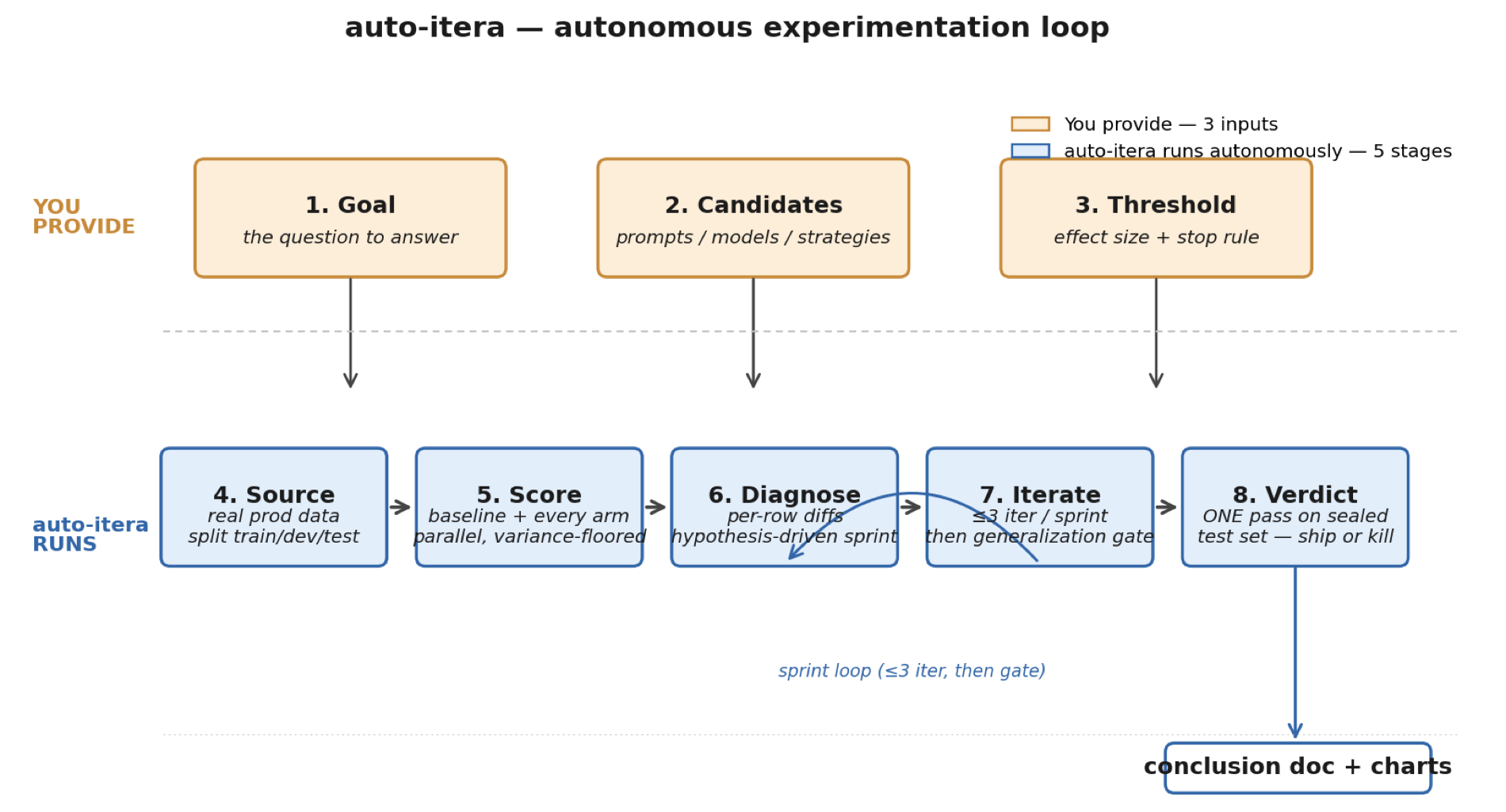
You provide (3 inputs):
- Goal — the question you want answered ("does prompt-v2 beat v1 on classification?")
- Candidates — the concrete arms to compare (a baseline + 1–3 alternatives)
- Threshold — pre-registered effect size + per-slice loss floor ("ship if ≥5pp aggregate AND no slice regresses >2pp")
auto-itera runs (5 autonomous stages):
- Source — sample real production data, stratify by tenant/class, split into train / dev / sealed test
- Score — run baseline + every arm in parallel on dev, with variance baseline (≥3 trials) + cross-judge sanity check
- Diagnose — per-row diffs against baseline, identify wins/losses by cluster, write a hypothesis for the next change
- Iterate — sprint of up to 3 hypothesis-driven iterations, then a generalization gate that strips out dev-set memorization. Continue or lock.
- Verdict — ONE pass on the sealed test set. Per-slice scores. Ship / scope narrowly / kill — with a conclusion doc and three publication-quality charts.
The output: a one-page conclusion doc embedding arm-bar, forest-plot, and cost-vs-accuracy figures, plus a discipline self-audit checklist. Code is throw-away; the conclusion is what compounds.
Honest expectation boundary
auto-iteraautomates the experimental execution + iteration. The evaluation criteria stay with you, by design.
You provide (3 pre-registered inputs):
- Candidate arms — the concrete prompts / models / strategies to compare
- Metric + judge — what counts as "better" and who scores it
- Threshold + per-slice loss floor — what counts as "ship-worthy"
auto-itera auto-designs and runs (everything else):
- Sampling strategy + train/dev/test splits sized to your effect threshold
- Parallel scoring with variance baseline + cross-judge sanity check
- Per-row diagnosis, hypothesis-driven sprints, generalization gate
- Held-out test pass + per-slice verdict + conclusion doc
The split is deliberate, not a capability gap. A metric the system picks for itself is a metric the system can drift toward — letting the evaluator design its own grading rubric is how teams accidentally ship +12% benchmark wins that regress 8% in production. Pre-registration is the discipline that keeps the verdict trustworthy.
Think of it as an autonomous experiment runner, not an autonomous AI scientist that invents the hypothesis AND grades it.
Why a sprint-and-generalize loop
The most interesting design choice is in stage 7. Naive "iterate until it looks better" optimizes the dev set — every refinement that doesn't survive the held-out test is overfitting in a lab coat. A flat "stop after 3 iterations" rule prevents that, but it also blocks legitimate deeper exploration.
auto-itera splits the difference:
iterate × up to 3
   ↓
generalization gate
   ↓
   ├──  every change is a universal mechanism (or got promoted to one) → start next sprint
   ├──  dev signal saturated → lock and run the test pass
   └──  changes were mostly "if input X return Y" hardcodes → kill this arm
The 3 inside a sprint is a working-memory cap (humans can't reliably attribute outcomes across more than ~3 simultaneous hypothesis edits). The gate between sprints separates principled iteration (finding deeper mechanisms) from dev-set memorization (adding rules that win specific rows but won't survive the test).
Most decisions converge in 1–2 sprints. Past 3 sprints, the prior shifts toward "the gate is failing to catch dev-memorization" — the right move is to audit the gate, not to keep iterating.
Safeguards — the 22 ways auto-itera refuses to lie to you
Autonomy without honesty is a worse outcome than vibes-based evals — at least vibes don't pretend to be science. auto-itera ships with 22 explicit safeguards that block the specific moves that look reasonable but contaminate the verdict.
Five real failure modes, drawn from actual shipped-and-regressed AI products:
| What the team would have shipped | What auto-itera caught |
|---|---|
| "Prompt v3 is +12% on eval. Ship it." | The "improvement" came from rows the engineer read during debugging. Test set was contaminated. Production regressed 8%. |
| "GPT-4o beat Claude on our 50-row eval." | Eval too small. Gap was 5pp, within-arm noise was 4pp. Not a real signal. |
| "Aggregate accuracy up 6pp across all customers." | One major tenant slice regressed -8pp. Aggregate winners are not winners when a major slice loses. |
| "Best-of-5 trial: 91% accuracy." | Mean was 84% ± 4pp. Best-of-N is biased high by ~√log N. |
| "New rubric finally captures what matters." | Rubric was rewritten after seeing scores. It happened to favor the arm they wanted to win. |
Each one is a specific anti-pattern with a specific safeguard. Other guards include held-out test sealing, pre-registered metrics, variance-floor noise checks, the generalization gate, cross-judge sanity checks, and a per-slice loss floor. The full list — plus a "Common Rationalizations" table cataloging the excuses engineers reach for in the moment — lives in SKILL.md.
How it fits in
Several solid tools exist for running evals — Promptfoo, Inspect, LangSmith Evals, OpenAI Evals. They give you the numbers. auto-itera is built for what comes after the numbers — the discipline that prevents the numbers from lying to you.
What's unique to auto-itera |
Why it matters |
|---|---|
| Held-out test sealed + metric pre-registered by default | "saw the score, edited the metric, re-ran" is structurally forbidden, not just discouraged |
| Sprint + generalization gate between iteration rounds | strips dev-set memorization before each new sprint; iter-3 hardcodes get rejected before they reach the test set |
| Per-slice loss floor | aggregate winner that regresses a major tenant slice is rejected automatically — no aggregate-winner-ships-and-quietly-breaks-SMB story |
| Pre-registered failure-mode taxonomy | 3–5 eval_finding categories locked alongside the rubric; two arms tying on aggregate while one shifts errors INTO the highest-severity category is rejected as a regression-dressed-as-a-tie |
| Optional severity weighting | when row impact varies by >5× (a $50K wire vs a $5 coffee), both unweighted and severity-weighted aggregates are reported; ship-rule applies the pre-registered tie-break when rankings disagree |
| One-shot test pass | the sealed test set opens ONCE; conclusion doc + 3 charts + discipline self-audit is the output |
| Runs inside Claude Code | no separate CLI / dashboard to maintain; git clone and ask a question |
The other tools all support pieces of this opt-in. auto-itera's value is making the discipline the default — and refusing to let you skip it mid-flight when the dev-set scores look exciting.
If you need a hosted eval dashboard with prompts in a UI, use LangSmith. If you need pre-built safety benchmarks, use Inspect. If you need a defensible ship-or-kill verdict on real production data in the next afternoon, that's auto-itera's lane.
Example output
A complete worked example lives at examples/prompt-tuning-classifier/ — three figures rendered from one data.json, telling one coherent teaching story.
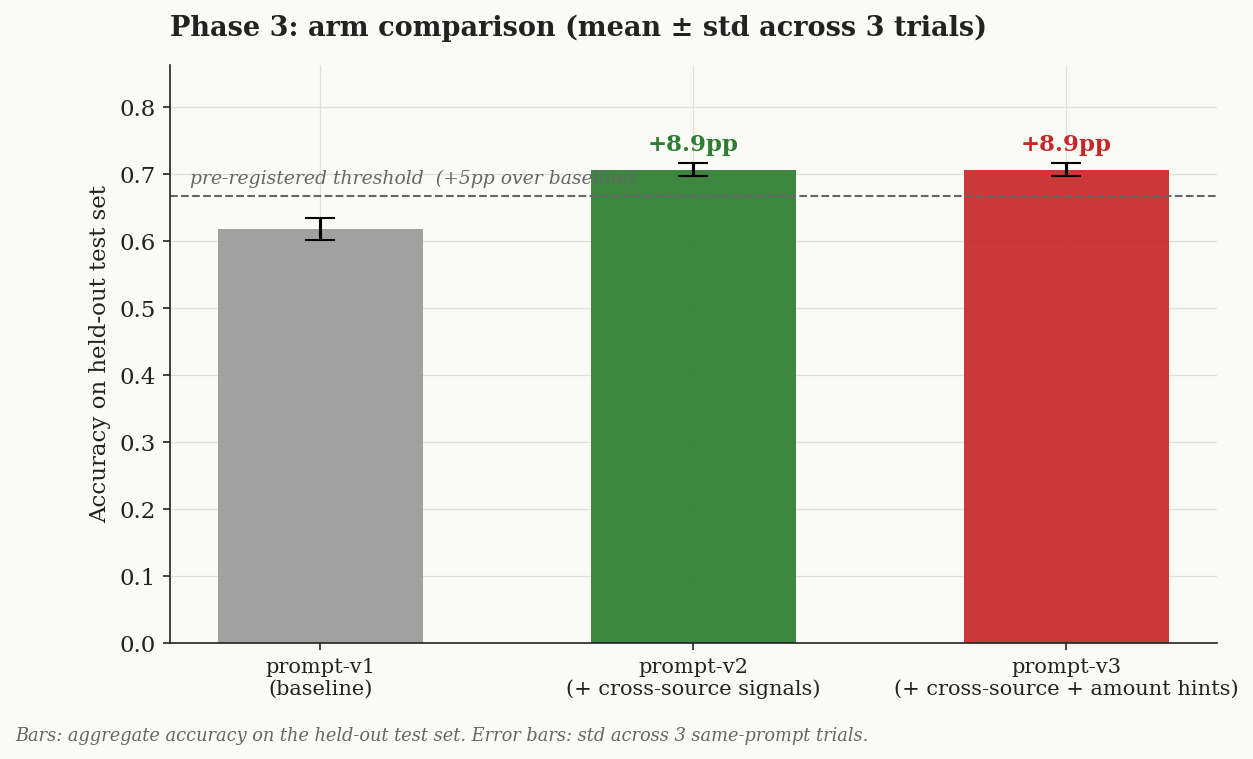
Stage 5 — both candidate arms beat baseline by +8.9pp, well above the 2× variance noise floor.
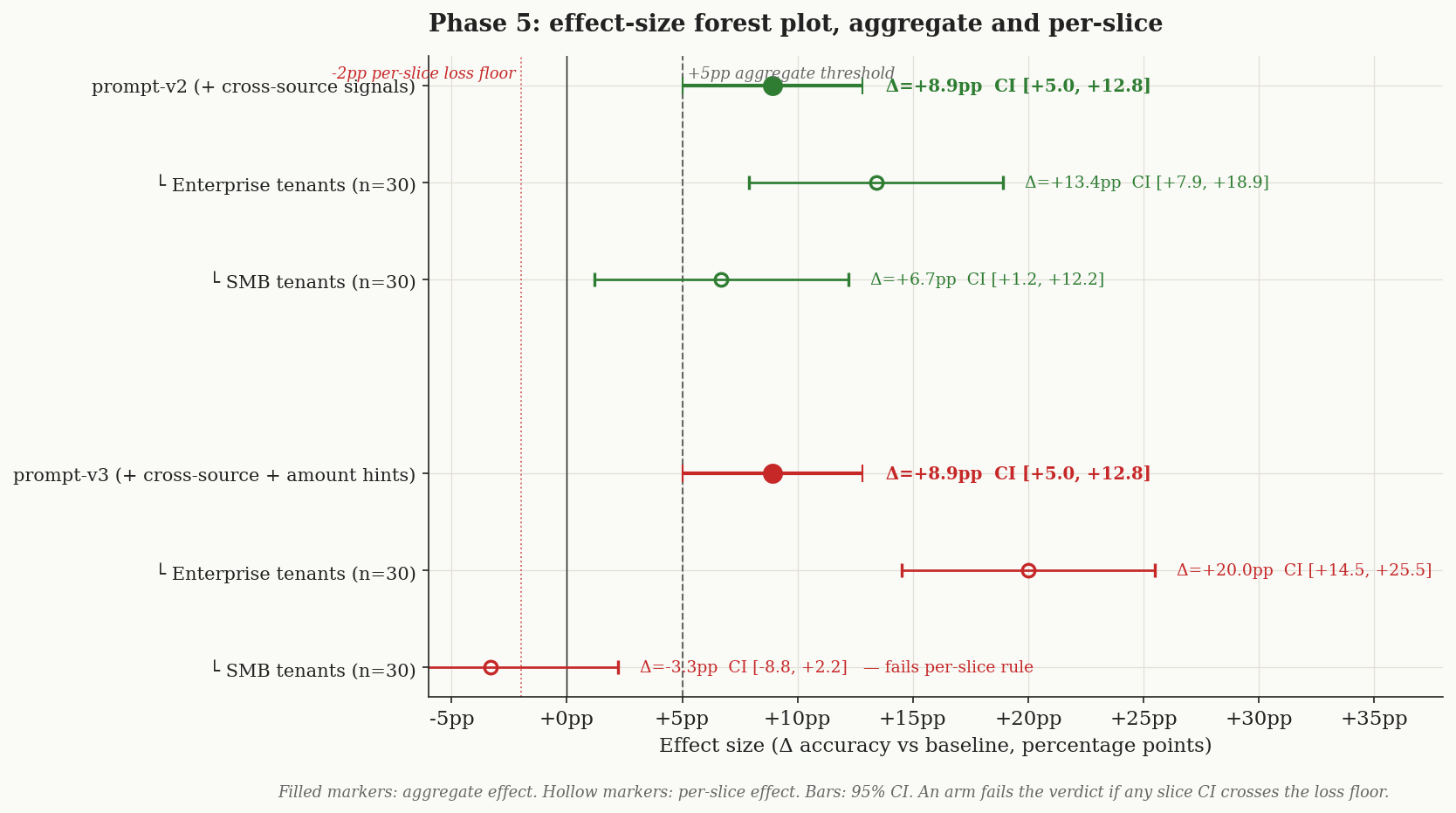
Stage 8 — both arms clear the aggregate threshold. But
v3regresses SMB tenants by -3.3pp, crossing the pre-registered loss floor. Aggregate winner ≠ winner.
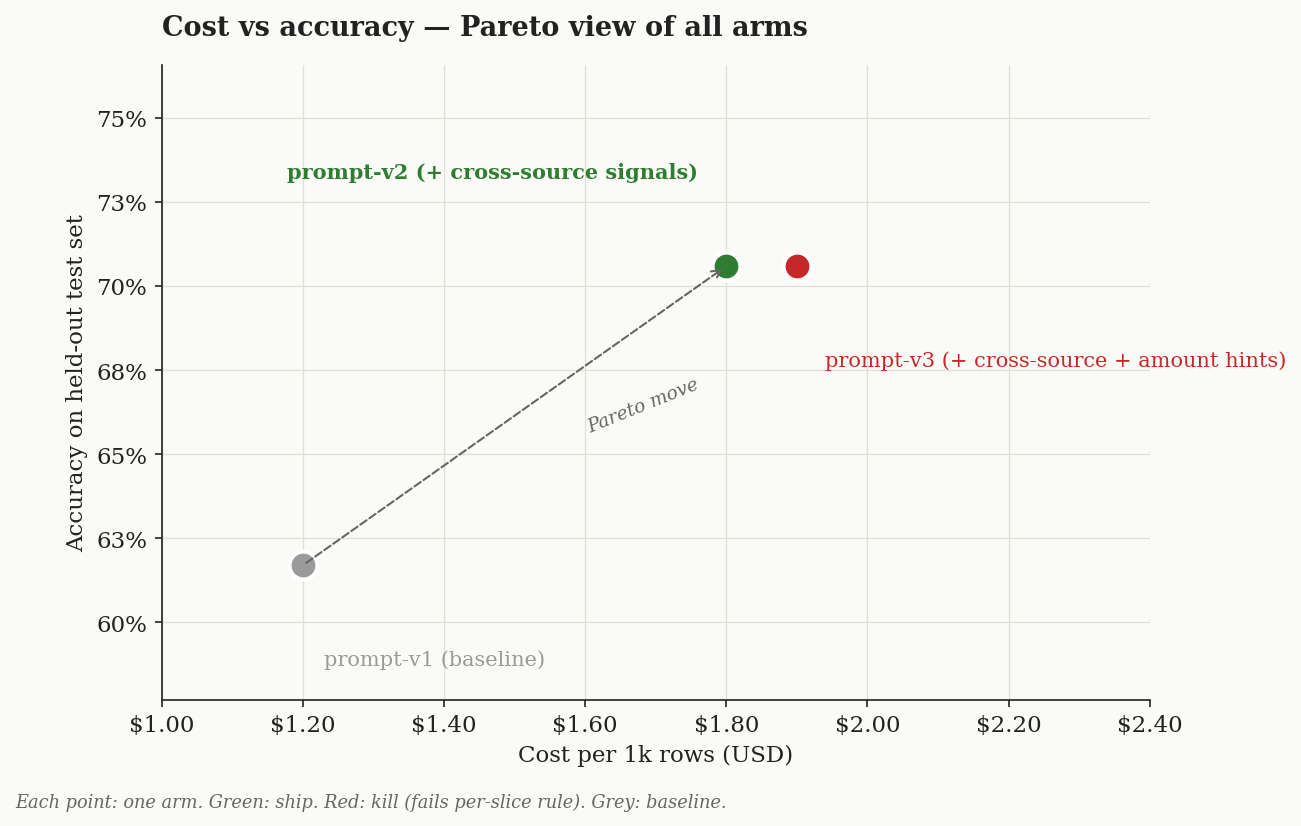
Cost view —
v2is the Pareto move: +8.9pp at +$0.60 / 1k rows. Shipv2. Killv3.
Who this is for
Teams shipping LLM products who need decisions that survive production:
- Choosing between models when cost and accuracy both matter
- Validating a prompt change actually helps before deploying it
- Comparing retrieval strategies on real customer queries
- Auditing whether your eval methodology is biased
If you're a solo dev experimenting in a notebook, you can skip this. If you have customers depending on whether your AI decisions are right, you can't.
Installation
Pick the path for your tool:
Claude Code — plugin marketplace (recommended)
Zero git, zero symlink — Claude Code handles install + updates:
/plugin marketplace add clfhaha1234/auto-itera
/plugin install auto-itera@auto-itera
To update later:
/plugin marketplace update auto-itera
Claude Code — git clone (no marketplace needed)
git clone https://github.com/clfhaha1234/auto-itera.git ~/.claude/skills/auto-itera
Works without the marketplace mechanism — Claude Code picks up any directory under ~/.claude/skills/ that contains a SKILL.md.
Cursor
Copy or symlink the skill content into .cursor/rules/:
git clone https://github.com/clfhaha1234/auto-itera.git ~/auto-itera
ln -s ~/auto-itera/SKILL.md /path/to/your/project/.cursor/rules/auto-itera.md
Windsurf
Add ~/auto-itera/SKILL.md to your Cascade context, or paste the content into a .windsurfrules file at the project root.
GitHub Copilot
Reference the skill content from .github/copilot-instructions.md — either inline the full SKILL.md or include it via @workspace on relevant files.
Any other agentic editor
SKILL.md is plain markdown — point any agent that can read project rules / system prompts / context files at it.
That's it. No other dependencies until you want to render charts standalone (see Optional: re-render charts).
Quick Start — your first experiment in 5 minutes
1. Paste a real comparison question in Claude Code
The format that triggers the skill cleanly: state the goal, spell out the candidates (baseline + 1–3 alternatives), and pre-register the threshold before any data is sampled.
I want to evaluate two versions of my classifier system prompt.
Baseline (
prompt-v1): current production prompt atsrc/classify/processor.ts:42.
Candidate (prompt-v2): same prompt + an extra sentence: "When the input mentions a payment processor (Stripe, PayPal, Square), classify as 'fees' not 'transfer'."I have ~200 real production rows in
data/classifier-eval.csvwith human-labeled ground truth in theexpected_labelcolumn. About 60% are enterprise tenants and 40% SMB.Ship criterion: ≥+5pp aggregate accuracy AND no per-tenant slice regresses more than -2pp.
2. Watch the autonomous loop run
auto-itera does the rest:
- Writes the Phase 0 frame as a markdown table — your question, the two arms, the metric, the threshold. Asks ONCE if anything's wrong; otherwise locks it.
- Splits your 200 rows stratified by tenant tier — ~60 train / ~100 dev / ~40 sealed test. Prints a distribution audit so the split matches your prod traffic mix.
- Runs a 1-row pilot to catch instrumentation bugs before the full run wastes 5 minutes.
- Scores baseline + v2 in parallel on dev. Reports aggregate + per-slice + variance (≥3 trials per arm). Cross-judge sanity check on 5 rows with a 2nd-family model.
- Sprint, if needed — up to 3 iterations of "diagnose per-row → hypothesis → tweak the arm → re-score". Generalization gate strips dev-set memorization. Continue or lock.
- One pass on the sealed test set. Per-slice scores. Verdict: ship
v2, ship narrowly to one slice, or kill. - Writes the conclusion doc to
docs/experiments/YYYY-MM-DD-<topic>/— three publication-quality charts embedded, full discipline self-audit checklist signed off.
Wall clock on a 200-row dataset: typically 5–15 minutes. Most of that is LLM scoring; Claude's thinking is a tiny fraction.
3. What you don't need
- No API keys to configure (uses whatever Claude Code already has)
- No separate dashboard / hosted service
- No YAML config files
- No Python (unless you want to render charts standalone — see below)
Optional: re-render charts from a saved data.json
If you want to regenerate the three figures from an already-completed experiment's data.json:
uv run scripts/chart.py arm-bar          --data data.json --out charts/arm-bar.png
uv run scripts/chart.py forest-plot      --data data.json --out charts/forest-plot.png
uv run scripts/chart.py cost-vs-accuracy --data data.json --out charts/cost-vs-accuracy.png
Re-render the loop diagram in this README (if you fork and want a customized version):
uv run scripts/render-loop-diagram.py --out docs/images/autonomous-loop.png
PEP 723 inline deps — uv run provisions matplotlib automatically. python3 scripts/*.py … also works if matplotlib is already installed.
FAQ
What is auto-itera actually doing?
Running the experimental discipline that AI teams know they should follow but skip because it's tedious. You hand it a goal + candidate arms + success threshold; it sources real production data, scores baseline + arms in parallel, diagnoses per-row, sprints with a generalization gate between rounds, picks the latest gate-passed iter, and runs the held-out test pass. The 22 safeguards make the discipline mechanical; the charts are a side effect; the verdict is the product.
Why "autonomous experimentation" and not "AI scientist"?
Because the skill autonomously runs experiments — it does not autonomously invent hypotheses or brainstorm what to test. The human (or Claude in conversation with the human) supplies the candidate arms; auto-itera runs the loop from there to verdict. Calling it an "AI scientist" would oversell what it does and undersell what it does well: turning a vague "should we use X or Y?" question into a defensible verdict in hours.
Why doesn't auto-itera pick its own metric?
By design. A metric the system picks for itself is a metric the system can drift toward — and "the model that scored highest on the metric the model designed" is exactly how teams accidentally ship +12% benchmark wins that regress 8% in production. Pre-registering the metric, threshold, and judge rubric BEFORE any data is sampled is the discipline that keeps the verdict trustworthy. The skill auto-designs the experimental execution (sampling, splits, variance trials, slicing, gating); you lock the evaluation criteria upfront. Splitting these responsibilities is what separates rigorous evaluation from automated self-confirmation.
Does this work with non-Claude models?
Yes. The skill is model-agnostic — it tells Claude Code what discipline to enforce, but the arms you compare can be any models, any providers, any prompt / retrieval / architecture variants.
Why a 3-iteration sprint cap, not a hard "stop at 3" rule?
3 is a working-memory cap — humans can't reliably attribute outcomes across more than ~3 simultaneous hypothesis edits inside a single sprint. But iteration itself isn't the enemy; un-audited iteration is. After each sprint, the generalization gate strips out dev-set memorization. If the gate passes and dev signal isn't saturated, you start a fresh sprint. Most decisions converge in 1–2 sprints. Past 3 sprints, the prior shifts toward "the gate is failing to catch dev-memorization" — and the right move is to audit the gate, not to keep iterating.
How is this different from a Jupyter notebook with matplotlib?
A notebook lets you do anything — including all the things that quietly bias your conclusion. auto-itera makes the discipline mechanical: forbids peeking at test, forbids picking best-of-N on test, forbids moving the metric after the score, forbids skipping the generalization gate between sprints. The discipline is what you can't get from a notebook.
Can I use this on experiments I've already run?
Use it on the next decision. For already-run experiments where the test set was peeked at during debugging, the test set is contaminated for that question — reseal from fresh production data before running auto-itera on it.
Does the chart helper require Python?
Yes. scripts/chart.py and scripts/render-loop-diagram.py use matplotlib via a PEP 723 inline-deps header — uv run provisions an isolated env automatically; python3 works as fallback if matplotlib is already installed. The skill itself (the discipline + conclusion doc) works without Python.
Contributing
Issues and PRs welcome. The highest-value contribution is a new entry to the Common Rationalizations table in SKILL.md from a real experience — the kind that ends "…and we shipped it, and then production regressed." Those are the stories the skill exists to prevent.
License
Yorumlar (0)
Yorum birakmak icin giris yap.
Yorum birakSonuc bulunamadi