nightme
Health Uyari
- License — License: MIT
- Description — Repository has a description
- Active repo — Last push 0 days ago
- Low visibility — Only 5 GitHub stars
Code Basarisiz
- rm -rf — Recursive force deletion command in .github/workflows/ci.yml
Permissions Gecti
- Permissions — No dangerous permissions requested
Bu listing icin henuz AI raporu yok.
Sleep tight. NightMe codes all night. A remote-pair developer agent. No more babysitting AI—stay in the loop from your phone while AI Coding Agent(claude/codex/opencode/pi/dsh...) takes the wheel.
NightMe

Sleep tight. NightMe codes all night.
A remote-pair developer agent. No more babysitting AI—stay in the loop from your phone while it takes the wheel.





What is NightMe
NightMe drives your local AI Coding Agents — Claude Code, Codex, DSH (DeepSeek Harness), Pi, OpenCode, etc. — from chat. Send a message in any connected chat platform; NightMe routes it to the right agent process and returns the reply as a structured card.
Multiple chats run in parallel — one per project. Multiple agents work in parallel, each on its own task — switching between them is instant, no cold restart. git worktree work is hardened into Git Team Workflow (/gtw): fix / push / pr / close / sync — each step is one IM reply card, integrated with GitHub, GitLab, and similar platforms. NightMe doesn't replace your agent subscriptions or memory; it sits in front of them and keeps them warm.
Why NightMe
One chat, one CWD, one project
You work across multiple projects at once. Each Feishu chat (group or DM) is a ChatSession, and each ChatSession has a CWD — its current working directory. The CWD is the project: set it with /cwd <path>, change it anytime. Multiple chats run in parallel, each bound to its own directory.
                            You (Feishu)
                                  │
                                  ▼

    ┌─ ChatSession ─┐  ┌─ ChatSession ─┐  ┌─ ChatSession ─┐
    │ CWD: ~/a      │  │ CWD: ~/b      │  │ CWD: ~/c      │
    │               │  │               │  │               │
    │ AI Agents:    │  │ AI Agents:    │  │ AI Agents:    │
    │   Claude Code │  │   Claude Code │  │   Claude Code │
    │   Codex       │  │   Codex       │  │   Codex       │
    │   Pi          │  │   Pi          │  │   Pi          │
    │   OpenCode    │  │   OpenCode    │  │   OpenCode    │
    │   DSH         │  │   DSH         │  │   DSH         │
    └───────────────┘  └───────────────┘  └───────────────┘

   ▲ CWD = project; agents run inside that CWD; all parallel from one NightMe instance ▲
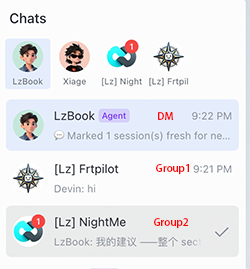
Project isolation is by directory. Each ChatSession's CWD is independent — re-running /cwd changes which directory a session operates on, without affecting the others. Multiple projects stay
live simultaneously.
The differentiator vs traditional tools (Hermes, openclaw, cc-connect, happycoder): they activate one session at a time. NightMe runs all your projects in parallel from a single instance. Switching chats is instant — same daemon, no cold start, no re-init.
Three core capabilities
| Capability | What it means in practice |
|---|---|
| Multiple Chat Sessions in parallel | N sessions on one machine, each running a different project or task. |
| CWD = project | Each ChatSession is bound to one current working directory — that directory is the project. Set it with /cwd <path>; switch anytime. |
| Multi-agent, in the same Chat | /use <agent> swaps the active agent. The previous one keeps running in the background — its task continues, results still come back, but new messages route to the new active agent. |
Prerequisites
- macOS, Linux, or Windows — NightMe ships as a single static Go binary; no runtime dependencies.
- A Feishu account — currently the only supported IM.
nightme login feishuregisters your bot via QR scan. - At least one local AI Coding Agent — Claude Code, Pi, OpenCode, Codex, or DSH (DeepSeek Harness). Install the CLI and have it on your
$PATH; NightMe spawns it as a subprocess.
Install
Three ways to get nightme on your machine:
One-liner (recommended):
macOS / Linux:
curl -fsSL https://nightme.dev/install.sh | bashWindows (PowerShell):
powershell -c "irm https://nightme.dev/install.ps1 | iex"Drops the latest release into a stable location on your
$PATH
and runsnightme versionto verify.Prebuilt binary (manual):
- Grab the archive for your platform from the
latest release page
(e.g.nightme_<version>_darwin_amd64.tar.gz,nightme_<version>_linux_amd64.tar.gz,nightme_<version>_windows_amd64.zip) - Extract it — the binary inside is just
nightme
(ornightme.exeon Windows):
On Windows, unzip and placetar -xzf nightme_<version>_darwin_amd64.tar.gz mv nightme /usr/local/bin/nightme chmod +x /usr/local/bin/nightmenightme.exesomewhere on yourPATH.
- Grab the archive for your platform from the
From source (for development or to pin a commit):
git clone https://github.com/cnlangzi/nightme.git
cd nightme
make dev
make devruns nightme directly from source using the example
config in./configs/. For a proper release-style build (with
the Windows icon embedded, macOS menu-bar template icons, and
version metadata baked in), usemake buildormake release.macOS .app bundle (optional, for the menu-bar experience):
A bare
nightmebinary on macOS still works, but the menu-bar
icon falls back to the generic executable glyph. To get the
proper icon, build the .app bundle:make build # bin/nightme + cmd/nightme/assets/trayTemplate.icns make app-bundle # dist/NightMe.app cp -R dist/NightMe.app /Applications/ open /Applications/NightMe.appThe .app has
LSUIElement=true, so it shows no Dock entry —
just the menu-bar icon. Closing the app from the menu (Stop /
Quit) gracefully exits the daemon.config — no separate build step needed.
Quickstart
nightme login feishu   # prints a QR code; scan with the Feishu mobile app
nightme start          # daemon runs in the background
When start returns, NightMe sends a welcome message to your Feishu DM — that's how you know you're live.
CLI commands
Most of the time you live in chat. These are the few things you do from a terminal:
| Command | What it does |
|---|---|
nightme start / stop / restart |
Turn NightMe on and off. Your agents keep working either way. |
nightme status |
Is NightMe running? |
nightme list |
All your agents: which chat, which project, still alive or finished. |
nightme kill |
Stop every agent at once. Send a message in the chat and it comes back, conversation intact. |
nightme logs |
Watch what NightMe is doing, live. |
nightme doctor |
Check NightMe's health when something feels off. |
nightme agents |
Which AI agents you have set up. |
Stopping comes in three scopes: /close (one project) · nightme kill (all agents) · nightme stop (NightMe itself). Your conversations survive all three.
Always-in-the-loop
You always know what your agent is doing, where, and at what cost — every reply carries a fixed footer with what you need to know, without leaving chat. Most other "AI dev in chat" tools feel like a black box; NightMe treats visibility as a first-class feature.
StatusBar — pinned to every Feishu reply

Every reply carries a fixed footer showing exactly what you need to know without leaving chat:
- CWD — which ChatSession is active (the "project")
- Git status — branch, dirty / clean, ahead / behind
- Agent status —
idle/running/thinking - Token usage — used / limit for the current session
Other tools drop you into the dark. NightMe shows you what your agent is doing, where, and at what cost.
Flexible visibility — you decide what to see
| Toggle | What it controls |
|---|---|
/think on|off |
Show or hide the agent's thinking blocks. |
/tools on|off |
Show or hide per-tool thread replies (default off). |
/watch on|off |
Listen to all group messages, not just @bot / @_all. |
Why this matters: NightMe defaults to visible. Toggle things off when you want quiet — your choice, no surprises.
What we do differently
| Feature | Openclaw / Hermes | NightMe |
|---|---|---|
| Sessions survive daemon restart | ❌ | ✅ |
Real /stop and /steer |
❌ | ✅ |
| No server-side timeout | 30 min | none |
| Clean prompts, no preamble | ❌ | ✅ |
The four differentiators, in short:
Sessions survive. Daemon restart, network blip, sleep — your chat picks up where it left off. The upstream CLI's session resumes via
--resume <session-id>.You can stop or redirect, mid-task.
/stophalts the in-flight turn./steer <msg>redirects. Both keep your session and context intact.No clock on you. If Claude runs 30 minutes, NightMe runs 30 minutes. You're in charge of when to stop.
No prompt padding. No preamble, no brand voice, no injected system message. The CLI sees just your words.
We sit in front of Claude / Codex / DSH (DeepSeek Harness) / Pi / OpenCode. You stay in control. Nothing in a black box.
Shell mode
You don't always need the agent to run a shell command. With Claude Code / Codex, asking the agent to run something goes through the agent's tool loop — long chain, eats context, nudges your real task aside while the agent's busy reading shell output.
!cmd skips all that. Type !make test and NightMe runs the command in the chat's CWD directly. The result comes back as a plain IM card. No agent, no round trip, no context eaten.
For the scripts you already have — make, npm test, deploy hooks. Anywhere the agent's reasoning adds nothing but a delay.
✅ $ make test
exit 0 · 12ms · ~/work/foo
stdout:
  All tests passed
Git Team Workflow (/gtw)
git worktree gives you isolated branches per task. gh pr create gives you a one-shot PR. AI agents give you on-demand coding help. /gtw glues the three together — each /gtw <cmd> is a slash command that spins up a short-lived agent for the heavy lifting and returns a clean IM card. The agent runs once, does the work, and exits. Your main chat stays clean.
GitHub / GitLab issues are the task flow — each /gtw fix pins to an issue, and the work moves through the issue's state as the subcommands fire.
The local dev loop: fix → hooks → close
Three subcommands chain into a complete local multi-branch development workflow. Run 3 of these in parallel — three issues, three worktrees, three agents, no state collision.
/gtw syncis NOT part of this loop.sync(a.k.a.git checkout main && git pull --rebase origin main) is a
main-repo operation — it switches the current branch to
main and pulls. Don't call it from inside a worktree; it
refuses to run there by design. Both/gtw fix(step 1)
and/gtw close(last step) already call sync internally
on the main repo before / after the worktree operation, so
you don't need to call sync manually. Afterclose, main is
fresh; the nextfixstarts from that.
/gtw fix -n <branch>— opens a fresh worktree named<branch>on your just-up-to-date main, runs a one-shot
agent to do the work. Pure local — no GitHub issue needed.
You keep chatting in your main chat.For the GitHub / GitLab flow, use
/gtw fix <issue-id>to
pin the worktree to a remote issue. First-time use on a new
repo just works — no setup needed.hooks fire automatically — the dev environment rebuilds
itself in the new worktree. CodeGraph re-indexes,npm install
/go mod download/cargo build— whatever your project
needs. Edit~/.nightme/gtw.yml:# ~/.nightme/gtw.yml fix: hooks: after: - codegraph init # bare string = shell hook - npm install - go mod download(You work. Agent on demand. Or just edit files yourself.)
/gtw close— when the task is done (or you decide not
to),/gtw closetears down the worktree, returns you to
main, and the branch is ready to ship (or discard).
Hooks — bring the dev environment with you
AI tool indexes (CodeGraph, language servers, caches) usually live inside the repo. Each worktree is a fresh checkout — they all need rebuilding. Hooks automate that.
The common case is fix: hooks: after — fires right after/gtw fix opens a new worktree, rehydrating the dev env
in-place:
# ~/.nightme/gtw.yml
fix:
  hooks:
    after:
      - tokensave branch add "$GTW_BRANCH" --path "$GTW_REPO_ROOT"
      - codegraph init                # re-index the new worktree
      - npm install                   # install deps
      - go mod download               # download Go modules
close:
  hooks:
    before:
      - tokensave branch remove "$GTW_BRANCH" --path "$GTW_REPO_ROOT"
Each command (not just fix) exposes hooks.before andhooks.after:
| Hook | When it fires | Typical use |
|---|---|---|
before |
before the main flow | record starting SHA, snapshot state |
after |
after the main flow (always runs, even on failure) | re-index, install deps, warm caches |
Iron rules (from the code):
- v1 supports shell hooks only — anything else warns + skips.
- Hook failures never block the main flow. Failed hook =
⚠️
note in the reply, main command proceeds. - All stdout/stderr is echoed back so you can see what actually ran.
- 30s default timeout per hook.
Slash commands
Chat-level slash commands. The /gtw subcommands live in
their own section and are not listed
here.
| Command | What it does |
|---|---|
/cwd <path> |
Bind this chat to a workspace. Validates the path; lazy-spawns on the next message. |
/use <agent> |
Switch the active agent (claude / codex / dsh / opencode / pi). The previous one keeps running in the background — its task continues, results still come back, but new messages route to the new active agent. |
/stop |
Halt the in-flight turn on the selected agent. Session stays; queued messages still flow. |
/steer <msg> |
Stop the in-flight turn and prepend <msg> to the queue. The steered message becomes the first thing the agent sees on the next turn. |
/close [agent] |
Terminate the bridge process(es) for AgentSession(s) in the current workspace. The AgentSession entry is preserved; next user message triggers a respawn that replays --resume <sessionID> to continue the conversation. |
/new [agent] |
Reset the agent's conversation context (Claude Code's /clear equivalent). Process stays alive; queued messages are cleared. |
/watch on|off |
Per-chat message-watch mode (default: only @bot / @_all in groups). |
/think on|off |
Show or hide the agent's thinking blocks in the receipt card. |
/tools on|off |
Show or hide per-tool thread replies (default off to keep the card quiet). |
/help |
List every slash command in-chat. |
!cmd runs shell commands directly in the chat's CWD — see
Shell mode for the rules.
Anything that doesn't match a slash command (or !cmd) is
forwarded to the active agent as a regular prompt — same as
sending the message in Claude Code's own CLI. NightMe doesn't
intercept or transform; the agent receives the message verbatim
and runs its own built-in slash commands (e.g. Claude Code's/clear, /compact, /init, etc.).
For developers
┌─────────────┐    ┌─────────────┐    ┌──────────────────────────┐
│  Channel    │ →  │  Gateway    │ →  │  ChatSession (per chat)   │
│  (Feishu,   │ ←  │  (router +  │ ←  │  ├─ AgentSession pool     │
│   Web TUI)  │    │   binding)  │    │  │  (agent, cwd) 1:1       │
└─────────────┘    └─────────────┘    │  ├─ InputBuffer FSM       │
                                     │  ├─ readPump              │
                                     │  └─ EventHandler          │
                                     │           ↓               │
                                     │  AgentSession → Bridge    │
                                     │     (PTY / ACP / SDK /    │
                                     │      JSON-IO / RPC)       │
                                     │           ↓               │
                                     │       Agent CLI           │
                                     └──────────────────────────┘
- Channel owns transport.
- Gateway routes inbound. The
inboundsubpackage owns the slash-command dispatch chain; everything else is forwarded to the ChatSession's active AgentSession. - ChatSession is the per-chat context. Owns the AgentSession pool and the InputBuffer FSM. Persists across daemon restarts.
- AgentSession is the per-CLI-process handle. One per
(agent, cwd)pair, kept alive across/useand/cwdswitches. - Bridge is the per-agent transport — one of
acp,claudecode,codex,dsh,opencode,pi, orpty(underinternal/bridge/), picked by what the CLI supports.
See docs/SPEC.md §1 for the full responsibility table and docs/SPEC.md §0.1 for the v1.3 "Channel is a dumb renderer" rewrite.
Configuration
NightMe reads YAML from ~/.nightme/config.yaml (or $NIGHTME_CONFIG if set). Env-var overrides: NIGHTME_<SECTION>_<KEY> (e.g. NIGHTME_PRIMARY).
primary: claude                          # global default agent

agents:                                  # each entry = name / bridge / command
  - name: claude
    bridge: claude
    command: "claude --dangerously-skip-permissions"
  - name: codex
    bridge: codex
    command: codex
  - name: opencode
    bridge: opencode
    command: opencode
  - name: pi
    bridge: pi
    command: "pi"
  - name: dsh
    bridge: dsh
    command: dsh

feishu:
  app_id: "cli_xxxxxxxxxxxxxxxx"
  app_secret: "xxxxxx…xxxx"
  verification_token: ""
  encrypt_key: ""

session:                                 # initial PTY + aggregator tunables
  default_pty_cols: 80
  default_pty_rows: 24
  output_chunk_size: 4096        # bytes
  output_flush_interval_ms: 200  # milliseconds

logging:
  level: "info"          # debug | info | warn | error
  file: ""               # empty = stdout; path = file

paths:
  data_dir: "~/.nightme"  # chat_sessions.json + agent_sessions.json root
The /gtw workflow reads a separate file: ~/.nightme/gtw.yml — see the Git Team Workflow section above.
See configs/nightme.example.yaml for the full schema and per-bridge notes.
Logs go to ~/.nightme/nightme.log (mode 0600) as JSON. Attribute keys containing secret, token, or password are auto-redacted to ***REDACTED***.
Documentation
| Doc | What |
|---|---|
docs/PRD.md |
Product definition — what / why / for whom. No tech. |
docs/SPEC.md |
Technical architecture — components, data flow, NFRs. |
docs/FEATURES.md |
Feature index — every F-XX in one table. |
docs/WFE.md |
Workflow YAML + engine runtime architecture — triggers, steps, bot↔wfe boundary. |
docs/feat/ |
Per-feature design docs. |
docs/bridge/ |
Per-agent bridge design: claude, codex, dsh, opencode, pi. |
docs/channel/feishu.md |
Feishu adapter reference (rendering rules, card semantics, thread routing). |
docs/flow/ |
Cross-cutting flow docs (e.g. the 3-layer doc model). |
docs/E2E_TESTING.md |
Manual Feishu round-trip + troubleshooting. |
CHANGELOG.md |
Current snapshot (single [Unreleased] section). |
MIGRATION.md |
Breaking changes between earlier snapshots. |
Development
make build     # ./bin/nightme with version metadata
make test      # go test -race ./...   (~20 packages, race-tested)
make lint      # go vet ./...          (0 warnings required by CI)
make install   # go install to $GOBIN
make dev       # go run ./cmd/nightme  (uses example config)
CI runs on GitHub Actions (.github/workflows/ci.yml) for every push and pull request: go vet, go test -race, and go build must all pass.
Project layout
cmd/nightme/                       # cobra CLI (start / stop / restart / status / logs / doctor / test / config / list / login / agents / name)
configs/                           # example YAML config
docs/
  PRD.md SPEC.md FEATURES.md       # 3-layer doc model
  WFE.md                           # workflow YAML + engine runtime (schema / triggers / steps / bot↔wfe)
  feat/                            # F-XX per-feature design
  bridge/  channel/  flow/         # per-subsystem design
  images/                          # README-served screenshots
internal/
  agent/                           # Agent / AgentEvent / Info / Starter interface
  agentsession/                    # AgentSession + Prompt + Spawner (per-CLI-process runtime unit)
  bridge/                          # Bridge abstraction, one sub-package per agent
    acp/  claudecode/  codex/  dsh/  opencode/  pi/  pty/
  channel/                         # Channel interface
    echo/  feishu/                 # adapters (Feishu is the production one)
  chatsession/                     # ChatSession + pool manager + persistence
  cli/                              # shared CLI helpers (config / doctor / login)
  command/                         # Slash-command Commander / Registry / Factory
    cwd/ close/ newcmd/ use/ think/ tools/ watch/ stop/ steer/ services/
    gtw/                           # /gtw fix / hooks / sync / close (worktree workflow)
  config/                          # YAML loader + env overrides
  daemoncontrol/                   # IPC for `nightme doctor` / `status`
  errors/                          # CodedError + ExitCode
  gateway/                         # Slash router + binding + receipt FSM
    inbound/  outbound/            # inbound dispatch chain + outbound sender
  gatewaytest/                     # integration test harness
  logging/                         # slog + secret redaction
  login/                           # Feishu app registration / QR login
  messages/                        # IM message types + dispatch
  prcache/                         # PR metadata cache (per-F-50)
  registry/                        # JSON-backed chat_sessions.json + agent_sessions.json (0600, atomic)
  shell/                           # `!cmd` shell-mode dispatcher
  statusbar/                       # Feishu footer-card stamp runtime (per F-58, F-133)
  testdata/                        # shared test fixtures
  version/                         # build-time version metadata
Exit codes
| Code | Meaning |
|---|---|
| 0 | Success |
| 1 | Generic / unmapped error |
| 2 | Config error |
| 3 | Auth error |
| 4 | Channel error |
| 5 | Session error |
| 6 | Agent error |
| 7 | Bridge error |
| 8 | Validation error |
| 9 | Not found |
Contributing
PRs and issues are welcome. The full guide lives in/docs — see the 3-layer doc model
for the design workflow.
Thanks for building with NightMe — we want more channels
(Feishu, Web TUI, anything) and more AI Coding Agents
(Claude Code, Codex, DSH (DeepSeek Harness), Pi, OpenCode, anything else) to plug in.
Drop a Channel / Bridge and the architecture handles the rest.
Contact the maintainer:
- Twitter: @imlangzi
- WeChat:
langzi(please mention "NightMe" when adding)
License
Yorumlar (0)
Yorum birakmak icin giris yap.
Yorum birakSonuc bulunamadi