bug-hunter
Health Gecti
- License — License: MIT
- Description — Repository has a description
- Active repo — Last push 0 days ago
- Community trust — 208 GitHub stars
Code Basarisiz
- exec() — Shell command execution in schemas/examples/findings.invalid.json
- rm -rf — Recursive force deletion command in schemas/examples/findings.invalid.json
- exec() — Shell command execution in schemas/examples/findings.valid.json
- rm -rf — Recursive force deletion command in schemas/examples/findings.valid.json
Permissions Gecti
- Permissions — No dangerous permissions requested
This tool is an adversarial AI code review and security vulnerability scanner. It uses a multi-agent pipeline to automatically find and fix security vulnerabilities, logic errors, and runtime bugs across multiple coding platforms.
Security Assessment
The tool operates by inherently requiring shell command execution to analyze codebases, create git branches, and run test scripts. The automated rule-based scan flagged shell command execution and recursive force deletion (`rm -rf`) commands. However, these findings are located exclusively within JSON schema example files (`findings.invalid.json` and `findings.valid.json`), meaning they are sample data used for documentation or testing, not live executable code. The package does not request dangerous permissions. Overall risk is Low.
Quality Assessment
The project is actively maintained, with its last push occurring today. It is covered by a standard MIT license and has solid community trust for a niche developer tool, sitting at 208 GitHub stars. The repository features a clear description, a straightforward CLI reference, and reports 113 passing tests. It is compatible with most major coding agents and IDEs.
Verdict
Safe to use — the flagged dangerous commands are just example strings in sample files, and the core tool is a well-maintained, permissively licensed project.
Adversarial AI bug hunter with auto-fix skill for Claude Code, Cursor, Codex CLI, GitHub Copilot CLI, Kiro CLI, Opencode, Pi Coding Agent, and more. Multi-agent pipeline finds security vulnerabilities, logic errors, and runtime bugs — then fixes them autonomously on a safe branch.
Bug Hunter
AI code review that argues with itself — adversarial multi-agent bug finding, security scanning, and auto-fix for any coding agent.




Install · Quick Start · How It Works · What It Finds · Auto-Fix · CLI Reference
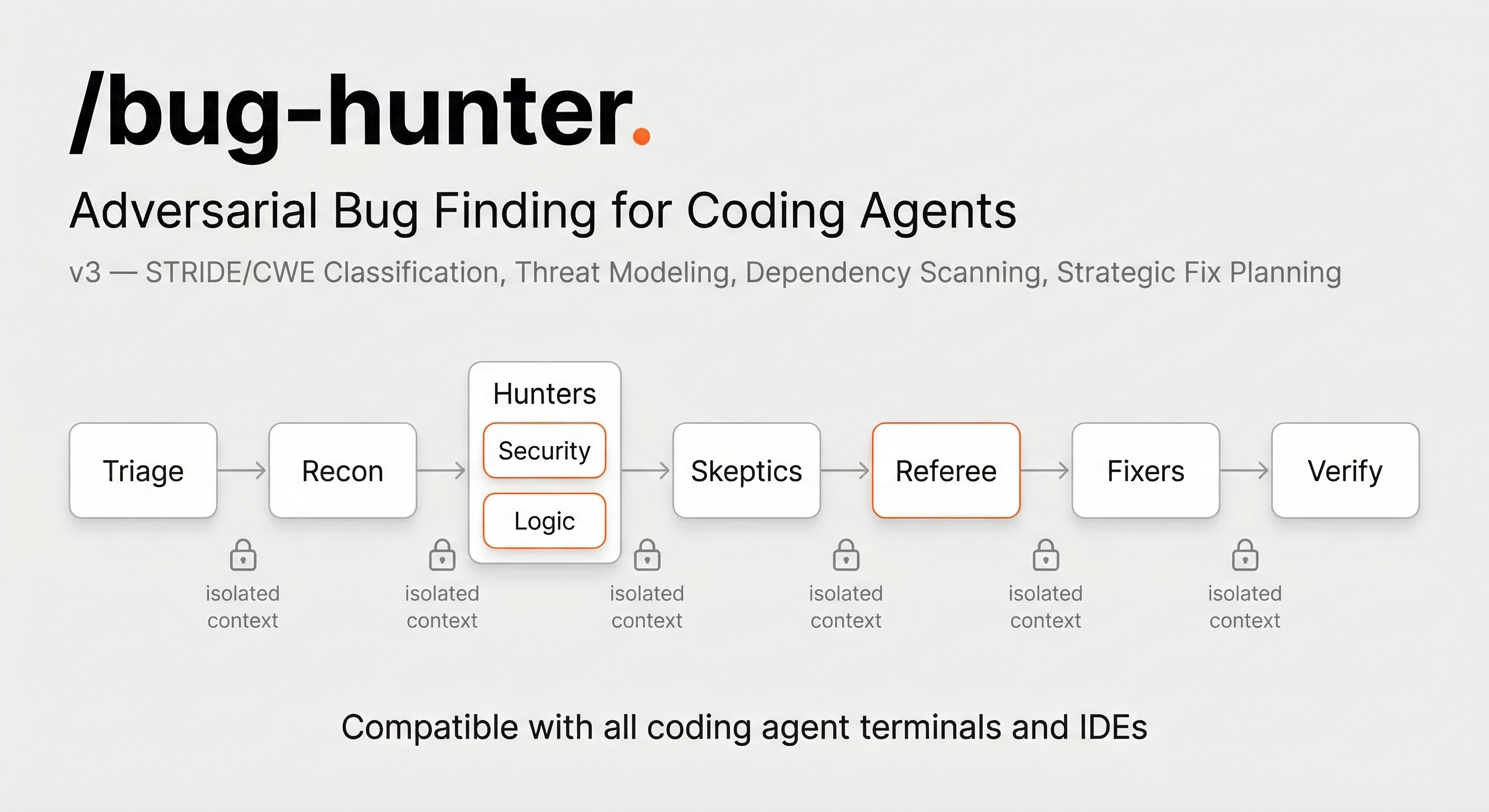
Bug Hunter is an open-source AI code review and security vulnerability scanner that works as a skill/plugin for AI coding agents. Three AI agents — a Hunter, a Skeptic, and a Referee — independently analyze your code in an adversarial pipeline. The Hunter finds bugs. The Skeptic tries to disprove them. The Referee delivers the final verdict. Only bugs that survive all three stages make the report, eliminating the false positive overload that plagues other AI code review tools.
It then auto-fixes confirmed bugs with a safe canary rollout pipeline — git branching, test baselines, per-fix commits, automatic rollback on failure, and post-fix re-scanning.
Install
npx skills add codexstar69/bug-hunter
Or via npm:
npm install -g @codexstar/bug-hunter
bug-hunter install     # auto-detects your IDE/agent
bug-hunter doctor      # verify environment
Or clone:
git clone https://github.com/codexstar69/bug-hunter.git ~/.agents/skills/bug-hunter
Requirements: Node.js 18+ recommended. Core pipeline works without it.
Compatible with: Claude Code, Cursor, Codex CLI, Windsurf, Kiro, Copilot, Opencode, Pi — or any AI agent that can read files and run shell commands.
Quick Start
/bug-hunter                      # scan project, auto-fix confirmed bugs
/bug-hunter src/                 # scan a specific directory
/bug-hunter --scan-only src/     # report only, no code changes
/bug-hunter --pr                 # review the current pull request
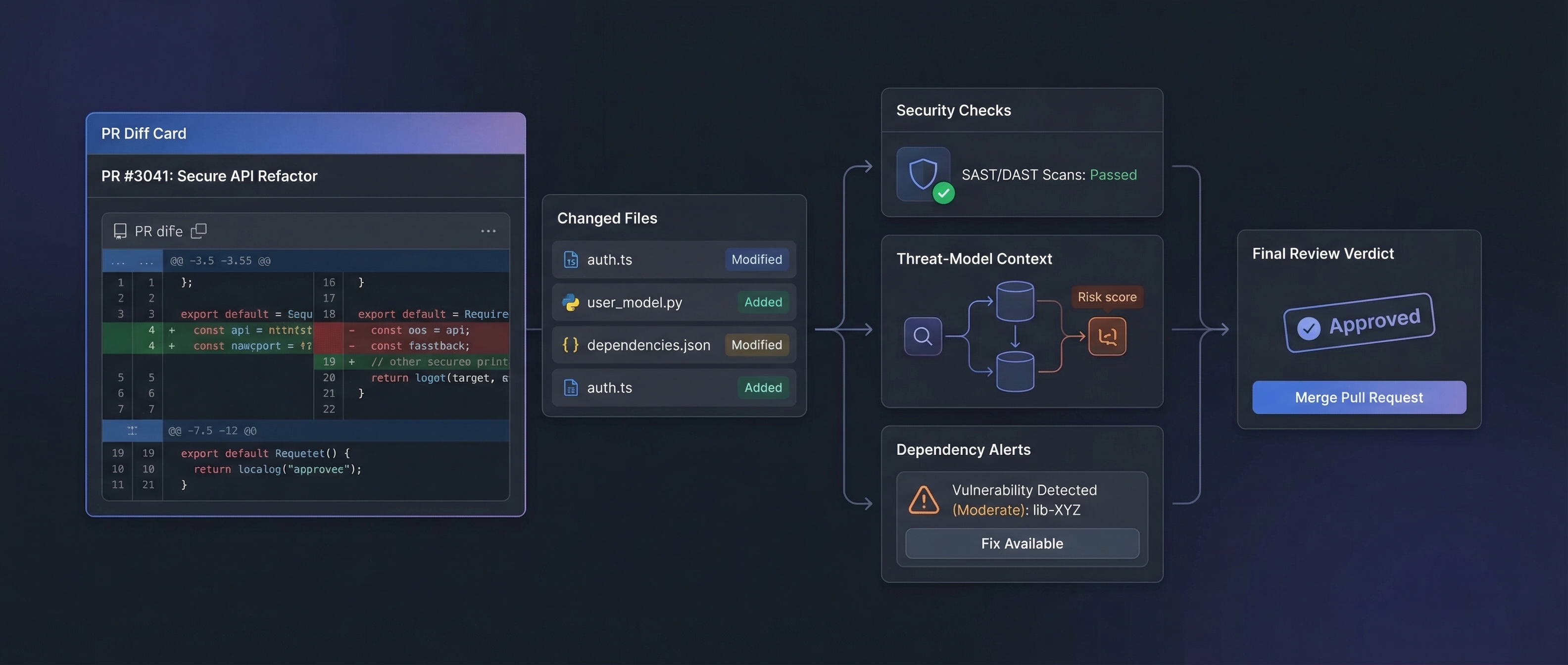
/bug-hunter --pr-security        # PR security review + threat model + CVEs
/bug-hunter --deps --threat-model # full security audit
How Adversarial AI Code Review Works
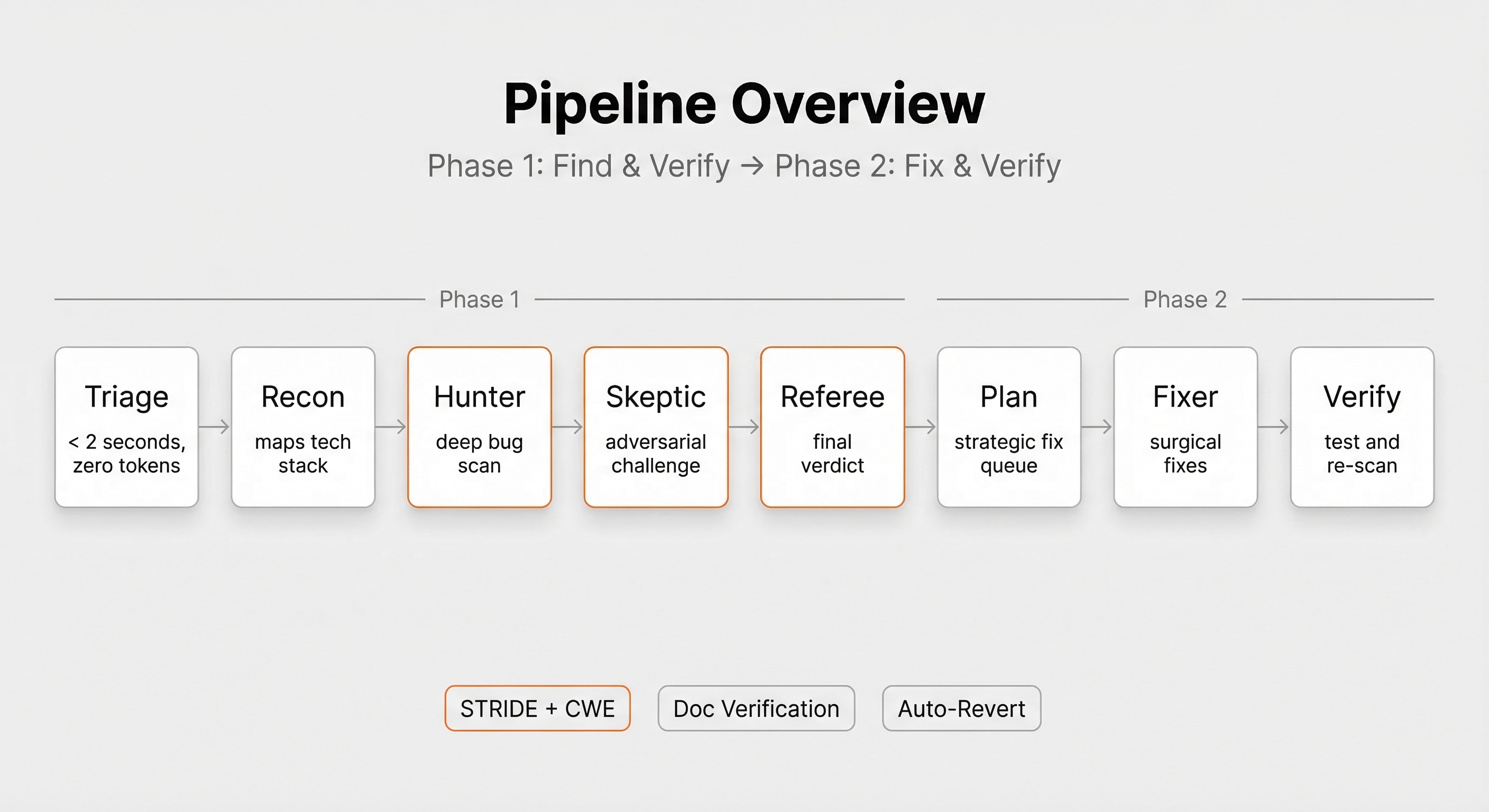
Triage  → Recon → Hunter → Skeptic → Referee → Fix Plan → Fixer → Verify
  (<2s)              ↕ doc verify    ↕ doc verify
- Triage — classifies every file by risk in <2 seconds, zero AI tokens
- Recon — maps tech stack, auth mechanisms, attack surfaces
- Hunter — deep behavioral scan for logic errors, security vulnerabilities, race conditions
- Skeptic — adversarial review that tries to disprove every finding with counter-evidence
- Referee — independent final judge, re-reads code, delivers CVSS-scored verdicts
- Fixer — applies canary-first patches with per-fix rollback safety
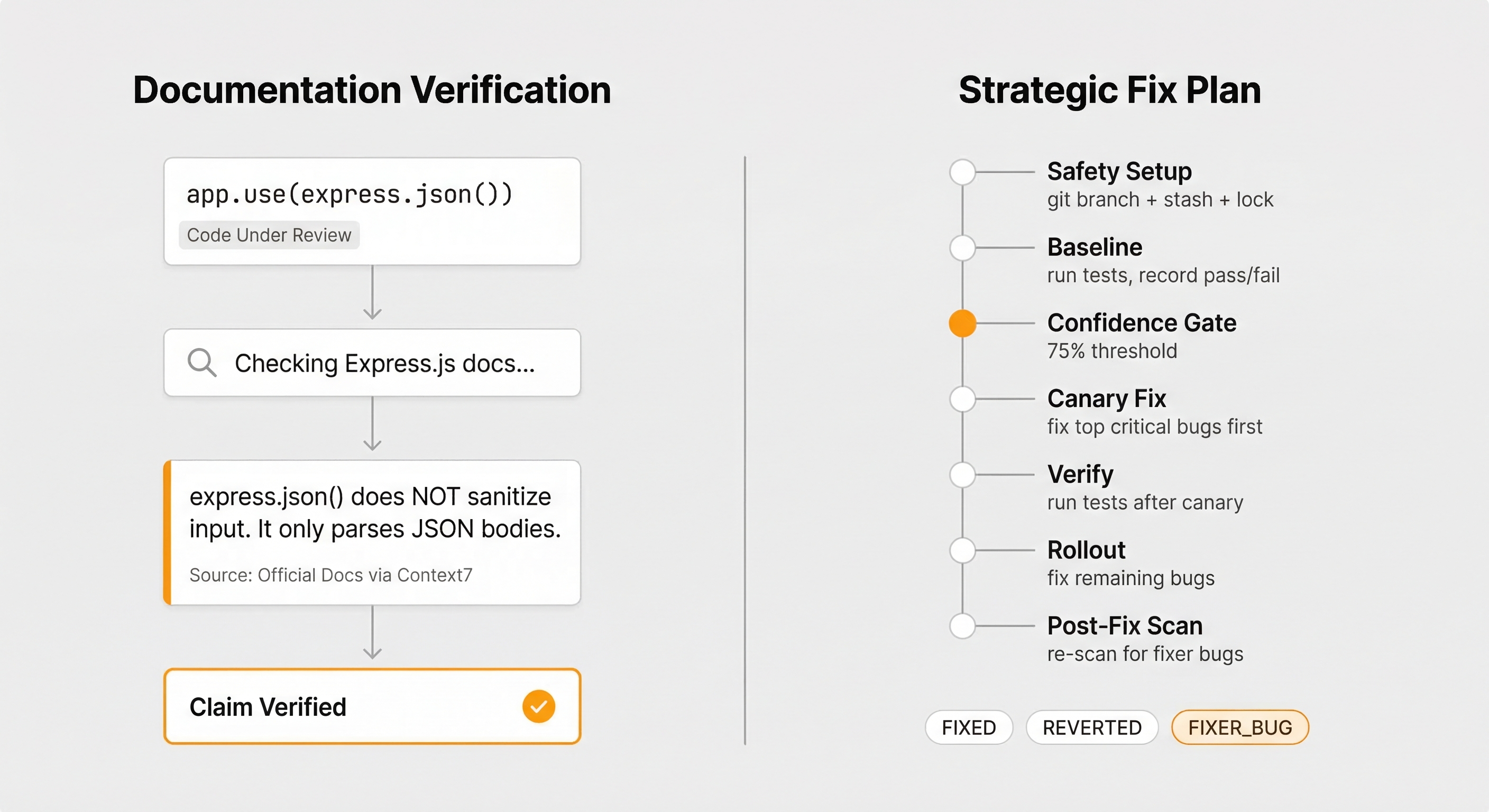
Claims are verified against official library documentation via Context Hub + Context7 before any agent asserts framework behavior.
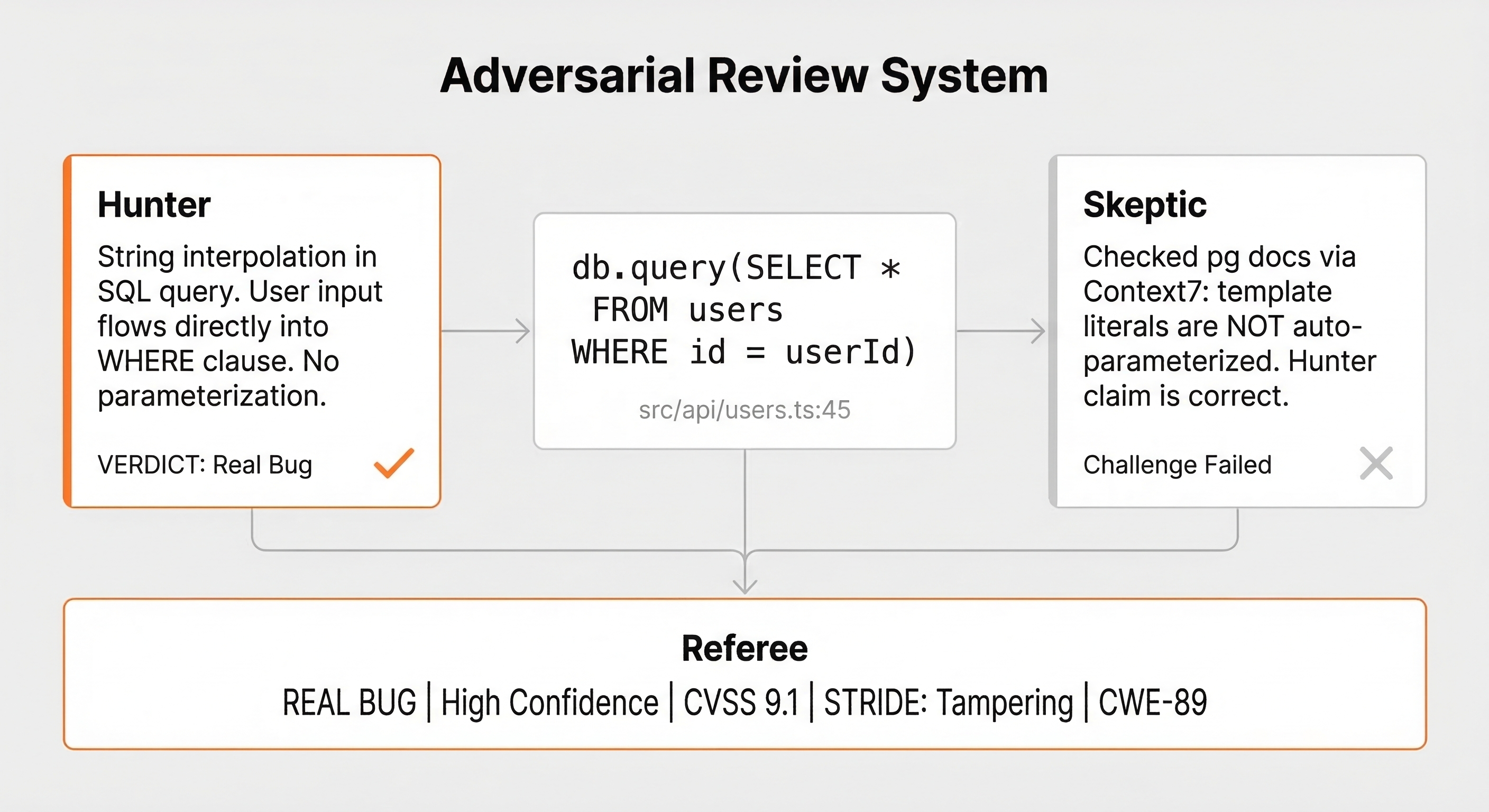
| Agent | Rewarded For | Penalized For |
|---|---|---|
| Hunter | Confirmed real bugs | False positives |
| Skeptic | Disproving false positives | Missing real bugs (2x penalty) |
| Referee | Accurate independent verdicts | Blind trust in either side |
Bugs and Vulnerabilities Detected
Runtime behavioral bugs only — not style, naming, or TODOs:
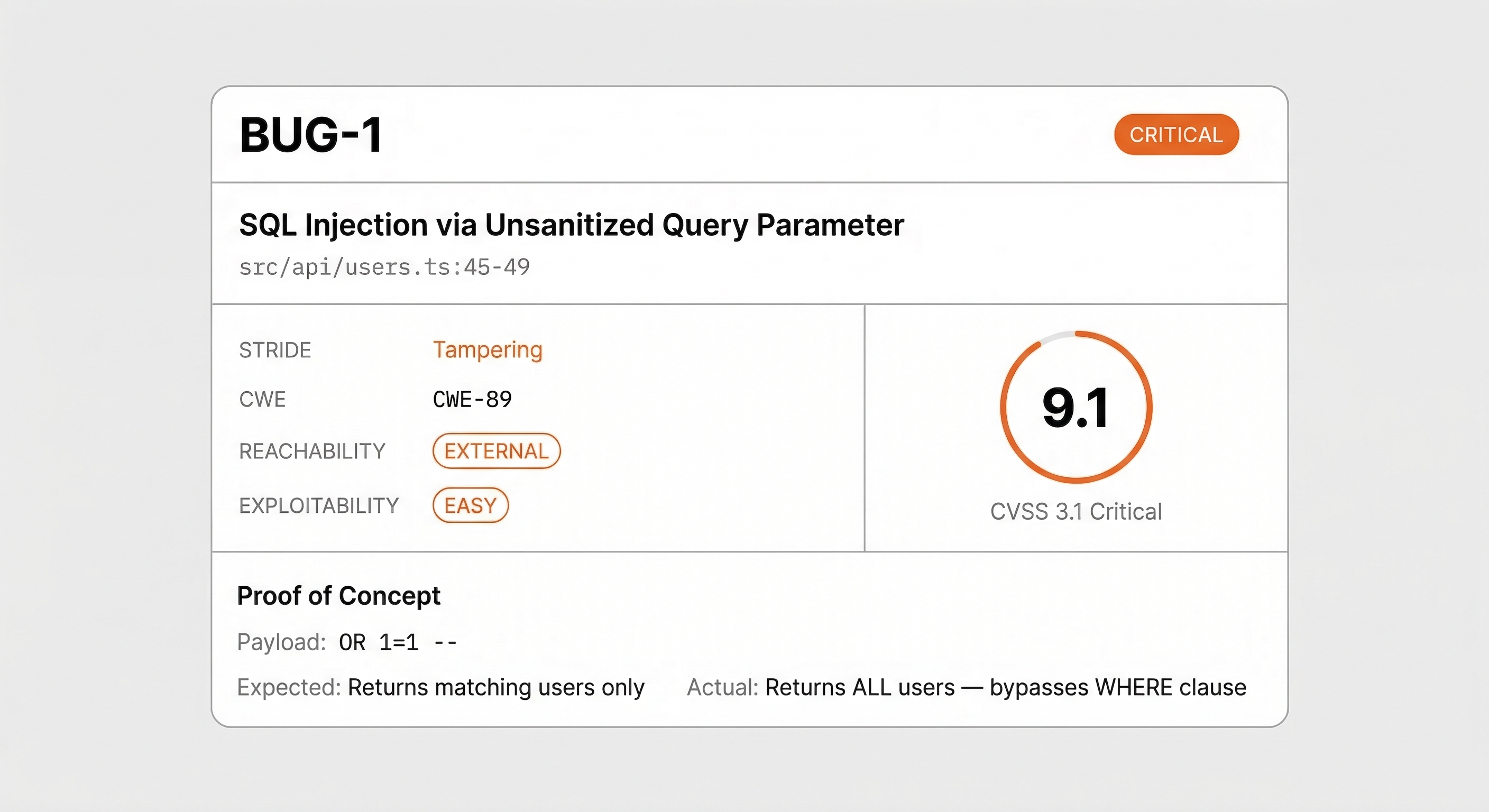
- Security — SQL injection, XSS, command injection, path traversal, IDOR, auth bypass, SSRF
- Logic — wrong comparisons, off-by-one, inverted conditions, unreachable branches
- Concurrency — race conditions, TOCTOU, deadlocks
- Error handling — swallowed exceptions, unhandled promise rejections
- Data integrity — silent truncation, encoding corruption, resource leaks
- API contracts — type mismatches, incorrect callback signatures
Every security finding gets STRIDE classification, CWE ID, and CVSS 3.1 scoring with proof-of-concept payloads.
Supported Languages and Frameworks
Languages: TypeScript, JavaScript, Python, Go, Rust, Java, Kotlin, Ruby, PHP
Frameworks: Express, Next.js, Django, Flask, FastAPI, Gin, Spring Boot, Rails, Laravel — and any framework with docs in Context7.
Safe Auto-Fix with Canary Rollout
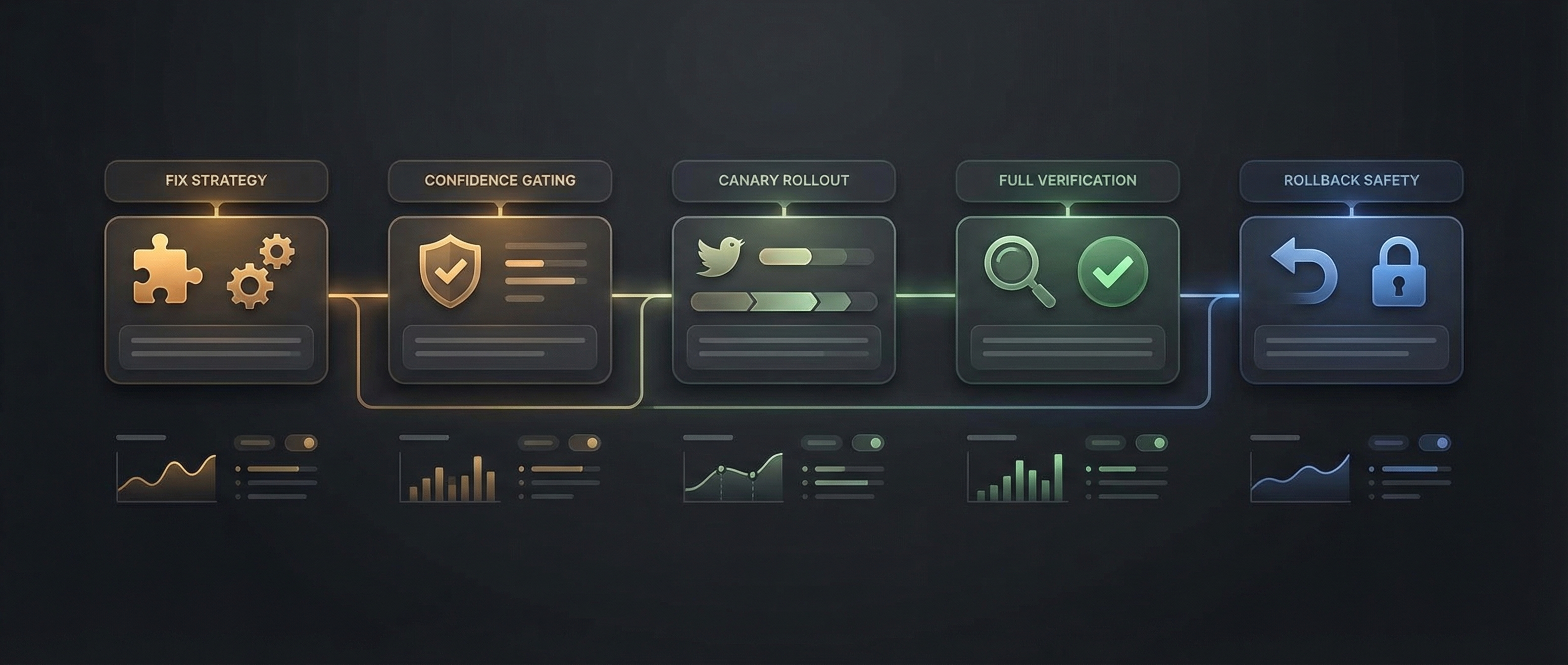
When bugs are confirmed, the Fixer engineers patches — not just edits:
- Git branch — dedicated fix branch with restore point
- Test baseline — captures passing tests before any edits
- Strategy — classifies each bug: safe-autofix / manual-review / larger-refactor / architectural
- Confidence gate — only auto-fixes bugs confirmed at >=75% confidence
- Canary rollout — top 1-3 Critical bugs fixed first; if tests break, pipeline halts
- Per-fix checkpoint — each fix committed individually; failures auto-revert
- Post-fix re-scan — catches bugs the Fixer itself introduced
--plan-only to see the strategy. --dry-run to preview diffs. --safe to approve each fix.
Security Scanning Features
| Flag | Capability |
|---|---|
--threat-model |
STRIDE threat model generation |
--deps |
Dependency CVE scanning (npm, pip, go, cargo, bun) with reachability analysis |
--pr-security |
PR-scoped security review with threat model + CVE context |
--security-review |
Enterprise security audit workflow |
--validate-security |
Exploitability validation with CVSS scoring |
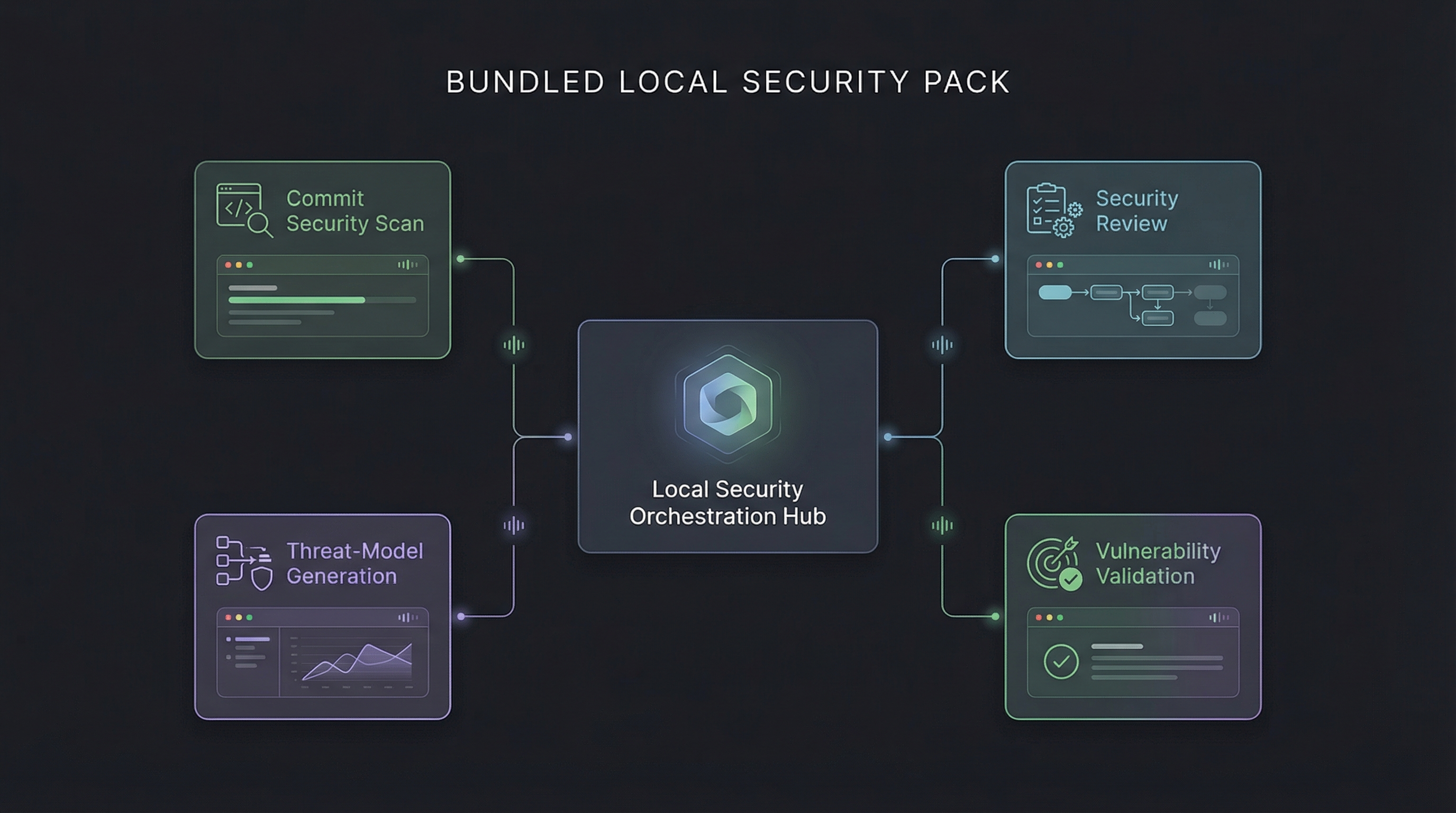
Bundled security skills: commit-security-scan, security-review, threat-model-generation, vulnerability-validation.
CLI Flags
| Flag | Behavior |
|---|---|
| (no flags) | Scan + auto-fix confirmed bugs |
src/ or file.ts |
Scan specific path |
--scan-only / --review |
Report only, no edits |
--fix --approve / --safe |
Approve each fix interactively |
--plan-only / --plan |
Generate fix strategy without editing |
--dry-run / --preview |
Preview fixes as diffs |
-b branch |
Scan branch diff vs main |
--pr / --pr 123 / --pr recent |
Review a pull request |
--staged |
Scan staged files (pre-commit hook) |
--deps |
Dependency CVE scan |
--threat-model |
STRIDE threat model |
--no-loop |
Single-pass scan (loop is on by default) |
--autonomous |
Zero-intervention auto-fix |
All flags compose: /bug-hunter --deps --threat-model --fix src/
Output Files
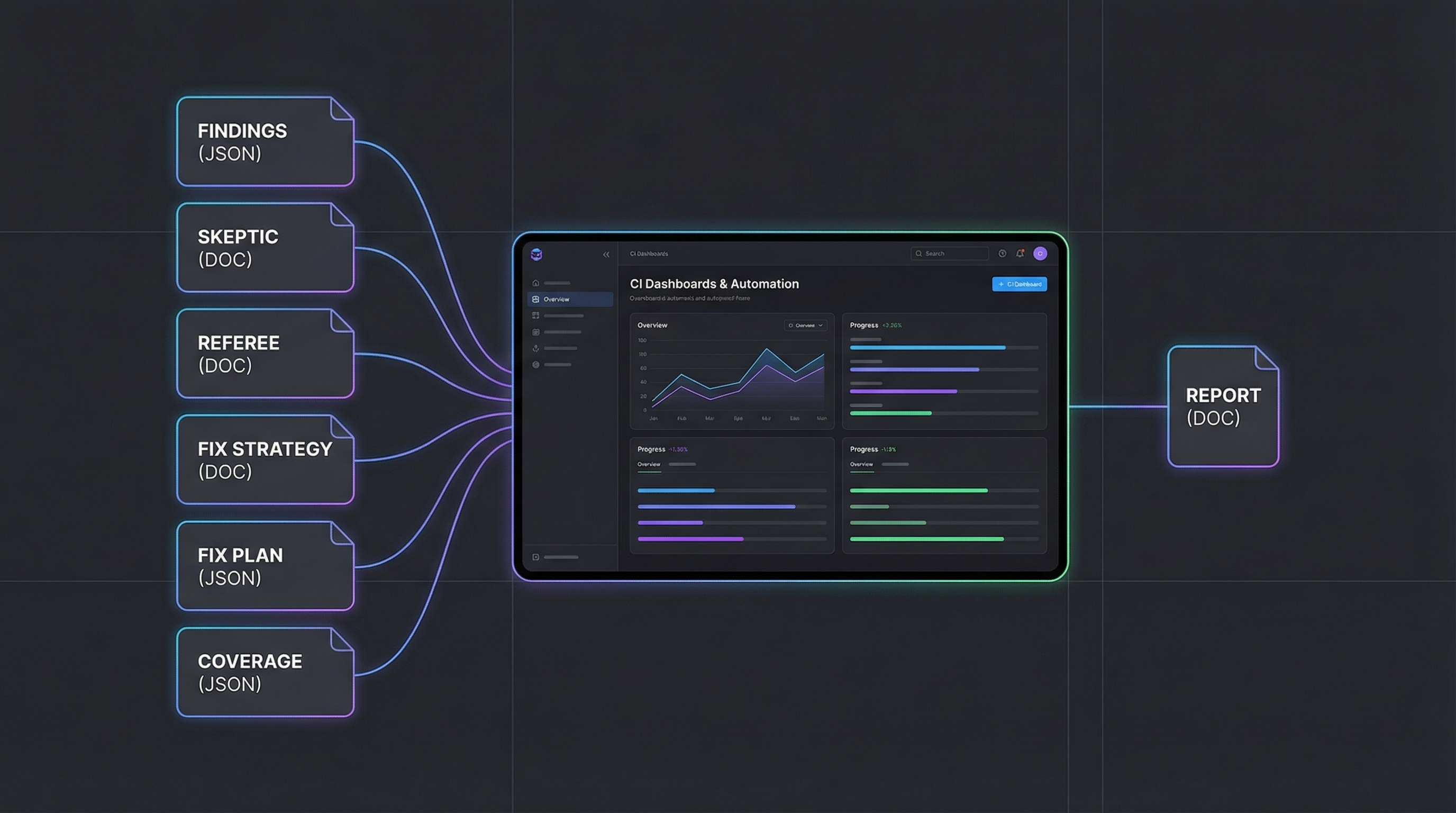
Every run creates .bug-hunter/ (add to .gitignore):
| File | Purpose |
|---|---|
findings.json |
Machine-readable findings (CI/CD gating, dashboards) |
report.md |
Human-readable report |
referee.json |
Final verdicts with CVSS scores and PoC payloads |
fix-strategy.json |
Remediation classification |
fix-plan.json |
Canary rollout execution plan |
fix-report.json |
Fix results |
triage.json |
File risk classification |
threat-model.md |
STRIDE threat model |
dep-findings.json |
Dependency CVE results |
Self-Test
Ships with 6 planted bugs and 113 regression tests:
/bug-hunter test-fixture/     # validate pipeline
npm test                      # run test suite
Project Structure
bug-hunter/
├── SKILL.md              # Pipeline orchestration
├── bin/bug-hunter         # CLI installer
├── skills/                # 10 agent skills (hunter, skeptic, referee, fixer, recon, + 5 more)
├── modes/                 # Execution strategies (single-file → large-codebase)
├── schemas/               # JSON artifact contracts
├── scripts/               # Node.js helpers + 113 tests
├── templates/             # Subagent dispatch template
└── test-fixture/          # 6 planted bugs for validation
License
MIT
Yorumlar (0)
Yorum birakmak icin giris yap.
Yorum birakSonuc bulunamadi