layermap
Health Warn
- License — License: Apache-2.0
- Description — Repository has a description
- Active repo — Last push 0 days ago
- Low visibility — Only 5 GitHub stars
Code Pass
- Code scan — Scanned 12 files during light audit, no dangerous patterns found
Permissions Pass
- Permissions — No dangerous permissions requested
No AI report is available for this listing yet.
LayerMap MCP: a layered map of your codebase for coding agents: callers, callees and the impact of a change, for TypeScript, JavaScript, Go, Python and Java. MCP server, CLI, and plugins for Claude Code and Codex.

LayerMap
English · 中文




LayerMap tells your coding agent what calls a function and what changing it affects, up to the HTTP routes, in one call. With at most 15 requests, agents found 97.9% of affected endpoints with LayerMap vs 58.8% without; with no limit, Claude Code cost 32% less (benchmark).
Resolved by each language's compiler or type checker, not guessed from names by tree-sitter: calls through interfaces, base classes, templates and decorators link as the compiler links them, for TypeScript, JavaScript, Go, Python and Java.
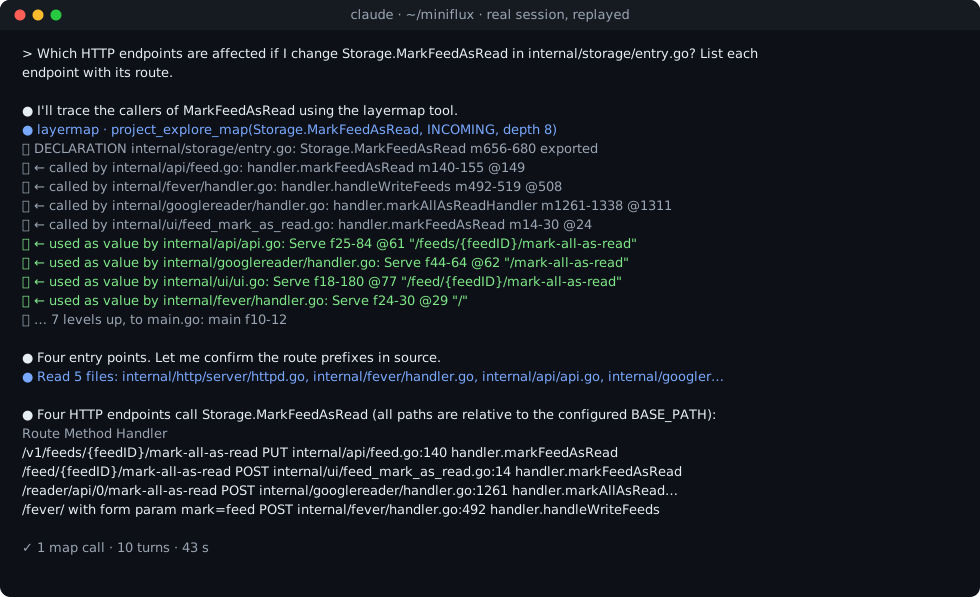
A real Claude Code session on Miniflux, replayed: one map call finds every endpoint, then the agent confirms them in source.
A layered map of your codebase for coding agents. LayerMap gives Claude Code, Codex, DeepSeek
Harness and other MCP clients three read-only tools that answer, in one call, what an agent otherwise works out with
dozens of searches:
- What calls this, and what does changing it affect? Callers traced up to 8 levels, to the
HTTP routes, handlers, jobs and commands they start from. - What does it call? Callees down to 8 levels.
- What is here? Modules, each file's declarations, and every usage of a symbol.
It maps TypeScript, JavaScript, Go, Python and Java with each language's own compiler, so calls
through interfaces, base classes, templates and decorators resolve as the compiler resolves them,
including the ones text search misses.
Example
In Miniflux, one call on Storage.MarkFeedAsRead finds all four
ways a request reaches it, each with its route:
DECLARATION internal/storage/entry.go: Storage.MarkFeedAsRead m656-680 exported
  ← called by internal/api/feed.go: handler.markFeedAsRead m140-155 @149
  ← called by internal/fever/handler.go: handler.handleWriteFeeds m492-519 @508
  ← called by internal/googlereader/handler.go: handler.markAllAsReadHandler m1261-1338 @1311
  ← called by internal/ui/feed_mark_as_read.go: handler.markFeedAsRead m14-30 @24
[1] internal/api/feed.go: handler.markFeedAsRead m140-155
  ← used as value by internal/api/api.go: Serve f25-84 @61 "PUT /v1/feeds/{feedID}/mark-all-as-read"
[1] internal/googlereader/handler.go: handler.markAllAsReadHandler m1261-1338
  ← used as value by internal/googlereader/handler.go: Serve f44-64 @62 "POST /reader/api/0/mark-all-as-read"
[1] internal/ui/feed_mark_as_read.go: handler.markFeedAsRead m14-30
  ← used as value by internal/ui/ui.go: Serve f18-180 @77 "POST /feed/{feedID}/mark-all-as-read"
… (the Fever API, then on down to main.go: main)
m and f mark methods and functions with their lines; @ is the line of the call, and the quoted
route is what it is registered under: the HTTP method and the full path, with the /v1 prefix its
subrouter adds. In Java, Python and TypeScript the route shows on the handler itself, as in@GetMapping("/{id}") route "GET /api/tasks/{id}".
Results
Impact questions ("which HTTP endpoints does changing this affect?") on public Go, Python and Java
projects, graded blind against truth sets cross-checked with each language's own toolchain:
| With LayerMap | Without | |
|---|---|---|
Endpoints found, at most 15 requests (gpt-5.5, 6 tasks × 3 runs) |
97.9% | 58.8% |
| Used unprompted by Claude Code / Codex (plugin installed, two rounds) | 12 of 12 / 12 of 12 | — |
| Endpoints found, no request limit (Claude Code / Codex, 0.1.5) | 100% / 100% | 99.0% / 100% |
| Claude Code cost, no request limit | −33% | |
| Codex input tokens, no request limit (current defaults) | +14% | |
| Time, no request limit (Claude Code / Codex) | +25% / +20% |
With a tight budget, the map finds far more of the affected code, at about 24% more tokens. With
no limit, both agents find nearly everything either way. Claude Code costs a third less with the
map. Codex's current defaults already search lean, so the map no longer saves it tokens; at
reasoning effort max, in the first round, it saved 55%. Agents with the map explore more widely,
which takes longer. These are small samples on tasks written by LayerMap's authors.
The report has the
setup, the published tasks and the limitations.
How LayerMap differs
Other tools give agents part of this. LayerMap combines compiler accuracy with whole-chain traces
in one local map:
| Tree-sitter code graphs (codegraph, GitNexus, …) | Language servers and IDEs (Claude Code's LSP tool, Serena, JetBrains) | Embedding search (Claude Context, Augment) | LayerMap | |
|---|---|---|---|---|
| How calls are linked | Matched by names, imports and framework rules, often with confidence scores | The compiler's own resolution | Not linked; similar code is retrieved | Resolved by each language's compiler or type checker |
| Callers traced to routes and handlers | In several tools, at varying depth | One level per request (JetBrains: 5 by default) | — | Up to 8 levels in one call |
| Kept as a map | Yes, with file watching | No, answered live by a running server | An index of code chunks | Yes, brought up to date on every call |
| Runs on your machine | Yes; some send anonymous telemetry | Yes | Usually with cloud embeddings | Yes, and sends nothing |
Another tool fits better if you need:
- more languages, since tree-sitter graphs cover 30 or more;
- Windows;
- renaming and refactoring, from language servers;
- search by meaning, from embedding search;
- search across many repositories, with Sourcegraph.
Install
Claude Code
/plugin marketplace add coffeecoproject/layermap
/plugin install layermap@layermap
Codex
codex plugin marketplace add coffeecoproject/layermap
codex plugin add layermap@layermap
DeepSeek Harness
npx layermap setup dsh
This adds LayerMap to every dsh profile. Each session maps the project dsh was started in, andnpx layermap remove dsh undoes it.
In every agent, start a new session in a Git repository and ask as usual. LayerMap tells the agent
when the map helps. On first launch, npx downloads the pinned layermap package from npm.
Claude Code asks once before each map tool runs in a project. Choose "don't ask again", or runnpx layermap allow claude to allow the plugin's read-only tools everywhere.
Without plugins: run npx layermap setup claude or npx layermap setup codex. Setup does three
things:
- registers the server;
- lets its read-only tools run without a prompt;
- adds one marked sentence to the agent's instructions file.
Use --scope project to set it up for a whole team, and npx layermap remove … to undo it. For any
other MCP client, run npx -y layermap mcp as a stdio server in the repository.
Requirements:
- Node.js 22.22 or later.
- macOS or Linux (x64 or arm64).
- A Git repository.
- For Java projects, a JDK 21 or later.
How it works
The first call in a repository builds its map: seconds for a small project, a few minutes for a
large one. Later calls re-analyze only what changed, so the map always matches the working tree.
Maps stay in your user cache (~/Library/Caches/layermap, ~/.cache/layermap orLAYERMAP_CACHE), never in the repository. LayerMap runs entirely on your machine and sends
nothing anywhere (privacy,
security).
| Tool | Use |
|---|---|
project_explore_map |
A directory, a file, or a declaration's callers and callees (direction INCOMING or OUTGOING, depth up to 8). |
project_search_map |
Find declarations by words in their names, paths or documentation. |
project_find_references |
Every usage of a declaration, compiled from current source. |
The same from the command line:
npx layermap explore src/api/users.ts --name createUser --direction INCOMING --depth 8
npx layermap search "invoice total"
npx layermap refs src/billing/tax.ts calculateTax
FAQ
How long does the first map take? On a recent Mac:
- Miniflux (400 Go files): about 3 s.
- Polar's server (1,900 Python files): about a minute.
- Conductor (1,500 Java and 1,300 TypeScript files): under two minutes.
What can't it see? Calls the compiler cannot resolve statically: dependency injection, unknown
framework routing, reflection and computed names. The tools say where a trace stops, and a missing
relationship does not prove absence.
Windows? Not yet.
How do I remove it?
- Claude Code:
/plugin uninstall layermap@layermap. - Codex:
codex plugin remove layermap@layermap. - Then delete the cache directory.
Development
You need pnpm, Go 1.24 and a JDK 21+. A missing toolchain leaves its language unanalyzed.
Run pnpm install. On the first install pnpm asks which dependencies may run build scripts; allow
esbuild only, since the SQLite package ships prebuilt binaries:
pnpm approve-builds esbuild '!@photostructure/sqlite'
Then run pnpm test, pnpm typecheck or pnpm lint.
pnpm package builds the npm package.
License
Reviews (0)
Sign in to leave a review.
Leave a reviewNo results found