NeuroPlasticity
Health Uyari
- License — License: MIT
- Description — Repository has a description
- Active repo — Last push 0 days ago
- Low visibility — Only 6 GitHub stars
Code Gecti
- Code scan — Scanned 6 files during light audit, no dangerous patterns found
Permissions Gecti
- Permissions — No dangerous permissions requested
This agent acts as an automated testing and self-healing framework for AI prompts. It runs your AI agent inside an isolated sandbox, evaluates its performance against deterministic tests, and uses a local LLM to automatically rewrite and improve the agent's prompt until it passes.
Security Assessment
Overall risk: Medium. The tool is built entirely in Rust and passed a light code scan without any dangerous patterns or hardcoded secrets. It requests no dangerous system permissions. However, by design, it orchestrates the execution of shell commands to test your agent. While it utilizes rootless Podman containers for 100% ephemeral sandboxing to prevent host bleed, the inherent nature of dynamically generating and executing code or commands always warrants careful oversight. Additionally, if not run in its offline mode, the tool may make external network requests to pull models or communicate with LLM APIs.
Quality Assessment
The project is highly transparent about its architecture and actively maintained, with its most recent push occurring today. It is properly licensed under the permissive MIT license. The main concern is its extremely low community visibility; currently, it only has 6 GitHub stars, meaning it has not been widely vetted by the broader developer community.
Verdict
Use with caution due to the inherent risks of automated code and command execution, though its sandboxed design and clean code scan make it a promising tool for prompt optimization.
Self-Reinforced Testing Framework (SRTF) for AI Agents.
NeuroPlasticity 🧠
Its like a gym for your agent to self improve it's rules.
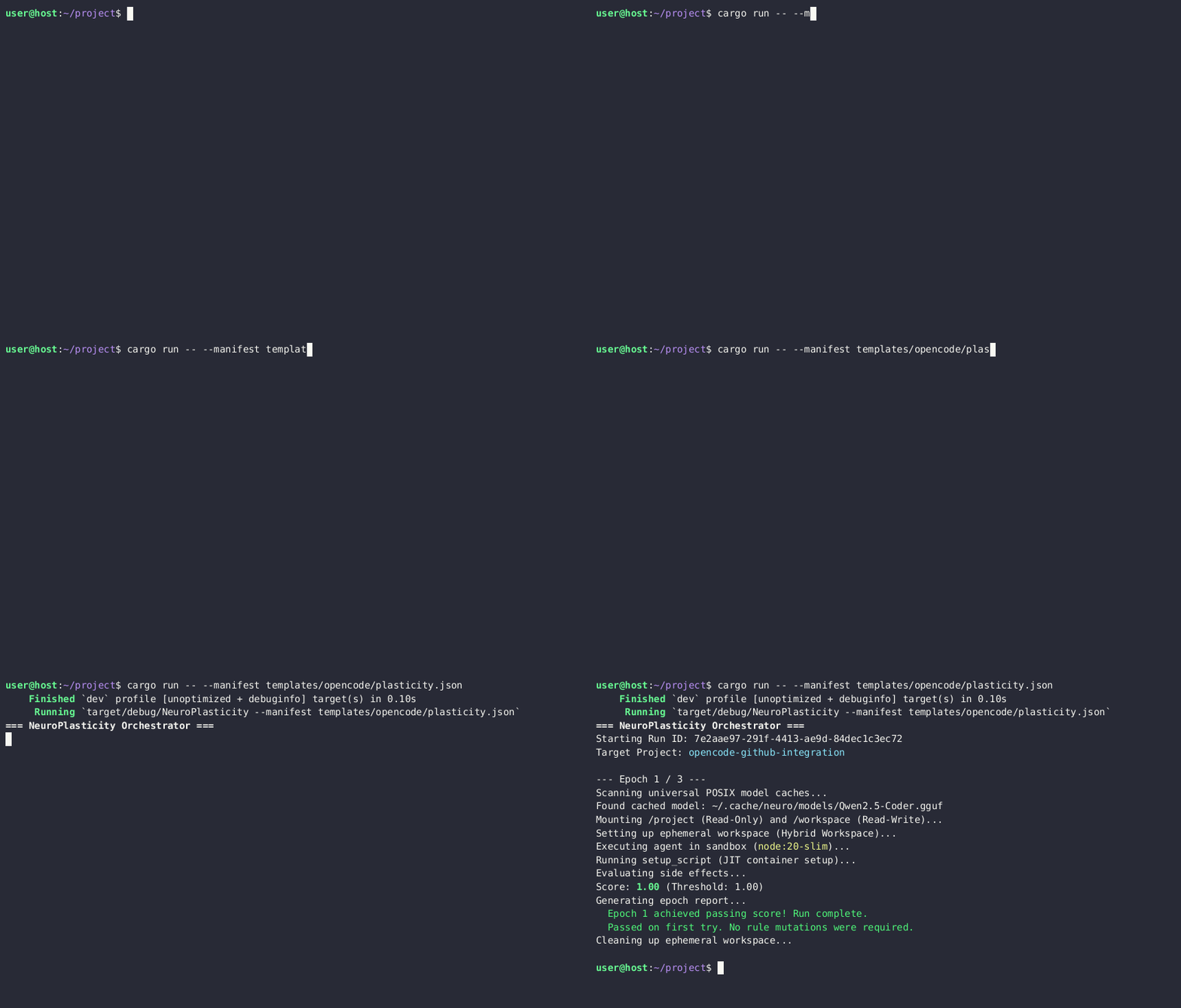
Building reliable AI agents is currently a dark art of manual prompt-tweaking and hoping for the best. NeuroPlasticity ends the guesswork by introducing Self-Reinforced Testing Framework (SRTF) to the prompt engineering lifecycle. Built in lightning-fast Rust and fully isolated via rootless Podman sandboxes, NeuroPlasticity treats your agent's system prompt like source code that needs to be compiled. You define the deterministic tests; if your agent fails, our Meta-Optimizer analyzes the stderr logs, autonomously writes a behavioral patch for the agent's prompt, and re-runs the container until the tests pass. When it succeeds, it hands you a mathematically verified neuroplasticity_patch.md to permanently upgrade your codebase.
"By treating verbal feedback from deterministic environments as a reward signal, language agents can iteratively refine their behavior, correcting hallucinations and logical errors without requiring traditional weight updates."
— Inspired by the architectural findings in Reflexion: Language Agents with Verbal Reinforcement Learning (Shinn et al., 2023) and Large Language Models as Optimizers / OPRO (Yang et al., Google DeepMind, 2023).
🔥 Features
- Automated Self-Healing: The Meta-Optimizer dynamically patches failing agents by analyzing evaluation logs and injecting targeted behavioral constraints.
- 100% Ephemeral Sandboxing: Agents execute inside secure, rootless Podman containers with copy-on-write scratch directories. No host bleed. No broken state.
- Offline First via
llama.cpp: Run fully disconnected. Compile withcargo run --features embedded-llmto automatically pull and run models likeQwen2.5-Coderdirectly in your computer's memory. To respect user disk space, NeuroPlasticity does not download duplicate models. It defaults to using universally accepted POSIX model caches:~/.cache/huggingface/hub/,~/.ollama/models/blobs/,~/.cache/lm-studio/models/, with a fallback to~/.cache/neuro/models/. - Declarative
plasticity.json: Define your tasks, sandbox constraints, and deterministicbashevaluators in a strict, schema-backed JSON manifest. - Verified Improvement Patches: If the framework successfully optimizes an agent, it generates a
neuroplasticity_patch.mddetailing the exact prompt overrides needed to fix the agent permanently.
⚡ How It Works
- Define the Test: You write a
plasticity.jsonstating what the agent should do, and write a simple bash script to evaluate if it did it. - The Failure (Epoch 1): The orchestrator spins up the agent in a Podman container. The agent fails the test.
- The Meta-Optimization: NeuroPlasticity extracts the failure logs (
stderr/stdout) and passes them to the LLM Meta-Optimizer. The LLM writes a specific, targeted rule to fix the agent's mistake. - The Fix (Epoch 2): NeuroPlasticity injects the new rule into
.neuroplasticity/rules.json, boots a fresh container, and runs the agent again. - The Patch: Once the evaluators pass, NeuroPlasticity generates a final
neuroplasticity_patch.md. You hand this patch to your primary dev-agent (like Claude or Aider) to permanently update your target project.
🚀 Quick Start (Zero-Dependency Sandbox Test)
We've included a self-test configuration in the root directory that demonstrates exactly how the Meta-Optimizer reacts to failure. You can run this immediately after cloning.
Ensure you have Podman installed.
1. Clone the repository and build the base container:
git clone https://github.com/Cognilogical/NeuroPlasticity.git
cd neuroplasticity

# Build the dummy container testbed
./images/build.sh
2. Review the dummy test (plasticity.json):
In this dummy test, we intentionally break an agent by forcing it to output {"wrong": 1} instead of what the prompt asks for ({"greeting": "world"}).
{
  "name": "neuroplasticity-self-test",
  "task_prompt": "Write a JSON file named hello.json containing the key 'greeting' with the value 'world'.",
  "agent_command": ["bash", "-c", "echo '{\"wrong\": 1}' > hello.json"],
  "sandbox": {
    "engine": "podman",
    "base_image": "localhost/neuro-agent-testbed:latest"
  },
  "evaluators": [
    {
      "name": "Check JSON Output",
      "script": ["bash", "-c", "jq -e '.greeting == \"world\"' hello.json"],
      "weight": 1.0
    }
  ],
  "optimization": {
    "target_rules_file": ".neuroplasticity/rules.json",
    "epochs": 2,
    "pass_threshold": 1.0,
    "meta_llm": {
      "provider": "embedded",
      "model": "qwen-local"
    }
  }
}
3. Run the CLI tool (with embedded local inference):
No API keys required. The embedded llama.cpp engine will automatically download a fast 4-bit Qwen2.5 model to your local cache.
cargo run --features embedded-llm
4. Watch the Magic Happen:
- Epoch 1: The script fails. The evaluator triggers an error.
- Meta-Optimization: Your local GPU spins up, reads the
jqfailure log, and generates a new rule (e.g. "Rule: Ensure the JSON file hello.json is created with the key 'greeting'"). - The Overlay: The orchestrator drops the generated fix into
.neuroplasticity/rules.json.
(Note: Because our dummy agent_command is just a hardcoded echo and doesn't read the rules.json file, Epoch 2 will fail again by design! But it perfectly demonstrates the feedback loop!)
🎯 Real-World Example: Fixing a Prompts File (agent.md)
Let's say you have a data-extraction agent. Its behavior is defined entirely by a markdown prompt file called agent.md. You've noticed a frustrating bug: when the agent extracts data to a .json file, it keeps wrapping the output in markdown code blocks (```json ... ```), which breaks your automated jq parsers.
Instead of endlessly tweaking agent.md and guessing, you can use NeuroPlasticity to mathematically force the agent to figure out the fix itself.
1. Write your plasticity.json:
{
  "$schema": "https://raw.githubusercontent.com/Cognilogical/NeuroPlasticity/main/schemas/v1/plasticity.schema.json",
  "name": "json-formatting-eval",
  "task_prompt": "Read the access logs and output a summary to summary.json.",
  "agent_command": ["my-agent-cli", "--system-prompt", "agent.md"],
  "sandbox": {
    "engine": "podman",
    "base_image": "localhost/my-agent-testbed:latest"
  },
  "optimization": {
    "target_rules_file": ".neuroplasticity/rules.json",
    "epochs": 3,
    "pass_threshold": 1.0,
    "meta_llm": {
      "provider": "embedded",
      "model": "qwen-local"
    }
  },
  "evaluators": [
    {
      "name": "Strict JSON Check",
      "script": ["bash", "-c", "jq . summary.json || (echo 'Output is not valid JSON! Did you use markdown blocks?' >&2; exit 1)"],
      "weight": 1.0
    }
  ]
}
2. Run the Test!
neuroplasticity
What Happens:
- Epoch 1: NeuroPlasticity runs your agent in the sandbox using your current
agent.md. The agent writes the file, but includes the markdown backticks.jqfails with a parse error. - The Meta-Optimizer: Your local embedded LLM reads the
jqfailure log. It autonomously writes a new system rule: "CRITICAL: When outputting JSON to a file, DO NOT wrap the output in markdown code blocks (```json). You must output raw JSON text only." It saves this to.neuroplasticity/rules.json. - Epoch 2: The agent runs again. Because your agent framework is set up to append
.neuroplasticity/rules.jsontoagent.mdduring tests, the agent now knows exactly what to avoid. It outputs raw JSON. Thejqevaluator passes! - The Patch: NeuroPlasticity outputs
neuroplasticity_patch.md. You simply copy that mathematically verified rule and paste it permanently into youragent.mdfile.
1. Baking in Dependencies (MCP Servers & Tools)
Because NeuroPlasticity treats your agent as a black box, your agent's environment needs to match reality. If your agent relies on external tools like sqlite, a Python environment, or an MCP (Model Context Protocol) server, you must provide them in the sandbox.
The Solution: Build a custom Containerfile or Dockerfile that installs your dependencies and starts any necessary background services (like an MCP router). Then point your plasticity.json to that image.
"sandbox": {
  "engine": "podman",
  "base_image": "localhost/my-agent-with-mcp-testbed:latest"
}
Pro-Tip for MCP: If your agent fails because it hallucinates data instead of using an MCP tool, ensure your evaluator's error message explicitly names the tool. (e.g., echo 'Agent hallucinated! It MUST use the postgres-mcp read_query tool.' >&2). The Meta-Optimizer will read this and explicitly write a rule enforcing the tool's use.
2. Chained Evaluators & Preventing Regressions
As your agent gets more complex, fixing one bug might introduce another. NeuroPlasticity supports Chained Evaluators to prevent regressions. You can define multiple independent tests in your plasticity.json.
The Meta-Optimizer must find a system prompt that satisfies all evaluators simultaneously to achieve a pass_threshold of 1.0.
"evaluators": [
  {
    "name": "Check JSON Format",
    "script": ["bash", "-c", "jq . output.json || (echo 'Must be valid JSON!' >&2; exit 1)"],
    "weight": 0.5
  },
  {
    "name": "Check For Markdown Code Blocks",
    "script": ["bash", "-c", "! grep -q '```' output.json || (echo 'No markdown code blocks allowed!' >&2; exit 1)"],
    "weight": 0.5
  },
  {
    "name": "Check Schema",
    "script": ["bash", "-c", "jq -e '.status == \"success\"' output.json || (echo 'Missing status field!' >&2; exit 1)"],
    "weight": 1.0
  }
]
If the agent fixes the markdown bug but suddenly breaks the schema, the overall run fails, and the Meta-Optimizer will attempt a new prompt that addresses both constraints until it finds the perfect balance.
🤯 META PRO-TIP: Don't want to write these JSON tests and bash evaluators manually? Just point your primary dev-agent (like OpenCode, Claude, Aider, or this CLI) at this
README.mdand tell it: "Read this framework's documentation, then write aplasticity.jsontest suite to evaluate and improve your own performance on [Task X]." Let the agent build its own gym!
🛠️ Configuration (plasticity.json)
{
  "$schema": "https://raw.githubusercontent.com/Cognilogical/NeuroPlasticity/main/schemas/v1/plasticity.schema.json",
  "name": "my-agent-eval",
  "task_prompt": "Update the database schema.",
  "agent_command": ["./run_my_agent.sh"],
  "sandbox": {
    "engine": "podman",
    "base_image": "localhost/my-agent-testbed:latest"
  },
  "optimization": {
    "target_rules_file": ".neuroplasticity/rules.json",
    "epochs": 3,
    "pass_threshold": 1.0,
    "meta_llm": {
      "provider": "embedded",
      "model": "qwen-local"
    }
  },
  "evaluators": [
    {
      "name": "Check Schema Creation",
      "script": ["bash", "-c", "test -f schema.sql"],
      "weight": 1.0
    }
  ]
}
Yorumlar (0)
Yorum birakmak icin giris yap.
Yorum birakSonuc bulunamadi