stateroot
Health Warn
- License — License: Apache-2.0
- Description — Repository has a description
- Active repo — Last push 0 days ago
- Low visibility — Only 5 GitHub stars
Code Fail
- fs module — File system access in editors/vscode/scripts/prepare-installers.cjs
- process.env — Environment variable access in editors/vscode/src/cli.ts
- os.homedir — User home directory access in editors/vscode/src/cliInstall.ts
- process.env — Environment variable access in editors/vscode/src/cliInstall.ts
- os.homedir — User home directory access in editors/vscode/src/copilotAssist.ts
Permissions Pass
- Permissions — No dangerous permissions requested
No AI report is available for this listing yet.
Persistent, federated meta-harness for AI agents. Continue, delegate, fork and merge work across Claude Code, Codex, Cursor, Kimi, OpenClaw and more.
StateRoot
Persistent, federated meta-harness for AI agents.
The harness is disposable. The work is not.
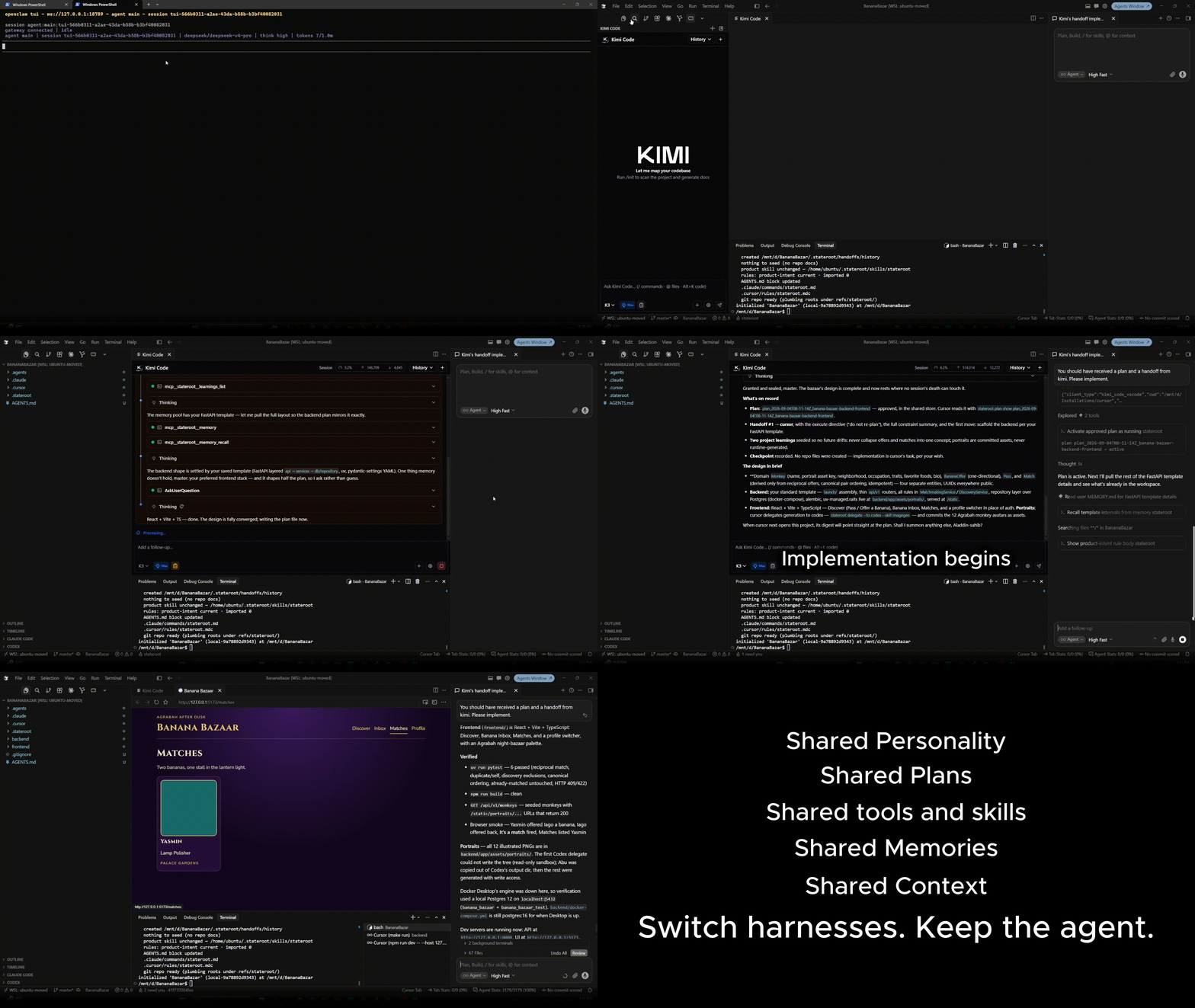
StateRoot federates Claude Code, Codex, Cursor, Kimi, OpenClaw, Hermes, Pi, DeepSeek Harness and other agent harnesses through shared working intelligence and versioned project state. Continue work in another harness. Hand a plan to a different agent. Delegate bounded tasks across tools. Run agents in parallel on independent StateRoot forks. Merge the results when the work converges.
Memory, personality, rules, skills, tools, plans and hard-won learnings persist across the harnesses using them. Each harness keeps its own runtime, model and strengths.
Shared intelligence. Independent execution.







Why StateRoot
Every model wants its own harness — Claude works best in Claude Code, GPT in Codex, DeepSeek in its own. And every harness keeps its own context: its own transcripts, rules, skills, and plans. So the everyday moments of modern AI work — a usage limit hit mid-task, a better model launching in a rival tool, an expensive model you'd rather only plan with — all carry the same hidden tax: re-explaining the project, re-reading the codebase, re-teaching how you work.
StateRoot is the persistent, federated meta-harness above those runtimes: a shared layer through which agents inherit common working intelligence while operating on versioned project states that can continue, diverge, and later converge — while each model keeps its own native runtime. One local CLI, everything on your machine.
It supports two ways of working:
- Sequential continuity — close Claude Code, open Codex, keep working. The next agent starts already knowing the goal, the plan, the decisions, and how you work — and every lesson one agent learns becomes a rule for all of them.
- Parallel collaboration — several harnesses work at the same time on independent StateRoot forks, sharing what they know while their execution stays separate. When the work converges,
stateroot mergefolds it back into one continuing project.
Memory tools preserve what your agents know. StateRoot also preserves what the work is — every meaningful state of the project, immutable and restorable, with a provable lineage of how it changed.
Continue. Delegate. Fork. Merge.
Continue. One harness stops; another continues from the accumulated state. Hooks inject a bounded digest (goal, plan, decisions, memories, next actions) at session start — no pasting transcripts. Plans cross too: a strong model authors the plan in its plan mode, a cheaper model executes it, and the executor's digest says "execute this plan; do not re-plan." Sessions themselves canonicalize into one store and transfer into Pi / DeepSeek Harness as real, resumable native sessions.
Claude Code ──→ State A ──→ State B
                             │
                             ├── continue with Codex
                             ├── branch with Cursor
                             └── restore an earlier state
Delegate. stateroot delegate --to codex --task "…" runs a bounded task inside another harness CLI with full project context — depth-capped, lineage recorded. The parent gets the conclusion, not the transcript.
Fork. stateroot fork branch-materializes any project state into its own worktree under refs/stateroot/forks/. Agents work in parallel on independent states of the same project — shared intelligence, independent execution. Your Git branches are never touched.
Merge. stateroot merge folds fork lineages back into the trunk: each fork is 3-way-merged into the accumulated union and committed as one root with the trunk and every fork tip as parents. Conflicts are reported per path; contained forks report nothing-to-merge. The work converges with its lineage intact.
                    one project, three forks
                            │
             ┌──────────────┼──────────────┐
             │              │              │
           Codex          Kimi          Cursor
             │              │              │
          fork A         fork B         fork C
             │              │              │
             └──────────────┼──────────────┘
                            │
                     stateroot merge
                            │
                  one continuing project
Switch harnesses, change models, retire tools — the project, the persona, and every lesson it ever learned carry on.
Native harnesses stay native
StateRoot does not replace Claude Code, Codex, Cursor, Kimi or any other tool with a proprietary runtime. Each harness keeps its own model, interface, capabilities and strengths; StateRoot is the persistent layer through which they share intelligence and work state. Choose the agent for the job: Codex authors the plan, Kimi implements one task, Cursor implements another on its own fork, Codex reviews and integrates. The agents remain distinct; the project does not reset when the worker changes.
OpenClaw, Hermes and other general agent harnesses can join the same persistent layer alongside Claude Code, Codex, Cursor, Kimi and Pi.
What crosses the boundary
One project, every harness — no new runtime, no required cloud, no lock-in:
| Travels with the work | How |
|---|---|
| Goal, state & next actions | one state of record every harness reads |
| Plans with an approval lifecycle | stateroot plan |
| Memory & facts | curated, provenance-labeled, searchable |
| Rules & preferences | shared pool, recorded once, seen everywhere |
| Real, resumable sessions | canon across harnesses + transfer |
| Subagents in other harnesses | stateroot delegate |
| State lineage (fork / merge / restore) | Git plumbing, your branches untouched |
| Personality | full persona + USER.md, never trimmed |
What it shares
| Project state | Objective, phase, handoffs, next actions — one place every harness reads. |
| Plans | A plan store with a lifecycle (draft → approved → active → done) and provenance. |
| Skills and tools | SKILL.md packages and MCP servers sync across agent configs. Conflicts are left alone. |
| Sessions | Full-fidelity canonical session store across harnesses; transfer into Pi / DeepSeek Harness. |
| Subagents | Delegate bounded tasks into other harness CLIs — depth-capped, bounded result, lineage recorded. |
| Extensions | Any stateroot-<name> executable on PATH becomes a subcommand — agents can extend the CLI itself. |
One personality across every agent
Soul + USER.md — your agent's name, character, voice, and boundaries, plus who you are and how you work — are injected in full at every session start, never truncated to fit a token budget. StateRoot projects the same persona, USER.md, communication preferences and working identity into every harness. The agents remain distinct — Codex stays Codex, Claude Code stays Claude Code — but the working relationship does not reset when the harness changes. You never re-introduce yourself.
Memory, in three layers
- Hot apex (
MEMORY.md) — the curated few hundred lines every session sees: the project's current facts, decisions, and hard-won context, scoped to project or user. - Compiled wiki — long-form knowledge distilled from evidence over time: pages, an index, and a log, compiled deterministically with optional LLM synthesis behind your own keys.
- Episodic log + full-text recall — every checkpoint and observation, append-only and locally searchable (
stateroot memory recall), so anything the project ever learned is one query away.
Every fact carries provenance — verified (Git), observed (transcripts), or synthesized (LLM) — and empty stays empty.
Learnings: taste that compounds
Learnings are judgment, not facts: prefer X over Y, never Z, each with when it applies. Record one — yourself, or any agent on your behalf — and it activates immediately for every harness: no approval queue, no classifier. Scoped to project, user, workspace, or domain; superseded over time, never silently lost. A correction made in one harness becomes a rule for all of them — this is how the team of agents gets smarter together instead of repeating the same mistake in six different tools.
What it snapshots
Git versions the commits you make. StateRoot snapshots the working tree during agent work, stored with Git plumbing under refs/stateroot. Your branches are never rewritten.
Every snapshot is a complete, immutable, content-addressed state: restore it exactly, fork it safely, compare any two states honestly, and read the receipt of what changed between them.
Restores and digests say where information came from: verified (Git), observed (transcripts), or synthesized (LLM). Empty stays empty.
Full map: stateroot.dev/docs.
Install
Install the StateRoot extension for Cursor or VS Code for guided setup and automatic CLI installation on supported platforms.
The CLI ships for Linux x64 and ARM64, Windows x64, and macOS Apple Silicon. One binary, no extra runtime.
Linux
curl -sSfL https://github.com/CognizTech/stateroot/releases/latest/download/install.sh | sh
Installs to ~/.local/bin. Put that directory on your PATH. The binary needs glibc 2.17 or newer (Ubuntu 16.04, Debian 9, RHEL 7, and later).
Windows
Download StateRootSetup-x64.msi from Releases, or:
irm https://github.com/CognizTech/stateroot/releases/latest/download/install.ps1 | iex
stateroot-windows-x64.exe is the portable CLI, not an installer.
macOS (Apple Silicon)
curl -sSfL https://github.com/CognizTech/stateroot/releases/latest/download/install.sh | sh
Installs to ~/.local/bin. Intel Macs can build from source, or straight from this repo: clone it, then cargo build --release -p stateroot-cli (Rust 1.85+; libgit2 is vendored) — the binary lands at target/release/stateroot.
stateroot --version
stateroot doctor     # passes with zero config and zero keys
Quickstart
Zero config, zero keys, one binary. stateroot doctor passes out of the box.
cd my-project
stateroot init
stateroot setup      # once per machine: identity, harnesses, skills
Work in your usual agent. Session hooks inject a digest. You do not need to paste anything.
Then the aha: close that agent and open any other supported harness in the same project. It starts the session already knowing the goal, the plan, the decisions, and the next actions — no re-explaining, no re-reading the codebase.
stateroot status
stateroot log
stateroot resume --harness cursor
stateroot checkpoint --note "wired auth middleware — unblocks handlers" --files src/auth.rs
stateroot handoff write --from cursor \
  --objective "Ship local handoffs" \
  --task "Finish adversarial CLI tests" \
  --context-summary "Structured write path is in; remaining work is workspace checks."
If a digest did not appear, run stateroot resume --harness <id> with the harness you are actually in (claude, codex, cursor, kimi, openclaw, hermes). Run it unpiped — never | head / | tail. The full digest is the state of record.
Walkthrough: Quickstart.
Supported harnesses
Hooks + transcripts: Claude Code · Codex · Cursor · Kimi Code · OpenClaw · Hermes · Pi
Transcripts / delegation: DeepSeek Harness · OpenCode · others detected at install
Per-harness notes: Harnesses.
Documentation
User docs live at stateroot.dev. This repository is the CLI.
| Section | Contents |
|---|---|
| Install | Cursor, VS Code, Linux, Windows, macOS, from source |
| Quickstart | Init → setup → first resume |
| Concepts | Roots, continuity, identity, memory, provenance |
| Capabilities | Lineage, handoffs, memory, wiki, skills, MCP, rules |
| Harnesses | Per-tool install and protocol |
| CLI reference | Every command |
| MCP tools | Local stdio server |
Machine-readable index: stateroot.dev/llms.txt.
Privacy
Project data stays in the repo (.stateroot/). Persona and USER.md live in ~/.stateroot/. Search stays in .stateroot/local/ and is never included in snapshots.
Snapshots honor root .gitignore and .staterootignore, plus .git/ and local/. Optional LLM synthesis runs only with DEEPSEEK_API_KEY (preferred, deepseek-v4-flash) or OPENAI_API_KEY (gpt-5.6-luna).
Details: Privacy.
Sharing a project
Committing .stateroot/ makes the project's state of record a team asset — and the boundary is deliberate so it merges cleanly:
- Travels with the repo: goal and project state, plans, learnings, rules, the skill pool, wiki and memory pages, handoff history, the project soul overlay, transitions. Your persona and USER.md never travel — they live in
~/.stateroot/by design, so every teammate keeps their own agent's personality. - Stays local (written to
.stateroot/.gitignoreat init): the search index, spool, delegations, sync cursors, the hot-apexmemories/MEMORY.mdandmemories/episodic.jsonl(per-person lens and private journal — shared truth lives in the wiki and learnings), the current handoff (per-session continuity; history is shared), androots/— lineage travels through Git itself:git push origin 'refs/stateroot/*'. - Append-only journals merge by union via
.stateroot/.gitattributes.stateroot doctorwarns when a local-set path is tracked in git.
A teammate's flow: clone, stateroot install once, open any harness — the digest already knows the goal, the plans, and every lesson the project has learned.
Contributing
cargo fmt --all -- --check
cargo clippy --workspace --all-targets -- -D warnings
cargo test --workspace
Rust 1.85+. libgit2 is vendored. The CLI-embedded session skill is in stateroot-cli/assets/stateroot-skill/. The marketplace install skill is in skills/stateroot/. Docs: Contributing.
Please preserve product intent: inject full persona/USER.md, warn on thin handoffs instead of refusing, do not auto-categorize learnings, and do not trim identity to save tokens.
License
Apache-2.0 — see LICENSE.
Reviews (0)
Sign in to leave a review.
Leave a reviewNo results found