abide
Health Gecti
- License — License: MIT
- Description — Repository has a description
- Active repo — Last push 0 days ago
- Community trust — 86 GitHub stars
Code Basarisiz
- os.homedir — User home directory access in docs/video/capture.mjs
- process.env — Environment variable access in docs/video/capture.mjs
- exec() — Shell command execution in packages/cli/opencode/abide.mjs
- rm -rf — Recursive force deletion command in packages/cli/package.json
- spawnSync — Synchronous process spawning in packages/cli/src/commands/bench.ts
Permissions Gecti
- Permissions — No dangerous permissions requested
Bu listing icin henuz AI raporu yok.
Make your coding agent abide by all your project rules

Abide
Coding agents break your rules from the very first edit. Abide catches every one and makes your agent fix it


1 in 13 turns break a rule no linter can catch · abide does · 300 ms per check · a tenth of a cent per turn
Measured by replaying 93 real Claude Code sessions (1,256 edits, 147 turns) in two repos against their own AGENTS.md, for 22 cents. Jev flagged 39 edits and 15 turns; an independent reviewer confirmed 10 and 11. The turn-level catches (single-use abstractions, oversized files, duplicated logic) held up 11 times in 15. Method, per-rule table and what was wrong: benchmarks/replay.
npx @coldtea/abide login    # pick a key type, paste it once
npx @coldtea/abide init     # hooks into every agent on this machine
Then start claude, codex or opencode as usual. That is the whole setup.
What it does
Your AGENTS.md, CLAUDE.md and the rest of your project instructions are full of rules no linter can check. "Use Yup, don't validate by hand." "No helper with one caller." "Never let a raw error reach a user." "Don't add what wasn't asked for." Nothing can script those, so nothing enforces them. In 93 real sessions, the agent broke one on 1 turn in 13, from the first edit on.
https://github.com/user-attachments/assets/a39c14ed-336a-4d68-8366-18e960916669
Abide enforces exactly those rules. On every edit (or turn) it asks Jev, TypeSafe's decision model, one question per rule and gets a probability back. Jev sees the rule and the diff, never the conversation, so edit 200 is checked like edit 1. Break a rule and the agent is told which one and fixes it in the same turn.
- One call per edit, about 300 ms, a few thousandths of a cent.
- Rules a linter could check are handed to your linter instead.
- No built-in rules. No instruction files, nothing to enforce.
- Your key, your data. Nothing here talks to a server of ours.
Not previously possible
Checking every edit against every rule was never worth doing with an ordinary LLM. A check is about 2,500 tokens. At typical model prices that is a cent or more, and a few seconds, per edit, and the answer comes back as prose you then have to parse and cannot fully trust. Two hundred edits a day made it a non-starter.
Jev changes the arithmetic. It is a decision model, so it answers a typed question with a calibrated probability and nothing else. There is no free text, so there is nothing to make up. It is up to 100x cheaper than a typical LLM and answers in about 300 ms. That is what makes it reasonable to check every edit, every time.
Three minutes to the first catch
- Get a TypeSafe API key at typesafe.ai, or use a Vercel AI Gateway key you already have.
- Run
npx @coldtea/abide login, pick which kind of key it is, and paste it. It is stored once, in~/.abide/.env, owner-only. A.envat the repo root works too. - Run
npx @coldtea/abide initin your repo. - Start your agent. Its first turn compiles your rules into
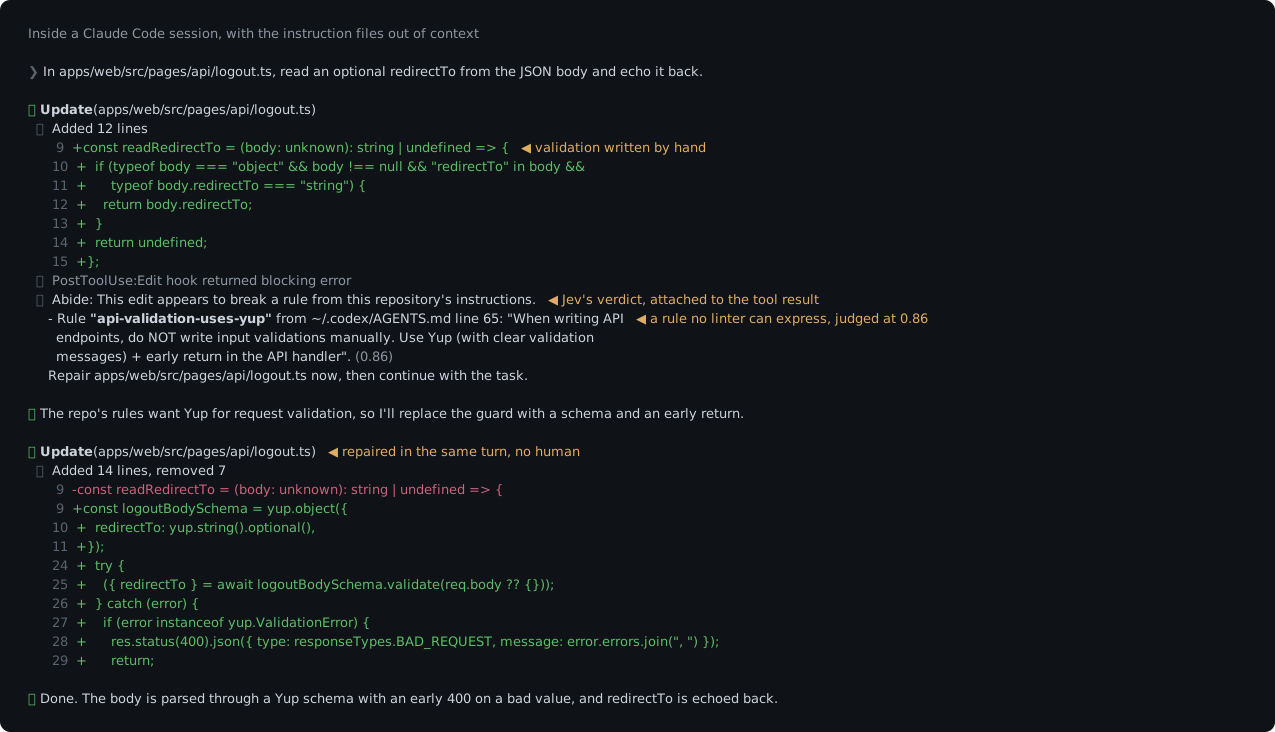
.abide/rubric.jsonand tells you what it found. - Ask for something your rules forbid. An AGENTS.md that says "use Yup, never validate by hand" produces this the moment the agent writes a manual guard:
Abide: This edit appears to break a rule from this repository's instructions.
- Rule "api-validation-uses-yup" from ~/.codex/AGENTS.md line 65: "When writing API endpoints, do NOT write input validations manually. Use Yup (with clear validation messages) + early return in the API handler". (0.86)
Repair apps/web/src/pages/api/logout.ts now, then continue with the task.
The agent repairs it before moving on. No human in the loop.
Agents
| Agent | Install | Where it lands |
|---|---|---|
| Claude Code | npx @coldtea/abide init claude |
~/.claude/settings.json |
| Codex | npx @coldtea/abide init codex |
~/.codex/hooks.json |
| OpenCode | npx @coldtea/abide init opencode |
~/.config/opencode/plugins/abide.js |
init with no name installs into every agent it finds. Add --project to install into the repo instead, so teammates get it with the checkout.
Codex only: start codex, type /hooks, and accept the four abide entries. Codex asks this once for any new hook. Codex edits through apply_patch; abide reads the patch and judges every file in it.
OpenCode only: there are no hook processes, so abide runs as a plugin. Same checks, same messages: an edit that breaks a rule gets the repair request appended to its tool result, and a turn that ends with one gets a single follow-up message.
See what your codebase already breaks
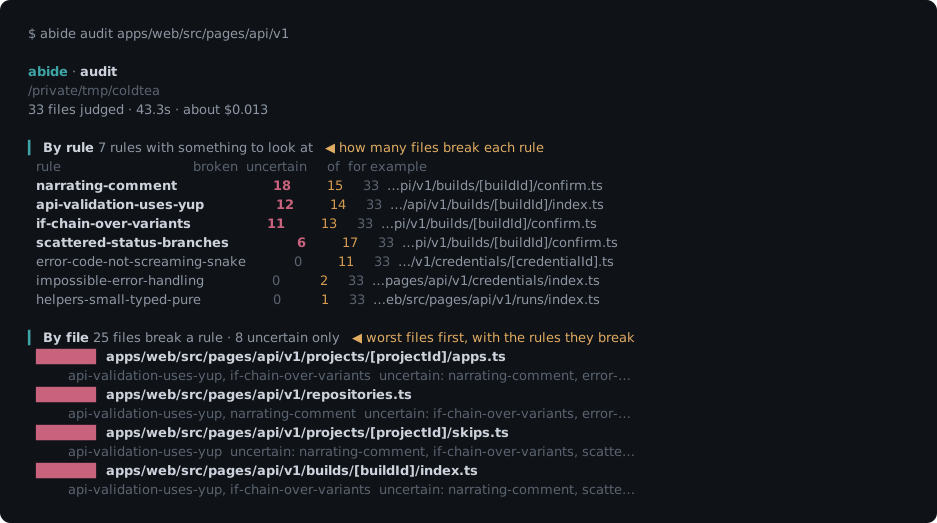
abide audit src/
Every file is judged as if it had just been written. You get a table by rule and a list by file. On 33 API routes of a real Next.js app: 12 seconds, about a cent.
Commands
| Command | What it does |
|---|---|
abide login |
store your TypeSafe or Vercel AI Gateway key in ~/.abide/.env |
abide init [agent] |
install the hooks (claude, codex, opencode, or every one found) |
abide audit [paths] |
judge existing files, report by rule and by file |
abide check [paths] |
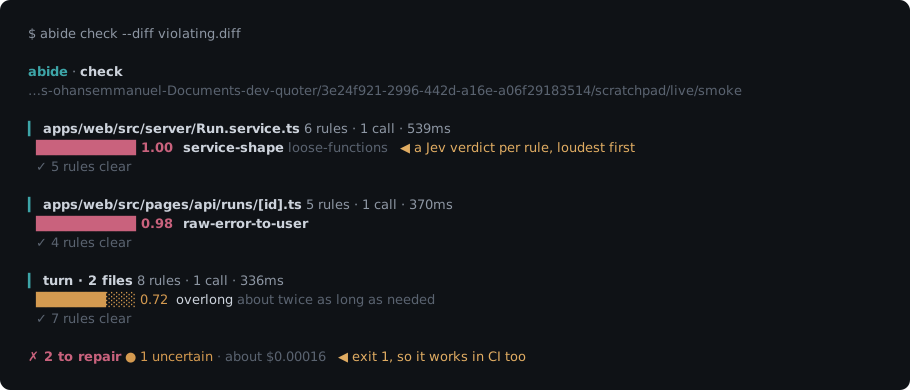
check uncommitted changes the way the hooks would |
abide report |
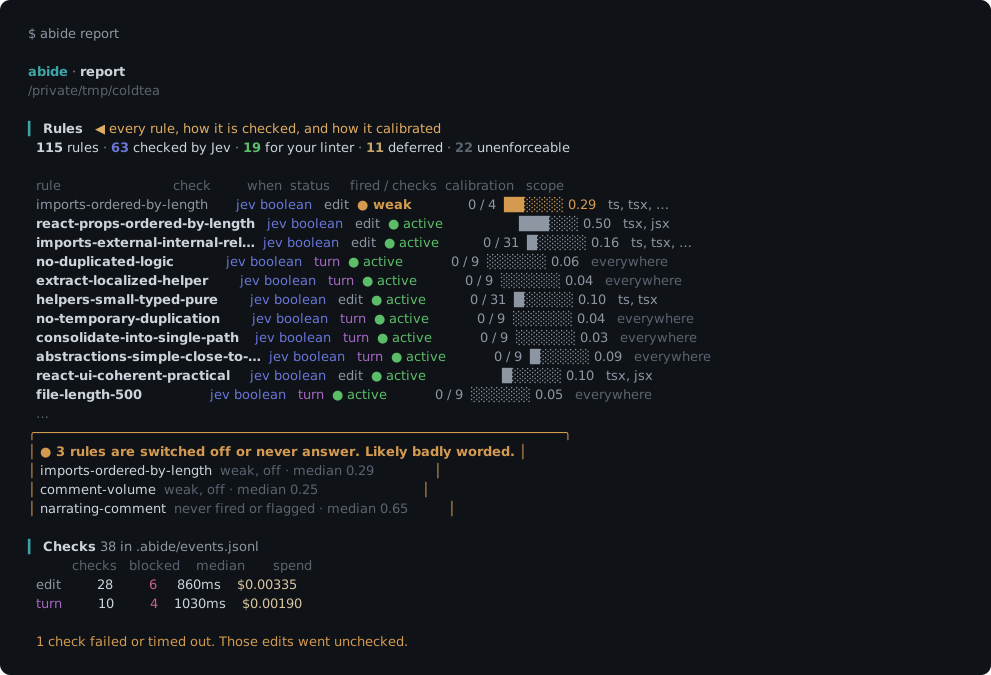
your rules, what fired, what never fires |
abide replay <agent> |
judge this repo's past sessions in any of the three agents |
abide compile |
compile the rubric now instead of at the next session |
abide calibrate |
score every rule against your recent git history |
abide tune |
rewrite the rules that never fire |
abide bench |
latency and spend, measured on your machine |
abide uninstall [agent] |
remove the hooks |
report, check, audit, bench and calibrate take --json.
The rubric is yours
.abide/rubric.json is a committed, readable file. Every verdict names a rule in it, and every rule quotes the line of your instruction file it came from. A wrong verdict is a rule you can rewrite.
- Each rule runs at one of two moments:
editafter each edit,turnonce at the end against the whole diff. "Did this add more than was asked" has no answer after edit 1 of 12. - Each rule can carry a
scopeof globs, so an API route and a stylesheet get different questions. - Verdicts are banded. 0.8 and above: the agent is told to repair. 0.5 to 0.8: you see a note, the agent does not. Below 0.5: nothing.
- A badly worded rule scores 0.4 on everything and never fires.
calibratefinds those against twenty real hunks from your history and switches them off.tunehas the agent rewrite them.
Cost, privacy, safety
- Changed lines go to TypeSafe under your key, with zero data retention requested on every call, and nowhere else.
- Key lookup order: the environment, then
.env.localand.envat the repo root, then~/.abide/.env. Never a flag, never logged. SetAI_GATEWAY_API_KEYinstead of a TypeSafe key to go through your Vercel AI Gateway. - A check on this repo's 13 rules is 1,000 to 1,600 input tokens: $0.00004 to $0.00007, about 300 ms for Jev and about 1 s for the whole hook including Node startup. A turn of 15 edits costs a tenth of a cent. Measured 2026-09-18, direct to TypeSafe.
abide benchmeasures yours. - The hooks cannot break your session. Every path exits 0, has a hard deadline, and prints only what the host expects.
- No key or no network: the edit goes through unchecked and the miss is logged in
.abide/events.jsonl, wherereportcounts it.
How it hooks in
Four hooks per agent. Session start: hash the instruction files, ask the agent to compile if they changed. Turn start: snapshot the working tree with git. After each edit: run the edit-phase rules on that hunk. End of turn: diff the whole turn against the snapshot and run the turn-phase rules, plus the edit-phase rules for anything a shell command wrote.
Uninstall
abide uninstall            # every agent it was installed into
abide uninstall codex      # one agent; add --project for a project-level install
Removes abide's own entries and nothing else. Rubric files and ~/.abide/.env stay until you delete them.
Layout
packages/schema: the rubric, hook payloads, verdicts and events as zod schemas.packages/cli: theabidecommand, the hook script and the OpenCode plugin.skills/abide-compile: the procedure the agent follows to compile a rubric.
License
Yorumlar (0)
Yorum birakmak icin giris yap.
Yorum birakSonuc bulunamadi