thunderbird-mcp
Health Uyari
- License — License: MIT
- Description — Repository has a description
- Active repo — Last push 0 days ago
- Low visibility — Only 6 GitHub stars
Code Gecti
- Code scan — Scanned 12 files during light audit, no dangerous patterns found
Permissions Gecti
- Permissions — No dangerous permissions requested
Bu listing icin henuz AI raporu yok.
MCP server for AI assistants: Thunderbird mail, calendar, contacts, filters. Windows, macOS, Linux.
Commonpost MCP for Thunderbird






MCP server for AI assistants: Thunderbird mail, calendar, contacts, filters. Windows, macOS, Linux.
Let your AI assistant work with Thunderbird -- search mail, compose messages, manage filters, and organize your inbox. All through the Model Context Protocol.
Latest release: v0.22.3 (2026-11-09) -- see the changelog or all releases.
Contents
- Quick install (about 3 minutes)
- Why?
- How it works
- What you can do
- Setup
- Security
- If Thunderbird disables Experiment add-ons on the Release channel
- Troubleshooting
- Development
- Project structure
- Known issues
- License and credits
Quick install (about 3 minutes)
Requirements: Windows, macOS or Linux, with Thunderbird 140 or later and Node.js 22 or later.
Every tool works the same on the three systems. One difference: on Windows, attachments go through the bridge rather
than by file path (see attachments on Windows).
Install the extension. Download
commonpost-mcp-v<version>.xpifrom the latest release. In Thunderbird: Tools > Add-ons and Themes > gear menu > Install Add-on From File. Restart Thunderbird. Thunderbird warns that the add-on gets "full, unrestricted access": it says so for every add-on of this kind (why, and what this one does).Download
mcp-bridge.cjsfrom the same release and put it in a folder you will keep, for example~/commonpost-mcp/. The bridge is a single file and needs nothing else: the release does not ship apackage.json. (The bridge carries its own version; it reads nopackage.json.)Check Node.js:
node --versionmust show 22 or later. The Claude Desktop bundle needs neither this step nor the
previous one (see step 4).Register the bridge with your MCP client.
Claude Desktop (macOS, Windows): download
commonpost-mcp-v<version>.mcpbfrom the same release and open it with
Claude Desktop, or use Settings > Extensions > Advanced settings > Install Extension. Claude Desktop runs it with
the Node.js it ships with, so there is nothing else to install (see
Claude Desktop).Claude Code, with the plugin (no file to download or to update by hand; see Claude Code plugin):
claude plugin marketplace add commonpost/thunderbird-mcp
claude plugin install commonpost-mcp@commonpost
Claude Code, with the file. Use the absolute path of the file, in quotes.
-s usermakes the server available
in every folder; without it, Claude Code adds it to the folder you run the command in only.claude mcp add -s user commonpost-mail -- node "/absolute/path/to/mcp-bridge.cjs"Claude Code on Windows, for example:
claude mcp add -s user commonpost-mail -- node "C:\Users\<you>\commonpost-mcp\mcp-bridge.cjs"Other clients: add this to the client's MCP config (Claude Desktop, VS Code, Cursor, Codex CLI and Gemini CLI have their own file and format: see Other MCP clients). In JSON, write Windows paths with
/or double the backslashes ("C:/Users/<you>/commonpost-mcp/mcp-bridge.cjs"). A JSON file does not expand~: write the full path. On macOS, if the client cannot findnode, setcommandto the full path thatwhich nodeprints.{ "mcpServers": { "commonpost-mail": { "command": "node", "args": ["/absolute/path/to/mcp-bridge.cjs"] } } }
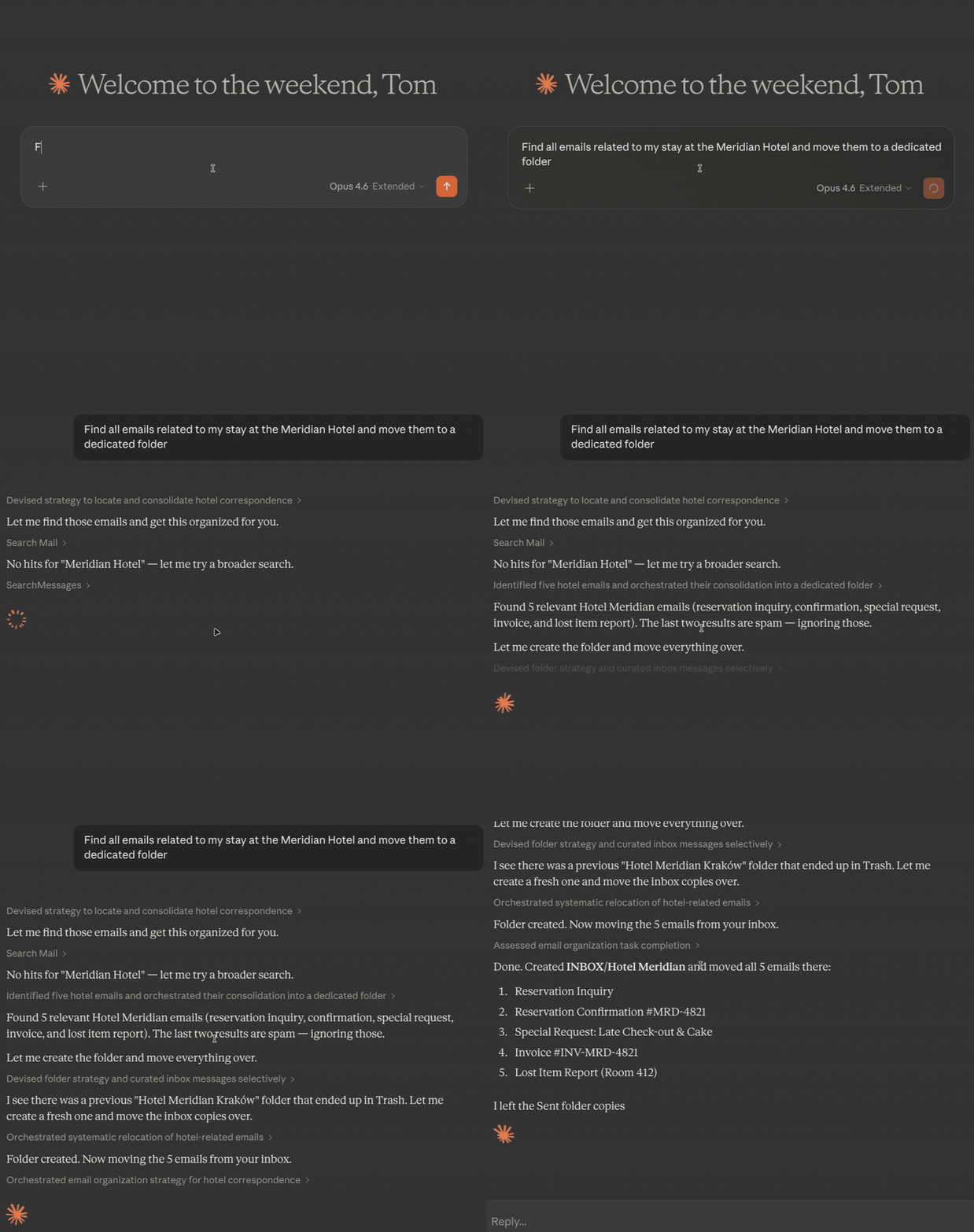
Test it. Keep Thunderbird open and ask your assistant: "list my Thunderbird accounts".
The bridge is not updated automatically, and each MCP client has its own. When one should be replaced, the extension says so in a tool result (your assistant passes it on) and in its options page (section Bridge), which lists the bridges that connected with "Up to date", "Newer version available" (it works; updating is optional) or "Update recommended". For a bridge to update or one the extension refuses, Thunderbird also shows a system notification, once per bridge and per Thunderbird session; the hidden preference extensions.commonpost-mcp.bridgeUpdateAlert set to false turns it off. Every release page starts with what the release brings, whether it changes the bridge, and the steps: download mcp-bridge.cjs and put it in place of your copy (its path is in the MCP configuration of your client; in Claude Code: claude mcp get <server name>), then reconnect your MCP client (/mcp in Claude Code); in Claude Desktop, install the .mcpb bundle again; with the Claude Code plugin, update the plugin. A release that does not change the bridge ships the same bridge again. The extension's version is shown in Tools > Add-ons and Themes.
Right after installing, open the extension's options page (Tools > Add-ons and Themes > Commonpost MCP for Thunderbird > wrench button (Options); it opens in its own tab) and choose which accounts and tools your assistant may use. Until you do, every account and tool is visible to MCP clients.
Snap, Flatpak and macOS need no extra step in most cases; see Sandbox-aware connection discovery. If something fails, see Troubleshooting.
Why?
Thunderbird has no official API for AI tools. Your AI assistant can't read your email, can't help you draft replies, can't organize your inbox. This extension fixes that -- it exposes 42 tools over MCP so any compatible AI (Claude, GPT, local models) can work with your mail the way you'd expect. The list is kept to about 40 tools so that assistants choose among them reliably; older Cursor versions also sent an agent only the first 40 tools of all servers combined (since January 2026 Cursor loads tool descriptions only when needed), and VS Code allows 128 tools per request.
Mail sends require review by default because Block skipReview for mail starts enabled: skipReview: true is honored only after you explicitly disable it. By default, nothing is sent without your review. Events and tasks are added at once on a new install, as updateEvent and deleteEvent change them: they send no invitation, and asking for six appointments means nothing to save by hand. Enable Block skipReview for events and tasks to review each one in Thunderbird's dialog.
How it works
stdio HTTP (localhost:8780-8789)
MCP Client <-----------> Bridge <---------------------> Thunderbird
(Claude, etc.) mcp-bridge.cjs Extension + HTTP Server
The Thunderbird extension embeds a local HTTP server with session-scoped auth tokens. The Node.js bridge translates between MCP's stdio protocol and HTTP, discovering the port and token automatically via a connection file. The bridge handles MCP lifecycle methods (initialize, ping) locally, so clients can connect even before Thunderbird is fully loaded. If the client asks for the tools while Thunderbird is not running, the bridge answers with the tools Thunderbird last listed, which it keeps in your cache folder (%LOCALAPPDATA%\commonpost-mcp on Windows, ~/Library/Caches/commonpost-mcp on macOS, $XDG_CACHE_HOME/commonpost-mcp or ~/.cache/commonpost-mcp elsewhere); tool calls fail until Thunderbird is started.
What you can do
| Tool | Description |
|---|---|
listAccounts |
List all email accounts and their identities |
listFolders |
Browse folder tree with message counts -- filter by account or subtree; savedSearches lists saved searches instead; refresh with folderPath first fetches that folder's new mail from its mail server (IMAP, Exchange, Graph; not news or feeds) and waits up to 20 s |
searchMessages |
Search headers across accounts. Words must all match (subject, from, to, cc, preview); operators from:, to:, cc:, subject:, participant: (from/to/cc/bcc; @domain matches addresses in that domain only, commas list alternatives: participant:@acme.com,@acme-group.com) and quoted phrases can be combined, e.g. participant:@acme.com subject:"invoice 42". groupBy: "sender" | "thread" returns one row per sender or conversation (latestId is the newest message that is not a draft); threadOf: {messageId, folderPath} returns a whole conversation across folders (Sent included), oldest first (it reads at most 10,000 headers, then sets incomplete: true). A Re: message sent without threading headers joins by subject the earlier message its sender took part in (linkedBy: "subject"); the same mail sent separately to several people and repeated notifications stay separate. Filters pick messages of the conversation without cutting its links. Trash and Junk are skipped unless includeTrash or an explicit folderPath. Always returns { messages, totalMatches, offset, limit, hasMore } (default 20 rows, max 200); format: "table" returns { columns, rows }, and format: "legacy" the output of 0.10 and earlier (deprecated), see CHANGELOG. Also countOnly, includeSubfolders, date range, unread/flagged/tag filters, searchBody (Gloda full text: terms under 3 characters are left out and listed in warning, English words match other forms, Russian and other languages only the exact word form) and dedupByMessageId (copies in several folders collapse into one row with dupLocations). attachmentName (part of a filename, any case) and attachmentType (application/pdf, or a prefix such as image/) keep messages with a matching attachment, combined with the other filters; each row lists its matching attachments (name, contentType, size). Only messages Thunderbird marks as having attachments are read, from their local copy (nothing is downloaded or decrypted), at most 500 per call and 16 MiB each; attachmentSearch gives how many were checked and why the others were skipped (encrypted, tooLarge, notOffline, unreadable, limitReached). Thunderbird flags a message from its top-level structure, so a signed message (multipart/signed), a multipart/related one or a single-part attachment is usually not found. While reading encrypted messages is not allowed, a query with words leaves out messages with an encrypted envelope, as without attachment options. attachmentName and attachmentType cannot be combined with searchBody, threadOf or format: "legacy". fields returns only the listed columns (date, author, recipients, ccList, subject, read, flagged, tags, preview, dupLocations); id, folderPath and the columns an option adds are always kept; not with countOnly, groupBy or format: "legacy". |
getMessage |
Read full email content -- bodyFormat: markdown (default), text, or html. Bodies are capped (maxBodyChars, default 20000); a longer body sets bodyTruncated and nextBodyOffset, read the rest with bodyOffset. Set rawSource: true for the complete RFC 2822 source (same cap), decoded as UTF-8 when valid, else by its top-level, part or detected charset (rawCharset; a warning when parts declare different charsets, listed in rawMixedCharsets, or when invalid UTF-8 was replaced), with hidden characters removed as in a body; rawEncoding: "base64" returns the exact bytes. Optional attachment saving. Set includeInlineImages: true to append supported inline CID images as MCP image blocks (PNG, JPEG, GIF, or WebP; max 1 MiB base64 per image and 4 MiB total). Skipped images are reported in attachment metadata. authentication gives the SPF, DKIM and DMARC results of the topmost Authentication-Results header, as the receiving mail server reported them (authservId names it); Thunderbird checks none of this, and a sender can forge such headers lower down. |
getMessages |
Read full email content for up to the configured batch limit in one call (default 10, max 20). Uses the same bodyFormat, rawSource, and attachment options as getMessage; each item supplies messageId and folderPath. Bodies are capped per message (maxBodyChars, default 4000). headersOnly returns only the headers as received and the flags, for up to 200 messages whatever that limit, without parsing any body; a List-Unsubscribe header also comes parsed as unsubscribe (mailto, https, oneClick), for reading only. |
getRecentMessages |
Recent messages newest first from all folders (Trash/Junk skipped) or one folder -- daysBack (default 7), unread/flagged filters, includeTrash, pagination. Same envelope, rows and format as searchMessages. fields as in searchMessages. |
displayMessage |
Open a message in Thunderbird's GUI -- 3pane (default), tab, or window mode |
updateMessage |
Mark read/unread, flag/unflag, add/remove tags, move between folders, or trash -- supports bulk via messageIds |
deleteMessages |
Delete messages as Thunderbird's Delete key does: moved to Trash, except in Trash itself (deleted for good) and on IMAP accounts set not to move deleted mail (their setting applies) |
createFolder |
Create new subfolders to organize your mail, or a saved search (virtual folder: a live view, nothing moved) with savedSearch |
renameFolder |
Rename an existing mail folder; returns its new URI as path |
deleteFolder |
Delete a folder (moves to Trash, or permanently deletes if already in Trash); a saved search is removed as a view, no mail deleted |
moveFolder |
Move a folder to a new parent within the same account |
emptyTrash |
Permanently delete all messages in Trash (including subfolders) |
emptyJunk |
Permanently delete all messages in Junk/Spam (including subfolders) |
Compose
| Tool | Description |
|---|---|
sendMail |
Compose a new email -- opens a review window; direct sending requires explicitly disabling the skipReview safety block, and adds the identity signature and automatic Cc/Bcc as the compose window would; dryRun reports what the call would do (sender, recipients, attachments, estimated size) or the error it would return, and does nothing |
replyToMessage |
Reply with quoted original and proper threading, from the identity Thunderbird would pick. mode: window (default) opens a review window, draft saves a draft with the recipients Thunderbird's Reply / Reply All computes and the body its reply window builds (cite line, quote, signature, reply position), send (or skipReview: true) sends directly -- it needs explicit to and from and is subject to the same safety block. latestInThread: true (window or draft only) replies to the newest message of the conversation, Sent included, and returns it as repliedTo; threadIncomplete in the result means a large mailbox was read in part and a newer message may exist |
forwardMessage |
Forward with all original attachments preserved, from the identity Thunderbird would pick. mode as for replyToMessage (draft and send get the subject and body Thunderbird's forward window builds: header table, original body, signature); to is optional except with send, which needs explicit to and from |
saveDraft |
Save a new message as a draft, as Thunderbird's compose window saves it (with the identity signature), or edit an existing draft with draftId -- returns its messageId and folderPath |
All compose tools open a window for you to review and edit before sending by default. The Block skipReview setting for mail is on by default, so skipReview: true (and mode: "send") is rejected until you explicitly disable it; only then can it send directly. mode: "draft" only saves a draft, so the preference does not block it (even next to skipReview: true); it needs the saveDraft tool to be enabled in the settings, as a tool you disabled is not reachable through another one. Attachments can be file paths or inline base64 objects.
A direct send or saving a draft (saveDraft, mode: "draft") can take a while: the bridge waits up to 180 s for Thunderbird (30 s for every other call). Your MCP client may also have its own time limit for a tool call; if it is shorter than 180 s, the client can give up while Thunderbird goes on sending or saving, so check the Sent folder and the Outbox (or the Drafts folder) before retrying to avoid sending the message, or saving the draft, twice.
Compose tools validate the from identity strictly -- if the specified sender doesn't match any configured Thunderbird identity, the tool returns an error instead of silently substituting another account.
Filters
| Tool | Description |
|---|---|
listFilters |
List all filter rules with human-readable conditions and actions; with confirmation: true, read the state of a pending or recent confirmation instead, optionally one by confirmationId (see below) |
createFilter |
Create filters with structured conditions (from, subject, date...) and actions (move, tag, flag...) |
updateFilter |
Modify a filter's name, enabled state, conditions, or actions |
deleteFilter |
Remove a filter by index |
reorderFilters |
Change filter execution priority |
applyFilters |
Run filters on a folder on demand -- let your AI organize your inbox |
Full control over Thunderbird's message filters. Changes persist immediately. Your AI can create sorting rules, adjust priorities, and run them on existing mail. applyFilters runs only the enabled rules marked "Manually Run" (tick it in the filter editor on the rules the assistant may launch) and lists the ones it skipped.
Filter rules that forward or reply send mail without the review window that the compose tools keep. The Block filter forward/reply setting (options page, Send Safety) is on by default: while it is on, such rules cannot be created or changed through MCP, and a filter list that holds one cannot be run through applyFilters. Deleting the rule stays possible. If you choose Ask me each time instead, a request of that kind returns pending_user_confirmation and Thunderbird shows a dialog with the rule, its conditions and its full destination; nothing is written unless you confirm it there, and closing the dialog or not answering within ten minutes writes nothing. Whatever the setting, a rule that forwards or replies cannot be created or changed through MCP to run on outgoing mail, on archiving or periodically: it would send mail already in the mailbox, or mail you sent. Through MCP, such a rule made in Thunderbird can only be deleted or given another type. Thunderbird also takes mail moved, copied or saved into a folder of an IMAP account for new mail, and runs that account's rules on it: in the Inbox whether read or not, and in any folder the rules that run after classification, if the mail is unread (a draft counts as unread). So, whatever the setting, MCP refuses to put mail where the rules for new mail run while such a rule is enabled there -- moving old mail into that account's Inbox, for instance. Everywhere else it does the work and warns in the result, naming the rule: moving unread mail to an ordinary folder, or saving a draft, on an account whose rules forward after classification. The check looks at whether such a rule is enabled, not at its conditions, so a warning does not mean the rule matches your messages. You can turn the rule off in Tools > Message Filters.
Encrypted messages
OpenPGP and S/MIME messages are not decrypted for the assistant by default: getMessage returns their headers and a short notice instead of their content. searchMessages leaves out a message its query matched, getRecentMessages lists one with the wire-level subject, no preview and encrypted: true, and threadOf leaves them out and never links a conversation through their subject. The setting Let the assistant read encrypted messages (Options > Encrypted messages) turns this on; the decrypted content is then handed to the assistant, and so to the service that runs it.
Contacts
| Tool | Description |
|---|---|
listAddressBooks |
List the address books the assistant may use, empty ones included, with the addressBookId that createContact takes and which one it uses by default |
searchContacts |
Search contacts across all address books by any of their email addresses, name, or organization (e.g. acme or @acme.com); empty fields are omitted. Supports maxResults and format: "table". |
getContact |
Read full contact details by UID, including every email address (emails: address, work/home type, primary; invalid: true on a stored value that is not one plain address) |
createContact |
Create a contact with optional email or several emails (work/home, one primary), name, phones, postal addresses, organization, title, note, and birthday. Phone-only contacts are supported. |
updateContact |
Update contact fields; omitted fields stay unchanged; emails, phones and addresses replace their lists (an empty array clears it), email alone changes only the primary address |
deleteContact |
Delete a contact by UID |
Calendar
| Tool | Description |
|---|---|
listCalendars |
List all calendars with read-only, disabled, event, and task support flags |
createEvent |
Create a calendar event -- added at once, with its eventId, calendarId and dates in the result; with Block skipReview for events and tasks enabled (or skipReview: false), opens a review dialog instead and returns its reviewId (listEvents with it tells whether the user saved the event, with its id, or closed the dialog). No duplicate check: list the events first. Accepts status: tentative | confirmed | cancelled (VEVENT STATUS per iCal RFC 5545) and showAs: busy | free (whether the time is blocked; does not change status). reminders adds display reminders, in minutes before the start (up to 5, 0 to 40320). |
listEvents |
Query events by date range with recurring event expansion; a date without a time is a whole day in local time. Returns status and reminders (display reminders, minutes before the start) on each event. Supports maxResults and format: "table". With the reviewId of createEvent, returns the state of that dialog instead. |
updateEvent |
Modify an event's title, dates, location, description, status, showAs, or reminders (replaces the display reminders; [] removes them; email, audio, absolute and end-related alarms are kept, as are reminders whose minutes stay; exceptions of a recurring event keep their own) |
deleteEvent |
Delete a calendar event by ID |
createTask |
Create a task -- added at once, with its taskId, calendarId and due date in the result; with Block skipReview for events and tasks enabled (or skipReview: false), opens a pre-filled task dialog instead and returns its reviewId (listTasks with it tells whether the user saved the task, with its id, or closed the dialog) |
listTasks |
List tasks/to-dos from calendars -- filter by completion status, due date, or calendar. Supports maxResults and format: "table". With the reviewId of createTask, returns the state of that dialog instead. |
updateTask |
Update a task's title, due date, description, priority, completion status, or percent complete |
deleteTask |
Delete a task by taskId + calendarId (from listTasks), with no review dialog, like deleteEvent; a recurring task is deleted with its whole series, and an event's id is refused. To keep a task as done, use updateTask with completed: true instead. |
listCategories |
List the calendar category names defined in Thunderbird, to use exactly in events and tasks |
Access Control
| Tool | Description |
|---|---|
getAccountAccess |
View which accounts the MCP server can access |
Account and tool access are configured via the extension settings page (Tools > Add-ons and Themes > Commonpost MCP for Thunderbird > wrench button (Options)). Access control is not MCP-exposed -- only the user can change it. Once you have disabled any tool, a tool added by a later update starts disabled too: the settings page marks it "new", and it stays off until you check it. If you have disabled nothing, new tools are enabled like the others.
The same settings page has a "Send Safety" section with two settings. Block skipReview for mail, enabled by default, rejects skipReview: true for sendMail, replyToMessage and forwardMessage (and mode: "send" for replyToMessage and forwardMessage); their review window still opens normally, and a direct send is honored only after you explicitly disable it. Block skipReview for events and tasks starts disabled on a new install: createEvent and createTask add the event or task at once, unless the client passes skipReview: false to open the dialog. Enabled, they always open the dialog and reject skipReview: true. An event or task added without the dialog sends no invitation (these tools take no attendees), but anyone the calendar is shared with sees it. An installation updated from a version without this setting keeps what it had: the setting for events and tasks takes the value of the one for mail.
Setup
1. Install the extension
Download commonpost-mcp-v<version>.xpi from the latest release, then in Thunderbird: Tools > Add-ons and Themes > gear menu > Install Add-on From File, and restart. Each release also carries a provenance attestation (*.sigstore.json) that ties the XPI to the commit and the workflow that built it; you can check it with gh attestation verify <file>.xpi --repo commonpost/thunderbird-mcp. The XPI can be rebuilt byte for byte from the tagged source with node scripts/build-xpi-reproducible.cjs.
The MCP bridge, mcp-bridge.cjs, is attached to each release next to the XPI (with its own provenance attestation). You can also git clone --branch v<version> https://github.com/commonpost/thunderbird-mcp.git and use the file from the clone; use the bridge of the same version as the extension.
Requires Thunderbird 140 or later, and Node.js 22 or later for the bridge (mcp-bridge.cjs). Tested on Thunderbird 140.16.0esr, 153.3.1esr and 156.0.1.
Automatic updates: the add-on checks https://commonpost.github.io/thunderbird-mcp/updates.json through Thunderbird's add-on update check; the file lists the hash of each release. Thunderbird downloads updates in the background and applies them on the next restart; because this add-on uses an Experiment API, updates are not hot-swapped. If updates do not arrive, check the Add-ons gear menu and make sure Update Add-ons Automatically is enabled. Thunderbird's default xpinstall.signatures.required=false lets unsigned add-ons install; a profile hardened to require signatures blocks both manual and automatic installs. Because the auto-update channel is a code-delivery channel, you can turn it off (per add-on, in its details page) and update by hand. The bridge is not updated automatically: the add-on tells you (in a tool result and in its options page, section Bridge) when to replace your mcp-bridge.cjs or .mcpb with the one of a newer release; then reconnect your MCP client. Some protections live in the bridge.
2. Configure your MCP client
Add to your MCP client config (e.g. ~/.claude.json for Claude Code):
{
"mcpServers": {
"commonpost-mail": {
"command": "node",
"args": ["/absolute/path/to/commonpost-mcp/mcp-bridge.cjs"]
}
}
}
Claude Code plugin
This repository is also a Claude Code plugin marketplace: the plugincommonpost-mcp declares the commonpost-mail MCP server and carries the bridge of the release, so there is nomcp-bridge.cjs to download or to replace by hand.
claude plugin marketplace add commonpost/thunderbird-mcp
claude plugin install commonpost-mcp@commonpost
- The plugin (
plugins/claude-code/) runs only the bridge, a copy of this repository'smcp-bridge.cjsthat
the version check keeps identical; install the Thunderbird extension separately (step 1 above). Node.js 22 or later
must be on thePATH. - It also carries a skill,
thunderbird-mail(instructions, no code), that Claude loads when it works with your
mail: where IDs come from, cheap searches, drafts and review windows, untrusted email content and common errors.
Run it yourself with/commonpost-mcp:thunderbird-mail. - Updates: Claude Code does not update a third-party marketplace on its own unless you turn it on (
/plugin>
Marketplaces > Enable auto-update). Otherwise run/plugin marketplace update commonpost(orclaude plugin update commonpost-mcp@commonpost), then/reload-plugins. Each release raises the plugin's version, so an update follows
every release, whether or not the bridge changed; the bridge in the plugin is always the one of the release. - Tool names carry the plugin and server names:
mcp__plugin_commonpost-mcp_commonpost-mail__searchMessages, for
example. Permission rules written for a server added by file (mcp__commonpost-mail__*) do not match them. The
options page of the add-on (section Bridge) lists this bridge as amcp-bridge.cjsfile. - The plugin comes from a published release, never from work merged since. Claude Code reads the marketplace from
this repository'smainbranch, and the marketplace points the plugin at the latest release: theplugins/claude-code/folder of that release's tag, pinned to its commit and fetched over https. The marketplace
moves to a new release a few minutes after the release is published and checked. The plugin is not signed; the
bridge inside it is themcp-bridge.cjsof that release, the same file the release attests. Up to 0.19.2, the
marketplace listed the plugin frommainitself.
Claude Desktop (one-click bundle)
On macOS and Windows, Claude Desktop can install the bridge from a .mcpb bundle instead of a hand-edited config file. Download commonpost-mcp-v<version>.mcpb from the latest release and open it with Claude Desktop, then confirm the installation. If the file does not open in Claude Desktop (on Windows it may not be associated with it), use Settings > Extensions > Advanced settings > Install Extension and choose the file.
- The bundle contains only the bridge (
mcp-bridge.cjs). Install the Thunderbird extension separately (step 1 above). The bundle's version is the version of the bridge inside, which changes only when the bridge changes: a release can carry a bundle with a lower number than the add-on, and it is still the current bridge. Claude Desktop never updates a bundle installed from a file: install the new.mcpbwhen the add-on (in a tool result or in its options page, section Bridge) says so. - Claude Desktop runs the bundle with the Node.js it ships with, so you do not need Node.js of your own; the bundle declares Node.js 22 or later, like the bridge. It has no settings: if the bridge cannot find the connection file, use the manual configuration in Other MCP clients with
COMMONPOST_MCP_CONNECTION_FILE. - The bundle is not signed. Each release carries a provenance attestation for it (
*.mcpb.sigstore.json): check it withgh attestation verify <file>.mcpb --repo commonpost/thunderbird-mcp. It can be rebuilt byte for byte from the tagged source withnode scripts/build-mcpb-reproducible.cjs.
Other MCP clients
The bridge is a standard MCP stdio server and is not tied to any client: it works with any client that can launch a local server. The mcpServers layout above is common but not universal, so each client below has its own file and format. In every case use the absolute path of mcp-bridge.cjs and the server name commonpost-mail, then restart the client.
Claude Desktop. Edit claude_desktop_config.json (Settings > Developer > Edit Config opens it): ~/Library/Application Support/Claude/claude_desktop_config.json on macOS, %APPDATA%\Claude\claude_desktop_config.json on Windows. In JSON, double the backslashes of Windows paths.
{
"mcpServers": {
"commonpost-mail": {
"command": "node",
"args": ["C:\\Users\\<you>\\commonpost-mcp\\mcp-bridge.cjs"]
}
}
}
Visual Studio Code. Edit .vscode/mcp.json in a workspace, or run "MCP: Open User Configuration" for your user profile. The top-level key is servers (not mcpServers), and a stdio server needs "type": "stdio".
{
"servers": {
"commonpost-mail": {
"type": "stdio",
"command": "node",
"args": ["/absolute/path/to/mcp-bridge.cjs"]
}
}
}
Cursor. Edit ~/.cursor/mcp.json (all projects) or .cursor/mcp.json (one project). The top-level key is mcpServers.
{
  "mcpServers": {
    "commonpost-mail": {
      "command": "node",
      "args": ["/absolute/path/to/mcp-bridge.cjs"]
    }
  }
}
OpenAI Codex CLI. Edit ~/.codex/config.toml (or .codex/config.toml in a trusted project). This is TOML, not JSON: one table per server.
[mcp_servers.commonpost-mail]
command = "node"
args = ["/absolute/path/to/mcp-bridge.cjs"]
startup_timeout_sec = 30
startup_timeout_sec leaves room for the bridge's first-start wait: with Thunderbird closed and no tool list cached yet, the first tools/list waits up to 20 s for Thunderbird.
Gemini CLI. Edit ~/.gemini/settings.json (or .gemini/settings.json in a project). The top-level key is mcpServers. Its env block expands $VAR, ${VAR} and, on Windows, %VAR% references, so a value containing $ or % would be altered. Or install the bridge as an extension: gemini extensions install https://github.com/commonpost/thunderbird-mcp; the add-on still goes in Thunderbird, as in step 1 of the install.
{
  "mcpServers": {
    "commonpost-mail": {
      "command": "node",
      "args": ["/absolute/path/to/mcp-bridge.cjs"]
    }
  }
}
The bridge normally finds Thunderbird's connection file by itself, so no environment variable is needed. Only if it cannot, set COMMONPOST_MCP_CONNECTION_FILE to the file's real path in the server's environment: an "env": { ... } object next to args in the JSON formats, a [mcp_servers.commonpost-mail.env] table for Codex (see Sandbox-aware connection discovery; on Windows the file must be under the bridge's own %TEMP%). A path set there replaces the automatic discovery, so never leave a placeholder in it. Client formats change; if one of these no longer matches, follow the client's own MCP documentation and keep the same command and arguments.
Read-only mode. Set COMMONPOST_MCP_READ_ONLY to 1 (or true) in the same env to give one MCP client reading tools only. The bridge then lists the tools that change nothing (readOnlyHint), plus getMessage and getMessages without saveAttachments, their only write, and it refuses any other tool before the call reaches Thunderbird. 0, false or an empty value leave it off; any other value leaves it off too, with a line on the client's error output. It adds to the add-on's own settings and does not replace them: the accounts and tools you allow in the options page still apply, and only the person who edits the client's configuration can turn the mode off.
From another computer (SSH)
To use Thunderbird from an MCP client on another computer, run the bridge on the computer where Thunderbird runs and
carry its standard input and output over SSH. The add-on keeps listening on localhost only, and the mail crosses the
network inside the encrypted SSH connection:
{
  "mcpServers": {
    "commonpost-mail": {
      "command": "ssh",
      "args": ["-o", "BatchMode=yes", "you@thunderbird-host", "node", "/absolute/path/to/mcp-bridge.cjs"]
    }
  }
}
The SSH login must work without a prompt (a key, and the host already in known_hosts): the client cannot answer
one, and BatchMode=yes makes it fail at once instead of waiting. node must be on the PATH of a non-interactive SSH
session on that computer, which can be Windows (OpenSSH Server) as well as Linux or macOS. Prefer this to "Listen on
all interfaces", which sends the token and the mail over the network as plain HTTP.
Sandbox-aware connection discovery
The bridge re-discovers connection.json on every cache miss. It tries these locations in order:
COMMONPOST_MCP_CONNECTION_FILE, if set- Native temp dir:
<os.tmpdir()>/commonpost-mcp/connection.json - macOS fallback:
/var/folders/*/*/T/commonpost-mcp/connection.jsonowned by the current user - Linux Snap: only from a process that is really the confined Thunderbird snap (
/proc/<pid>/exeresolves under/snap/thunderbird/andSNAP_NAME=thunderbirdis in its environment), read from its liveTMPDIR; the official snap's own~/Downloads/thunderbird.tmpfallback is tried only once such a process was actually seen - Linux Flatpak / Betterbird Flatpak: the real
/run/user/<uid>(verified bylstat, never trusted from$XDG_RUNTIME_DIR), under a closed list of app ids (org.mozilla.thunderbird,org.mozilla.thunderbird_esr,org.mozilla.Thunderbird,eu.betterbird.Betterbird)
This covers native installs, the official Thunderbird snap, Thunderbird Flatpak (including its beta channel, which shares the same app id installed from a different remote), and Betterbird Flatpak, without changing the extension side. If multiple sandbox candidates exist at once, the bridge tries the newest file first. Set COMMONPOST_MCP_CONNECTION_FILE to force a single explicit path.
Example override:
{
  "mcpServers": {
    "commonpost-mail": {
      "command": "node",
      "args": ["/absolute/path/to/commonpost-mcp/mcp-bridge.cjs"],
      "env": {
        "COMMONPOST_MCP_CONNECTION_FILE": "/absolute/path/to/connection.json"
      }
    }
  }
}
That's it. Your AI can now access Thunderbird.
Migrating from thunderbird-mcp
Both add-ons can be installed at the same time: they use different ids, preferences, ports (8780-8789 here, 8765-8774 there) and temporary directories. Nothing is shared or migrated automatically:
- settings (
extensions.thunderbird-mcp.*) are not copied; set them again in this add-on's options page. Until you do, every account and tool is visible to MCP clients: your account and tool restrictions are not carried over; - your MCP client must point its bridge at this repository's
mcp-bridge.cjs(or thecommonpost-mcpbinary) and, if you set it, useCOMMONPOST_MCP_CONNECTION_FILE(the oldTHUNDERBIRD_MCP_CONNECTION_FILEis ignored on purpose, so that one bridge never reads the other add-on's file); - if you keep both, the options page shows a notice, and each MCP client must be configured for the one you want. To avoid two servers touching the same mailbox, disable the one you do not use;
createEventandcreateTaskadd events and tasks at once instead of opening a dialog, unless you enable BlockskipReviewfor events and tasks in Send Safety.
Security
Why Thunderbird says "full, unrestricted access"
When you install the add-on, and in its Permissions tab, Thunderbird says it will "have full, unrestricted access to
Thunderbird and your computer". Thunderbird shows this line for every add-on that uses an Experiment API, whatever the
add-on does: an Experiment runs with Thunderbird's own privileges, so the add-on cannot ask for less, and it cannot
change or narrow the line (Thunderbird's documentation).
This add-on needs an Experiment because Thunderbird's regular add-on APIs do not cover what it does: its local server,
message filters, and writing to the calendar (inventory). It declares no other
permission.
What it does with that access:
- It listens on this computer only (
127.0.0.1), unless you turn on "Listen on all interfaces", and every request
needs the token written in a file only your user can read. - It writes files only in its own folder of the system's temporary directory: the connection file, and attachments
when a tool is asked to save them. - Its code makes no Internet request. It reads mail through your Thunderbird accounts, and it renders messages in a
frame that loads nothing from the network. Thunderbird itself checkscommonpost.github.iofor updates of the
add-on, as it does for any add-on with an update address. - What the assistant reads leaves this computer only through the AI app you connect, and goes wherever that app sends
it (for most apps, their provider's servers). You choose the accounts and tools it may use in the options. - The code is open, and each release is built byte for byte from this repository, with a provenance attestation for
each file (assurance case). See also PRIVACY.md.
Protections
- Auth tokens: The HTTP server requires a session-scoped bearer token. Generated on startup, written to
<TmpD>/commonpost-mcp/connection.jsonwith 0600 permissions. The bridge re-discovers that file automatically across native installs, Snap, Flatpak, Betterbird Flatpak, and macOS temp directories. The options page also offers a stable token that stays the same across restarts, stored in a Thunderbird preference instead of the connection file; removing the add-on while it is still enabled clears that preference, but removing an add-on that was disabled first does not, so clear it yourself (uncheck "Use stable token" in the options page) before removing a disabled add-on. - Dynamic port: Tries ports 8780-8789, records the actual port in the connection file. No hardcoded port dependency.
- Account access control: Restrict which email accounts are visible to MCP clients via the settings page (All accounts, or only the ones you check). Each change takes effect as soon as you make it.
- Tool access control: Disable specific tools via the settings page. Disabled tools are hidden from
tools/listand blocked at dispatch. Once you have disabled any tool, a tool added by an update stays disabled until you enable it. - Read-only mode for one client:
COMMONPOST_MCP_READ_ONLY=1in a client's MCP configuration makes the bridge list and run only the tools that change nothing (plusgetMessageandgetMessageswithoutsaveAttachments), for that client only; see Other MCP clients. A defence in depth on the bridge's side: the add-on's settings above remain the authority. - Hidden text in HTML mail: text a sender hides from you (a style rule, tiny or transparent text, white on white, text moved off the page or clipped away) is left out of the
markdownandtextbodies ofgetMessageandgetMessages, so it does not reach your assistant;bodyNotecounts what was removed. Thunderbird renders the message as its message pane shows it, at the pane's size, in a hidden frame of the add-on's background page that runs no script and loads nothing from the network, and the text Thunderbird would not show is left out (limits: assurance case). When that cannot be done (an encrypted or signed message, an IMAP message without a local copy, a body over 2 MiB...), the inline styles of the HTML are read instead. Thehtmlformat returns the sender's HTML unchanged. Removing hidden text reduces prompt injection; it does not prevent it. - Tool cache: the bridge keeps the last tool list Thunderbird gave (names, descriptions and parameters; no mail and no token) in the cache folder named in How it works: the bridge creates a 0700 folder and a 0600 file on Linux and macOS, and ignores them there if they belong to another user or let group or others write; on Windows, the folder is in the user's own profile. Delete the folder at any time; the bridge writes it again the next time Thunderbird answers.
- Localhost only: By default, the server binds to localhost only. The "Listen on all interfaces" option in settings binds to every IPv4 interface for WSL, Docker, or remote access, and only after you list the IPv4 addresses or networks allowed to connect (for example
172.16.0.0/12for WSL2 and Docker, or one computer's address); a connection from any other address is closed before anything is read, and this computer can always connect. Thunderbird gives add-ons no way to bind a single interface, hence the list. Turning the option on takes a confirmation; a list that is empty, not valid, IPv6 or wider than /8 is refused, and a stored list that is not valid keeps the server on localhost. A profile that had the option on before the list existed gets the private networks and Tailscale's range (10.0.0.0/8, 172.16.0.0/12, 192.168.0.0/16, 100.64.0.0/10). The allowed devices reach the server over plain HTTP: the token and the mail are not encrypted. Only enable on trusted networks. Auth token is always required. From another computer, run the bridge over SSH instead (From another computer (SSH)): nothing listens on the network and everything is encrypted. - Auto-update integrity: Auto-update is a code-delivery channel whose integrity depends on continued control of the GitHub repository, the GitHub Actions token, and the
commonpostGitHub organization. - Bridge version: the bridge announces its version on every request (
X-Commonpost-Bridgeheader). The add-on warns about bridges older than it recommends and can refuse bridges below a security floor written in its code (shipped disarmed); nothing is checked or downloaded over the Internet. The header is self-declared: the token, not the header, protects the server. See SECURITY.md.
Attachments refused
A sendMail, saveDraft, replyToMessage or forwardMessage call whose attachment path matches any of the
following is refused, and the whole call fails (nothing is sent, saved, or opened) rather than silently dropping
just that attachment:
- a dotfile or dot-directory anywhere in the path (
.ssh,.aws,.config/gcloud,.git-credentials, ...); - a filename that holds credentials or secrets on its own, wherever it is found (
credentials.json,*.ppk,*.jks,*.pem,*.p12,*.kdbx,wallet.dat,terraform.tfstate*,Local State, browser cookie/login
stores, ...); - system directories (
/etc,/proc,C:\Windows\System32, ...) and each mail client's own profile
(Thunderbird's, other mail clients' saved credentials); - the folders of every Thunderbird profile and the local folder of every mail account, wherever they are (another
drive, a portable install, a folder you chose): the add-on lists them in the connection file, and the bridge
refuses anything under them by path, by real path and by folder identity, so a link to them or a second mount of
the same folder is refused too. This needs the add-on and the bridge of 0.17.1 or later. Not covered: the account
folders of profiles other than the running one, a mail store at the root of a drive, a folder the bridge sees
under another path (a bridge under WSL or in a container), and copies made outside these folders; - on macOS, anything under the signed-in user's
Libraryfolder (Mail, Messages, Keychains, Application Support,
...), including its APFS Data-volume real-path form; - on Windows, AppData and its compatibility-junction aliases (
Local Settings,Application Data,Cookies,Recent,SendTo, ...) -- with one exception: the extension's own<TEMP>\commonpost-mcp\backup folder, so a
previously-saved attachment there can still be attached;connection.jsonitself is refused even there; - a UNC or device path (
\\server\share\...,\\?\...), an alternate data stream, or a Windows form (8.3 short
name, trailing dot or space) that resolves to a different name than the one given.
The bridge additionally resolves the attachment's real path (through symlinks and, on Windows, junctions and
reparse points) and checks that too, so a denied file reached under an innocuous-looking name is still refused.
The extension cannot do this on Windows (Gecko's nsLocalFile::IsSymlink has no implementation there) and instead
refuses every string file path attachment on Windows outright; attach files through the bridge there.
If Thunderbird disables Experiment add-ons on the Release channel
This add-on uses a Thunderbird Experiment API (see docs/experiment-inventory.md).
Thunderbird's Add-ons team has announced plans to stop running Experiment-API add-ons on the Release channel, and to
keep supporting them on the ESR (Extended Support Release) channel. As of November 2026 this had not happened yet.
If that happens on your Thunderbird and this add-on stops working: switch to Thunderbird ESR. Downloads for every
platform are on the official Thunderbird site (look for the
"ESR" builds). This continuation has supported Thunderbird ESR since 0.8.2 (minimum 140.0; see the badge above and
CHANGELOG.md).
Troubleshooting
| Problem | Fix |
|---|---|
| Extension not loading | Check Tools > Add-ons and Themes. Errors: Tools > Developer Tools > Error Console |
| Claude Code: no Thunderbird tools in another folder | claude mcp add without -s user adds the server to the folder it was run in only. In that folder, run claude mcp remove commonpost-mail, then add it again with -s user |
Failed to connect with Connection closed, right after adding the server |
The path to mcp-bridge.cjs is wrong. Common causes: a path with a space and no quotes around it (claude mcp get commonpost-mail shows what was saved), or ~ in a JSON file, where it is not expanded. Write the full path, in quotes on the command line |
Executable not found in $PATH: "node" (with the plugin, Claude Code may name "stdio" instead) |
Node.js is not installed, or not on the PATH the client sees. Install Node.js 22 or later, or set command to the full path of node (which node; where node on Windows). In Claude Desktop, the .mcpb bundle needs no Node.js of your own |
claude mcp list shows tools fetch failed with Request timed out |
Thunderbird is not running: this check gives up after about 5 s, while the bridge waits up to 20 s for Thunderbird on a first start. Start Thunderbird and run the check again |
| Connection refused | Make sure Thunderbird is running and the extension is enabled |
Bridge can't find connection.json |
Set COMMONPOST_MCP_CONNECTION_FILE explicitly if your environment uses a non-standard temp/runtime path |
| On Windows, bridge finds the file but still refuses it | The file must be under the bridge process's own %TEMP%. Running the bridge under WSL or in a container gives it a different %TEMP% than the one Thunderbird (native Windows) used, even if the file is reachable through \\wsl.localhost\... or a mount -- this is a correct refusal, not a bug. Set COMMONPOST_MCP_CONNECTION_FILE to the file's real path instead |
| Bridge in a container or under WSL, which used to find the connection file through a mounted temp folder, is now refused (stale or foreign process) | The bridge no longer trusts a file it cannot tie to a running Thunderbird. Set COMMONPOST_MCP_CONNECTION_FILE to the file's real path |
On Windows, an attachment under %TEMP% is refused |
%TEMP% sits under AppData\Local, which the deny-list treats like the rest of AppData (it holds credentials and app data for other programs on Windows). Copy the file to another folder first, for example Documents |
| Missing recent emails | IMAP folders can be stale. Click the folder in Thunderbird to sync, or right-click > Properties > Repair Folder |
| Tool not found after update | Reconnect MCP (/mcp in Claude Code) to pick up new tools |
| No Thunderbird tools in a client that started before Thunderbird | The bridge lists the tools Thunderbird last listed. With no list cached yet (the bridge has not reached Thunderbird before, or the cache folder was deleted), it waits 20 s for Thunderbird and then lists none: start Thunderbird, then restart the client (quit it completely: on Windows, closing Claude Desktop's window may leave it running in the notification area) or reconnect the server (/mcp in Claude Code). Claude Desktop and Claude Code do not pick up a new tool list by themselves. The reason is in the client's log of the server |
searchBody returns no results |
IMAP accounts need offline sync enabled for Gloda to index message bodies |
rawSource fails on IMAP |
Requires local/offline message copy. Enable offline sync or click the message first to cache it. |
Development
# Build the extension
./scripts/build.sh

# Test via the bridge (handles auth automatically)
echo '{"jsonrpc":"2.0","id":1,"method":"tools/list"}' | node mcp-bridge.cjs

# Test the HTTP API directly.
# On Snap / Flatpak / Betterbird Flatpak / macOS, point CONN_FILE at the
# real file or export COMMONPOST_MCP_CONNECTION_FILE first.
CONN_FILE="${COMMONPOST_MCP_CONNECTION_FILE:-/tmp/commonpost-mcp/connection.json}"
TOKEN=$(jq -r .token "$CONN_FILE")
PORT=$(jq -r .port "$CONN_FILE")
curl -X POST http://127.0.0.1:$PORT \
  -H "Content-Type: application/json" \
  -H "Authorization: Bearer $TOKEN" \
  -d '{"jsonrpc":"2.0","id":1,"method":"tools/list"}'
A program that calls the HTTP API directly, without the bridge, sends no X-Commonpost-Bridge header and is treated like a bridge 0.11 or older: tool results can carry a notice to update the bridge, and replyToMessage / forwardMessage with mode: "send" or "draft" are refused (an old bridge stops waiting after 30 s). A direct client that waits at least 180 s for those calls can declare itself with -H "X-Commonpost-Bridge: 0.12.0; packaging=file". If a release arms the bridge security floor, a client without the header is refused entirely.
Dev-only extension reload: After changing extension source locally, remove the add-on from Thunderbird, restart, reinstall the XPI, and restart again. Thunderbird caches aggressively.
Run the tests with npm ci --ignore-scripts && npm test; see CONTRIBUTING.md. Everything that needs Thunderbird's full privileges is listed in docs/experiment-inventory.md.
How the pieces fit together: docs/architecture.md. Why the design is believed secure, and its
known limits: docs/assurance-case.md. Who decides and how: GOVERNANCE.md.
What comes next: ROADMAP.md.
Project structure
commonpost-mcp/
├── mcp-bridge.cjs              # stdio <-> HTTP bridge (auth, port discovery)
├── extension/
│   ├── manifest.json
│   ├── background.js           # Extension entry point
│   ├── httpd.sys.mjs           # Embedded HTTP server (Mozilla)
│   ├── options.html            # Settings page UI
│   ├── options.js              # Settings page logic
│   ├── icons/                  # Extension icons
│   └── mcp_server/
│       ├── api.js              # All 40 MCP tools + auth + access control
│       └── schema.json
├── test/                       # Test suite (node:test; fast-check for the property tests)
├── docs/                       # Experiment inventory, filter API notes
└── scripts/
    ├── build-xpi-reproducible.cjs   # release build (byte-for-byte reproducible)
    ├── build.sh                # quick development build
    └── install.sh
Known issues
- IMAP folder databases can be stale until you click on them in Thunderbird
- HTML-only emails are converted to plain text (original formatting is lost)
- Recurring calendar event CRUD operates on the series, not individual occurrences
- IMAP folder operations (rename, delete, move) are async -- verify with
listFoldersafter - Combining tags with move/trash on IMAP may not preserve tags on the moved copy -- use separate calls
- Pre-existing Thunderbird filters with cross-account move/copy targets are not restricted by account access control
searchBodyon IMAP without offline sync only searches headers (Gloda limitation)rawSourcerequires offline message copy for IMAP -- online-only messages will error
License and credits
Origin. This project started from thunderbird-mcp by Tomasz Kasperczyk, at its 0.7.5 release, and keeps its full history; that project was inspired by bb1/thunderbird-mcp. It is maintained independently by the Commonpost community, is not endorsed by the original author, and can be installed beside the original (see Migrating). Thunderbird is a trademark of the Mozilla Foundation; this project is not affiliated with Mozilla or MZLA.
MIT (see LICENSE): copyright Tomasz Kasperczyk (original project) and the Commonpost contributors. extension/httpd.sys.mjs is Mozilla's embedded HTTP server under the MPL-2.0 (see THIRD-PARTY.md). Fixes and ideas taken from upstream pull requests keep their authors: Tony (TKasperczyk/thunderbird-mcp#209), safrano9999 (TKasperczyk/thunderbird-mcp#214), Daniel Glaser (the78mole; TKasperczyk/thunderbird-mcp#195, since superseded by TKasperczyk/thunderbird-mcp#222), Neel Radhakrishnan (TKasperczyk/thunderbird-mcp#175), JordanRO2 (TKasperczyk/thunderbird-mcp#126, and the idea and preference name of the filter send guard, TKasperczyk/thunderbird-mcp#127), KinJLy and coulof (forks).
Yorumlar (0)
Yorum birakmak icin giris yap.
Yorum birakSonuc bulunamadi