use-conifer
Health Gecti
- License — License: Apache-2.0
- Description — Repository has a description
- Active repo — Last push 0 days ago
- Community trust — 11 GitHub stars
Code Gecti
- Code scan — Scanned 12 files during light audit, no dangerous patterns found
Permissions Gecti
- Permissions — No dangerous permissions requested
Bu listing icin henuz AI raporu yok.
The Conifer SDK — one gateway for cloud, local, and BYOK inference, with exact per-call cost receipts. TypeScript + Python + MCP.

The Conifer SDK
One API key in front of every major model — and the exact cost of every call.



One client for the Conifer gateway, in TypeScript and
Python, plus an MCP server so tools that speak no OpenAI wire can still call it.
Conifer speaks the OpenAI and Anthropic wires, so the base URL and the key are
most of a migration. Credits are charged at the model's list price, and every
call returns its exact settled cost — down to the nanodollar, itemized. Bring
your own provider keys and Conifer proxies them for a small fee on list price.
See it run
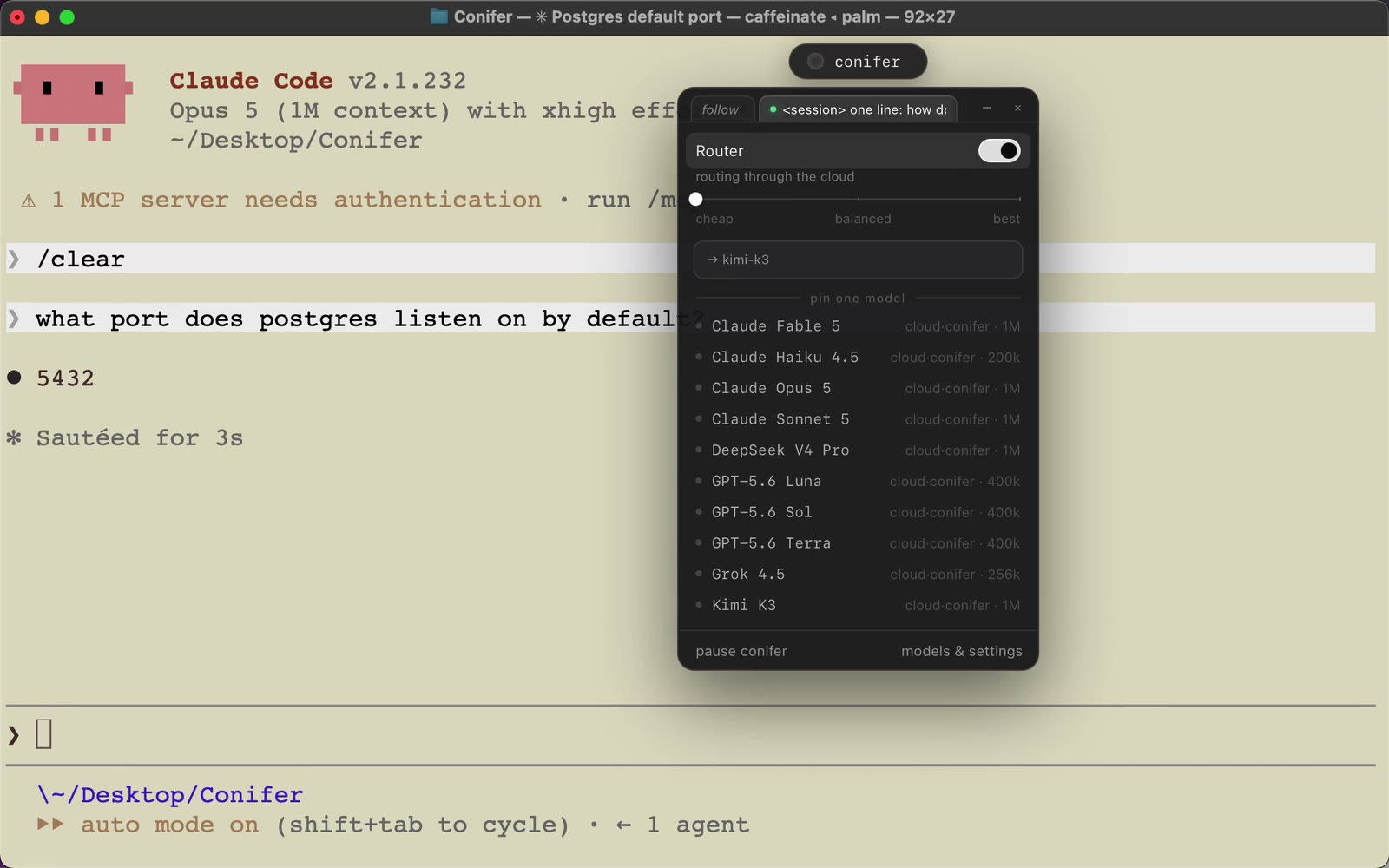
The router reads the question and picks the model. A question about a port
number went to Kimi K3 and came back in three seconds; a question about KV cache
limits, with the cost dial moved to best, went to Claude Opus 5 and took a
minute. Same session, nothing restarted, no frame sped up.
export CONIFER_API_KEY='sk-conifer-…' # mint one at https://conifer.build/console#/keys
npm i conifer-sdk                 # TypeScript
pip install "conifer-sdk[tls]"    # Python — keep the [tls] extra
Both are live:
conifer-sdkon npm and on PyPI. The npm package is
UNSCOPED —@conifer/sdkis not ours and does not exist.On macOS,
[tls]is what keeps a fresh python.org venv from failing its first
call withCERTIFICATE_VERIFY_FAILED. Why it is an extra rather than a
dependency.
import { Conifer, textOf } from "conifer-sdk";

const conifer = new Conifer();
const answer = await conifer.chat({
  model: "claude-haiku-4-5",
  messages: [{ role: "user", content: "three names for a build cache" }],
  maxTokens: 200,
  maxCostNanoUsd: 5_000_000,      // refuse this turn if it could cost over $0.005
});

console.log(textOf(answer));
console.log(answer.receipt.costUsd);            // "0.001250000" — this exact call
console.log(answer.receipt.costComponentsNanoUsd); // itemized across four token classes
from conifer_sdk import Conifer, ChatRequest

conifer = Conifer()
answer = conifer.chat(ChatRequest(
    model="claude-haiku-4-5",
    messages=[{"role": "user", "content": "three names for a build cache"}],
    max_tokens=200,
    max_cost_nano_usd=5_000_000,
))
print(answer.text, answer.receipt.cost_usd)

# Streaming, with the same semantics as the TypeScript twin.
for chunk in conifer.stream(ChatRequest(model="claude-haiku-4-5", messages=[...])):
    ...
print(conifer.stream_receipt.effective_model)   # routing arrives with the head
The cost is on the body too, not only the headers:
answer.usage.cost;          // 0.00178  — decimal USD, the field OpenRouter uses
answer.usage.cost_nanousd;  // 1780000  — the exact integer the gateway billed
answer.receipt.costNanoUsd; // the same number; the receipt stays the authority
That duplication is deliberate. Conifer discloses cost on a response header,
and OpenRouter puts it in usage.cost — so every logging pipeline, request
recorder, LangChain/LiteLLM callback and JSON dump keeps the body and throws the
headers away. A team migrating would lose their cost column and never see why.
It matters more here than elsewhere: a normal caller cannot read their usage
history back, so the receipt on the turn is their only record of what they
spent.
It is additive only — a cost the gateway sends itself always wins — and it is
absent where the cost is unknown, because a 0 would read as "free".
On a streamed turn the cost headers are absent in both languages, and that
is the wire being honest rather than a gap: the response head is sent before the
first token and the money settles after the last. Reconcile a stream from its
terminal usage chunk, which the SDK always requests.
When the answer comes back empty
The most confusing thing this API can return is "", and the reason is never in
the content. A reasoning model spends maxTokens on its thinking block
first — so a budget that looks generous for a one-word answer can be consumed
entirely before the visible answer starts. You get empty content,finish_reason: "length", and a bill for every one of those output tokens.
Measured on both the OpenAI and Anthropic wires: claude-fable-5 atmaxTokens: 16 does exactly this; at 200 the same prompt answers fine.
That empty string looks identical to a refusal, a content filter, or a broken
SDK. So the SDK reads the one distinguishing field for you:
const answer = await conifer.chat({ model, messages, maxTokens: 16 });
textOf(answer);        // ""
emptyReason(answer);   // "the model hit maxTokens before emitting visible text.
                       //  On a reasoning model the thinking block is spent FIRST…"
answer.text          # ""
answer.empty_reason  # the same sentence, or None when there is nothing to explain
It returns undefined/None whenever there is text — and also for a tool call,
because empty text beside a tool call is the correct answer, not an absence.
Embeddings
Same key, same receipts, same cost ceiling — and the vectors arrive as plain
numbers whatever the wire did.
const result = await conifer.embeddings.create({
  model: "text-embedding-3-small",
  input: ["alpha", "beta"],       // one vector per input, in order
});

console.log(result.data[0].embedding.length); // 1536
console.log(result.receipt.costUsd);          // "0.000000040" — settled, in band
from conifer_sdk import EmbeddingsRequest, vector_of

result = conifer.embed(EmbeddingsRequest(
    model="text-embedding-3-small",
    input="hello world",
))
print(len(vector_of(result)), result.receipt.cost_nano_usd)
Three things worth knowing, because they are decisions rather than defaults:
- base64 on the wire, numbers in your hands. The SDK requests
encoding_format: "base64"and decodes it for you. A JSON float array spends
~20 bytes per dimension against base64 float32's 5.33, so this is roughly 3x
less network on the one payload that is actually large. It is applied silently
only because it is exactly lossless — verified live,text-embedding-3-small
returns identical values both ways, max absolute difference 0.0. PassencodingFormat: "float"for JSON floats;rawalways holds the provider's
own body either way. - Embeddings bill on input only. There is no completion, so there is no
output term, nomax_tokens, no sampling knobs and no stream. Unlike a
streamed chat turn, the cost is on this very response. - Refusals are legible. A chat model sent here is a 400 naming the chat
door, not an opaque upstream 404 charged to you; token-id input is refused
client-side before any spend, because the gateway cannot price token ids it
did not tokenize. - Some models are not deterministic, and that is upstream of us. Measured
2026-08-27: six identicalbge-m3calls returned four distinct vectors,
differing by up to 2.2e-4, whiletext-embedding-3-smallreturned the same
bytes every time. Batched GPU inference reorders float accumulation depending
on what else shares the batch. It is far below anything that changes a
ranking, but if you are diffing stored vectors or asserting on exact values in
a test, compare with a tolerance rather than==.
conifer.cheapestFor(["embeddings"]) picks the cheapest embedding seat the
catalog actually declares, and each catalog row carries embeddingDimensions
(embedding_dimensions in Python) so you can size a vector(1536) column
before spending a token — getting that wrong means a migration on a populated
table.
Deferred jobs
For work that is not interactive — an overnight re-index, a bulk
classification, an eval sweep — submit the turn as a job and collect it later.
const job = await conifer.defer({
  model: "claude-fable-5",
  messages: [{ role: "user", content: "classify these 400 tickets…" }],
});
console.log(job.jobId, job.status);          // "job-gw-…", "queued"

const answer = await conifer.jobs.wait(job.jobId);
console.log(textOf(answer), answer.receipt.costUsd);
job = conifer.defer(ChatRequest(model="claude-fable-5", messages=[...]))
answer = conifer.jobs_wait(job.job_id)       # or job_status / job_result
chat({ defer: true })throws, on purpose. A deferred turn is answered
with 202 and a job envelope, not a completion — sochat()has nothing to
return. The previous behavior was worse than an error: the turn was accepted
and debited, and came back aschoices: [], indistinguishable at the call
site from a model that answered with nothing.- The window floor is the gateway's, not ours. Deferred work rides a
provider batch, so the gateway requires a completion window of at least 24h
and refuses anything narrower rather than quietly serving it synchronously at
a different price.defer()defaults to that floor so the common call works. wait()stops on terminal states.cancelled,failedandexpired
never change; a poll loop keyed only on "is it ended yet" spins until the
process dies. It also backs off exponentially, and on timeout it raises
without cancelling — killing work you already paid for because a
client-side clock ran out is not a decision an SDK should make for you.
Keep your client. Get the receipts anyway.
The exact per-turn cost is the thing Conifer has that other gateways do not, and
it arrives on the response headers — which openai, @anthropic-ai/sdk,
LangChain, LiteLLM and the Vercel AI SDK all throw away. So pointing an existing
client at Conifer works perfectly and makes the whole differentiator invisible.
You do not have to rewrite anything to fix that. Every one of those clients takes
an injected fetch (or an http_client), so hand it one that reads the receipt
on the way past:
import OpenAI from "openai";
import { ReceiptCollector } from "conifer-sdk";

const receipts = new ReceiptCollector();
const openai = new OpenAI({
  baseURL: "https://api.conifer.build/v1",
  apiKey: process.env.CONIFER_API_KEY,
  fetch: receipts.fetch,          // the only line that changes
});

await openai.chat.completions.create({ model: "claude-fable-5", messages });

receipts.last.costNanoUsd;   // 580000 — that exact call
receipts.total.costUsd;      // "0.001170000" — the whole session
import httpx
from openai import OpenAI
from conifer_sdk import ReceiptCollector

receipts = ReceiptCollector()
openai = OpenAI(
    base_url="https://api.conifer.build/v1",
    api_key=os.environ["CONIFER_API_KEY"],
    http_client=httpx.Client(event_hooks={"response": [receipts.httpx_hook]}),
)
It never reads the response body. A body is a single-use stream that belongs
to the caller: consuming it to find a cost would break streaming and double
memory for everyone, and it would fail far from where it was caused. Headers are
already materialized, so observing them costs nothing and changes nothing —
the same response object is handed straight back.
SpendBudget answers the other question, the one no single request can:
const budget = new SpendBudget(5_000_000_000);   // $5 for this whole job
const openai = new OpenAI({ /* … */ fetch: budget.fetch });
It refuses the next call once the budget is gone. It cannot refund the one that
crossed the line, because a turn's cost is only known after it settles — so the
true worst case is budget + one turn. Pair it with a per-requestmaxCostNanoUsd and that overshoot is bounded rather than open-ended.
This works on all three wires
The gateway serves three request shapes, and the receipt headers are identical
on every one. Verified against the real vendor SDKs, unmodified:
| wire | client | verified |
|---|---|---|
POST /v1/chat/completions |
openai → .chat.completions |
✅ receipts, streaming |
POST /v1/responses |
openai → .responses (the only wire Codex ≥ 0.145 speaks) |
✅ receipts |
POST /v1/messages |
anthropic → .messages |
✅ receipts, streaming |
import anthropic
client = anthropic.Anthropic(
    base_url="https://api.conifer.build",     # note: no /v1 on the Anthropic door
    api_key=os.environ["CONIFER_API_KEY"],
    http_client=httpx.Client(event_hooks={"response": [receipts.httpx_hook]}),
)
This SDK deliberately does not reimplement the Responses or Messages wires.
Your vendor SDK already speaks them correctly, the gateway relays them
faithfully, and a third implementation of someone else's wire is a liability,
not a feature. ReceiptCollector is the piece that was missing, and it is
wire-agnostic because it reads headers.
Why this exists when the OpenAI SDK already works
It still does, and it remains the right choice for a plain drop-in. This package
exists for the four things the OpenAI client structurally cannot give you:
| The receipt | Every response carries the exact integer nanodollar cost of that call, itemized across fresh input, cache write, cache read, and output. No second stats request, no float dollars, no estimating from token counts and a price table. |
| Named refusals | A 402 is three different problems: the account is out of credit, your own per-request ceiling refused this turn, or this key's lifetime cap is spent. The remedies are unrelated — top up, raise the ceiling, or rotate the key — so they are ConiferPaymentError, ConiferCostCeilingError and ConiferKeySpendCapError, not one status number. A 409 splits the same way: two of them mean "retry shortly" and are retried for you; the third never will be. |
| The spend ceiling | maxCostNanoUsd is a hard, server-enforced bound checked before any upstream call. The gateway refuses rather than serves. |
| Portability | Migration shims that refuse what Conifer cannot honor instead of dropping it silently. |
Migrating from another gateway
Conifer speaks the OpenAI wire, so the base URL and key are most of the work:
// Vercel AI Gateway  ->  Conifer
- baseURL: "https://ai-gateway.vercel.sh/v1", apiKey: process.env.AI_GATEWAY_API_KEY
+ baseURL: "https://api.conifer.build/v1",    apiKey: process.env.CONIFER_API_KEY

// OpenRouter  ->  Conifer   (vendor/model ids resolve unchanged)
- baseURL: "https://openrouter.ai/api/v1",    apiKey: process.env.OPENROUTER_API_KEY
+ baseURL: "https://api.conifer.build/v1",    apiKey: process.env.CONIFER_API_KEY
The rest is the part that usually goes wrong quietly. The shims refuse what
Conifer cannot honor, and name the replacement:
import { fromOpenRouter } from "conifer-sdk";

fromOpenRouter({ model: "anthropic/claude-opus-5", messages, provider: { order: ["anthropic"] } });
// ConiferPortabilityError: OpenRouter's `provider` preferences pin a serving host.
// Conifer picks the host for the admitted model itself, by price and health, and no
// client can override it. Remove the block, or use `maxCostNanoUsd` if the goal was
// cost control.
That is deliberate. Dropping a provider pin, a moderation flag, or a rate-limit
policy on the floor is what makes a migration look clean while changing what
runs and what it costs. The full honored/translated/refused matrix, field by
field, is cards/portability.card.json.
The one thing worth knowing up front: Conifer admits exactly the model you
name. There is no server-side fallback list. OpenRouter's models, Vercel'sgateway.models, and Helicone-Fallbacks all become a client-side chain of
separate billed requests, which you must opt into:
const answer = await conifer.chat({
  model: "claude-opus-5",
  messages,
  fallbackModels: ["claude-haiku-4-5"],
  allowClientFallback: true,   // yes, I accept these are separate billed calls
});
answer.fallbackIndex;          // 0 = the model you asked for, 1 = the first fallback
Only a retryable failure advances the chain. A 402 or a bad request is the
same answer on every member, and spending on a second model would not fix it.
The MCP server
The paste-one-line-into-your-agent trick only helps a tool that already speaks
the OpenAI wire. An agent, a Slack bot, or an IDE that speaks MCP has no such
hook — it can only use what its host exposes as a tool. So:
Build it once, then point any MCP host at the compiled binary:
git clone https://github.com/ConiferKit/use-conifer
cd use-conifer && npm install && npm run build
{
  "mcpServers": {
    "conifer": {
      "command": "node",
      "args": ["/path/to/use-conifer/bin/conifer-mcp.mjs"],
      "env": { "CONIFER_API_KEY": "sk-conifer-…" }
    }
  }
}
The npx form is now the recommended config:"command": "npx", "args": ["-y", "conifer-sdk", "conifer-mcp"], which removes
the build step. The path form above still works for local development against
an unpublished checkout.
Six tools, each one real gateway call:
conifer_complete— ask any model a question, or hand it a whole conversation. The answer returns with what it cost, andmax_cost_nanousdbounds the spend before the call. An empty answer carriesempty_reason, so an agent is told why instead of retrying and paying twice.conifer_compare— the same prompt across 2–5 models in parallel, each answer beside its cost, cheapest first. The ceiling caps each turn, not the total.conifer_embed— text to embedding vectors, with the settled cost. Returns the shape, the cost and a short preview rather than the raw vectors: a single 1536-dimension embedding is ~30 KB of digits that no model can read, and a batch would swallow the context window.conifer_list_models— the catalog, with declared capabilities and as-charged prices.conifer_choose_model— the cheapest model declaring the capabilities you need. It skips models with undeclared capabilities rather than assuming them, and unpriced models rather than assuming they are free.conifer_balance— remaining credit.
The reason conifer_complete reports its cost is that an agent that can see
what its last call cost can be told to spend less. One that cannot, cannot.
A Slack bot that routes by cost
import { Conifer } from "conifer-sdk";

const conifer = new Conifer({ defaultHeaders: { "x-conifer-client": "slack-bot" } });

export async function onMention(text: string, isLongTask: boolean) {
  // Pick from what the catalog actually declares, not from a hardcoded list.
  const model = await conifer.cheapestFor(isLongTask ? ["tools"] : [], {
    minContextWindow: isLongTask ? 200_000 : undefined,
  });
  if (model === undefined) return "no model in the catalog fits that request";

  const answer = await conifer.chat({
    model: model.id,
    messages: [{ role: "user", content: text }],
    maxTokens: 800,
    maxCostNanoUsd: 20_000_000,          // $0.02 per Slack reply, hard ceiling
    deadlineSeconds: isLongTask ? 900 : undefined,  // advisory: may serve on a cheaper tier
  });

  return `${answer.choices[0]?.message?.content}\n\n_${model.id} · $${answer.receipt.costUsd}_`;
}
The cards
This package's contract is data rather than prose, so it cannot drift from the code that reads it:
cards/sdk.input.card.json— everything the SDK reads, and which gateway input each field maps to.cards/sdk.output.card.json— everything it emits, including every receipt field and every error class.cards/portability.card.json— the migration contract, per competitor.
The cards are tested, not decorative: tests/cards.test.ts reads the
gateway's own generated wire contract — vendored atcontracts/gateway-contract.json and pinned
by byte — and fails if a receipt header the gateway emits is not parsed, if a header the input card claims is
never sent, or if a field the portability card calls unsupported does not
actually refuse. The Python suite re-checks the same portability card, so both
languages refuse the same things.
TypeScript consumers
Target ES2018 or later ("target": "ES2018", or "lib": ["ES2018"]). The
stream type is an AsyncIterable, whose name only exists in lib.es2018, so an
older target reports TS2583 pointing into our declarations. The officialopenai package has the same requirement for the same reason — async iteration
cannot be described without the names that describe it.
Verified from a real npm i: an ES2022 consumer typechecks clean understrict with no skipLibCheck, and CommonJS require() works on Node 22,
24 and 26.
Python and TLS
The Python package has zero dependencies, which is a real feature: it drops
into a lambda or a locked-down build image with no package tree to audit. Socertifi ships as the optional [tls] extra rather than a hard dependency.
You want that extra on macOS. A python.org install whose Install
Certificates.command was never run has an empty CA trust store, and so does
every venv built on it — it cannot verify any HTTPS host, and the first call
dies with CERTIFICATE_VERIFY_FAILED. With [tls] installed the SDK detects
the empty store and uses certifi automatically. Linux, Homebrew, Docker and
conda already have a working store.
Hit it without the extra and the error says so, and names the fix, rather than
reporting that the gateway is unreachable.
Tests
npm run build     # emit dist/ (ESM + .d.ts)
npm test          # 162 tests, offline
npm run typecheck

cd python && python3 -m pytest -q   # 105 tests, offline
Most assertions run with an injected transport: no network, no mock framework,
and every one is about bytes that would go on the wire or values handed back.tests/packaging.test.ts is the exception, and it matters: it checks the
package as a consumer receives it, which is where two real defects hid.
Verified against the live gateway
A suite that mocks the server can only confirm what we already believed, so
every claim in this README is also checked against production:
CONIFER_API_KEY=sk-… npm run qa:live                     # 20 checks
CONIFER_API_KEY=sk-… node scripts/live-qa.mjs --include-deferred   # 22

cd python && CONIFER_API_KEY=sk-… python3 scripts/live_qa.py --include-deferred
It exercises every surface — catalog, chat, streaming, embeddings, receipts,
budgets, deferred jobs, and each refusal — against api.conifer.build, in both
languages, and prints the real cost of what it just did. A fresh-install pass
installs the packed tarball and the Python package into clean projects and uses
them as a consumer does.
It spends real money (a few tenths of a cent), which is why it is not part
of npm test: run it before a release, deliberately.
This gate earns its keep. Every defect found in the 2026-08-27 pass was
invisible offline and obvious here — three error classes unreachable in
production, a caller's requestId never once consulted, and a deferred turn
that was billed and returned nothing readable.
What Conifer does not do
Stated here so you find out now rather than mid-migration:
- No image generation, reranking, moderation, audio, Files, or Batches.
assertSupportedVercelSurfacethrows at the call site, naming the remedy,
rather than letting you find out as a 404 in production on the one code path
nobody exercised. - No provider pinning. The gateway chooses the host for the model you named, by price and health. The model is never substituted.
- No server-side prompt compression, moderation, injection scanning, or prompt registry.
- No mid-stream fallback. The first token commits the turn, so a chain cannot be attached to a stream.
Reporting a problem
Include the version. Both languages expose it, so a bug report can name exactly
what ran:
import { VERSION } from "conifer-sdk";
console.log(VERSION);            // "0.1.1"
import conifer_sdk
print(conifer_sdk.__version__)   # "0.1.1"
A receipt's id identifies the turn on the gateway; quoting it alongside the
version usually turns "it broke" into a one-look diagnosis. Please do not paste
an API key.
Changes between versions are in CHANGELOG.md.
License
Apache License 2.0. Contributions are welcome under the same license
— start with CONTRIBUTING.md.
Yorumlar (0)
Yorum birakmak icin giris yap.
Yorum birakSonuc bulunamadi