gimp-mcp
Health Uyari
- License — License: AGPL-3.0
- Description — Repository has a description
- Active repo — Last push 0 days ago
- Low visibility — Only 5 GitHub stars
Code Basarisiz
- eval() — Dynamic code execution via eval() in _core.py
- eval() — Dynamic code execution via eval() in assets/make_crest.py
- eval() — Dynamic code execution via eval() in build_pdb_dump.py
- eval() — Dynamic code execution via eval() in gimp_bridge.py
Permissions Gecti
- Permissions — No dangerous permissions requested
Bu listing icin henuz AI raporu yok.
Drive GIMP 2.10 from Claude (or any MCP client) via the Script-Fu bridge — 53 tools + an AI-native GIMP knowledge base.
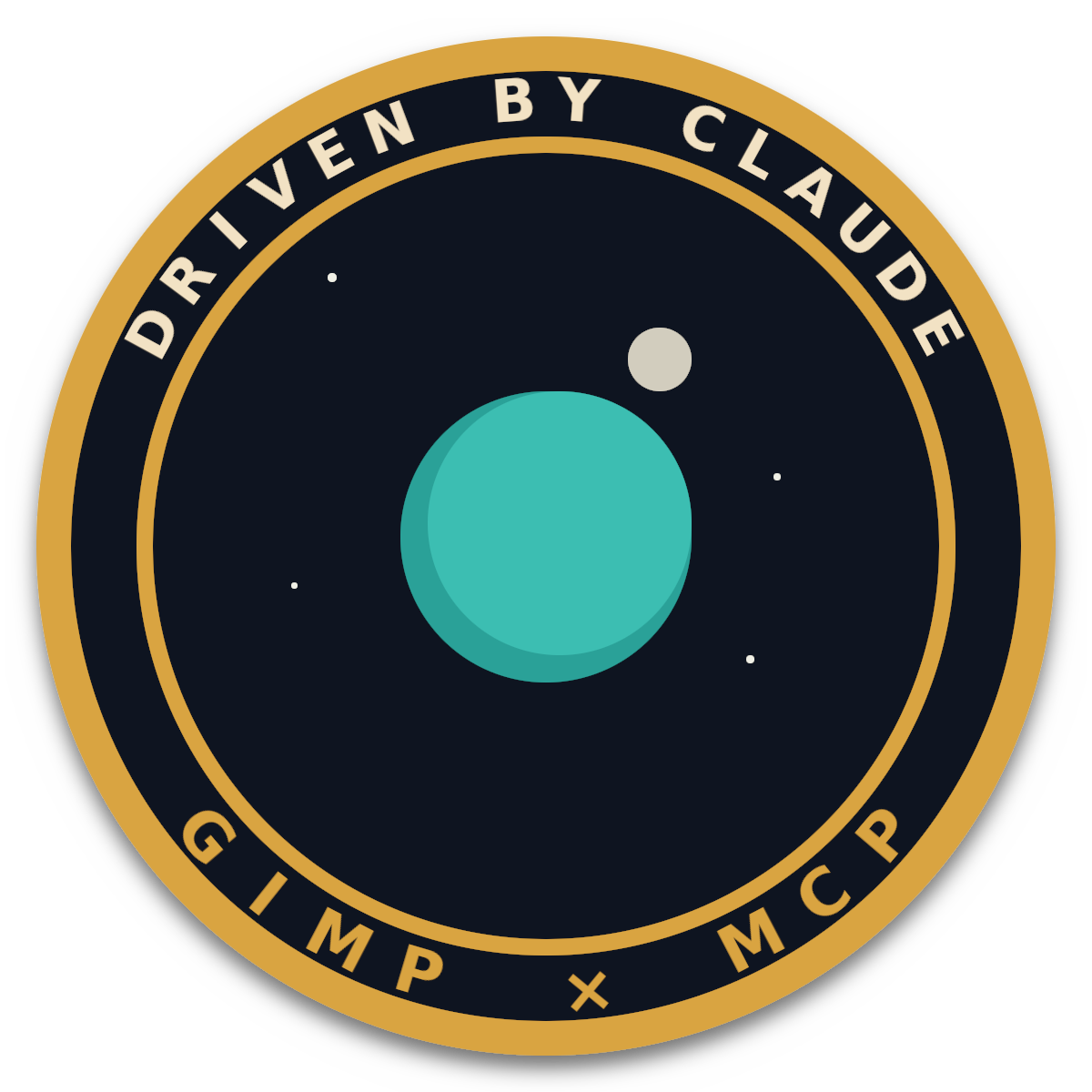
this crest was designed entirely by an agent driving gimp-mcp — shapes + arc-text + transparency, no human in the pixels
       _
  __ _(_)_ __ ___  _ __        _ __ ___   ___ _ __
 / _` | | '_ ` _ \| '_ \ _____| '_ ` _ \ / __| '_ \
| (_| | | | | | | | |_) |_____| | | | | | (__| |_) |
 \__, |_|_| |_| |_| .__/      |_| |_| |_|\___| .__/
 |___/            |_|                        |_|
gimp-mcp

Drive GIMP 2.10 from an AI agent. An MCP
server bridges tool calls to GIMP's built-in Script-Fu server, exposing the
entire GIMP procedure database (every filter, layer op, transform, exporter) —
plus a vision feedback loop so the model can actually see what it edits.
Agent ──MCP/stdio──▶ server.py ──TCP :10008──▶ GIMP Script-Fu server ──▶ GIMP PDB
Works with any MCP client. Examples below use Claude Code.
What makes it work: the model sees its own edits
The single most useful tool is look — it renders the current image and returns it
inline to the model as an image, so there's no blind editing. The loop is:
edit →
look→ judge → adjust
Backed by inspect (region luminance/contrast + a text-placement hint — quantitative
eyes for "is this area dark enough for light text?") and describe (exact size / mode /
layers / dpi), the agent works the way a person does: make a change, look at the result,
correct. Everything else is in service of that loop.
look and render_preview take a bg argument — auto (default) shows a transparency
checkerboard when the image has alpha, so transparent/cut-out art is actually visible
instead of vanishing onto white. Use bg=black/bg=white to preview art as it'll sit on
a dark or light background (shirt, sticker, page), or bg=none to keep the alpha.
Built for agents driving it (frontier and local models)
The tool surface is shaped around how an LLM actually works this, not how a human clicks:
- See transparency, not white — the vision loop composites alpha onto a checkerboard
by default, so the model never edits blind on cut-out art. - No coordinate math —
place/add_text(anchor=…)position by gravity
(center,top-center,bottom-left, …). One call instead of a
measure → compute → set-offset round-trip that small models routinely get wrong. - Native transparency ops —
color_to_alpha(soft-key a background out) andtrim_to_content(crop to the alpha bounding box) make print/sticker workflows one call. - Recoverable errors — failures are translated into actionable hints ("font missing —
calllist_fonts", "stale image id — calllist_images", "server down — runstart-gimp-server.sh"). This matters most for local models (Hermes, Qwen, etc.) that
otherwise stall on GIMP's opaque"returned no return values". - Fewer round-trips —
gimp_batchruns many statements in one call with per-step
error capture; wrappers return the ids/bboxes you'd otherwise have to re-query.
Not just editing — drawing from scratch

no source image — every shape here (sunburst, sun, layered mountains, stars) was
drawn by an agent from the generate pack primitives, checking each move with look
The generate pack (draw_ellipse/draw_polygon/draw_star/draw_line/sunburst +
procedural render_plasma/render_noise) turns the tool from an editor into a canvas:
an agent composes original vector/procedural art and iterates against the vision loop.
Beyond one image — automation, vectors, motion
GIMP's real power isn't editing a single file; it's scale and range. Three packs open that up:
batch— process whole folders:batch_resize,batch_convert,batch_watermark,batch_recipe(apply any saved recipe to every image),contact_sheet. The
production-pipeline unlock: "watermark these 200 photos," "vintage the whole shoot."paths—draw_curve: real smooth bezier curves through anchor points (waves,
ribbons, organic outlines) — proper vector illustration, not just rectangles and ellipses.animate—frames_to_gif(layers → animated GIF),gif_from_folder(a frame
sequence → GIF),spin_gif(rotate a layer into a looping spinner). Motion graphics.
Why a Script-Fu bridge (not a GIMP plugin)
On modern Linux, GIMP 2.10's Python-Fu is effectively gone — gimp-python was
dropped because it depended on Python 2 (EOL), so a Python plugin won't install.
But Script-Fu (Scheme) is always built in, and GIMP ships a Script-Fu server
that listens on TCP and runs any PDB command. This project bridges to that. Nothing
is installed into GIMP itself — it just talks to a socket.
Requirements
- GIMP 2.10 (2.10.30+ verified) on the
PATHasgimp - Python 3.10+
fastmcp— the only third-party dep (pip install -r requirements.txt)- Linux/macOS (Windows should work via the Script-Fu server but is untested)
Install
git clone https://github.com/constant-itis/gimp-mcp.git
cd gimp-mcp
pip install -r requirements.txt
Register the server with your MCP client. For Claude Code:
claude mcp add gimp -s user -- python3 "$(pwd)/server.py"
(For other clients, point them at python3 /abs/path/to/server.py, stdio transport.)
Go lean if you want. The tool surface is modular (core + opt-in packs). Load only
what you need with GIMP_MCP_PACKS — e.g. GIMP_MCP_PACKS=core,text,select gives ~24
tools instead of 72, which context-limited / local models appreciate. See PACKS.md.
Quickstart
Headless (fast, no window):
./start-gimp-server.sh # GIMP on 127.0.0.1:10008, idempotent
Then ask your agent — the gimp tools load automatically:
"Load ~/pic.jpg, scale to 800px wide, bump the contrast,
lookat it, export a PNG."
The model composes the Scheme and checks its own work with look. No GIMP scripting
needed on your end.
Watch it work — the designer workflow
The common case isn't "generate an image from scratch." It's: you already have GIMP
open with your artwork and you say "hey, do X to this." Because GIMP is
single-instance, you point the server at the window you already have open:
# 1. open GIMP with your image (normally)
# 2. attach the server to that same window:
./start-gimp-server.sh --gui      # (or in GIMP: Filters ▸ Script-Fu ▸ Start Server)
# 3. tell your agent: "work on the image I have open — do X"
The agent finds your open image (list_images / suggest), shows it, and edits it
live in your window — every tool flushes the display so you watch it happen. Ask to
"see it" any time and it opens/refreshes the view.
House rules — AGENTS.md. A short convention set for any LLM driving
the tool: attach to the file you already have open, compose abilities (don't railroad),
show a preview + offer options at each stage, and snapshot (checkpoint) before
any destructive/automated step — GIMP 2.10 has no API undo, so the snapshot is the
undo. suggest gives the agent a context-aware menu of next moves to offer you.
Recipes & journaling — the power-user layer
Techniques are saved, parameterized, and reused, not rebuilt each time:
apply_recipe(name, image_id, params)runs a named, tunable pipeline on any image
— e.g.distressed-text(grit dial),vintage,sticker-outline. Bundled recipes are
just editable JSON inrecipes/; your own live in~/.config/gimp-mcp/recipes/
($GIMP_MCP_RECIPES).list_recipes/show_recipeto browse.journalis a macro-recorder:journal start→ do edits →journal show/journal script(a standalone replay.py) /save_recipe(from_journal=True)to turn
what you just did into a reusable recipe. Pure queries and preview scratch are filtered
out, so the log reads like the recipe you'd hand-write.
Recipes are abilities, not baked-in behavior — data you can read, edit, share, and
extend; nothing forces a workflow.
Tools (16 core + 73 in packs = 89)
Modular: the core (~16, always on) reaches the whole PDB and drives the vision loop;
the rest live in opt-in packs (PACKS.md). Listing below is the full set.
The core three make the whole PDB reachable — the rest are conveniences:
gimp_eval(scheme)— raw escape hatch; runs any Scheme/PDB expressionpdb_query(keyword)— search the PDB for procedure namespdb_help(procedure)— a procedure's blurb + typed argument list
Vision & watch: look (inline render — the feedback loop, transparency-aware bg),render_preview, describe (metadata), inspect (region luminance/contrast + placement
hint), show (open it in the GIMP window to watch live), suggest (context-aware menu of
next moves)
Recipes & journal: apply_recipe, list_recipes, show_recipe, save_recipe,delete_recipe, journal (record → replay script / new recipe)
Editing: layers (new_layer, add_layer_from_file, set_layer, list_layers,merge_visible, delete_layer), text (add_text, list_fonts, outline_text,text_with_shadow, arc_text — text on a circular arc, for seals/badges/mission
patches), transforms (crop, autocrop, rotate, flip, resize_canvas,scale_image, scale_to_fit), color/tone (brightness_contrast, hue_saturation,desaturate, invert, auto_levels, curves_adjust), filters (gaussian_blur,sharpen, pixelize, drop_shadow, vignette, oilify, emboss, lens_flare,motion_blur), selections (select, select_by_color — magic-wand/keying,feather_selection, grow_shrink_selection), fills/shapes (fill, draw_rect,gradient_fill, add_border, overlay_blend), placement & transparency
(place — anchor a layer by gravity, color_to_alpha — soft-key a bg to transparent,trim_to_content — crop to the alpha bounds)
Draw from scratch (generate): draw_ellipse, draw_polygon, draw_star,draw_line, sunburst, render_plasma, render_noise — vector + procedural primitives
an agent composes into original art, checking each move with look.
Session & safety: load_image, list_images, new_image, export_image,save_xcf, export_layers, close_image, checkpoint/restore_checkpoint
(immutable snapshots — GIMP 2.10 has no undo over the PDB), gimp_batch
(multi-statement run with per-step error capture), gimp_status, gimp_docs
Knowledge base (knowledge/)
An AI-native, self-regenerating GIMP reference — generated from the installed GIMP
by introspection, so it never drifts from what you can actually call:
pdb_full.json— all ~1264 procedures with typed args (machine ground truth)pdb_index.md— categorized one-line index of everythingcookbook/00..11— dense per-domain guides with working Scheme (read00-overviewfirst)recipes.md— "I want to do X" → which tool / cookbook- search it in-session with the
gimp_docstool; rebuild after a GIMP upgrade with./build-knowledge.sh
See knowledge/README.md for the full layout and regeneration story.
Files
| file | role |
|---|---|
server.py |
entry point — loads the core + enabled packs, serves over stdio |
_core.py |
the lean substrate: eval/introspection, vision loop, IO, safety, shared infra |
packs/ |
opt-in tool bundles (layers, text, fx, recipes, watch, …) — see PACKS.md |
recipes/ |
bundled recipe pipelines (editable JSON) |
AGENTS.md · PACKS.md |
house rules for driving it · the pack system |
gimp_bridge.py |
zero-dep socket client for the Script-Fu wire protocol |
start-gimp-server.sh |
launches GIMP (headless, or --gui to watch) with the Script-Fu server |
build_pdb_dump.py |
introspects the live PDB → knowledge/pdb_full.json |
build_index.py |
builds knowledge/pdb_index.md + per-domain _slices/ |
build-knowledge.sh |
one-shot regenerate of the machine-readable knowledge |
knowledge/ |
the AI-native GIMP reference (see knowledge/README.md) |
Teaching a smaller model (teach/)
The Opus→Fable move: a strong model manufactures a verified corpus of worked
examples that teaches a small / local model (Hermes, a Qwen, a fine-tune) to drive
gimp-mcp. teach/factory.py executes JSON task specs against a live GIMP,
records the exact tool-call trace, renders + checks each, and emits demos.jsonl
(fine-tune ready), fewshot.md (prompt-ready examples), and a contact-sheet.png. The
bundled curriculum (36 verified design tasks) was authored by a seed pass + subagents;
the factory drops anything that doesn't actually run. See teach/README.md.
Wire protocol (confirmed on GIMP 2.10.30)
- Request:
'G'+ uint16_be(len) + scheme - Response:
'G'+ err_byte(0 ok / 1 err) + uint16_be(len) + body plug-in-script-fu-serverargs:run-mode, ip(STRING), port(INT), logfile(STRING)
Gotchas worth knowing
- Don't launch GIMP with
-f/--no-fonts—gimp-text-fontnamethen silently
returns-1and renders nothing.start-gimp-server.shomits it deliberately. script-fu-*procedures take no run-mode arg;plug-in-*procedures do
(RUN-NONINTERACTIVE).- The Script-Fu interpreter is one long-lived process, so context (foreground color,
brush, etc.) anddefines persist across calls — usegimp-context-push/pop. gimp-drawable-histogramreturns mean/std on a 0..255 scale on 2.10 (white =
255.0), not 0..1.
Troubleshooting
| Symptom | Cause & fix |
|---|---|
| "cannot reach GIMP Script-Fu server" / connection refused | The server isn't up. Run ./start-gimp-server.sh (headless) or --gui (watchable). Check gimp is on your PATH and gimp_status reports OK. |
| Text renders nothing / blank | GIMP was launched with -f/--no-fonts, which makes gimp-text-fontname silently no-op. Use start-gimp-server.sh (it omits -f); don't add it. Also check the font name with list_fonts. |
| New tools don't show up in your client | The stdio MCP server loads tools at session start. Restart the MCP session (e.g. a new Claude Code session) after pulling changes or editing packs. |
| Only some tools appear | GIMP_MCP_PACKS is limiting them. Unset it (or set all) for the full 89; see PACKS.md. |
"returned no return values" error |
Usually a missing font (see above) or bad args. The tool's error text now appends a hint — follow it (list_fonts, pdb_help, etc.). |
| Transparent art looks black or white | For viewing: use look(bg="checker") (auto already does this when there's alpha). For exporting: export_image preserves alpha by default (PNG/WebP); pass flatten=True only if you want it composited. To make a transparent canvas use new_image(transparent=True) — fill_white=False alone leaves an opaque layer. |
| Can't watch it work in a window | Start with ./start-gimp-server.sh --gui. GIMP is single-instance, so it attaches to a GIMP you already have open. Then show <image_id> pops it into the window; every tool flushes the display. |
| Port already in use / multiple GIMPs | Override with GIMP_HOST / GIMP_PORT env vars (both the launcher and the server read them). |
| Edits go to the wrong image/layer | State is by integer id. Re-check with list_images / list_layers / describe; ids are stale after close_image or a GIMP restart. |
| A destructive step went wrong | GIMP 2.10 has no API undo — take a checkpoint before risky/automated ops and restore_checkpoint to recover. |
Path to GIMP 3.x
If you later install GIMP 3, Python 3 GI plugins come back and the Script-Fu server
still exists — this bridge keeps working; you'd just gain the option of richer
in-process plugins.
Contributing
Contributions are welcome — most are additive (a new pack, a recipe, or a tool in an
existing pack) with no core changes. See CONTRIBUTING.md for setup,
the test/dogfood loop, and the pack/recipe contracts. Bug reports and "this tool fought me
as an agent" friction reports are just as valuable as code.
License
Yorumlar (0)
Yorum birakmak icin giris yap.
Yorum birakSonuc bulunamadi