Anselm
Health Warn
- License — License: Apache-2.0
- Description — Repository has a description
- Active repo — Last push 0 days ago
- Low visibility — Only 7 GitHub stars
Code Pass
- Code scan — Scanned 12 files during light audit, no dangerous patterns found
Permissions Pass
- Permissions — No dangerous permissions requested
No AI report is available for this listing yet.
The agentic workflow platform that builds itself. Describe what you need; the AI creates functions, agents and workflows, schedules them, and runs them durably on your own machine. Local-first Flutter desktop app with a Go sidecar.

Anselm
The agentic workflow platform that builds itself.
Describe what you need in plain language. Anselm creates the functions, agents, and workflows,
schedules them, and runs them durably on your own machine. No orchestration code, no infrastructure to manage.
Download, open, ask. No API key, no Docker, no config to start.





Website · Download · How it works · Docs · 中文
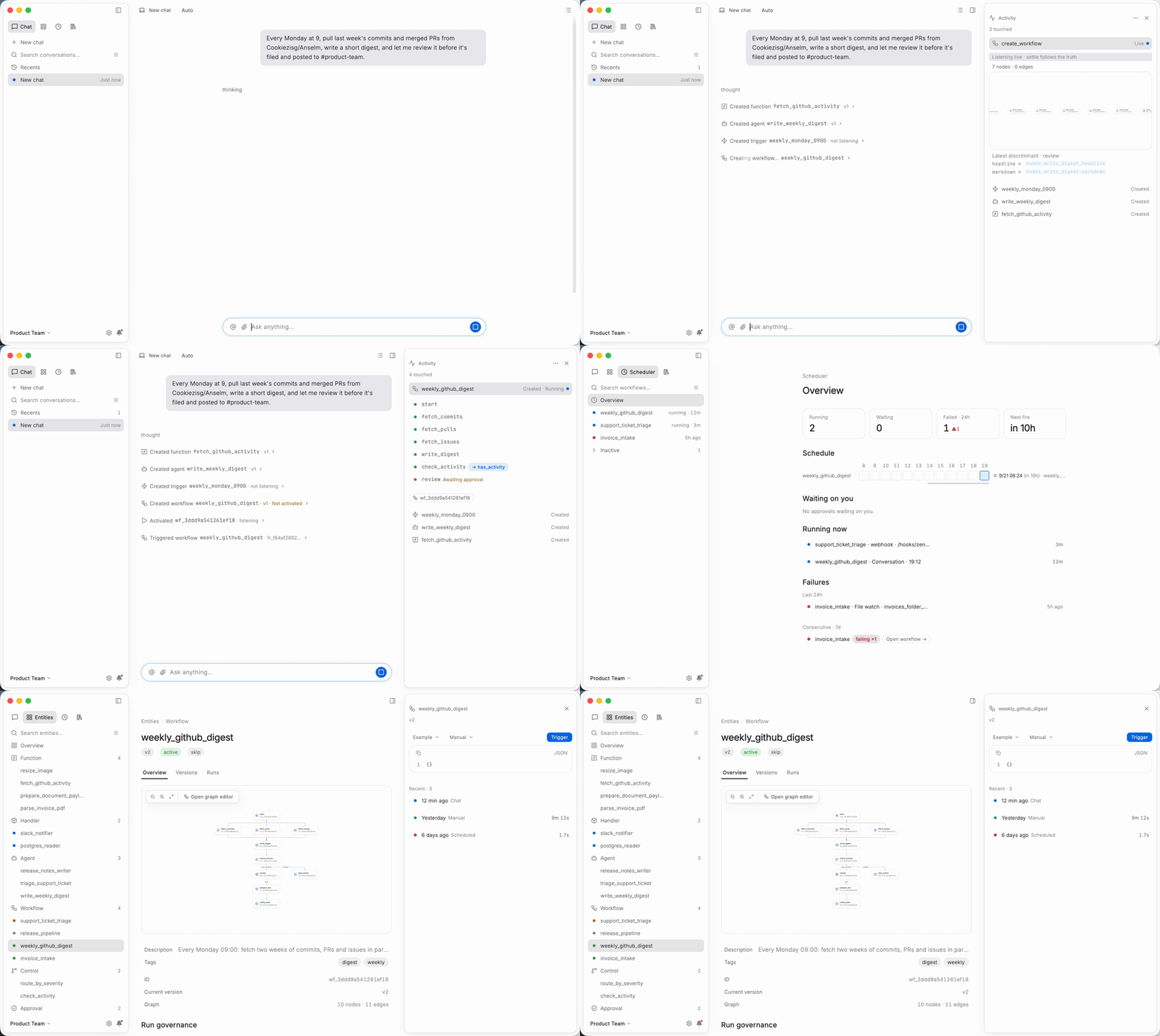
One sentence in. Anselm writes the function, the agent, the trigger and the workflow, runs it once, and waits for your approval before filing; then the scheduler, the filed digest and the workflow page show what now exists. Everything on screen is the real app; the model's replies are scripted so the reel is reproducible (make -C frontend demo DATASET=story LOCALE=en AUTOPLAY=promo).
Why Anselm
Most agent frameworks give you a library and leave the orchestration to you: you write the graph, the retries, the scheduling, the state store, the approval flow. Anselm ships all of that as a finished runtime, and lets the AI do the building.
- The AI builds the workflow. Ask for an outcome in chat. Anselm plans the work, creates each building block as a real, versioned entity, wires them into a graph, and runs it. Every step is a card you can open.
- Four kinds of executable, one graph. Functions (stateless code), Handlers (stateful classes), Agents (LLM workers with tools), and Workflows (the graph that composes them). Triggers, controls, and approvals are the nodes in between.
- Durable by design. Every node result is written to SQLite as it completes. After a crash or restart the interpreter re-walks the graph, reuses what finished, and runs only what did not. Side effects are never repeated.
- Human in the loop. Approval nodes park a run as a persistent state. Decide from the notification ledger or the Scheduler, or let a timeout policy decide. The run continues from that node.
- Local-first. One desktop app, one Go sidecar, one SQLite file. Your workflows, run history, documents, and keys stay on your machine. Managed models work out of the box; or point it at Ollama or any OpenAI- or Anthropic-compatible endpoint, or bring your own OpenAI, Gemini, DeepSeek, or Qwen keys. With Ollama, nothing leaves the machine.
- Observable. Every run has a matrix column, a Gantt, a dossier with its entry payload and pinned references, and an activity log of what each Function, Handler, and Agent did.
What it looks like
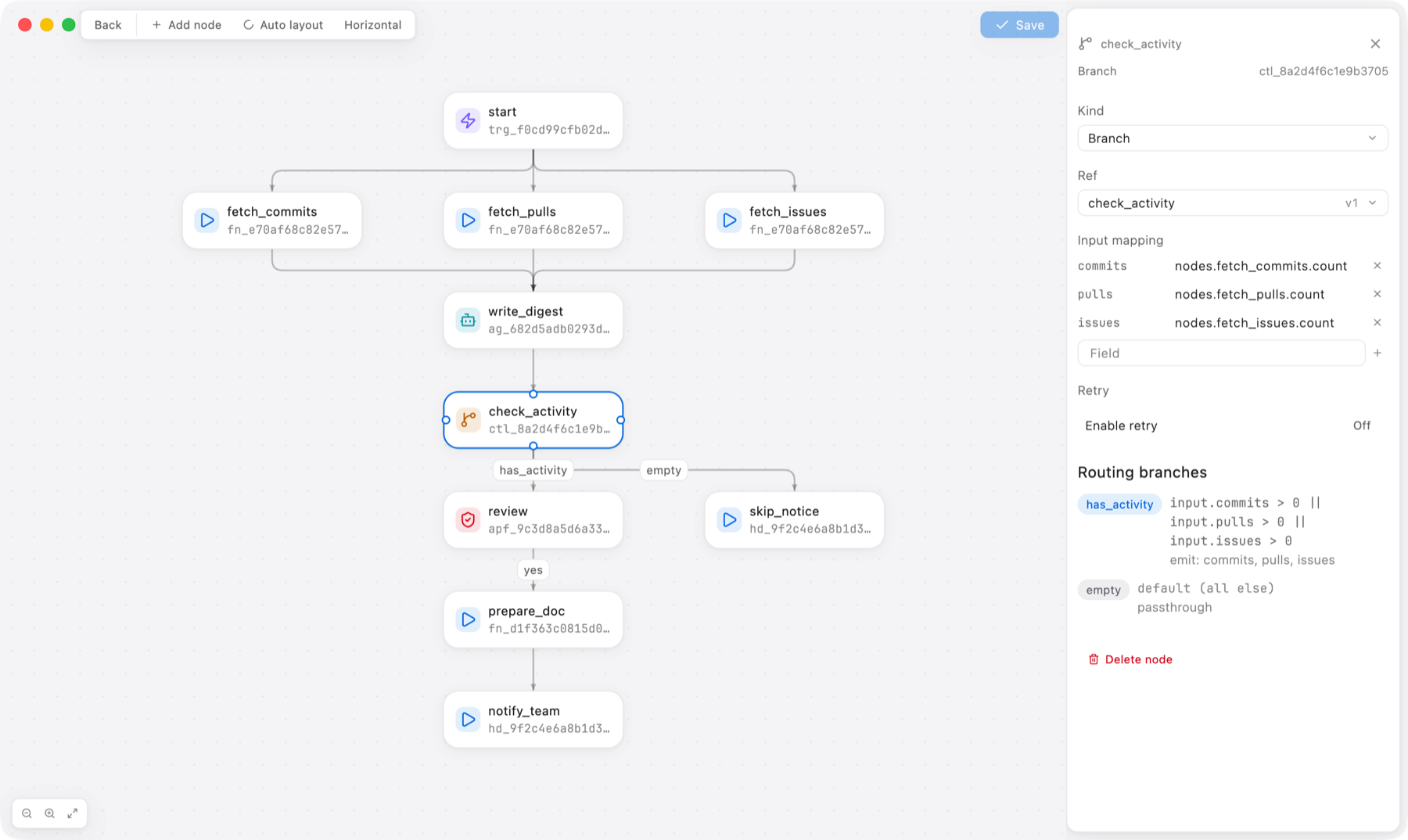
Workflow editor. Three parallel fetches fan in to an Agent; a Control node routes on activity; the inspector shows input mapping, retry policy, and branches. |
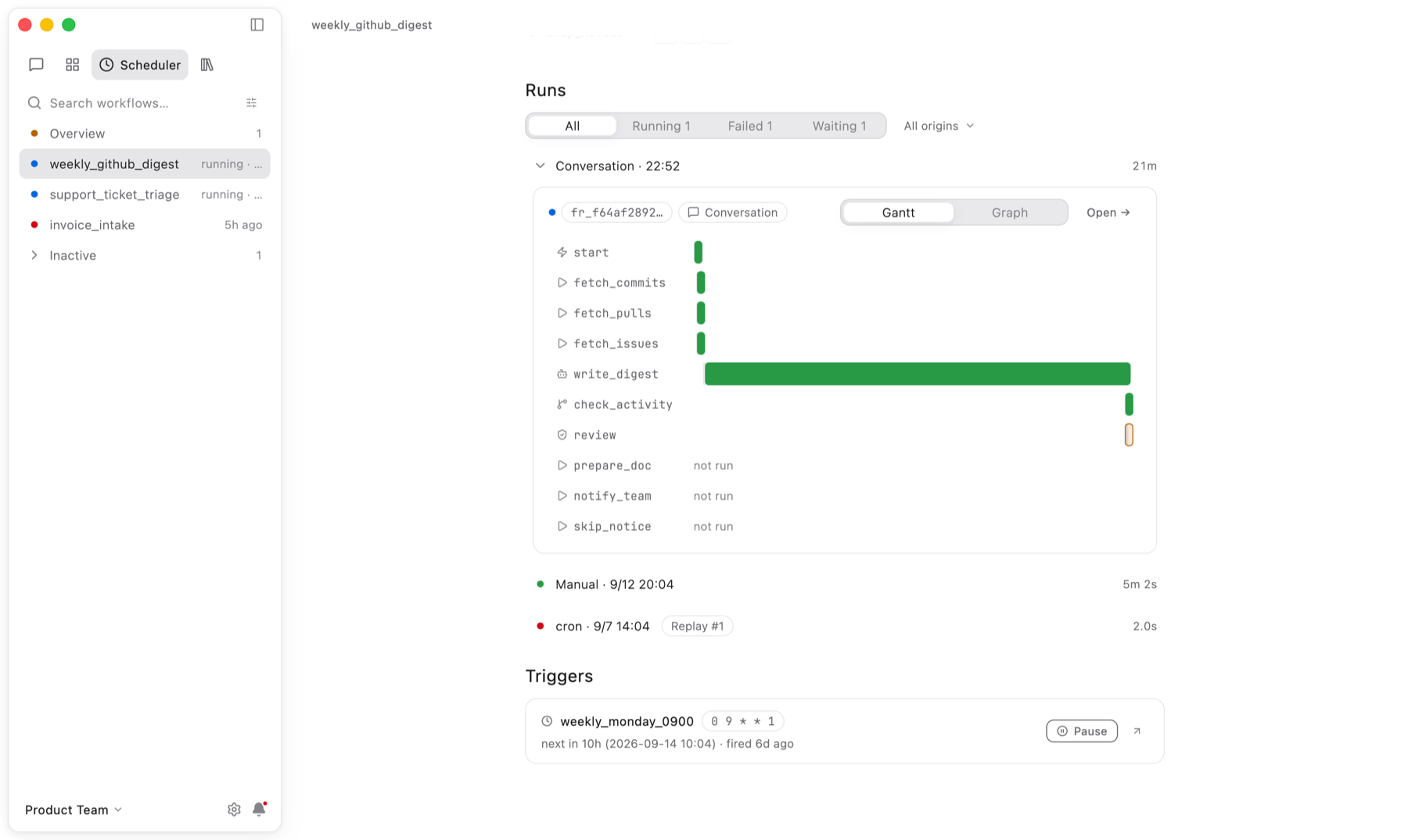
Scheduler. Every run is a column of node states; expand one for a Gantt of where the time went and where it is waiting. |
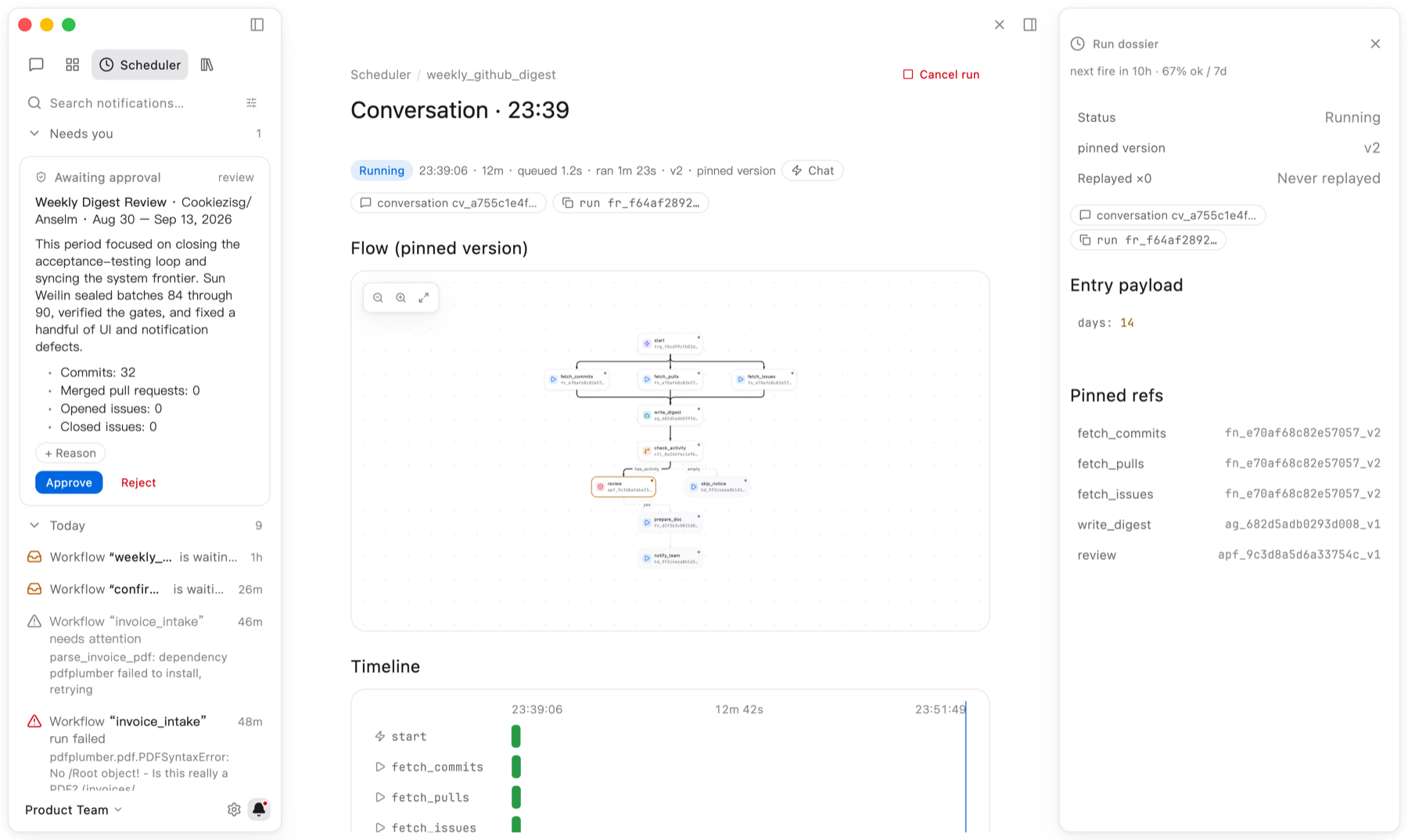
Approvals. The request lands in a durable ledger with the digest summary. Approve, and the run resumes from that node. |
Chat, Entities, Scheduler, Notifications, Library, and Settings, in English and Chinese, light and dark. See all surfaces on anselm.website. |
How it works
One request, start to finish:
- Describe. "Every Monday at 09:00, collect the last two weeks of GitHub activity, write a digest, wait for my approval, and file it in the Library."
- Build. Anselm creates a Function that calls the GitHub API, an Agent that writes the digest, a Control node that skips empty weeks, an approval node, a Function that files the document, and a Handler that posts to Slack. Then it wires them into a Workflow with a cron trigger and runs it once.
- Schedule. The Scheduler shows what is running, what is waiting on you, what failed in the last 24 hours, and when the next fire is due.
- Supervise. A run parks at the approval node. You decide from the notification. The document is published, and next Monday the cron fires on its own.
If the first run fails (say, a 502 from GitHub), Anselm fixes the Function, publishes version 2, and re-runs. Both runs stay in the matrix. In-flight runs keep the versions they started with.
Concepts
Four executables
| Entity | What it is | How it runs |
|---|---|---|
| Function | Stateless code, one call per process | Sandboxed process (Python, Node, .NET), exits after the call |
| Handler | A stateful class with methods | Long-lived sandboxed instance, one accounting entry per call |
| Agent | An LLM worker with a model, instructions, and mounted tools | ReAct loop |
| Workflow | A static graph that references the others | Durable scheduler |
Entities are immutable version rows with a movable active pointer. A run pins the workflow version and every referenced entity version when it starts, so editing never changes a run that is already in flight.
Workflow graph
| Node | References | Purpose |
|---|---|---|
| trigger | Trigger | Receives cron, webhook, file-change, or sensor signals |
| action | Function, Handler method, MCP tool | Executes one activity |
| agent | Agent | Runs a configured LLM worker |
| control | Control | Chooses an exit with a CEL expression and reshapes data |
| approval | Approval | Renders a human review and waits for a decision |
Edges carry payloads. Back-edges start the next iteration; the persisted choice of a control or approval node selects the active subgraph.
Durable execution
Node results are memoized in the database as the source of truth. Recovery is an idempotent re-walk of the graph, not a replay of an event log. Failed runs can be replayed from the failed node without re-running what already succeeded. Triggers deduplicate firings and apply an overlap policy (serial, skip, buffer_one, replace or allow_all) before a run is even created.
Everything else the AI can use
- Tools and MCP. Agents mount tools directly or through a curated MCP catalog with verified install and auth steps.
- Skills and documents. Instructions and knowledge are first-class entities; the Library is a native editor with outlines and backlinks.
- Search. Full-text search (FTS5 with BM25) plus embeddings from a built-in engine or a local Ollama.
- Multimodal. Images, audio, and video flow through conversations, entities, and workflows; managed image, speech, and video generation are available on the free tier.
Install
Download the latest build for your platform from Releases or the download page.
| Platform | Artifact |
|---|---|
| macOS (Apple silicon and Intel) | Anselm-<version>-macos.dmg |
| Linux x64 | Anselm-<version>-linux-x86_64.AppImage · anselm_<version>_amd64.deb · Anselm-<version>-linux-x64.tar.gz |
| Windows x64 | Anselm-<version>-windows-x64-setup.exe · Anselm-<version>-windows-x64.zip (portable) |
On macOS you can also use Homebrew:
brew install --cask Cookiezisg/tap/anselm
Every package bundles the desktop app and the Go sidecar; nothing else is required. The macOS DMG and the Windows setup are the recommended installs; the archives are portable builds. On first launch the app creates its data directory and a default workspace, and the managed model route works without any key setup.
The macOS build is signed with a Developer ID and notarized by Apple, so it opens like any other app. Windows and Linux builds are not yet signed; Windows SmartScreen will show a warning the first time. See the code signing policy.
Build from source
Requires mise (installed by make setup), Xcode on macOS, and the usual desktop toolchain on Linux or Windows.
git clone https://github.com/Cookiezisg/Anselm.git
cd Anselm
make setup                  # pins Go, Flutter, Node via mise
make -C frontend app        # real app + Go sidecar, hot reload
make -C frontend package    # release archive for this machine, in frontend/dist/
Architecture
Flutter desktop app
        │ localhost HTTP + 3 SSE streams (messages · entities · notifications)
        ▼
Go sidecar ───────────────► local SQLite / files / sandbox runtimes
        │
        ├── BYOK ──────────► provider APIs
        │
        └── managed route ─► Anselm API ─► provider APIs
The Go sidecar owns the workspace, entities, run records, attachments, and BYOK configuration; SQLite is the local truth. The desktop app is a pure client over loopback. The managed route talks to a deployed Anselm API that holds provider secrets and metering; the desktop never sees a provider key it did not enter itself.
Backend layering is strict: transport → app → (domain ∪ infra/store) → infra/db. Domain has no external dependencies; the frontend mirrors the wire contract as generated DTOs.
| Path | Responsibility |
|---|---|
backend/ |
Go sidecar: HTTP/SSE transport, use cases, domain, SQLite store, sandbox, LLM, MCP, triggers |
frontend/ |
Flutter desktop: shared core, six feature surfaces, three platform hosts |
testend/ |
Black-box acceptance against the real binary over HTTP/SSE |
docs/ |
References (exact projections of the code), concepts, ADRs, how-tos |
demo/ |
Static web prototype and Playwright assets; not a product source of truth |
Development
make verify                 # backend + frontend + docs + demo gates
make -C backend run         # sidecar on the dev port
make -C backend testend     # black-box acceptance (minutes, no real model)
make -C frontend quick      # diff-driven inner loop
make -C frontend demo       # real shell with fixture data, no backend
make -C frontend gallery    # design-system primitives catalog
make verify runs the static and unit gates for every subproject. Real-model evaluations are opt-in (make -C backend evals) and consume quota. Toolchain versions are pinned in mise.toml.
Engineering rules live in CLAUDE.md: contract-first APIs, strict dependency direction, and documentation that changes in the same commit as the code.
Documentation
- Docs index, the entry point for humans and AI agents
- Architecture, the system's mental model and data flows
- Backend reference: API · database · events · error codes
- Frontend reference: architecture · contract · design system · platform
- Managed gateway boundary, what stays local and what the Anselm API provides
- Architecture decisions
- Data directory, backup, and migration
Status
Anselm is at 0.1.4. The product paths above are implemented and covered by unit, integration, and black-box acceptance suites. What is not there yet:
- Windows code signing (installer is unsigned; SmartScreen warns on first run)
- Multi-user or hosted deployments; Anselm is single-user and local by design
Contributing
Issues and pull requests are welcome. Read CLAUDE.md for the engineering discipline and docs/GOVERNANCE.md for how documentation is kept in sync with code. Run make verify before pushing.
License
Reviews (0)
Sign in to leave a review.
Leave a reviewNo results found