zotero-mcp
Health Gecti
- License — License: MIT
- Description — Repository has a description
- Active repo — Last push 8 days ago
- Community trust — 547 GitHub stars
Code Basarisiz
- execSync — Synchronous shell command execution in zotero-mcp-plugin/scripts/init-release.js
Permissions Gecti
- Permissions — No dangerous permissions requested
Bu listing icin henuz AI raporu yok.
It's a plugin extension in Zotero. Zotero MCP Plugin enables integration between AI assistants and Zotero through MCP. Zotero MCP Plugin 是一个 Zotero 插件,通过 MCP协议实现 AI 助手与 Zotero深度集成。插件支持文献检索、元 数据管理、全文分析和智能问答等功能,让 Claude、ChatGPT 等 AI 工具能够直接访问和操作您的文献库。
Zotero MCP - Model Context Protocol Integration for Zotero
Zotero MCP is an open-source project designed to seamlessly integrate powerful AI capabilities with the leading reference management tool, Zotero, through the Model Context Protocol (MCP). This project consists of two core components: a Zotero plugin and an MCP server, which work together to provide AI assistants (like Claude) with the ability to interact with your local Zotero library.
This README is also available in: :cn: 简体中文 | :gb: English.




Fork us on Wechat
| MP | Forum |
|---|---|
 |
 |
📚 Project Overview
The Zotero MCP server is a tool server based on the Model Context Protocol that provides seamless integration with the Zotero reference management system for AI applications like Claude Desktop. Through this server, AI assistants can:
- 🔍 Smart Search: Multi-dimensional library search (title/creator/year/tags/fulltext/semantic) with boolean operators and relevance scoring
- 📖 Content Extraction: Extract PDF full-text, notes, abstracts, webpage snapshots with fine-grained mode control
- 📝 Annotation Analysis: Search and analyze PDF highlights and annotations by color, tags, and keywords
- 📂 Collection Browsing: Browse and search collection hierarchies, retrieve items within collections
- 🧠 Semantic Search: AI-powered concept matching via embedding vectors, discover related literature across languages
- ✏️ Write Operations: Create notes, manage tags, update metadata, create new items and attach PDFs
- 💾 Full-text Database: Access and search cached PDF full-text content
This enables AI assistants to help you with literature reviews, citation management, content analysis, annotation organization, knowledge base management, and more.
🚀 Project Structure
This project now features a unified architecture with an integrated MCP server:
zotero-mcp-plugin/: A Zotero plugin with integrated MCP server that communicates directly with AI clients via Streamable HTTP protocolIMG/: Screenshots and documentation imagesREADME.md/README-zh.md: Documentation files
Unified Architecture:
AI Client ↔ Streamable HTTP ↔ Zotero Plugin (with integrated MCP server)
This eliminates the need for a separate MCP server process, providing a more streamlined and efficient integration.
🚀 Quick Start Guide
This guide is intended to help general users quickly configure and use Zotero MCP, enabling your AI assistant to work seamlessly with your Zotero library.
1. Installation (For General Users)
What is Zotero MCP?
Simply put, Zotero MCP is a bridge connecting your AI client (like Cherry Studio, Gemini CLI, Claude Desktop, etc.) and your local Zotero reference management software. It allows your AI assistant to directly search, query, and cite references from your Zotero library, greatly enhancing academic research and writing efficiency.
Two-Step Quick Start:
Install the Plugin:
- Go to the project's Releases Page to download the latest
zotero-mcp-plugin-x.x.x.xpifile. - In Zotero, install the
.xpifile viaTools -> Add-ons. - Restart Zotero.
- Go to the project's Releases Page to download the latest
Configure the Plugin:
- In Zotero's
Preferences -> Zotero MCP Plugintab, configure your connection settings:- Enable Server: Start the integrated MCP server
- Port: Default is
23120(you can change this if needed) - Generate Client Configuration: Click this button to get configuration for your AI client
- In Zotero's
2. Connect to AI Clients
Important: The Zotero plugin now includes an integrated MCP server that uses the Streamable HTTP protocol. No separate server installation is needed.
Streamable HTTP Connection
The plugin uses Streamable HTTP, which enables real-time bidirectional communication with AI clients:
- Enable Server in the Zotero plugin preferences
- Generate Client Configuration by clicking the button in plugin preferences
- Copy the generated configuration to your AI client
Supported AI Clients
- Claude Desktop: Streamable HTTP MCP support
- Cherry Studio: Streamable HTTP support
- Cursor IDE: Streamable HTTP MCP support
- Custom implementations: Streamable HTTP protocol
For detailed client-specific configuration instructions, see the Chinese README.
👨💻 Developer Guide
Prerequisites
- Zotero 7.0 or higher
- Node.js 18.0 or higher
- npm or yarn
- Git
Step 1: Install and Configure the Zotero Plugin
- Download the latest
zotero-mcp-plugin.xpifrom the Releases Page. - Install it in Zotero via
Tools -> Add-ons. - Enable the server in
Preferences -> Zotero MCP Plugin.
Step 2: Development Setup
Clone the repository:
git clone https://github.com/cookjohn/zotero-mcp.git
cd zotero-mcp
Set up the plugin development environment:
cd zotero-mcp-plugin
npm install
npm run build
Load the plugin in Zotero:
# For development with auto-reload
npm run start

# Or install the built .xpi file manually
npm run build
Step 3: Connect AI Clients (Development)
The plugin includes an integrated MCP server that uses Streamable HTTP:
- Enable the server in Zotero plugin preferences
- Generate client configuration using the plugin's built-in generator
- Configure your AI client with the generated Streamable HTTP configuration
Example configuration for Claude Desktop:
{
  "mcpServers": {
    "zotero": {
      "transport": "streamable_http",
      "url": "http://127.0.0.1:23120/mcp"
    }
  }
}
🧩 Features
zotero-mcp-plugin Features
- Integrated MCP Server: Built-in MCP server using Streamable HTTP protocol, no separate process needed
- Advanced Search Engine: Full-text search with boolean operators, relevance scoring, filtering by title, creator, year, tags, item type, and more
- Unified Content Extraction: Extract content from PDFs, attachments, notes, abstracts, webpage snapshots with four modes (minimal/preview/standard/complete)
- Smart Annotation System: Search and retrieve PDF highlights, annotations, and notes by color, tags, and keywords with intelligent ranking
- Collection Management: Browse, search collection hierarchies, get collection details, subcollections, and item lists
- Semantic Search: AI-powered semantic search using embedding vectors
- Supports OpenAI and Ollama embedding APIs (auto-detection)
- Vector indexing with SQLite-vec storage
- Index status column in main library view
- Collection/item context menu for index management
- Write Operations: Create/modify notes, manage tags, update metadata fields, create new items and reparent standalone PDFs
- Full-text Database: Cached PDF full-text database with list, search, get, and stats operations
- Standalone Attachment Management: Search and manage standalone PDF items without parent metadata
- Client Configuration Generator: Automatically generates configuration for various AI clients
- Security: Local-only operation ensuring complete data privacy
- User-Friendly: Easy configuration through Zotero preferences interface
📸 Screenshots
Here are some screenshots demonstrating the functionality of Zotero MCP:
| Feature | Screenshot |
|---|---|
| Feature Demonstration | 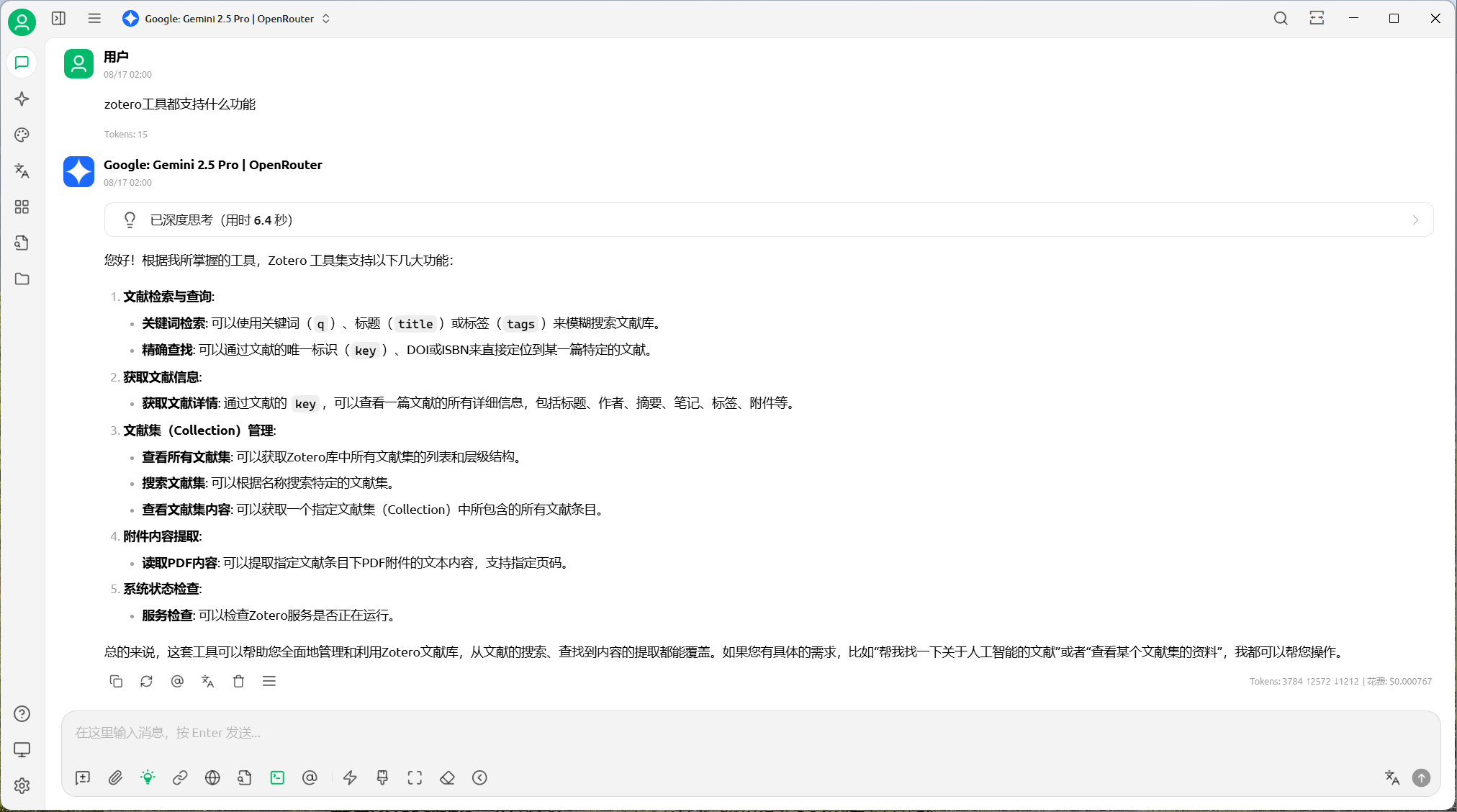 |
| Literature Search | 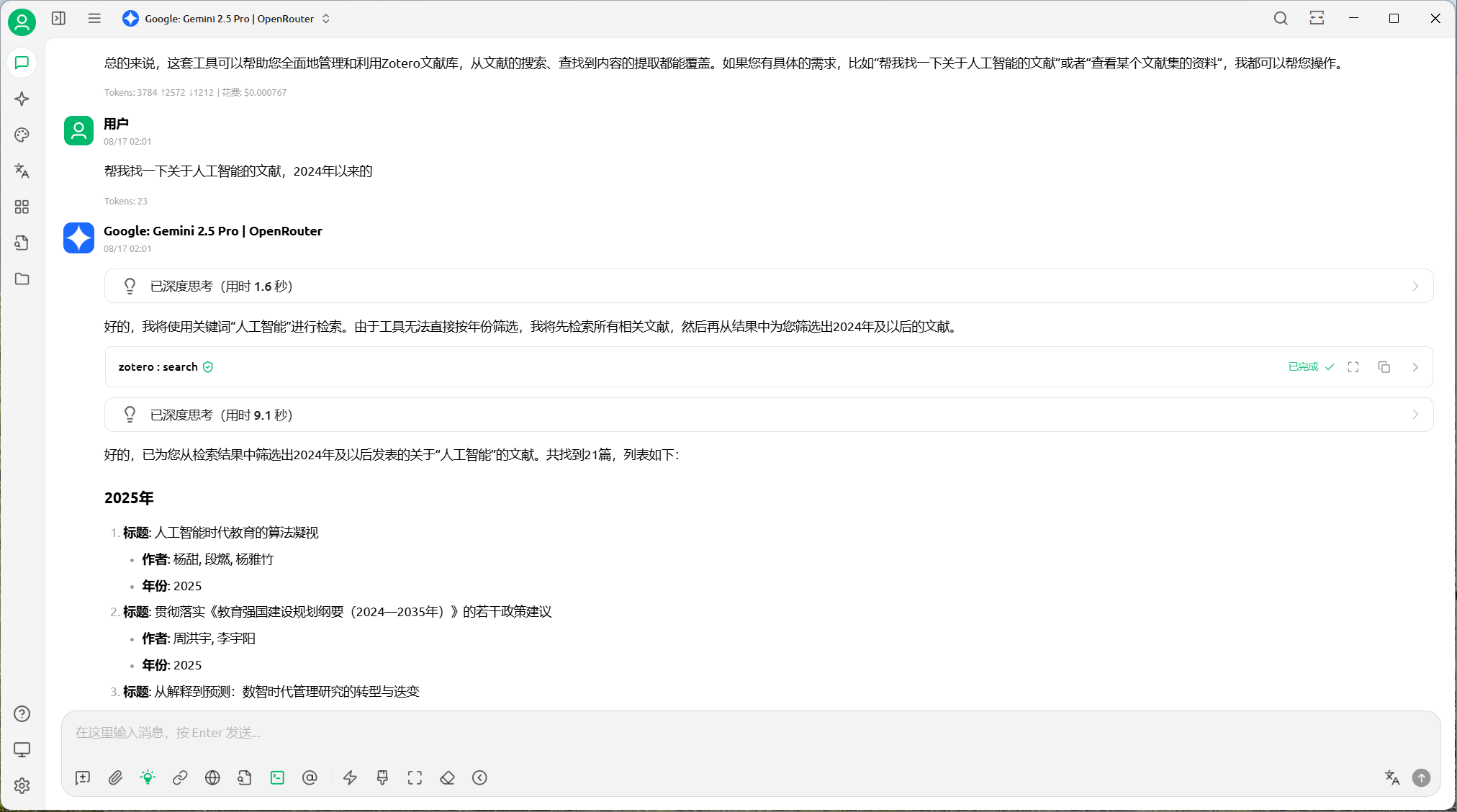 |
| Viewing Metadata | 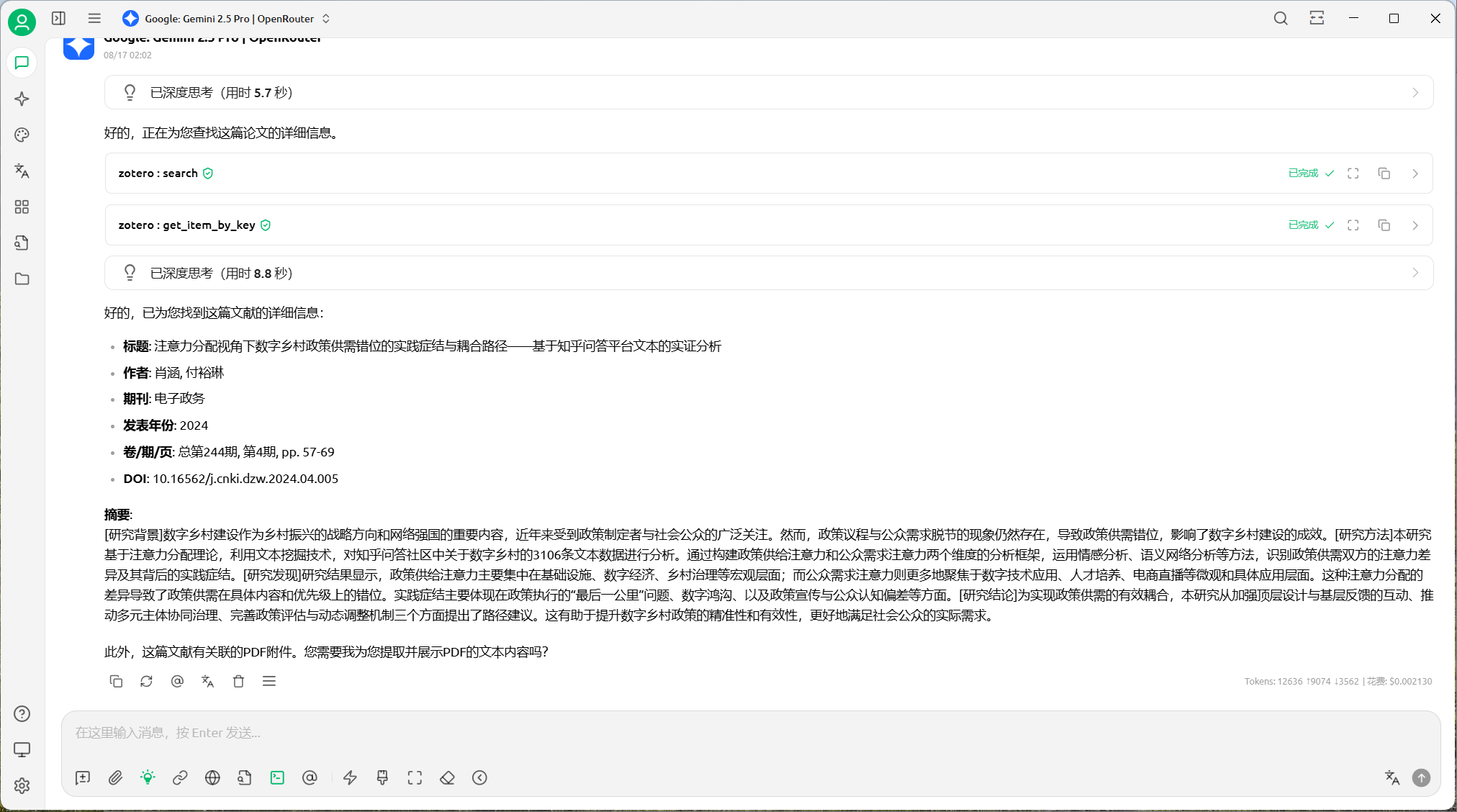 |
| Full-text Reading 1 | 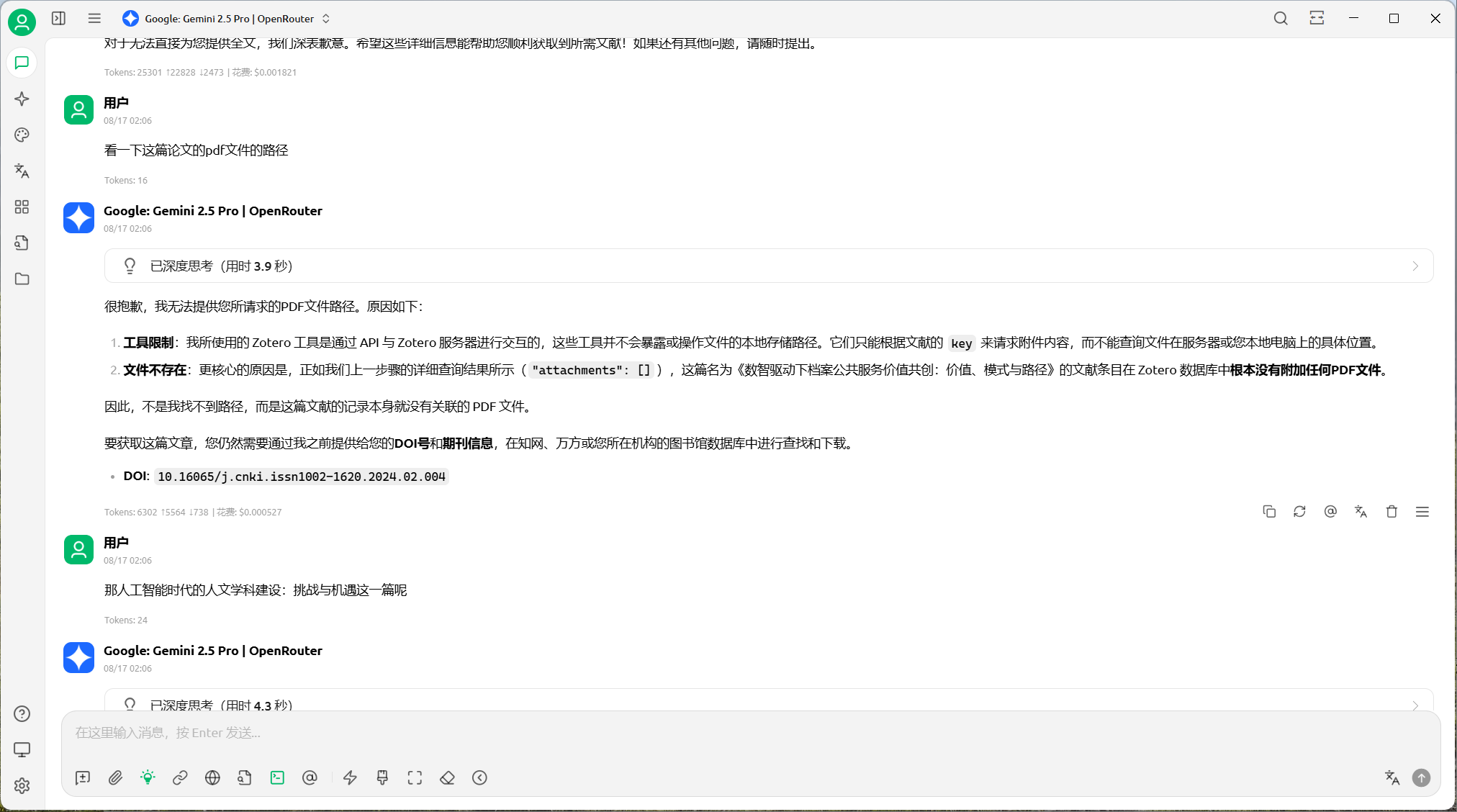 |
| Full-text Reading 2 | 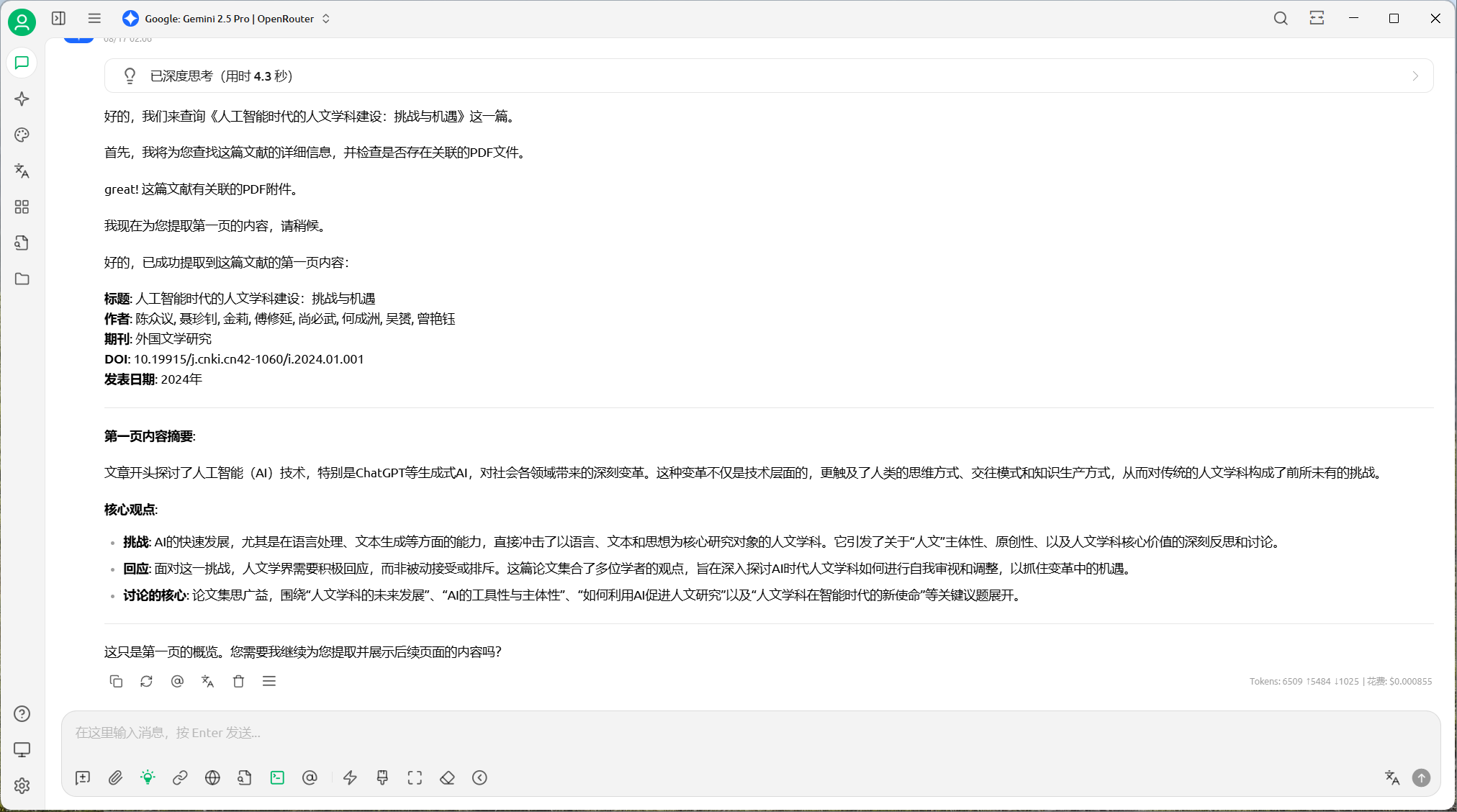 |
| Searching Attachments (Gemini CLI) | 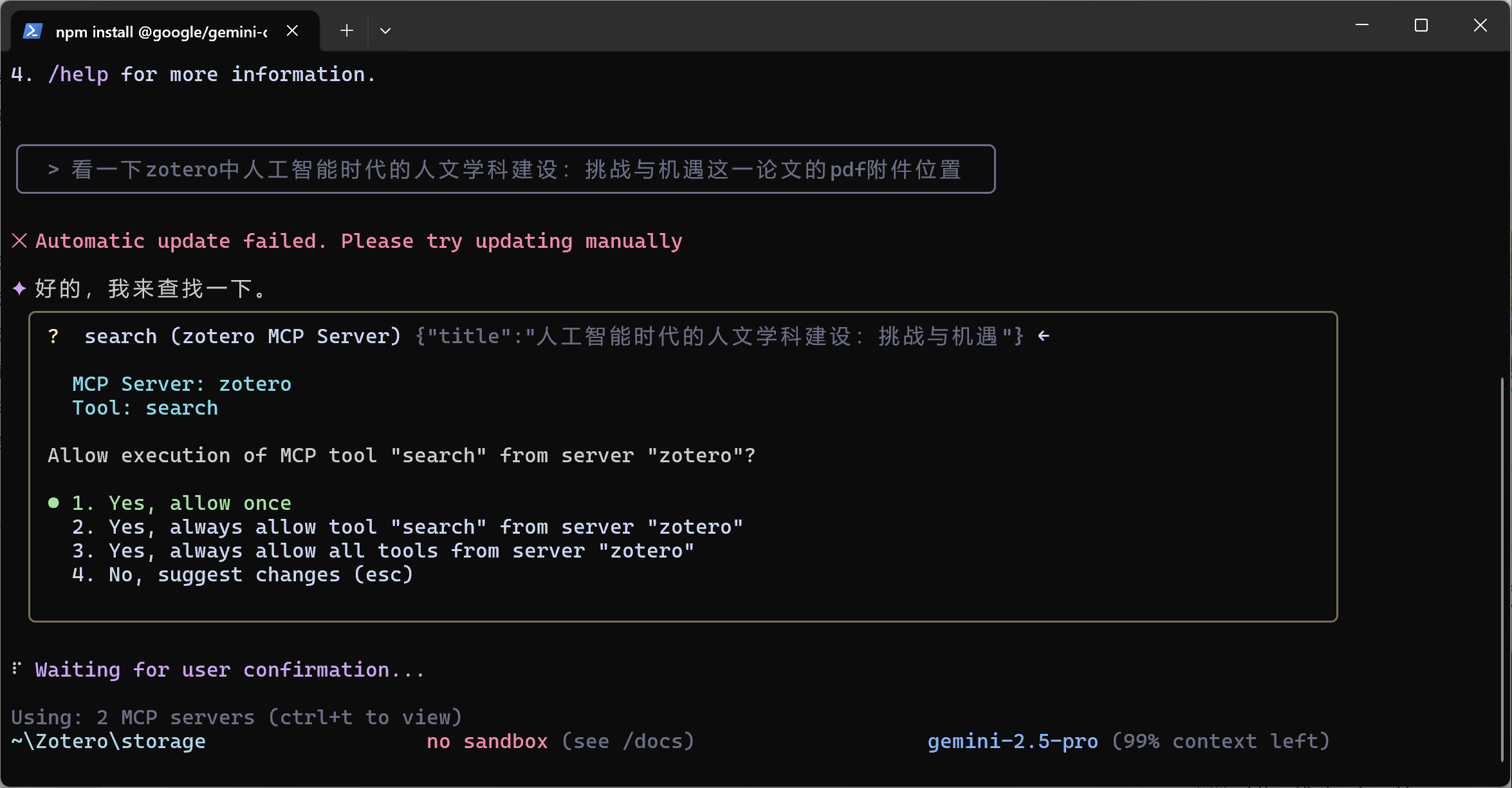 |
| Reading PDF (Gemini CLI) | 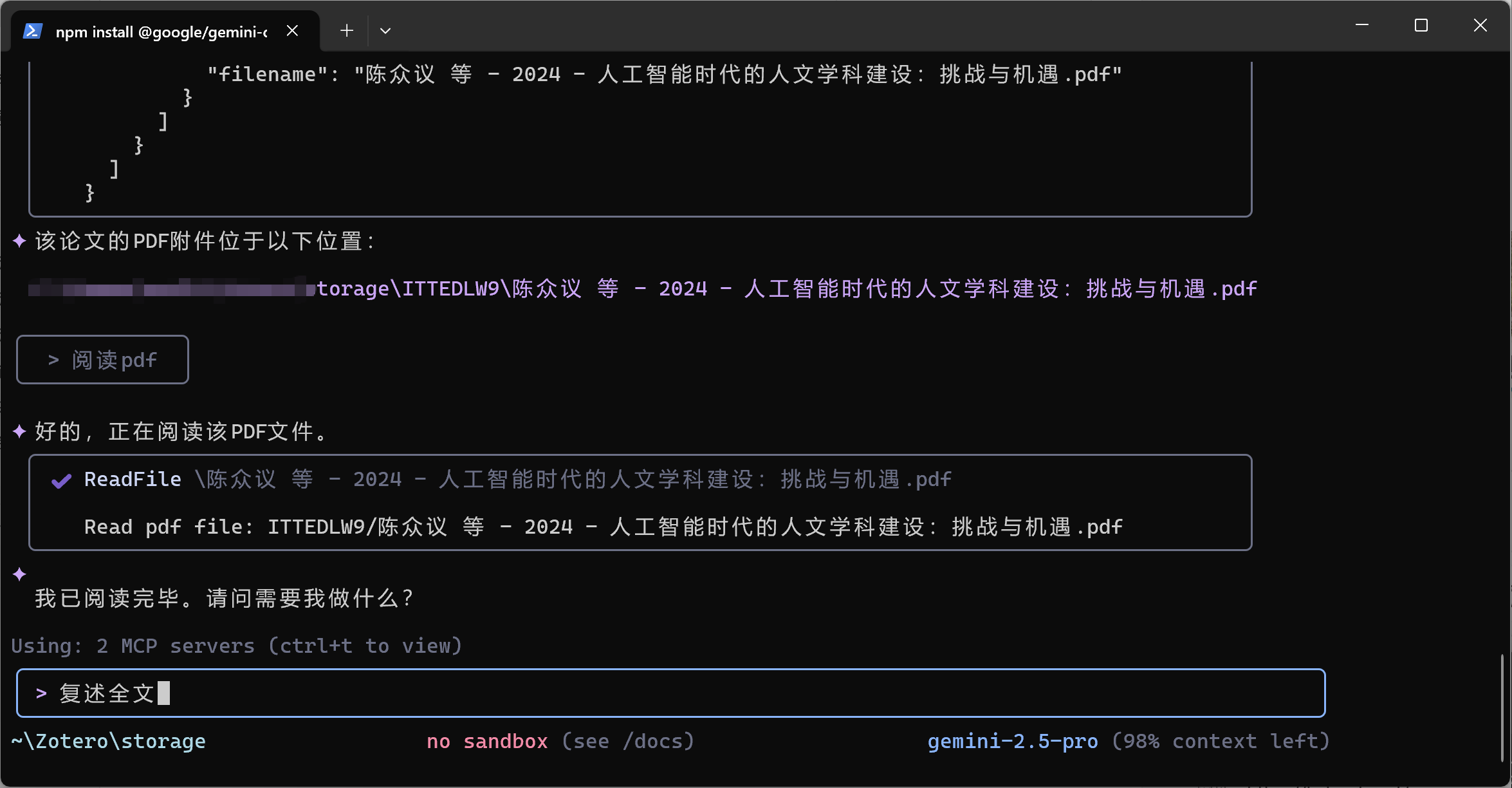 |
🔧 API Reference (MCP Tools)
The integrated MCP server provides 20 tools in 5 categories:
1. Search & Query (7 tools)
search_library
Advanced library search with multi-dimensional filtering, boolean operators, relevance scoring, and intelligent mode control.
q,title,titleOperator,yearRange,fulltext,fulltextMode,itemType,includeAttachments,mode(minimal/preview/standard/complete),relevanceScoring,sort,limit,offset
search_annotations
Search annotations by query, colors, or tags with intelligent ranking.
q,itemKeys,types(note/highlight/annotation/ink/text/image),colors,tags,mode,limit,offset
search_fulltext
Full-text search across all document content with context snippets.
q(required),itemKeys,mode,contextLength,caseSensitive
search_collections
Search collections by name. Params: q, limit.
get_item_details
Get complete metadata for a single item. Params: itemKey (required), mode.
get_item_abstract
Get item abstract/summary. Params: itemKey (required), format (json/text).
get_content
Unified content extraction: PDF full-text, notes, abstracts, webpage snapshots from items or specific attachments.
itemKey,attachmentKey,mode,include(pdf/attachments/notes/abstract/webpage),contentControl,format(json/text)
2. Collection Management (4 tools)
get_collections
Get all collections. Params: mode, limit, offset.
get_collection_details
Get details of a specific collection. Params: collectionKey (required).
get_collection_items
Get items in a collection. Params: collectionKey (required), limit, offset.
get_subcollections
Get subcollections. Params: collectionKey (required), limit, offset, recursive.
3. Semantic Search (3 tools, can be disabled in preferences)
semantic_search
AI-powered semantic search using embedding vectors. Finds conceptually related content even without exact keyword matches.
query(required),topK,minScore,language(zh/en/all)
find_similar
Find items semantically similar to a given item.
itemKey(required),topK,minScore
semantic_status
Get semantic search service status and index statistics. No parameters required.
4. Full-text Database (1 tool)
fulltext_database
Access cached full-text content database (read-only).
action(required: list/search/get/stats),query,itemKeys,limit
5. Write Operations (4 tools, can be disabled in preferences)
write_note
Create or modify Zotero notes. Supports Markdown auto-conversion to HTML.
action(required: create/update/append),parentKey,noteKey,content(required),tags
write_tag
Add, remove, or replace tags on items.
action(required: add/remove/set),itemKey(required),tags(required)
write_metadata
Update metadata fields on items (title, abstract, date, DOI, creators, etc.).
itemKey(required),fields,creators
write_item
Create new items or reparent existing attachments.
action(required: create/reparent),itemType,fields,creators,tags,attachmentKeys,parentKey
🤝 Contributing
Contributions are welcome! Please feel free to submit pull requests, report issues, or suggest enhancements.
- Fork the repository.
- Create your feature branch (
git checkout -b feature/AmazingFeature). - Commit your changes (
git commit -m 'Add some AmazingFeature'). - Push to the branch (
git push origin feature/AmazingFeature). - Open a Pull Request.
📄 License
This project is licensed under the MIT License.
🙏 Acknowledgements
- Zotero - An excellent open-source reference management tool.
- Model Context Protocol - The protocol for AI tool integration.
Contact us

Yorumlar (0)
Yorum birakmak icin giris yap.
Yorum birakSonuc bulunamadi