kraki
Health Uyari
- License — License: MIT
- Description — Repository has a description
- Active repo — Last push 0 days ago
- Low visibility — Only 8 GitHub stars
Code Basarisiz
- spawnSync — Synchronous process spawning in .github/workflows/e2e-remote-update.yml
- rm -rf — Recursive force deletion command in .github/workflows/e2e-remote-update.yml
- process.env — Environment variable access in .github/workflows/e2e-remote-update.yml
- fs module — File system access in .github/workflows/e2e-remote-update.yml
- rm -rf — Recursive force deletion command in .github/workflows/release.yml
Permissions Gecti
- Permissions — No dangerous permissions requested
Bu listing icin henuz AI raporu yok.
Native chat app for your coding agents — Claude Code, Codex, Pi and more, on every machine. Mac, iPhone, Windows and the web.

Kraki
A native chat app for your coding agents — every agent, every machine, one app.
Website · Docs · Discussions · MIT License


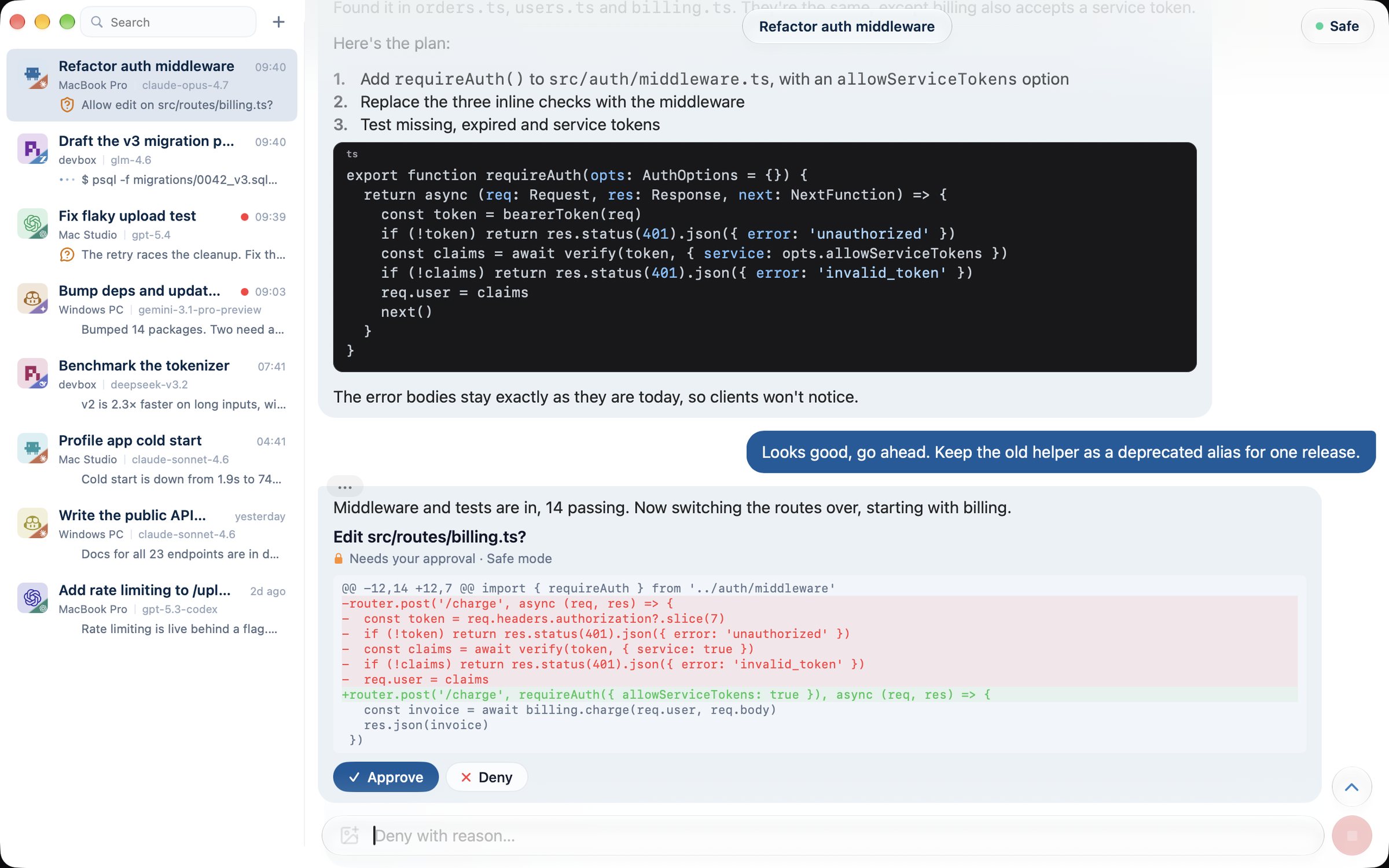
Kraki brings Claude Code, Codex, GitHub Copilot and Pi — running on all your computers — into one
chat app. Follow what your agents are doing, approve tool calls, answer their questions and send the
next instruction (by voice, too) from your Mac, iPhone, PC or any browser. Step away from the desk
and keep your agents moving.
- Every agent, every machine. Sessions from your work laptop, your home desktop and every agent
on them, in one list. - Approve from anywhere. A notification when an agent needs you; answer its questions, and in
Safe mode approve or deny each change, from your phone. - Native, not a chat box in a browser. Mac and iPhone apps with code, diffs, tables and live
tool activity, and voice input that knows your code. - Zero network setup. No ports, VPN or tunnels: each computer makes one outbound connection.
Conversations are end-to-end encrypted between your devices. Run your own relay if you prefer.
Get Kraki
| Mac | Download Kraki for Mac — macOS 15+, Apple silicon and Intel. Finds your agents and signs you in; no Terminal needed. |
| iPhone | Native app, in beta on TestFlight. |
| Windows (preview) | Download Kraki for Windows — Windows 10/11 x64. The installer isn't signed yet: choose More info → Run anyway. |
| Any phone or browser | app.kraki.chat — add it to your home screen for notifications. |
| Linux / command line | See below. |
Install Kraki on each computer whose agents you want to use (Kraki for Mac, Kraki for Windows, or the
command-line version), then add your phone by scanning the QR code it shows.
# macOS / Linux
curl -fsSL https://app.kraki.chat/install.sh | bash

# Windows (PowerShell)
irm https://app.kraki.chat/install.ps1 | iex

# or with npm
npm i -g @kraki/tentacle
kraki
On first run the command-line version checks the coding agents on this computer, signs you in with
GitHub, starts in the background and shows a QR code for your phone. Run kraki agents any time to
recheck your agents. Binaries are also on the releases page.
More: install and troubleshooting ·
run your own relay · security model
How it works
Agent <-> tentacle -- WebSocket --> head -- WebSocket --> arm
tentaclelistens to agent events on the machine doing the work, encrypts them, and sends them tohead.headauthenticates devices and forwards encrypted payloads over a reliable transport (pulse). It cannot read message contents.armdecrypts messages, shows sessions, and sends approvals, answers, and user input back to the right machine.
Tentacle buffers messages and handles replay on reconnect so sessions recover cleanly after temporary disconnects.
Security at a glance
Kraki is always end-to-end encrypted. The relay sees pulse frame headers, envelope type, destination device ID, sender device ID, and payload size. Everything else — message content, session IDs, tool names, user input — is inside the encrypted payload.
The relay stores only a users table and a devices table. No messages, no sessions, no content.
For the full security model, see docs/security.md.
Repository guide
packages/tentacle- thekrakiCLI and background service next to your agentspackages/head- thin relay serverpackages/protocol,packages/crypto,packages/pulse- shared message types, encryption and the reliable transportpackages/arm/web- web app / PWA (also the UI of Kraki for Windows)packages/arm/ios- Kraki for Mac and the iPhone apppackages/desktop- Kraki for Windows (Electron shell)packages/voice-broker- cloud voice gatewaypackages/monitor- independent client diagnostic log REST collector (not the relay)packages/tests- integration tests
For the runtime design, see docs/architecture.md.
Development
git clone https://github.com/corelli18512/kraki.git
cd kraki
pnpm install

# Full TypeScript regression (not necessary after every edit)
pnpm validate
Prefer focused checks for the changed component. See test scope and device safety
for isolated native tests and explicitly opt-in performance/hardware acceptance.
Everything a person can do with Kraki is listed in FEATURES.md: add or update its
row when a change adds or changes something people see. Before big releases, run the full manual pass
in QA-TEMPLATE.md.
Run the pieces individually
pnpm dev:head       # relay on ws://localhost:4000 (GitHub auth, E2E, pairing)
pnpm dev:tentacle   # CLI bridge (connects to relay, bridges agent events)
pnpm dev:web        # web app → auto-pairs with prod relay, opens Chrome
Web app against a local relay
pnpm dev:web --local-relay # web app → ws://localhost:4000
All-in-one local dev
pnpm dev
Starts a real local stack in one command:
- local
headonws://localhost:4000 - the real Kraki daemon with isolated state under
.tmp/kraki-local - the real local web app with a stable pairing entry URL
It prints the local entry URL, log directory, and SQLite DB path, then opens the browser automatically. This is the fastest way to do end-to-end local feature testing without touching your real ~/.kraki state.
Useful helpers:
pnpm dev:logs    # tail local stack logs
pnpm dev:stop    # stop the local stack
pnpm dev:reset   # stop + delete .tmp/kraki-local
pnpm dev:demo          # old mock tentacle / REPL demo flow
Company / enterprise use
Kraki's security guarantees are limited to the model described in docs/security.md. The relay cannot read message bodies, but that does not cover endpoint compromise, company policy, network monitoring, logging, data residency, or other organizational controls.
You are responsible for deciding whether Kraki is appropriate for your environment. If you plan to use it with company-managed devices, repositories, or networks, review your organization's policies and consult your security / IT team before using it.
Contributing
See CONTRIBUTING.md. Security problems: SECURITY.md.
License
MIT
Yorumlar (0)
Yorum birakmak icin giris yap.
Yorum birakSonuc bulunamadi