pstack-t3
Health Uyari
- License — License: MIT
- Description — Repository has a description
- Active repo — Last push 0 days ago
- Low visibility — Only 5 GitHub stars
Code Basarisiz
- exec() — Shell command execution in scripts/cli_reference.py
Permissions Gecti
- Permissions — No dangerous permissions requested
Bu listing icin henuz AI raporu yok.
Lauren Tan's pstack agent skills, ported to T3 Code so any model can lead and other models can review the work. Adds brigade, a standing coordinator per project that runs each unit of work in its own git worktree, has another model family review the commit when one can run, and lands it through a queue that is the only writer to trunk.
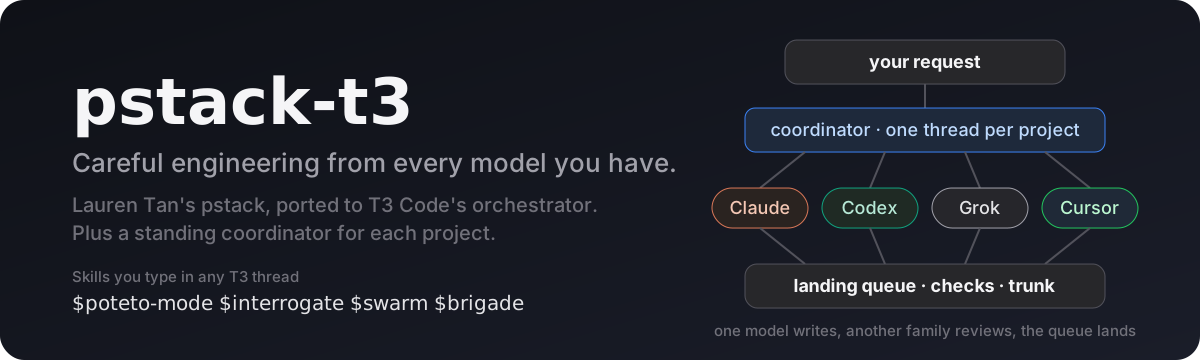




Quick start · Guide · All skills · Command-line reference · How it works · Live runs · FAQ
pstack-t3 makes any model in T3 Code do careful engineering, and gives each project a standing coordinator that turns your requests into reviewed, landed changes.
The workflows are Lauren Tan's pstack, ported from Cursor to T3 Code. Lauren's premise is that AI writes too much slop and the fix is depth, not speed. A pstack agent reproduces a bug before fixing it, settles the design before writing code, proves the change works, and sends its diff to other models to break.
Any provider can lead. A Claude, Codex, Grok, or Cursor thread leads through T3's orchestrator and delegates work and review to the others. The skills read T3's live model catalog, so they use the models you have.
A coordinator runs the project. $brigade, pstack-t3's own addition, pins one coordinator thread to a project. You send it requests. It runs each unit of work as a pstack playbook in its own git worktree. A second model, from another family when you have one, reviews the exact commit, and one queue lands what passes. You choose who merges and how often you hear about it.
It has run unattended. In the first live Autopilot run, Grok wrote four changes, four other model families verified each one, and all four merged, three within 30 minutes, with no question to the operator.
Try it. Get a T3 Code nightly. The Quick start lists the other prerequisites and the two-command install.
What the workflows do
- Picks the right workflow for your request.
$poteto-modematches your task to one of 23 playbooks, such as bug fix, feature, refactor, perf, investigation, ship a PR stack, or run overnight. It follows the playbook's steps in a visible todo list. - Makes different models check each other's work.
$interrogatesends your diff to reviewers on different model families at once. You get one verdict, with claims the lead has verified and agreement mapped across families. - Runs work in parallel without collisions.
$swarmsplits work across workers or races them.$arenaruns several attempts and grafts the best parts into one. Workers that write get their own git worktree. - Proves the change works. It reproduces bugs on the real surface, including driving a web UI through T3's preview tools, and verifies against the real artifact rather than "it compiles".
- Keeps going while you're away. Overnight runs use child agents, separate worktree threads, and an hourly scheduled check. It still stops for anything irreversible you didn't authorize.
- Uses only models you have. Every role resolves against T3's live model list. Signed-out providers and retired models fall back, and the report says so. No role runs Claude Haiku 4.5 or a fast Grok model.
- Keeps working at a usage limit. When a provider hits its limit,
roles.py backuprelaunches the failed seat when a backup is free. A worker moves to Claude, and a reviewer moves to Grok, then Claude, never onto the family that wrote the diff. The work parks until the reset when no backup is free. A parked worker keeps its branch and lease. - Writes like a senior engineer. Short, direct replies, every claim labeled measured, inferred, or guess, and the engineering principles behind each decision named.
A standing coordinator for each project
$poteto-mode drives one task. $brigade keeps a whole project moving. It pins one coordinator thread to a project, or to one focus area inside a project, the way Lauren runs one coordinator per area. That thread holds the project's purpose and never writes code. You send it requests in plain language. Each request takes this path.
flowchart LR
    you["You<br/>a request"] --> coord["Coordinator<br/>one pinned thread"]
    coord --> worker["Worker thread<br/>own worktree,<br/>a pstack playbook"]
    worker --> review["Reviewer<br/>another model family"]
    review -->|passes| queue["Landing queue<br/>rebase, checks, trunk"]
    review -->|sent back to a fresh worker| worker
- Intake. The coordinator records the request and groups related requests into one unit of work. When the project's purpose names a source of work, intake also runs on a schedule. The coordinator reads open work from the repository's tracker, and pull requests only when the project's standing orders name them.
- Build. It claims a lease on the paths the unit will change, then launches a worker thread in its own git worktree. The worker runs the matching poteto-mode playbook, such as bug fix, feature, or perf issue, and reports back.
- Review. The coordinator reads the report and the diff itself. Then a reviewer from another model family checks that exact commit. The reviewer asks whether the change works on the real surface, and whether it serves the project's purpose without scope the request did not ask for. When no other family can run, the reviewer shares the author's family and the verdict says so. Work that the review sends back goes to a fresh worker. When a review passes, the coordinator files the follow-ups in the worker's report as waiting tickets.
- Land. A change that passes goes to the landing queue. The queue rebases it onto trunk, runs your checks in a clean worktree, and lands it. If the rebased change differs from the reviewed one, the queue refuses it.
Only the queue writes trunk. Trunk is the branch every change lands on. Workers commit in their own worktrees and never merge, rebase a shared branch, or push trunk. A lease on the paths a change will touch refuses overlapping work before it starts, and builds and tests share a machine-wide slot limit. That is how many agents work in one repository on one machine. The queue is its own skill, $landing, and any coordinator can use it.
You choose who merges. The landing mode belongs to the repository. Four modes decide what reaches trunk.
mergeopens a pull request and merges it after the checks pass. You review what landed. A pull request that requires an approving review pauses the queue until you relax that rule or switch tohuman.humanopens the same pull request and leaves the merge to you.pushpushes trunk after the checks pass, only while the remote is still at the tested base. It opens no pull request.locallands onrefs/landing/<trunk>and does not change the remote.
You choose how often it reports. The coordinator wakes on your messages, a worker's report, a finished review, a pull request event, and its schedules. The reporting level you pick when you open it decides which wakes get a reply.
every-turnsends a short reply after every wake.milestonesreplies when work merges, a review sends work back or blocks it, a decision needs you, something fails or the queue pauses, or you send a message. A routine wake ends with no reply, or with one line when the host requires text.digestreplies only for a decision you must make, a failure or a paused queue the coordinator cannot fix itself, one summary when a batch drains, the 18:00 report, and a message from you. Every other wake ends with no reply text at all. A batch has drained when nothing is in progress, in review, passed review, or waiting to land. Adigestmessage is a few plain sentences on what got done, what comes next, and what you must decide.
Every level sends the 18:00 report. A message from you gets at least one line, and a direct question gets an answer. A decision only you can make is raised once, with its options and a default, and other work continues around it. The guide describes each level and how to change it.
Ask the coordinator what its agents are doing and it shows one page with what is running now, a timeline of agents and sub-agents grouped by unit of work, and the units in flight. The guide describes that page.
$brigade open a standing coordinator for bridgekit focused on startup performance.
Open one coordinator per project or focus area. Several can share one repository, because the queue and its leases keep them apart. An optional executive admin, opened with $brigade-admin, serves every coordinator on one repository. It routes your requests. It settles conflicts between coordinators by rules you can overrule. It sends you one update instead of one per coordinator. brigade.py walk lists every coordinator on the machine, grouped by repository, with its counts and open decisions.
The coordinator and the queue have both run on real work.
- A pilot. One coordinator on Claude Opus ran five units of work in 4.5 hours. Four merged as pull requests, and one was dropped because no change beat the noise. Grok wrote every change. Codex and Claude reviewed them, and two of six reviews sent work back for real bugs. The pilot audit lists what went wrong and what changed.
- This repository. 38 of the 39 pull requests from #8 to #46 landed through the same queue. The queue then added a line to each body naming the reviewer and the commit that reviewer checked. It no longer adds that line, and the reviewer stays in the queue's local store.
What is frozen
Three pieces are frozen. A frozen piece keeps the tests it has and gets no new work. A fix for data loss or for a broken install still lands.
- The executive admin. The
brigade-adminskill, opened with$brigade-admin. - The
localandpushlanding modes. Themergeandhumanmodes are not frozen. - The light-mode design and trial page.
docs/light-mode.mdholds the design and the trial record. Thelightsetting itself is not frozen.
See it in action
These are real runs in T3 Code.
A Claude Opus thread took a queue of four issues, and the operator answered no question. The Autopilot playbook launched one owner per issue, each on Grok in its own worktree. For every round, four verifiers on GPT, Claude, Gemini, and Composer checked the reported commit.
| Issue | Review rounds | Merged, minutes from launch |
|---|---|---|
Fix median for even-length input |
1 | 13 |
Raise a clear error from mode on empty input |
1 | 16 |
Add variance and stdev |
3 | 30 |
Add a python -m stats command line |
5 | 109 |
The verifiers caught real defects before merge. Three verifiers on three models each found that variance raised TypeError on a generator. One round later only the Claude Opus verifier found that the fix relabelled errors raised by the caller's own generator. The Gemini verifier had passed that commit. The run also exposed four defects in pstack-t3's own skills. Pull requests #42, #44, #45, and #46 fixed them after the run. The full record lists every round, and describes each defect as the run found it.
The next two runs are against a small repository with a planted bug that its own tests passed. Replies are excerpted and trimmed. They predate the current defaults. The default $interrogate panel is Claude Opus and Grok.
A Codex thread ran a four-family review.
$interrogate review the last commit, "Fix median for even-length input".
Reviewers. Resolved
interrogate reviewerswithroles.py. Launched all four throughdelegate_taskwith identical read-only briefs.
- A: Codex / gpt-6.1-sol
- B: Claude / claude-opus-5-5
- C: Cursor / Auto
- D: Grok / grok-4.7
Act on.
- Incorrect even-length median (A, B, C, D).
stats.py:5uses// 2, flooring the average.[1, 2]returns1instead of1.5.- The regression test asserts the bug (A, B, C, D). It expects
2for[4, 1, 3, 2]. The correct median is2.5.I verified that all three existing tests pass despite these errors. The commit should not pass review.
Dismissed. Grok's claim that
-3is a full unit below-2.5is incorrect. The difference is0.5. Its flooring finding remains valid.
A Grok thread ran a coverage swarm.
$swarm audit stats.py: one read-only worker per public function.
Coverage swarm: one read-only worker for
medianand one formean.swarm workersresolved toinherit, so both run on grok / grok-4.7.median: ISSUES. I reran its commands and they match.
median([])raisesIndexError.- Even counts return the floor:
median([1, 2])is1,median([-5, -2])is-4.- An infinite middle value becomes
nan:median([1.0, inf]).
Quick start
You need a T3 Code nightly 0.0.46-nightly.20261005.2702 or later, the minimum this project accepts for watch_pull_request, plus git and Python 3.10 or later. pstack-t3 runs on the orchestrator V2 tools (delegate_task, t3_thread_launch, schedule_task, watch_pull_request). Stable releases through v0.0.45 don't ship them. Nightlies are the pre-releases on the T3 Code releases page.
Complete each prerequisite before using the feature it names.
- Install the GitHub CLI and run
gh auth login. Reading GitHub issues or pull requests needsgh, and so does landing inmergeandhumanmodes. User requests need nogh. - To make the first commit in a new repository, run
git config --local user.name "Your Name"andgit config --local user.email "[email protected]"in that repository.land.py init --baseneeds an existing commit, and a clone already has one. A global identity is optional. - Run
pip install pyyamlbefore the test suite.scripts/check.pyskips YAML frontmatter validation when PyYAML is missing. - Confirm
orchestrator_capabilitiesis in the T3 thread's tool list.$setup-pstackcalls it first.
git clone https://github.com/creedants/pstack-t3.git ~/pstack-t3
cd ~/pstack-t3
python3 scripts/install.py           # link the skills into Claude, Codex, Grok, and Cursor
python3 scripts/install.py doctor    # confirm each provider sees them
Keep the checkout on disk, because the install links to it. Then open a new T3 thread.
- Run
$setup-pstackto pick models per role and a reasoning budget. This is optional. Unset roles use Claude Opus at xhigh for judgment and Grok at xhigh for code. Skill tests, and the read-only explorers in$howand$why, use Claude Haiku 5.5.unlimitedleaves the Haiku seats alone. It raises the Opus and Grok seats to each model's highest level at or below max, so Opus moves from xhigh to max and Grok stays at xhigh. - Start any real task with
$poteto-mode.
The guide walks through your first hour. Stuck, or unsure which skill fits? Ask $poteto-help. It answers and hands you a prompt. It does not start the work.
What you can say
| You type | What happens |
|---|---|
$poteto-mode the export button sometimes downloads an empty file. repro first, then fix and verify. |
Bug fix playbook. It reproduces, finds the root cause, fixes, and proves the reproduction now passes. |
$poteto-mode add rate limiting to the public API. |
Feature playbook. It names the data shape, settles the design, builds in verifiable steps, and verifies. |
$interrogate review this branch. |
Reviewers on different model families attack the diff. You get one verdict. |
$arena write the caching layer. |
Several candidates on different models. It picks a base and grafts in the best ideas. |
$swarm check every API route for missing auth. |
One worker per slice, with a single report of PASS, ISSUES, or BLOCKED. |
$how does session refresh work? |
An explorer agent maps the code, then an explainer agent turns it into a walkthrough. |
$why did we pick Postgres here? |
A cited answer from git history and whatever doc and issue tools are connected. |
$poteto-mode babysit PR 482 until it's green. |
It calls watch_pull_request and waits on CI, reviews, and conflicts. It fixes what it can and reports. |
$poteto-mode i'm going to bed. land the stack. everything merged by morning. |
An autonomous run with a decision log. It waits on each pull request with watch_pull_request, uses schedule_task as the merge heartbeat, and verifies each pull request before merge. |
$recall where did I leave off on the billing migration? |
A current-state brief rebuilt from your past T3 threads, git, and PRs. |
$correct |
A census of the mistakes agents repeat here, each fixed at the highest level that holds, from architecture through types, lint, and tests, plus a rule table. |
$brigade open a standing coordinator for bridgekit focused on startup performance. |
A pinned thread that owns that goal. It groups incoming requests, hands each to a pstack playbook, has a reviewer, from another model family when one can run, check every result against the goal, and reports what landed. |
$landing set up this repo so several agents can land work at once. |
A landing contract with your test commands as checks. Every coordinator then claims leases before delegating and lands through one queue. |
$poteto-help which skill should I use to review this branch? |
It points at the skill or playbook and hands you a prompt. It does not start the work. |
See all 57 skills and every playbook. Every command and flag of activity.py, brigade.py, land.py, and roles.py is in the command-line reference.
How it works
flowchart LR
    you["$interrogate"] --> lead["Lead thread<br/>any provider"]
    lead --> runtime["pstack-runtime<br/>+ roles.py"]
    runtime -->|delegate_task| a["Claude Opus"]
    runtime -->|delegate_task| b["Grok"]
    a & b -->|completion wakes the lead| verdict["One verified verdict"]
The default panel is Claude Opus and Grok. A roles file can name Codex or another model. verifiers is this thread's model plus one seat per other model family you can run.
T3 Code gives every provider the same orchestration tools. They are delegate_task for child agents, t3_thread_launch for worktree threads, schedule_task for a cadence, watch_pull_request for a pull request's checks, reviews, or conflicts, thread history and forks, browser preview, rendered report pages, and PR linking. The pstack-runtime skill teaches each model to use them the pstack way. The other skills are Lauren's workflows, with the Cursor-specific mechanics replaced. pstack-t3 adds three of its own, brigade, landing, and pstack-author-skill. Details are in How it works.
Why skills, not an MCP server or a plugin? T3 already gives every provider its orchestration server, so pstack-t3 needs no server of its own. T3's $ picker lists each provider's native skills, so $poteto-mode appears whichever model you pick. Muse is the exception. T3's picker does not list Muse's skills, though Muse still loads them. A Claude Code plugin would namespace the skills and hide them from that picker, and the other providers have no plugin format.
FAQ
Do I need every provider?No. Everything works with one provider. The default arena, architect, and interrogate panels are Claude Opus and Grok. A seat whose model you cannot run falls back, and the report names each replacement. verifiers is this thread's model plus one seat per other model family you can run. Signing in to a provider does not add a seat to the other three panels. Add Codex or another model in a roles file.
The playbooks, principles, rubrics, and their wording are the same. The plumbing is different. Upstream uses Cursor's subagents, cloud agents, /loop, and a fixed list of Cursor model names. pstack-t3 uses T3's delegate_task, worktree threads, schedule_task, and roles resolved against T3's live model list. pstack-t3 also adds $brigade, $landing, and pstack-author-skill, which upstream does not have. The full mapping is under What changed from upstream.
The default $interrogate panel is two seats, Claude Opus and Grok, so that review costs about two reviews. A roles file can add seats. Single-agent playbooks cost about the same as doing the work by hand, plus verification. Use the small budget in $setup-pstack for routine work, or light mode to cut the fan-out around the checks that catch real bugs. Skill tests and the read-only explorers in $how and $why run on Claude Haiku 5.5 by default.
No. If a skill with the same name exists, the installer lists the taken paths, links nothing, and exits. --replace moves each one aside and records it instead, and python3 scripts/install.py uninstall restores it when it can do so without overwriting anything. See Install details.
Children inherit the lead thread's runtime mode. In approval-required mode, a child can wait on an approval prompt that no tool can answer. Run fan-out work in a mode that allows commands and edits.
Does it work outside T3 Code?It is built for T3. Outside T3, the skills fall back to the host's own subagents on the current model, without cross-provider panels or scheduling. For Cursor itself, use upstream pstack.
How do I update?git pull in the checkout, then python3 scripts/install.py. The installer is safe to rerun.
No. It is an independent project, not affiliated with or endorsed by Lauren Tan, Cursor, T3 Tools, Anthropic, OpenAI, or xAI.
What changed from upstream
| Upstream (Cursor) | pstack-t3 (T3) |
|---|---|
Task subagents with subagent_type and model |
delegate_task children with a role and a resolved target |
| Cloud agents | Local child tasks, or t3_thread_launch threads bound to their own worktree |
| A Cursor rule file of model names | roles.json resolved against T3's live catalog. No role resolves to a fast Grok model or Claude Haiku 4.5, and a usage limit relaunches on Claude or Grok when a backup is free and parks otherwise. |
| A fixed default panel of four Cursor models | Claude Opus and Grok for arena, architect, and $interrogate. verifiers is this thread's model plus one seat per other model family you can run. |
/loop, automations, hourly ticks |
schedule_task for a cadence with no pull request event. A wait on checks, reviews, or conflicts is watch_pull_request. A wait whose predicate is the merge also keeps the schedule_task heartbeat the runtime's Pull request watching section requires. |
| Cursor transcripts and cloud-agent URLs | T3 threads |
control-ui from cursor-team-kit |
T3 preview and device tools |
Cursor's built-in create-skill |
pstack-author-skill, for every provider |
| A worktree audit that reads Cursor's chat storage on macOS | Git inventory on Linux and macOS, plus T3 thread bindings |
link_pull_request on every PR a playbook opens or drives |
Install details
| Provider | User directory | Project directory |
|---|---|---|
| Claude | ~/.claude/skills (or $CLAUDE_CONFIG_DIR/skills) |
.claude/skills |
| Codex | ~/.agents/skills |
.agents/skills |
| Grok | ~/.grok/skills |
.grok/skills |
| Cursor | ~/.cursor/skills |
.cursor/skills |
--project /path/to/repoinstalls for one repository.--harness claude,codexlimits the providers.--dry-runprints the plan.- Prefer the user install. When a name exists at both scopes, Claude and Grok load the user copy, so another pstack at user scope shadows a project install.
doctorreports shadowed and stale copies. - Each checkout records its own links. The install state lives in
~/.config/pstack-t3(or$XDG_CONFIG_HOME/pstack-t3when that variable is an absolute path) for a user install and in<repo>/.pstackfor a project install. A checkout writes the links it owns to its own file underinstall-owners/, and the sharedinstall-manifest.jsonbeside it lists links and moved-aside entries for older installers.--dry-runwrites nothing. If the manifest or this checkout's owner file is not a valid JSON object, install and uninstall stop, name the file, and change nothing. - A relative
XDG_CONFIG_HOMEis ignored. A command of the installer or ofroles.pythat reads the variable then uses~/.config/pstack-t3and printsXDG_CONFIG_HOME=<quoted-value> is not an absolute path, so it is ignored and the config home is <quoted-path>on stderr. The quoted placeholders use Python'srepr. The installer reads the variable only without--project. To keep using a directory an earlier run used under a relative value, setXDG_CONFIG_HOMEto the full path of that config home. To move to the default location, rununinstallfrom the earlier working directory under that full path, unset the variable, and runinstall. - Uninstall removes only links to its own checkout.
python3 scripts/install.py uninstallremoves a link only after it proves the link points at this checkout'sskills/<name>. That covers this checkout's links that another checkout's--replacemoved aside. It leaves a link that points somewhere else. - Nothing is overwritten. Without
--replace, a path taken by another entry stops the install and nothing is linked. With it, the old entry moves intobackups/beside the manifest. Uninstall restores a backup only to an empty path, and only while the backup is still the entry it read when it planned. A backup that is no longer that entry is never put back in its place. Uninstall leaves whatever it finds at the backup path. When it detects the change, it prints a line that beginsskipped restoreorkeptand names the path.- When uninstall finds the original path of a backup taken, it keeps the backup and prints a line that begins
kept backuporskipped restore. When the occupant is a link into a deleted checkout, thekept backupline says so. Clear the path and rerun uninstall.
- When uninstall finds the original path of a backup taken, it keeps the backup and prints a line that begins
- A skipped step exits 3.
installanduninstallexit 3 when the run printed a line that beginsskipped. The run continues and prints its summary line.--dry-runnever exits 3. Lines that beginkeptorleftdo not change the exit status. A run that stops before its summary exits 1, for exampleinstallon a taken path without--replace, or either command on a state file that is not valid. A usage error exits 2. doctorlists leftover records. A claim is a link that this checkout's file underinstall-owners/records. Under each harness,doctorprints this checkout's claims that it can prove neither at their path nor in a recorded backup, backup records with nothing at their backup path, and owner files of other checkouts whose checkout directory is missing. A record that prints alone names on its line a command to run, or the entry or file to delete. Two or more under one harness with the same advice print as one group, a line with their count and the advice and then one line per record. A backup record with a relative path and no entry held beside it never joins a group, and neither does an owner file of another checkout.doctorwrites nothing, and these lines do not change its exit status. It names a record file it cannot read and still runs the checks that do not need that file. It exits 1 when that file isinstall-manifest.jsonor this checkout's owner file. In a checkout with noskills/it prints onlyskills/ is missing; run python3 scripts/build.py firstand exits 1.- State stays after a full cleanup. Uninstall never deletes
install-manifest.json. Once it has removed every record, the file'slinksandbackupslists are empty. A checkout's file underinstall-owners/is removed with its last record, and the emptyinstall-owners/directory and yourroles.jsonstay. An install that moves an entry aside files it underbackups/<stamp>/<harness>/. Where the platform allows it, uninstall removes that backup's<harness>directory and then its<stamp>directory after it restores or withdraws the backup, when each is empty and nothing frombackups/down is a symlink. Under the same conditions, an install removes each<harness>directory it made and then its<stamp>directory when its steps end. Neither removesbackups/or a directory that holds anything. - Interrupted runs are recovered. A stop or an error in the middle of a move can leave an entry in a
.pstack-t3-*directory beside the path it left. When a step fails with an entry left there, itsskippedline ends with; it is kept at <path>. Every later install or uninstall looks in those directories under the skills directories of the harnesses you ran it for, and in the backups filed for them. That includes a harness that shares a skills directory with one of them. It printsrecovered <path> from <entry>and moves the entry back when a backup record or this checkout's own record proves where it belongs, and it never overwrites a taken path. It deletes only a second name for an entry that is already in place, and this checkout's own link when its path is taken, and printsremoved <entry>: <reason>. It printsleft <entry>: <reason>on every run for an entry it cannot prove, and leaves that entry for you to move or delete. An install that stops on a taken path prints theleftlines and recovers nothing.--dry-runprintswould recover,would remove, andleftlines and changes nothing. When a backup is in a.pstack-t3-*directory and another entry has taken its backup path, uninstall restores neither and keeps the backup's record. Itsleftline names both. Remove the one that is not the backup and rerun uninstall. - Known limits. An entry in a
.pstack-t3-scrap-*directory is an unfinished copy or a backup that was already restored. Nothing returns or deletes it, so delete it by hand. If another entry replaces a backup and no.pstack-t3-*directory holds the original, uninstall cannot tell the two apart and restores the entry it finds. A process of the same user that works inside a.pstack-t3-*directory during a run can swap an entry there. Off Linux, uninstall keeps a backup it cannot move without risking an overwrite, such as a directory, and says why. Tests exercise that route by simulation only.
Roadmap
- More live end-to-end runs of the longest playbooks on real multi-PR projects. Autopilot has run once, on a four-PR scratch queue. Orchestrate has not run yet. See Live runs for what merged and the defects each run found.
- Testing on macOS, and on T3's other providers (OpenCode, Antigravity, ACP agents).
- A T3-native port of Lauren's long-form guide.
- Tracking upstream pstack releases from the repository, so a new upstream commit opens porting work without a person watching.
scripts/sync_upstream.py --checkreports what upstream changed and what pstack-t3 does with each changed path. Nothing runs it on a schedule or files the porting work yet, and syncing is a manualscripts/sync_upstream.pyrun. - Cloud workers through local cua container sandboxes. Today landing still only needs a branch, a path lease, and a reviewed commit.
- Batch bisection in the landing queue. Today a failed batch tries one entry alone, then batches the rest again.
--batchofland.py initapplies topushandlocalonly.mergeandhumanopen one PR per change. - A cap on running workers across repositories. Today
brigade.py set --workerscaps one coordinator's units in progress or in review, andfirerefuses past it.land.py capcaps changes in flight on one repository, andland.py slotlimits heavy commands on the machine. Nothing counts workers across repositories.
Ideas and bug reports are welcome in issues.
Contributing
vendor/pstack is upstream, untouched, and all T3 changes live in t3/. The build regenerates skills/ and fails on any Cursor-only leftover, broken link, or invalid frontmatter. CI checks that the committed skills match the sources. See CONTRIBUTING.md and AGENTS.md.
pip install pyyaml
python3 scripts/build.py
python3 scripts/run_tests.py
Credits and license
pstack is by Lauren Tan (poteto), who built it from her work on React and at Meta, Netflix, and Cursor. The skills, playbooks, principles, and their wording are hers. pstack-t3 changes how they reach models, not what they ask of them. $brigade, $landing, and pstack-author-skill are pstack-t3's own. $brigade copies the setup Lauren runs, with one coordinator per area that delegates and never does the work itself.
MIT licensed. See LICENSE. The upstream license is preserved in vendor/pstack/LICENSE.
Yorumlar (0)
Yorum birakmak icin giris yap.
Yorum birakSonuc bulunamadi