aether-core
Health Uyari
- License — License: Apache-2.0
- Description — Repository has a description
- Active repo — Last push 0 days ago
- Low visibility — Only 5 GitHub stars
Code Gecti
- Code scan — Scanned 12 files during light audit, no dangerous patterns found
Permissions Gecti
- Permissions — No dangerous permissions requested
Bu listing icin henuz AI raporu yok.
Embeddable agent runtime and workbench for teams that need sandboxed execution, host integration, platform governance, and reusable AI infrastructure.
AetherCore
Agent infrastructure for multi-product integration scenarios, so teams do not have to rebuild an Agent Runtime from scratch for every product.




AetherCore is an Agent-as-a-Service platform that packages a shared Agent Runtime, an embedded Workbench, sandboxed execution, a host integration layer, files and skills, and long-context orchestration into one deployable foundation. Through an SDK-style integration path, teams can quickly embed a ready-made workbench into their own products.
The goal of the project is to let multiple products reuse the same Agent capability layer, instead of rebuilding chat orchestration, tool execution, session storage, sandbox security, and embedded interaction flows over and over again.
Whether you only want a chat surface or need a full AI Agent workbench, AetherCore can cover both.
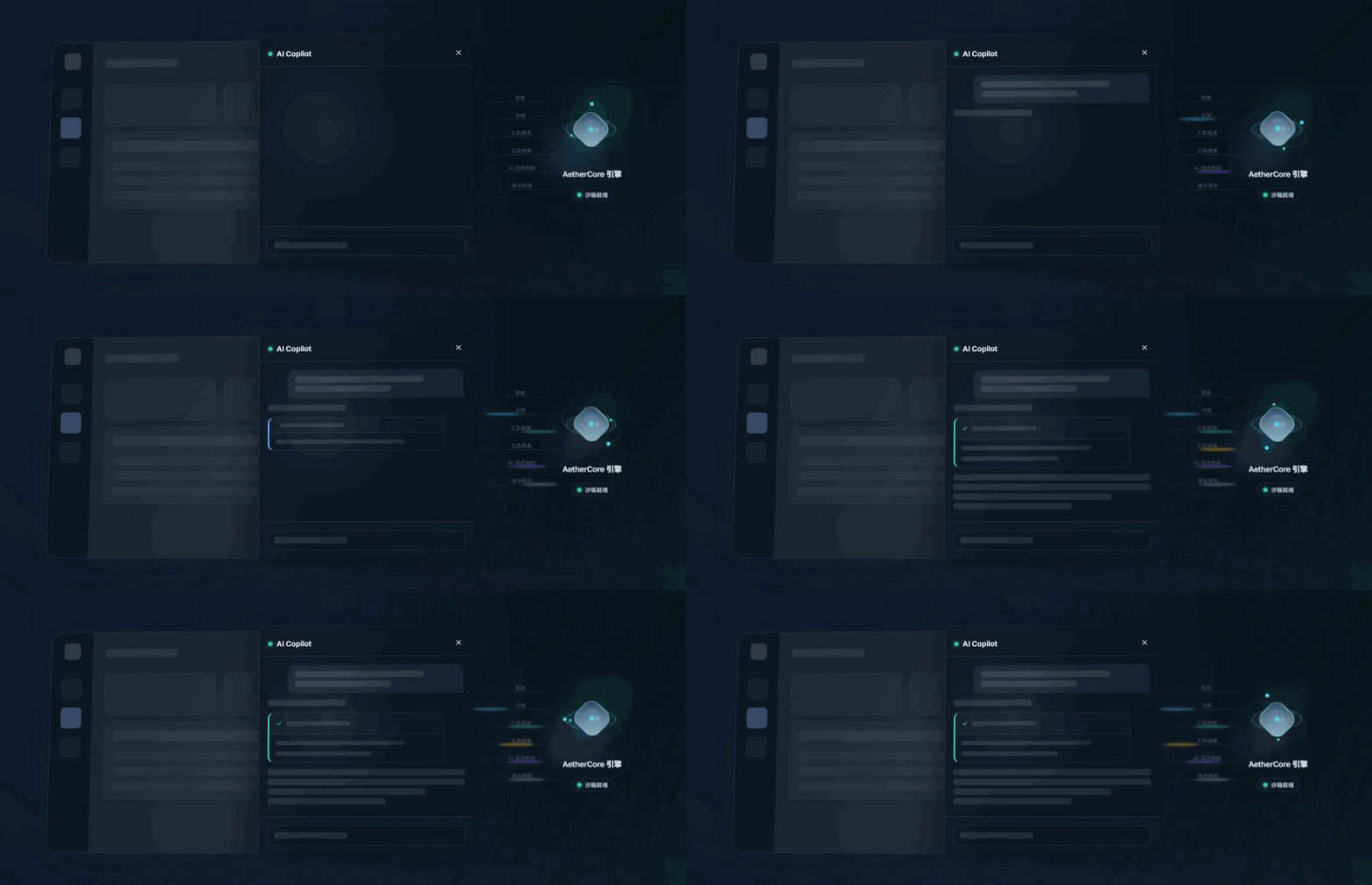
What AetherCore Provides
- Admin login and standalone workbench access
- Embedded workbench flows based on platform registration, bootstrap, and bind
- Dynamically injected tools, files, skills, and other host-side capabilities for the Agent to use
- User-level and platform-level LLM override configuration
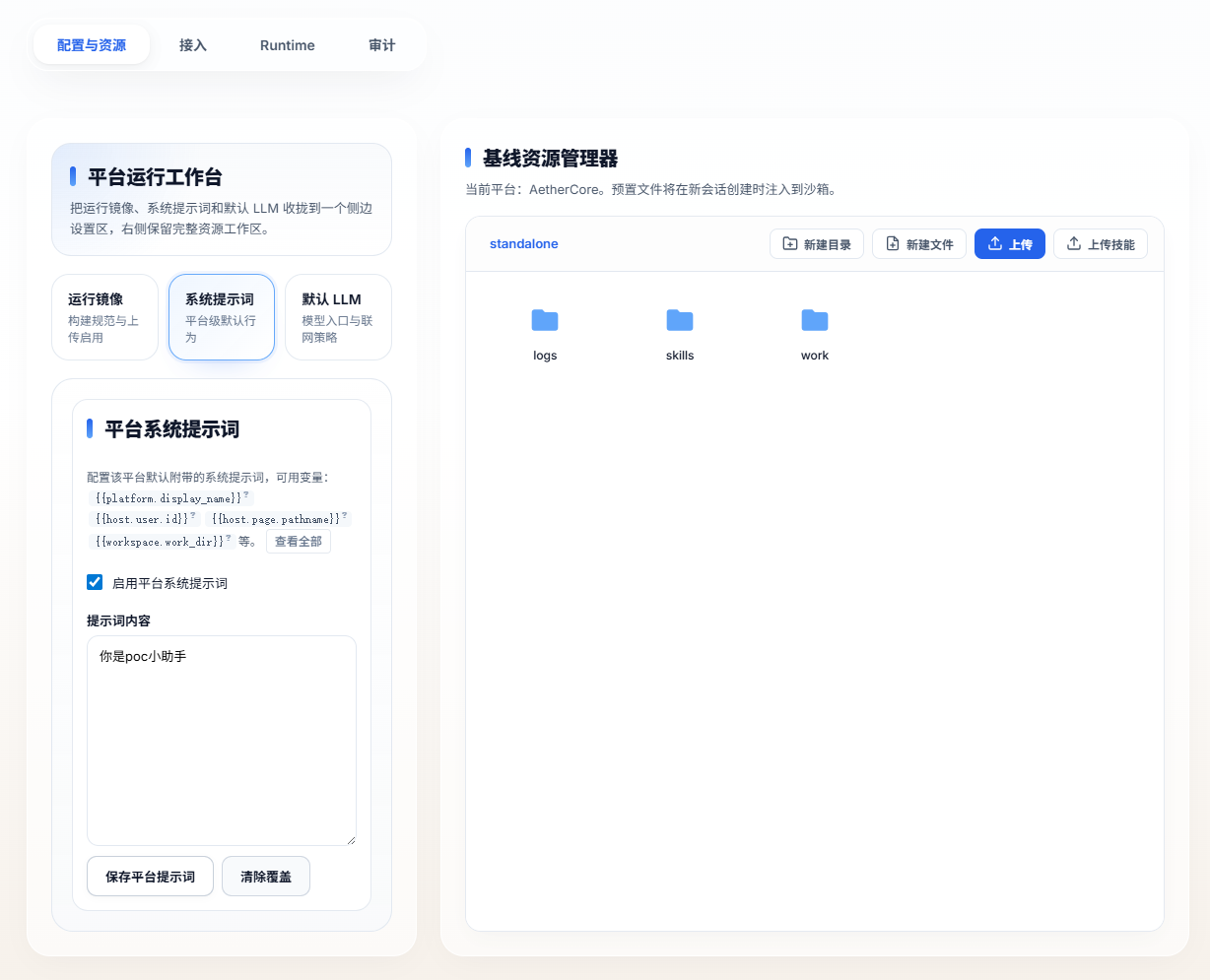
- Platform baselines for files, skills, and workspace content
- Platform runtime image management and audit views
Agent Capabilities
- Streaming long-context conversations
- Asking follow-up questions proactively and presenting options to users
- File upload and download
- Planning lists
- Skill upload and usage
- Sandboxed command execution
- Web search and retrieval
- Automatic long-context compaction
- Session branching, message editing, and rerunning conversations
Product Preview
Full Workbench
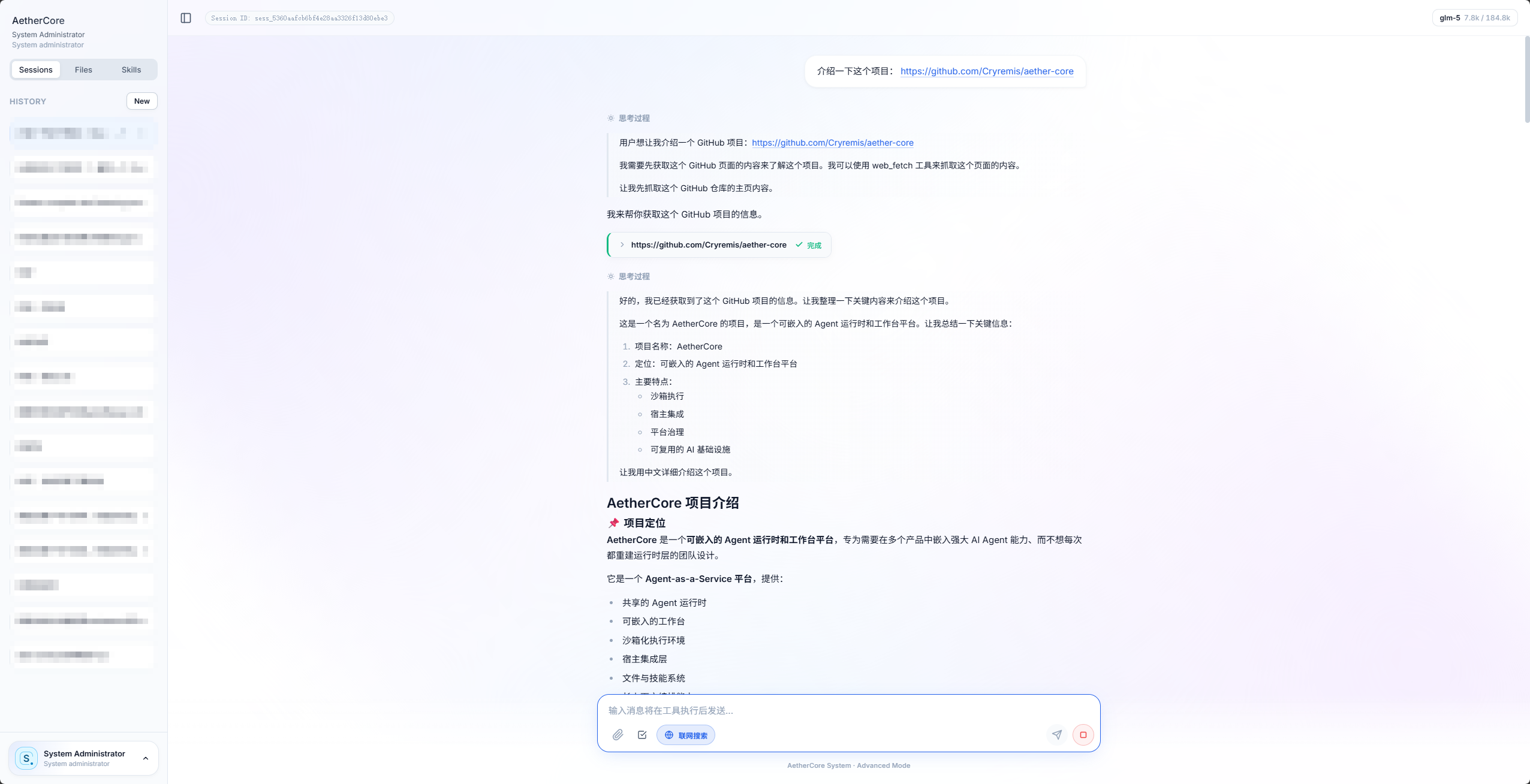
Embedded Workbench Inside a Host Product
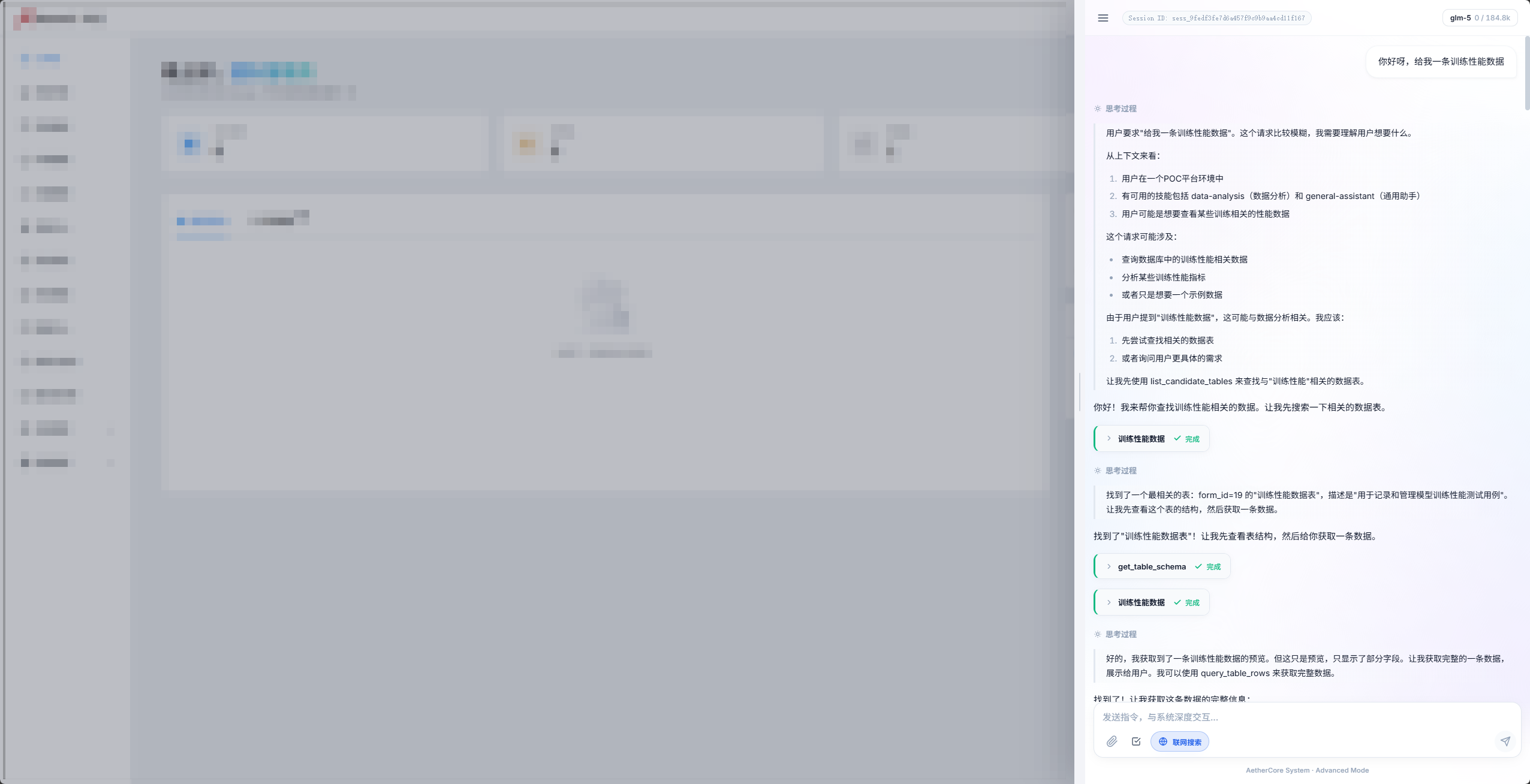
Long-running Task Execution
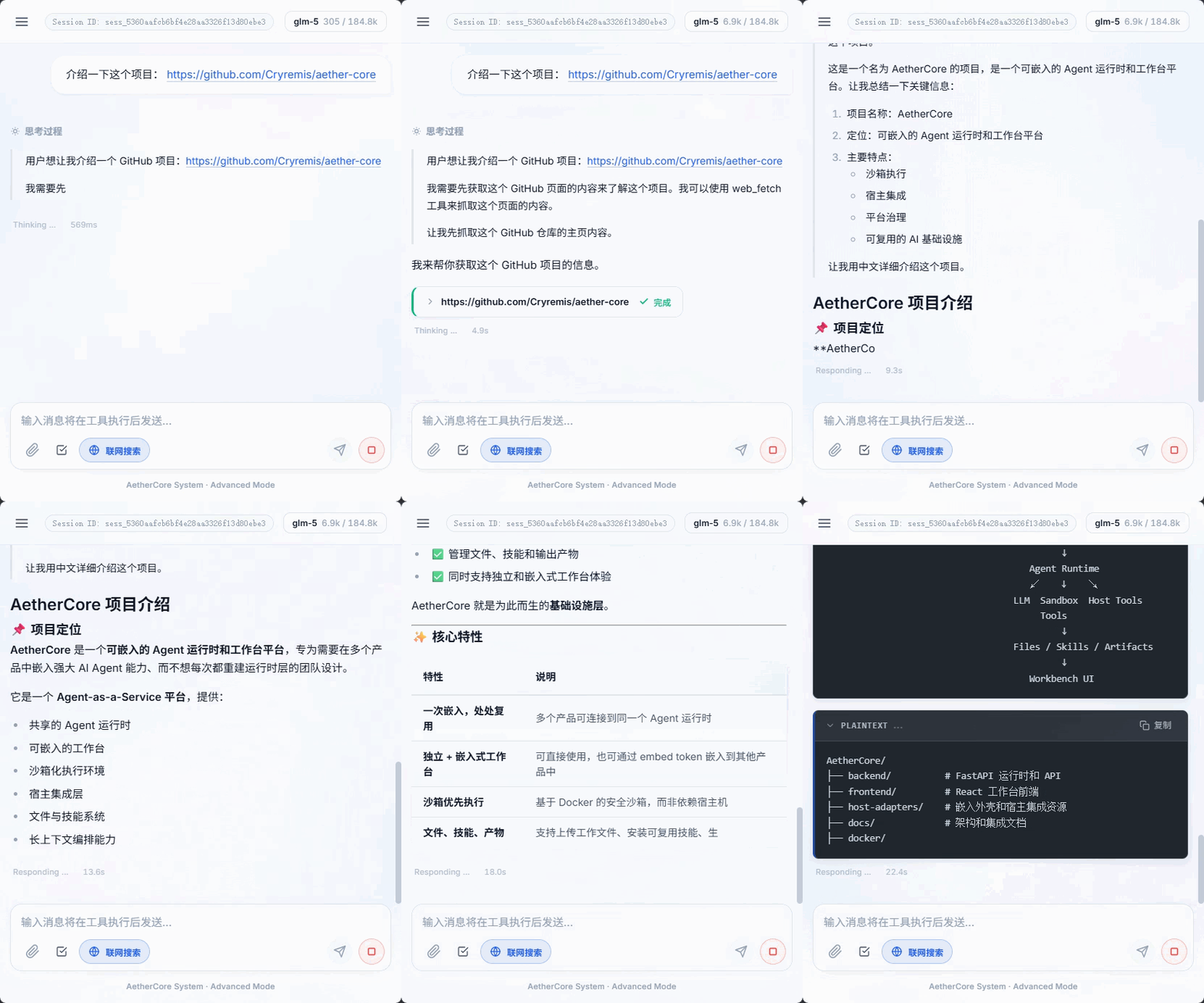
Platform Governance and Runtime Control
Good Fit For
- Teams that want to embed an Agent panel into an existing SaaS product or internal system
- Teams that need the Agent to actually use tools, files, and command execution instead of only chatting
- Teams that want multiple products to share one Runtime
- Teams that need centralized model policy, platform baselines, and audit
- Teams that care about sandbox isolation and execution boundaries early
Where It Sits In The System
flowchart LR
    A["Host Product"] --> B["AetherCore Bind Flow"]
    B --> C["Session + Platform Context"]
    C --> D["Agent Runtime"]
    D --> E["LLM"]
    D --> F["Sandbox Tools"]
    D --> G["Host Tools"]
    D --> H["Files / Skills / Artifacts"]
    C --> I["Workbench UI"]
    A --> I
Typical Use Cases
- Embed an Agent workbench into an existing SaaS or internal system.
- Standardize Agent infrastructure for multiple products on one Runtime.
- Run tool-using Agents while isolating command execution in a sandbox.
- Support compound workflows that combine chat, files, skills, and generated artifacts.
- Inject different default workspace content and configuration for different platforms.
Quick Start
Prerequisites
- Python
3.11+ - Node.js
20+ - Docker
1. Configure the backend
Create backend/.env from backend/.env.example, and set at least:
LLM_BASE_URLLLM_MODELLLM_API_KEYAUTH_SECRET_KEY
If you want to prepare configuration in a more production-oriented way, start from backend/.env.production.example.
2. Install dependencies
cd backend
pip install -e .[dev]
cd frontend
npm install
3. Build the sandbox image
docker build -t aethercore-sandbox:latest -f docker/sandbox/Dockerfile .
4. Start the development environment
python run_dev.py start
Useful commands:
python run_dev.py status
python run_dev.py restart
python run_dev.py build frontend
5. Start the production environment
python run.py status
python run.py start
python run.py health
Default local ports:
- backend:
127.0.0.1:8100 - frontend:
127.0.0.1:5178
How To Embed It Into Your Product
AetherCore can be embedded into an existing product as a workbench while still reusing the same backend Agent Runtime. A host product can bind the current user and page context into an AetherCore session, and can also expose host APIs as tools for the Agent to call when it needs product data or host-side actions.
Recommended integration flow:
- Register a platform in AetherCore.
- Keep
host_secretonly on your backend. - Provide a host-side bind endpoint, such as
/api/v1/aethercore/embed/bind. - Return
tokenandsession_idto the browser. - Mount the embedded workbench through the universal adapter.
- If the Agent needs to call your product APIs, add host tools as needed.
The admin console generates a dedicated integration guide for every registered platform. That is the main place to copy integration code, because it knows the current platform key, host secret, same-origin or cross-origin deployment mode, authentication mode, and backend framework template.
If you only need an embedded workbench, keep host capabilities empty. If you want the Agent to use product data, add host tools during bind so AetherCore can call controlled product APIs on behalf of the current user.
Relevant entry points:
- host-adapters/universal/aethercore-embed.js
- host-adapters/universal/README.md
- docs/host-integration.md
- docs/host-integration-standard.md
Repository Layout
AetherCore/
  backend/          FastAPI runtime and APIs
  frontend/         React workbench
  host-adapters/    Host integration adapters and assets
  docs/             Architecture and integration docs
  docker/           Sandbox image definitions
  ops/              Runtime and deployment notes
  site/             Static GitHub Pages project site
License
Apache-2.0. See LICENSE.
Yorumlar (0)
Yorum birakmak icin giris yap.
Yorum birakSonuc bulunamadi