AiDex
Health Gecti
- License — License: MIT
- Description — Repository has a description
- Active repo — Last push 0 days ago
- Community trust — 23 GitHub stars
Code Basarisiz
- rimraf — Recursive directory removal in package.json
- fs module — File system access in package.json
- execSync — Synchronous shell command execution in scripts/postinstall.mjs
- process.env — Environment variable access in scripts/postinstall.mjs
Permissions Gecti
- Permissions — No dangerous permissions requested
This MCP server provides AI coding assistants with persistent, pre-built indexing for your codebase. It allows the AI to quickly search across files, manage tasks, and capture screenshots while claiming to use significantly less context than standard search tools.
Security Assessment
Overall risk: Medium. The tool presents some significant security concerns that require attention. During installation, it runs a post-install script that executes synchronous shell commands (`execSync`), which is a common attack vector for malicious npm packages. This same script also accesses environment variables (`process.env`), meaning it could potentially read sensitive system information like API keys. Once installed, the server requires broad file system access to index your project and uses recursive directory removal (`rimraf`), which could be dangerous if misconfigured. While no hardcoded secrets or dangerous explicit permissions were found, the combination of shell execution, environment variable reading, and deep file system access warrants caution, especially in projects containing sensitive data.
Quality Assessment
The project appears to be actively maintained, with its most recent push happening today. It uses the standard and permissive MIT license, making it safe for most commercial and personal projects. However, community trust is currently quite low; with only 23 GitHub stars, the tool has not yet been widely tested or vetted by a large audience.
Verdict
Use with caution — review the `postinstall.mjs` script carefully before installing in environments containing sensitive data.
MCP Server for persistent code indexing. Gives AI assistants (Claude, Gemini, Copilot, Cursor) instant access to your codebase. 50x less context than grep.
AiDex



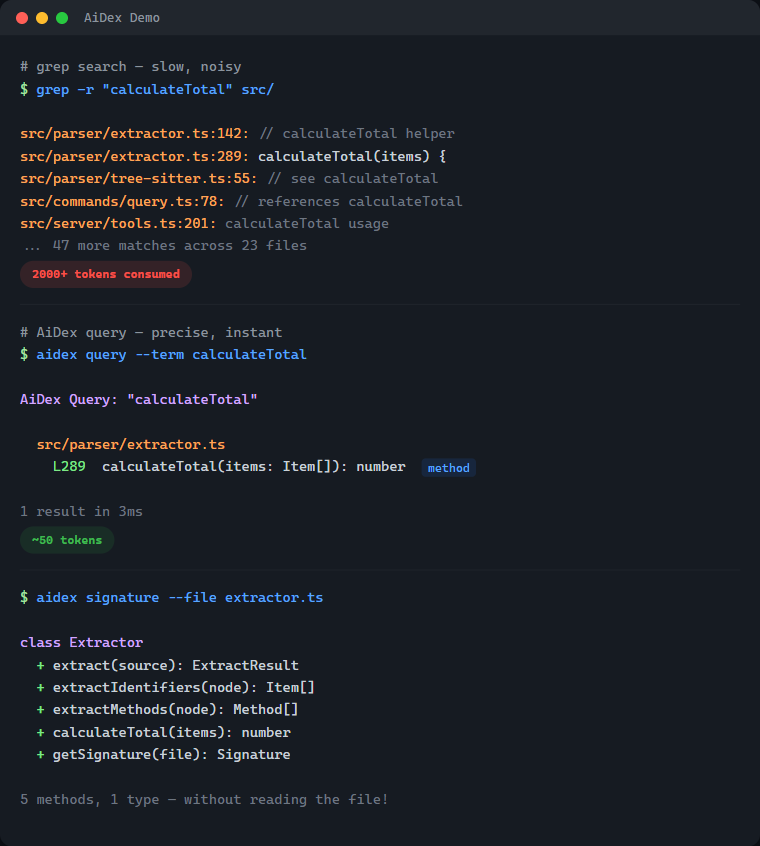
Stop wasting 80% of your AI's context window on code searches.
AiDex is an MCP server that gives AI coding assistants instant access to your entire codebase through a persistent, pre-built index. Works with any MCP-compatible AI assistant: Claude Code, Claude Desktop, Cursor, Windsurf, Gemini CLI, VS Code Copilot, and more.
What's Inside — 30 Tools in One Server
| Category | Tools | What it does |
|---|---|---|
| Search & Index | init, query, update, remove, status |
Index your project, search identifiers by name (exact/contains/starts_with), time-based filtering |
| Signatures | signature, signatures |
Get classes + methods of any file without reading it — single file or glob pattern |
| Project Overview | summary, tree, describe, files |
Entry points, language breakdown, file tree with stats, file listing by type |
| Cross-Project | link, unlink, links, scan |
Link dependencies, discover indexed projects |
| Global Search | global_init, global_query, global_signatures, global_status, global_refresh |
Search across ALL your projects at once — "Have I ever written X?" |
| Guidelines | global_guideline |
Persistent AI instructions & coding conventions — shared across all projects |
| Sessions | session, note |
Track sessions, detect external changes, leave notes for next session (with searchable history) |
| Task Backlog | task, tasks |
Built-in task management with priorities, tags, auto-logged history, and scheduled/recurring tasks |
| Log Hub | log |
Universal log receiver — any program sends logs via HTTP, queryable by the AI, live in Viewer |
| Screenshots | screenshot, windows |
Cross-platform screen capture with LLM optimization — scale + color reduction saves up to 95% tokens |
| Viewer | viewer |
Interactive browser UI with file tree, signatures, tasks, logs, and live reload |
11 languages — C#, TypeScript, JavaScript, Rust, Python, C, C++, Java, Go, PHP, Ruby
Quick Examples — see it in action# Find where "PlayerHealth" is defined — 1 call, ~50 tokens
aidex_query({ term: "PlayerHealth" })
→ Engine.cs:45, Player.cs:23, UI.cs:156
# All methods in a file — without reading the whole file
aidex_signature({ file: "src/Engine.cs" })
→ class GameEngine { Update(), Render(), LoadScene(), ... }
# What changed in the last 2 hours?
aidex_query({ term: "render", modified_since: "2h" })
# Search across ALL your projects at once
aidex_global_query({ term: "TransparentWindow", mode: "contains" })
→ Found in: LibWebAppGpu (3 hits), DebugViewer (1 hit)
# Leave a note for your next session
aidex_note({ path: ".", note: "Test the parser fix after restart" })
# Create a task while working
aidex_task({ path: ".", action: "create", title: "Fix edge case in parser", priority: 1, tags: "bug" })
Table of Contents
- What's Inside
- The Problem
- The Solution
- Why Not Just Grep?
- How It Works
- Features
- Supported Languages
- Quick Start
- Available Tools
- Time-based Filtering
- Project Structure
- Session Notes
- Task Backlog
- Global Search
- AI Guidelines
- Log Hub
- Screenshots — LLM-Optimized
- Interactive Viewer
- CLI Usage
- Performance
- Technology
- Contributing
- License
The Problem
Every time your AI assistant searches for code, it:
- Greps through thousands of files → hundreds of results flood the context
- Reads file after file to understand the structure → more context consumed
- Forgets everything when the session ends → repeat from scratch
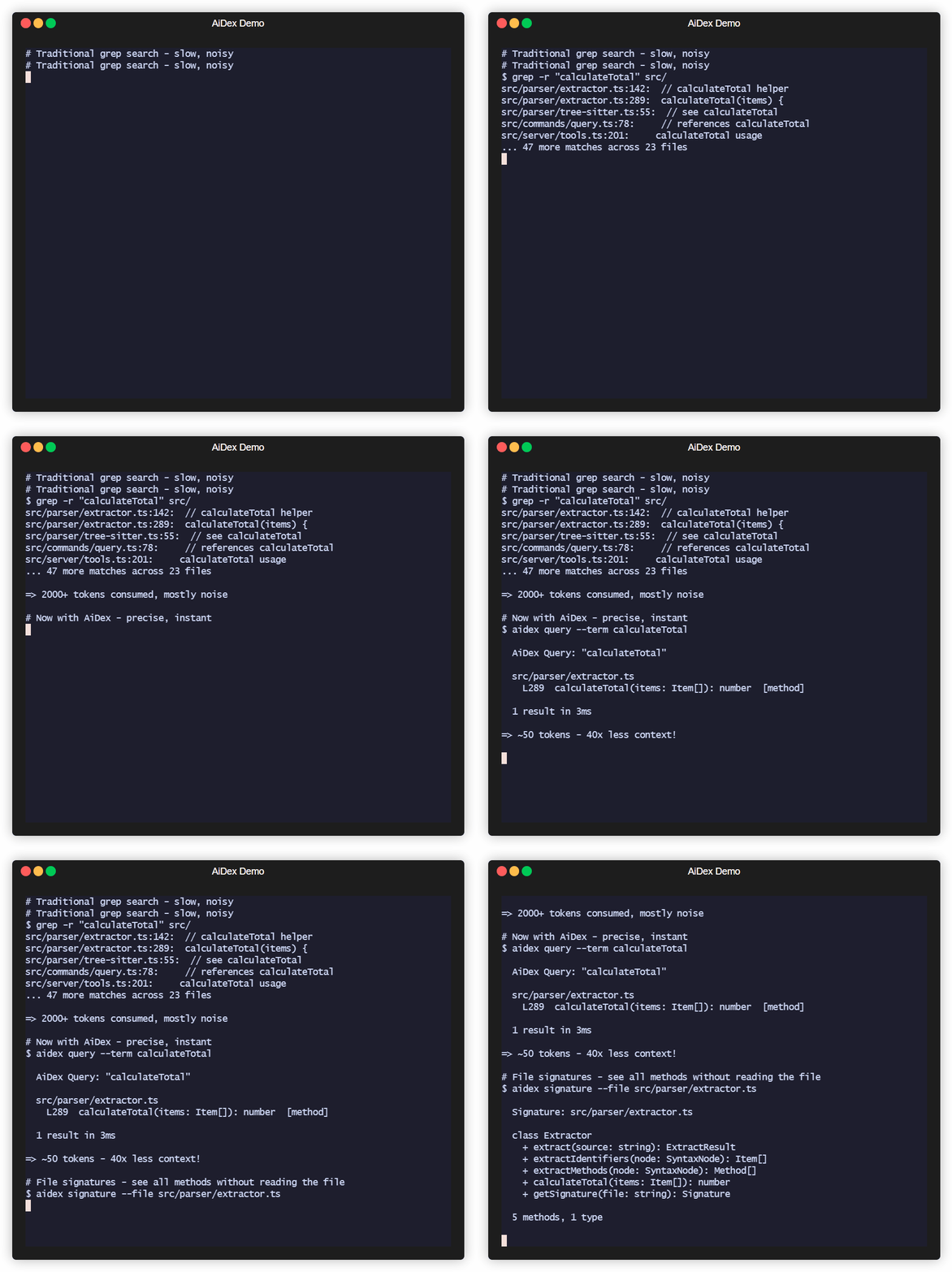
A single "Where is X defined?" question can eat 2,000+ tokens. Do that 10 times and you've burned half your context on navigation alone.
The Solution
Index once, query forever:
# Before: grep flooding your context
AI: grep "PlayerHealth" → 200 hits in 40 files
AI: read File1.cs, File2.cs, File3.cs...
→ 2000+ tokens consumed, 5+ tool calls

# After: precise results, minimal context
AI: aidex_query({ term: "PlayerHealth" })
→ Engine.cs:45, Player.cs:23, UI.cs:156
→ ~50 tokens, 1 tool call
Result: 50-80% less context used for code navigation.
Why Not Just Grep?
| Grep/Ripgrep | AiDex | |
|---|---|---|
| Context usage | 2000+ tokens per search | ~50 tokens |
| Results | All text matches | Only identifiers |
| Precision | log matches catalog, logarithm |
log finds only log |
| Persistence | Starts fresh every time | Index survives sessions |
| Structure | Flat text search | Knows methods, classes, types |
The real cost of grep: Every grep result includes surrounding context. Search for User in a large project and you'll get hundreds of hits - comments, strings, partial matches. Your AI reads through all of them, burning context tokens on noise.
AiDex indexes identifiers: It uses Tree-sitter to actually parse your code. When you search for User, you get the class definition, the method parameters, the variable declarations - not every comment that mentions "user".
How It Works
Index your project once (~1 second per 1000 files)
aidex_init({ path: "/path/to/project" })AI searches the index instead of grepping
aidex_query({ term: "Calculate", mode: "starts_with" })
→ All functions starting with "Calculate" + exact line numbers

aidex_query({ term: "Player", modified_since: "2h" })
→ Only matches changed in the last 2 hours
Get file overviews without reading entire files
aidex_signature({ file: "src/Engine.cs" })
→ All classes, methods, and their signatures
The index lives in .aidex/index.db (SQLite) - fast, portable, no external dependencies.
Features
- Tree-sitter Parsing: Real code parsing, not regex — indexes identifiers, ignores keywords and noise
- ~50 Tokens per Search: vs 2000+ with grep — your AI keeps its context for actual work
- Persistent Index: Survives between sessions — no re-scanning, no re-reading
- Incremental Updates: Re-index single files after changes, not the whole project
- Time-based Filtering: Find what changed in the last hour, day, or week
- Auto-Cleanup: Excluded files (e.g., build outputs) are automatically removed from index
- Zero Dependencies: SQLite with WAL mode — single file, fast, portable
Supported Languages
| Language | Extensions |
|---|---|
| C# | .cs |
| TypeScript | .ts, .tsx |
| JavaScript | .js, .jsx, .mjs, .cjs |
| Rust | .rs |
| Python | .py, .pyw |
| C | .c, .h |
| C++ | .cpp, .cc, .cxx, .hpp, .hxx |
| Java | .java |
| Go | .go |
| PHP | .php |
| Ruby | .rb, .rake |
Quick Start
1. Install
npm install -g aidex-mcp
That's it. Setup runs automatically after install — it detects your installed AI clients (Claude Code, Claude Desktop, Cursor, Windsurf, Gemini CLI, VS Code Copilot) and registers AiDex as an MCP server. It also adds usage instructions to your AI's config (~/.claude/CLAUDE.md, ~/.gemini/GEMINI.md).
To re-run setup manually: aidex setup | To unregister: aidex unsetup | To skip auto-setup: AIDEX_NO_SETUP=1 npm install -g aidex-mcp
2. Or register manually with your AI assistant
For Claude Code (~/.claude/settings.json or ~/.claude.json):
{
  "mcpServers": {
    "aidex": {
      "type": "stdio",
      "command": "aidex",
      "env": {}
    }
  }
}
For Claude Desktop (%APPDATA%/Claude/claude_desktop_config.json on Windows):
{
  "mcpServers": {
    "aidex": {
      "command": "aidex"
    }
  }
}
Note: Both
aidexandaidex-mcpwork as command names.
Important: The server name in your config determines the MCP tool prefix. Use
"aidex"as shown above — this gives you tool names likeaidex_query,aidex_signature, etc. Using a different name (e.g.,"codegraph") would change the prefix accordingly.
For Gemini CLI (~/.gemini/settings.json):
{
  "mcpServers": {
    "aidex": {
      "command": "aidex"
    }
  }
}
For VS Code Copilot (run MCP: Open User Configuration in Command Palette):
{
  "servers": {
    "aidex": {
      "type": "stdio",
      "command": "aidex"
    }
  }
}
For other MCP clients: See your client's documentation for MCP server configuration.
3. Make your AI actually use it
Add to your AI's instructions (e.g., ~/.claude/CLAUDE.md for Claude Code, or the equivalent for your AI client). This tells the AI when and how to use AiDex instead of grepping:
## AiDex - Persistent Code Index (MCP Server)

AiDex provides fast, precise code search through a pre-built index.
**Always prefer AiDex over Grep/Glob for code searches.**

### REQUIRED: Before using Grep/Glob/Read for code searches
Do I want to search code?
├── .aidex/ exists → STOP! Use AiDex instead
├── .aidex/ missing → run aidex_init (don't ask), THEN use AiDex
└── Config/Logs/Text → Grep/Read is fine
**NEVER do this when .aidex/ exists:**
- ❌ `Grep pattern="functionName"` → ✅ `aidex_query term="functionName"`
- ❌ `Grep pattern="class.*Name"` → ✅ `aidex_query term="Name" mode="contains"`
- ❌ `Read file.cs` to see methods → ✅ `aidex_signature file="file.cs"`
- ❌ `Glob pattern="**/*.cs"` + Read → ✅ `aidex_signatures pattern="**/*.cs"`

### Session-Start Rule (REQUIRED — every session, no exceptions)

1. Call `aidex_session({ path: "<project>" })` — detects external changes, auto-reindexes
2. If `.aidex/` does NOT exist → run `aidex_init` automatically (don't ask)
3. If a session note exists → **show it to the user** before continuing
4. **Before ending a session:** always leave a note about what to do next

### Question → Right Tool

| Question | Tool |
|----------|------|
| "Where is X defined?" | `aidex_query term="X"` |
| "Find anything containing X" | `aidex_query term="X" mode="contains"` |
| "All functions starting with X" | `aidex_query term="X" mode="starts_with"` |
| "What methods does file Y have?" | `aidex_signature file="Y"` |
| "Explore all files in src/" | `aidex_signatures pattern="src/**"` |
| "Project overview" | `aidex_summary` + `aidex_tree` |
| "What changed recently?" | `aidex_query term="X" modified_since="2h"` |
| "What files changed today?" | `aidex_files path="." modified_since="8h"` |
| "Have I ever written X?" | `aidex_global_query term="X" mode="contains"` |
| "Which project has class Y?" | `aidex_global_signatures term="Y" kind="class"` |
| "All indexed projects?" | `aidex_global_status` |

### Search Modes

- **`exact`** (default): Finds only the exact identifier — `log` won't match `catalog`
- **`contains`**: Finds identifiers containing the term — `render` matches `preRenderSetup`
- **`starts_with`**: Finds identifiers starting with the term — `Update` matches `UpdatePlayer`, `UpdateUI`

### All Tools (30)

| Category | Tools | Purpose |
|----------|-------|---------|
| Search & Index | `aidex_init`, `aidex_query`, `aidex_update`, `aidex_remove`, `aidex_status` | Index project, search identifiers (exact/contains/starts_with), time filter |
| Signatures | `aidex_signature`, `aidex_signatures` | Get classes + methods without reading files |
| Overview | `aidex_summary`, `aidex_tree`, `aidex_describe`, `aidex_files` | Entry points, file tree, file listing by type |
| Cross-Project | `aidex_link`, `aidex_unlink`, `aidex_links`, `aidex_scan` | Link dependencies, discover projects |
| Global Search | `aidex_global_init`, `aidex_global_query`, `aidex_global_signatures`, `aidex_global_status`, `aidex_global_refresh` | Search across ALL projects |
| Guidelines | `aidex_global_guideline` | Persistent AI instructions & conventions (key-value, global) |
| Sessions | `aidex_session`, `aidex_note` | Track sessions, leave notes (with searchable history) |
| Tasks | `aidex_task`, `aidex_tasks` | Built-in backlog with priorities, tags, summaries, auto-logged history, scheduled/recurring tasks |
| Log Hub | `aidex_log` | Universal log receiver — any program sends logs via HTTP, AI queries them, live in Viewer |
| Screenshots | `aidex_screenshot`, `aidex_windows` | Screen capture with LLM optimization (scale + color reduction, no index needed) |
| Viewer | `aidex_viewer` | Interactive browser UI with file tree, signatures, tasks, and live logs |

**11 languages:** C#, TypeScript, JavaScript, Rust, Python, C, C++, Java, Go, PHP, Ruby

### Session Notes

Leave notes for the next session — they persist in the database:
aidex_note({ path: ".", note: "Test the fix after restart" }) # Write
aidex_note({ path: ".", note: "Also check edge cases", append: true }) # Append
aidex_note({ path: "." }) # Read
aidex_note({ path: ".", search: "parser" }) # Search history
aidex_note({ path: ".", clear: true }) # Clear
- **Before ending a session:** automatically leave a note about next steps
- **User says "remember for next session: ..."** → write it immediately

### Task Backlog

Track TODOs, bugs, and features right next to your code index:
aidex_task({ path: ".", action: "create", title: "Fix bug", priority: 1, tags: "bug" })
aidex_task({ path: ".", action: "update", id: 1, status: "done" })
aidex_task({ path: ".", action: "log", id: 1, note: "Root cause found" })
aidex_tasks({ path: ".", status: "active" })
Scheduled & recurring tasks
aidex_task({ path: ".", action: "create", title: "Check PR status", due: "3d", interval: "3d", task_action: "gh pr list" })
Priority: 1=high, 2=medium, 3=low | Status: `backlog → active → done | cancelled`

### Global Search (across all projects)
aidex_global_init({ path: "/path/to/all/repos" }) # Scan & register
aidex_global_init({ path: "...", index_unindexed: true }) # + auto-index small projects
aidex_global_query({ term: "TransparentWindow", mode: "contains" }) # Search everywhere
aidex_global_signatures({ term: "Render", kind: "method" }) # Find methods everywhere
aidex_global_status({ sort: "recent" }) # List all projects
### Screenshots
aidex_screenshot() # Full screen
aidex_screenshot({ mode: "active_window" }) # Active window
aidex_screenshot({ mode: "window", window_title: "VS Code" }) # Specific window
aidex_screenshot({ scale: 0.5, colors: 2 }) # B&W, half size (ideal for LLM)
aidex_screenshot({ colors: 16 }) # 16 colors (UI readable)
aidex_windows({ filter: "chrome" }) # Find window titles
No index needed. Returns file path → use `Read` to view immediately.

**LLM optimization strategy:** Always start with aggressive settings, then retry if unreadable:
1. First try: `scale: 0.5, colors: 2` (B&W, half size — smallest possible)
2. If unreadable: retry with `colors: 16` (adds shading for UI elements)
3. If still unclear: `scale: 0.75` or omit `colors` for full quality
4. **Remember** what works for each window/app during the session — don't retry every time.
4. Index your project
Ask your AI: "Index this project with AiDex"
Or manually in the AI chat:
aidex_init({ path: "/path/to/your/project" })
Available Tools
| Tool | Description |
|---|---|
aidex_init |
Index a project (creates .aidex/) |
aidex_query |
Search by term (exact/contains/starts_with) |
aidex_signature |
Get one file's classes + methods |
aidex_signatures |
Get signatures for multiple files (glob) |
aidex_update |
Re-index a single changed file |
aidex_remove |
Remove a deleted file from index |
aidex_summary |
Project overview |
aidex_tree |
File tree with statistics |
aidex_describe |
Add documentation to summary |
aidex_link |
Link another indexed project |
aidex_unlink |
Remove linked project |
aidex_links |
List linked projects |
aidex_status |
Index statistics |
aidex_scan |
Find indexed projects in directory tree |
aidex_files |
List project files by type (code/config/doc/asset) |
aidex_note |
Read/write session notes (persists between sessions) |
aidex_session |
Start session, detect external changes, auto-reindex |
aidex_viewer |
Open interactive project tree in browser |
aidex_task |
Create, read, update, delete tasks with priority and tags |
aidex_tasks |
List and filter tasks by status, priority, or tag |
aidex_screenshot |
Take a screenshot (fullscreen, window, region) with optional scale + color reduction |
aidex_windows |
List open windows for screenshot targeting |
aidex_global_init |
Scan directory tree, register all indexed projects in global DB |
aidex_global_status |
List all registered projects with stats |
aidex_global_query |
Search terms across ALL registered projects |
aidex_global_signatures |
Search methods/types by name across all projects |
aidex_global_refresh |
Update stats and remove stale projects from global DB |
aidex_global_guideline |
Store/retrieve AI guidelines and coding conventions (key-value, global) |
aidex_log |
Universal log receiver — start HTTP server, query logs, live stream in Viewer |
Time-based Filtering
Track what changed recently with modified_since and modified_before:
aidex_query({ term: "render", modified_since: "2h" })   # Last 2 hours
aidex_query({ term: "User", modified_since: "1d" })     # Last day
aidex_query({ term: "API", modified_since: "1w" })      # Last week
Supported formats:
- Relative:
30m(minutes),2h(hours),1d(days),1w(weeks) - ISO date:
2026-01-27or2026-01-27T14:30:00
Perfect for questions like "What did I change in the last hour?"
Project Structure
AiDex indexes ALL files in your project (not just code), letting you query the structure:
aidex_files({ path: ".", type: "config" })  # All config files
aidex_files({ path: ".", type: "test" })    # All test files
aidex_files({ path: ".", pattern: "**/*.md" })  # All markdown files
aidex_files({ path: ".", modified_since: "30m" })  # Changed this session
File types: code, config, doc, asset, test, other, dir
Use modified_since to find files changed in this session - perfect for "What did I edit?"
Session Notes
Leave reminders for the next session - no more losing context between chats:
aidex_note({ path: ".", note: "Test the glob fix after restart" })  # Write
aidex_note({ path: ".", note: "Also check edge cases", append: true })  # Append
aidex_note({ path: "." })                                              # Read
aidex_note({ path: ".", clear: true })                                 # Clear
Note History (v1.10): Old notes are automatically archived when overwritten or cleared. Browse and search past notes:
aidex_note({ path: ".", history: true })                    # Browse archived notes (shows summaries)
aidex_note({ path: ".", search: "parser" })                 # Search note history (searches summaries too)
aidex_note({ path: ".", history: true, limit: 5 })          # Last 5 archived notes
Note Summaries (v1.15): Provide a summary when writing/clearing a note — the archived note gets this one-sentence description. History then shows summaries instead of truncated text:
aidex_note({ path: ".", note: "New focus", summary: "Previous session: finished parser refactoring" })
Use cases:
- Before ending a session: "Remember to test X next time"
- AI auto-reminder: Save what to verify after a restart
- Handover notes: Context for the next session without editing config files
- Search past sessions: "What did we do about the parser?"
Notes are stored in the SQLite database (.aidex/index.db) and persist indefinitely.
Task Backlog
Keep your project tasks right next to your code index - no Jira, no Trello, no context switching:
aidex_task({ path: ".", action: "create", title: "Fix parser bug", priority: 1, tags: "bug", summary: "Parser crashes on nested generics in C#" })
aidex_task({ path: ".", action: "update", id: 1, status: "done" })
aidex_task({ path: ".", action: "log", id: 1, note: "Root cause: unbounded buffer" })
aidex_tasks({ path: ".", status: "active" })
Scheduled & Recurring Tasks
Tasks can have due dates and repeat intervals. Overdue tasks are reported at every session start across ALL projects:
# One-shot: remind in 3 days
aidex_task({ path: ".", action: "create", title: "Review PR", due: "3d", task_action: "Check if PR was submitted" })

# Recurring: check every week
aidex_task({ path: ".", action: "create", title: "Check dependencies", due: "1w", interval: "1w", task_action: "npm outdated" })

# Auto-execute: runs the action automatically when due
aidex_task({ path: ".", action: "create", title: "Refresh stats", due: "1d", interval: "1d", auto_go: true })
Due formats: Relative ("30m", "2h", "3d", "1w") or ISO date ("2026-04-10")
At every aidex_session call, the Task Scheduler checks ~/.aidex/global.db for due tasks across all projects — even if you're working on a different project. Recurring tasks automatically advance their due date after each trigger.
Features:
- Summaries: One-sentence table-of-contents per task — scan the backlog without reading full details
- Priorities: 🔴 high, 🟡 medium, ⚪ low
- Statuses:
backlog → active → done | cancelled - Tags: Categorize tasks (
bug,feature,docs, etc.) - History log: Every status change is auto-logged, plus manual notes
- Scheduling: Due dates, recurring intervals, actions, auto-execute across all projects
- Viewer integration: Tasks tab in the browser viewer with live updates
- Persistent: Tasks survive between sessions, stored in
.aidex/index.db
Your AI assistant can create tasks while working ("found a bug in the parser, add it to the backlog"), track progress, and pick up where you left off next session.
Global Search
Search across ALL your indexed projects at once. Perfect for "Have I ever written a transparent window?" or "Where did I use that algorithm?"
Setup
aidex_global_init({ path: "Q:/develop" })                              # Scan & register
aidex_global_init({ path: "Q:/develop", exclude: ["llama.cpp"] })      # Skip external repos
aidex_global_init({ path: "Q:/develop", index_unindexed: true })       # Auto-index all found projects
aidex_global_init({ path: "Q:/develop", index_unindexed: true, show_progress: true })  # With browser progress UI
This scans your project directory, registers all AiDex-indexed projects in a global database (~/.aidex/global.db), and reports any unindexed projects it finds by detecting project markers (.csproj, package.json, Cargo.toml, etc.).
With index_unindexed: true, it also auto-indexes all discovered projects with ≤500 code files. Larger projects are listed separately for user decision. Add show_progress: true to open a live progress UI in your browser (http://localhost:3334).
Search
aidex_global_query({ term: "TransparentWindow" })                      # Exact match
aidex_global_query({ term: "transparent", mode: "contains" })          # Fuzzy search
aidex_global_signatures({ term: "Render", kind: "method" })            # Find methods
aidex_global_signatures({ term: "Player", kind: "class" })             # Find classes
How it works
- Uses SQLite
ATTACH DATABASEto query project databases directly — no data copying - Results are cached in memory (5-minute TTL) for fast repeated queries
- Projects are batched (8 at a time) to respect SQLite's attachment limit
- Each project keeps its own
.aidex/index.dbas the single source of truth - Auto-deduplication: Parent projects that contain sub-projects are automatically skipped (e.g.,
MyApp/is removed whenMyApp/Frontend/andMyApp/Backend/exist as separate indexed projects)
Management
aidex_global_status()                                                  # List all projects
aidex_global_status({ sort: "recent" })                                # Most recently indexed first
aidex_global_refresh()                                                 # Update stats, remove stale
AI Guidelines
Store persistent coding conventions, review checklists, and AI instructions in a single place — shared across all projects.
aidex_global_guideline({ action: "set", key: "review", value: "Always check: error handling, null safety, no hardcoded strings" })
aidex_global_guideline({ action: "set", key: "style", value: "Use PascalCase for classes, camelCase for methods, 4-space indent" })
aidex_global_guideline({ action: "get", key: "review" })               # Retrieve a guideline
aidex_global_guideline({ action: "list" })                             # Show all guidelines
aidex_global_guideline({ action: "list", filter: "code" })             # Filter by name
aidex_global_guideline({ action: "delete", key: "old-rule" })          # Remove a guideline
Use cases:
- Code review checklist: Tell your AI exactly what to look for every time
- Coding conventions: Store team style rules once, reference them in any project
- Release checklist: Step-by-step process for shipping
- Project-agnostic instructions: No more pasting the same context into every session
Guidelines are stored in ~/.aidex/global.db — available across all your projects without aidex_init. Ask your AI: "Load the review guideline and apply it to this file."
Log Hub — Universal Logging
Turn any program into a log source for your AI assistant. Your app sends logs via HTTP POST, the AI queries them via MCP, and you see them live in the Viewer — zero dependencies, zero setup in your code.
How it works
Your Program ──HTTP POST──→ AiDex Log Hub (port 3335) ──→ Ring Buffer
                                        │                      │
                                        │ WebSocket             │ MCP query
                                        ↓                      ↓
                                   Viewer (Logs tab)      AI Assistant
                                   (you see live)       (queries & analyzes)
Quick start
- AI starts the Log Hub:
aidex_log({ action: "init" }) - AI opens the Viewer:
aidex_viewer({ path: "." })— Logs tab shows live stream - Add one line to your program:
// C#
await new HttpClient().PostAsJsonAsync("http://localhost:3335/log",
    new { level = "info", source = "MyApp", message = "Player spawned", data = new { x = 10, y = 20 } });
# Python
requests.post("http://localhost:3335/log", json={"level": "info", "source": "MyApp", "message": "Done"})
// JavaScript
fetch("http://localhost:3335/log", {
    method: "POST", headers: {"Content-Type": "application/json"},
    body: JSON.stringify({level: "info", source: "MyApp", message: "Started"})
});
# PowerShell
Invoke-RestMethod -Uri http://localhost:3335/log -Method POST -ContentType "application/json" -Body '{"level":"info","source":"Script","message":"Done"}'
HTTP API
| Endpoint | Method | Body | Description |
|---|---|---|---|
/log |
POST | { level, source, message, data? } |
Single log entry |
/logs |
POST | [{ ... }, ...] |
Batch (multiple at once) |
/health |
GET | — | Status + buffer usage |
Fields: level (debug/info/warn/error), source (app name), message (text, required), data (optional JSON), timestamp (optional, ms)
Features
- Ring Buffer: Fixed-size in-memory FIFO (default 10,000 entries) — oldest entries overwritten
- Zero-cost: No server, no buffer, no resources until
initis called - Persistence: Optional SQLite storage with 7-day auto-cleanup (
persist: true) - Consume pattern:
querywithconsume: trueremoves returned entries — ideal for polling - Viewer integration: Logs tab with WebSocket live-stream, level/source/text filters, auto-scroll
- Fire & forget: Just POST and go — if the server isn't running, the POST silently fails
Screenshots — LLM-Optimized
Take screenshots and reduce them up to 95% for LLM context. A typical screenshot goes from ~100 KB to ~5 KB — that's thousands of tokens saved per image.
Why this matters
| Raw Screenshot | Optimized (scale=0.5, colors=2) | |
|---|---|---|
| File size | ~100-500 KB | ~5-15 KB |
| Tokens consumed | ~5,000-25,000 | ~250-750 |
| Text readable? | Yes | Yes |
| Colors | 16M (24-bit) | 2 (black & white) |
Most screenshots in AI context are for reading text — error messages, logs, UI labels. You don't need 16 million colors for that.
Usage
aidex_screenshot()                                             # Full screen (full quality)
aidex_screenshot({ mode: "active_window" })                    # Active window
aidex_screenshot({ mode: "window", window_title: "VS Code" }) # Specific window
aidex_screenshot({ scale: 0.5, colors: 2 })                   # B&W, half size (best for text)
aidex_screenshot({ scale: 0.5, colors: 16 })                  # 16 colors (UI readable)
aidex_screenshot({ colors: 256 })                              # 256 colors (good quality)
aidex_screenshot({ mode: "region" })                           # Interactive selection
aidex_screenshot({ mode: "rect", x: 100, y: 200, width: 800, height: 600 })  # Coordinates
aidex_windows({ filter: "chrome" })                            # Find window titles
Optimization parameters
| Parameter | Values | Description |
|---|---|---|
scale |
0.1 - 1.0 | Scale factor (0.5 = half resolution). Most HiDPI screens are 2-3x anyway. |
colors |
2, 4, 16, 256 | Color reduction. 2 = black & white, ideal for text screenshots. |
Recommended strategy for AI assistants
The tool description tells LLMs to optimize automatically:
- Start aggressive:
scale: 0.5, colors: 2(smallest possible) - If unreadable: retry with
colors: 16(adds shading for UI elements) - If still unclear: try
scale: 0.75or full color - Remember: cache what works per window/app for the rest of the session
This way the AI learns the right settings per app without wasting tokens on oversized images.
Features
- 5 capture modes: Fullscreen, active window, specific window (by title), interactive region selection, coordinate-based rectangle
- Cross-platform: Windows (PowerShell + System.Drawing), macOS (sips + ImageMagick), Linux (ImageMagick)
- Multi-monitor: Select which monitor to capture
- Delay: Wait N seconds before capturing (e.g., to open a menu first)
- Size reporting: Shows original → optimized size and percentage saved
- Auto-path: Default saves to temp directory with fixed filename
- No index required: Works standalone, no
.aidex/needed
Interactive Viewer
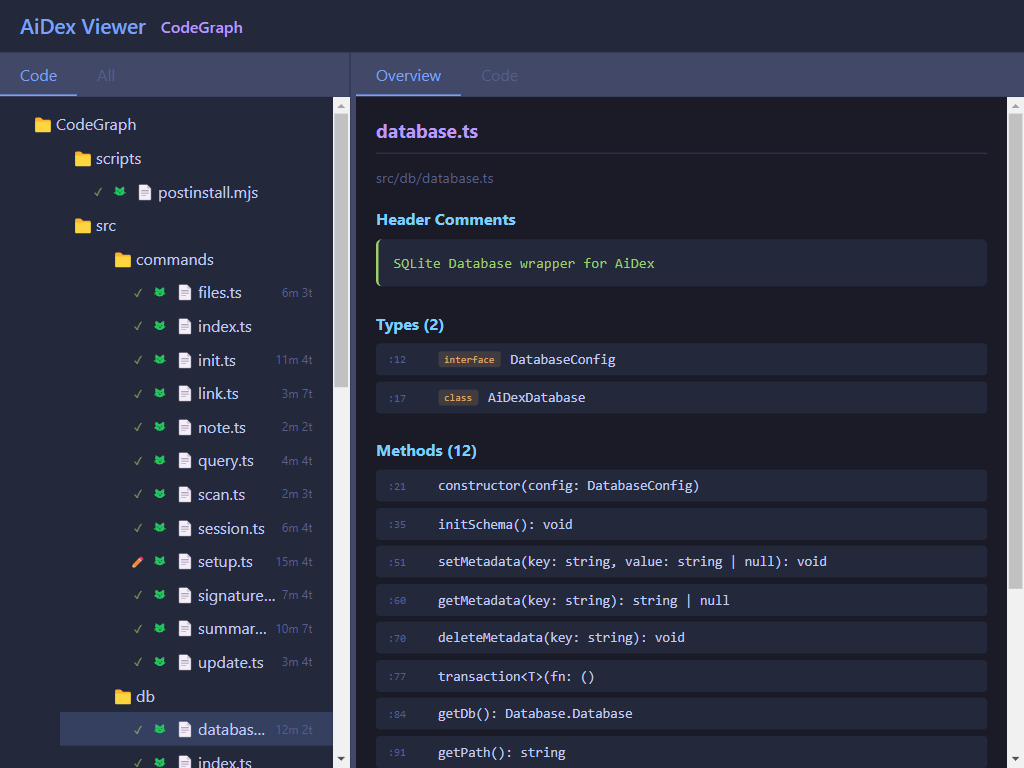
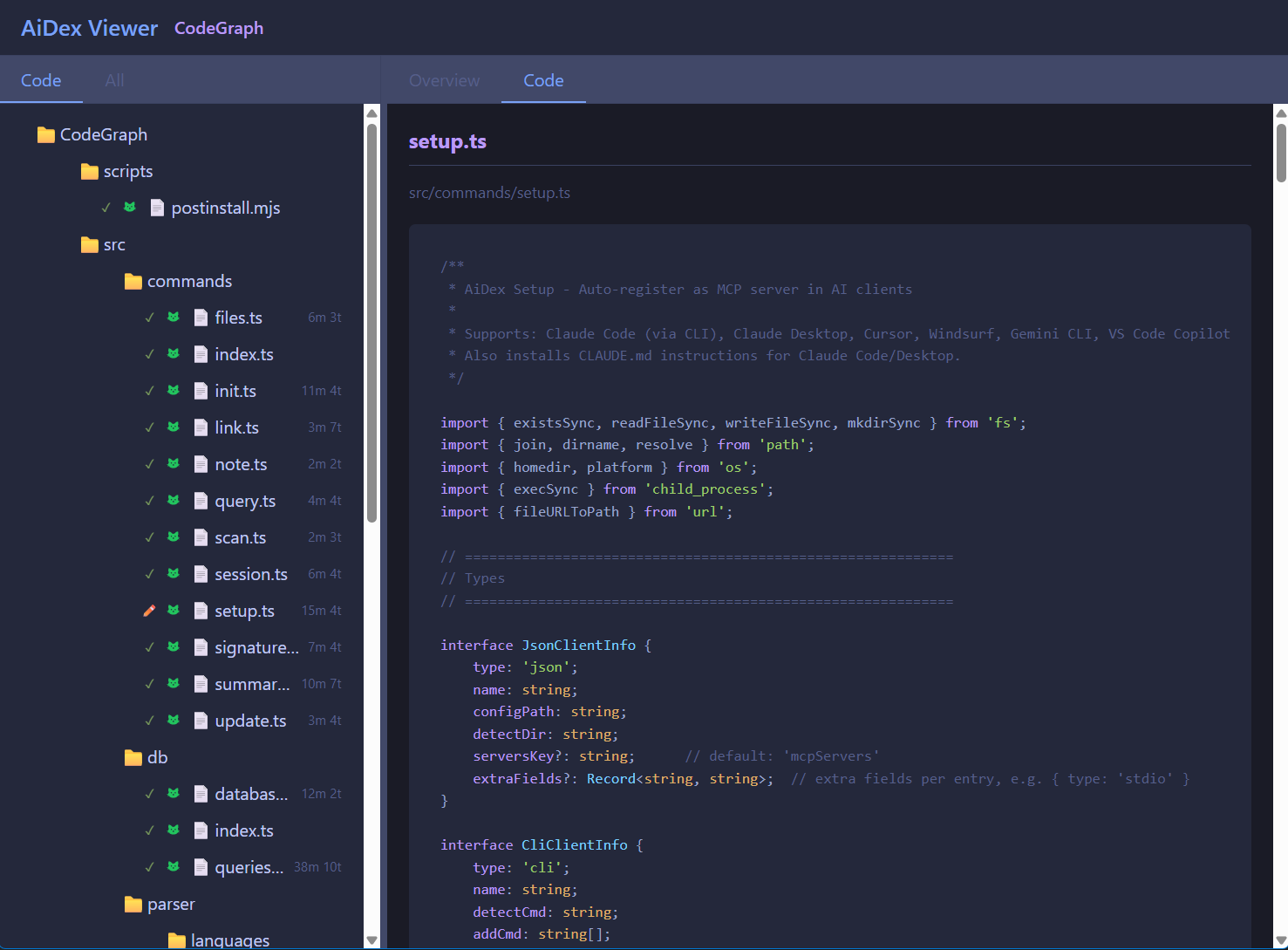
Explore your indexed project visually in the browser:
aidex_viewer({ path: "." })
Opens http://localhost:3333 with:
- Interactive file tree - Click to expand directories
- File signatures - Click any file to see its types and methods
- Live reload - Changes detected automatically while you code
- Git status icons - See which files are modified, staged, or untracked
- Logs tab - Live log stream from Log Hub with filters (level, source, text search)
- Tasks tab - View and manage your task backlog
Close with aidex_viewer({ path: ".", action: "close" })
CLI Usage
aidex scan Q:/develop       # Find all indexed projects
aidex init ./myproject      # Index a project from command line
aidex-mcpworks as an alias foraidex.
Performance
| Project | Files | Items | Index Time | Query Time |
|---|---|---|---|---|
| Small (AiDex) | 19 | 1,200 | <1s | 1-5ms |
| Medium (RemoteDebug) | 10 | 1,900 | <1s | 1-5ms |
| Large (LibPyramid3D) | 18 | 3,000 | <1s | 1-5ms |
| XL (MeloTTS) | 56 | 4,100 | ~2s | 1-10ms |
Technology
- Parser: Tree-sitter - Real parsing, not regex
- Database: SQLite with WAL mode - Fast, single file, zero config
- Protocol: MCP - Works with any compatible AI
Project Structure
.aidex/                  ← Created in YOUR project
├── index.db             ← SQLite database
└── summary.md           ← Optional documentation

AiDex/                   ← This repository
├── src/
│   ├── commands/        ← Tool implementations
│   ├── db/              ← SQLite wrapper
│   ├── parser/          ← Tree-sitter integration
│   └── server/          ← MCP protocol handler
└── build/               ← Compiled output
Community
GitHub Discussions — Ask questions, share your setup, suggest ideas.
| Category | For |
|---|---|
| Q&A | Setup help, usage questions |
| Ideas | Feature suggestions |
| Show & Tell | Share your workflow |
| Announcements | Release news (maintainer only) |
Contributing
See CONTRIBUTING.md for full details. Quick summary:
- Bug? → Open an issue
- Idea? → Start a Discussion
- New language? → Add a keyword file in
src/parser/languages/and open a PR
License
MIT License - see LICENSE
Authors
Uwe Chalas & Claude
Yorumlar (0)
Yorum birakmak icin giris yap.
Yorum birakSonuc bulunamadi