oh-my-symphony
Health Warn
- License — License: Apache-2.0
- Description — Repository has a description
- Active repo — Last push 0 days ago
- Low visibility — Only 5 GitHub stars
Code Pass
- Code scan — Scanned 12 files during light audit, no dangerous patterns found
Permissions Pass
- Permissions — No dangerous permissions requested
No AI report is available for this listing yet.
Multi-agent fork of OpenAI Symphony — drives Codex, Claude Code, Gemini, and Pi CLIs from one orchestrator with a Jira-style CLI Kanban TUI
oh-my-symphony



One terminal. One Kanban board. Four AI coding agents
(Codex, Claude Code, Gemini, Pi) — pick per ticket, run in
parallel, watch live.
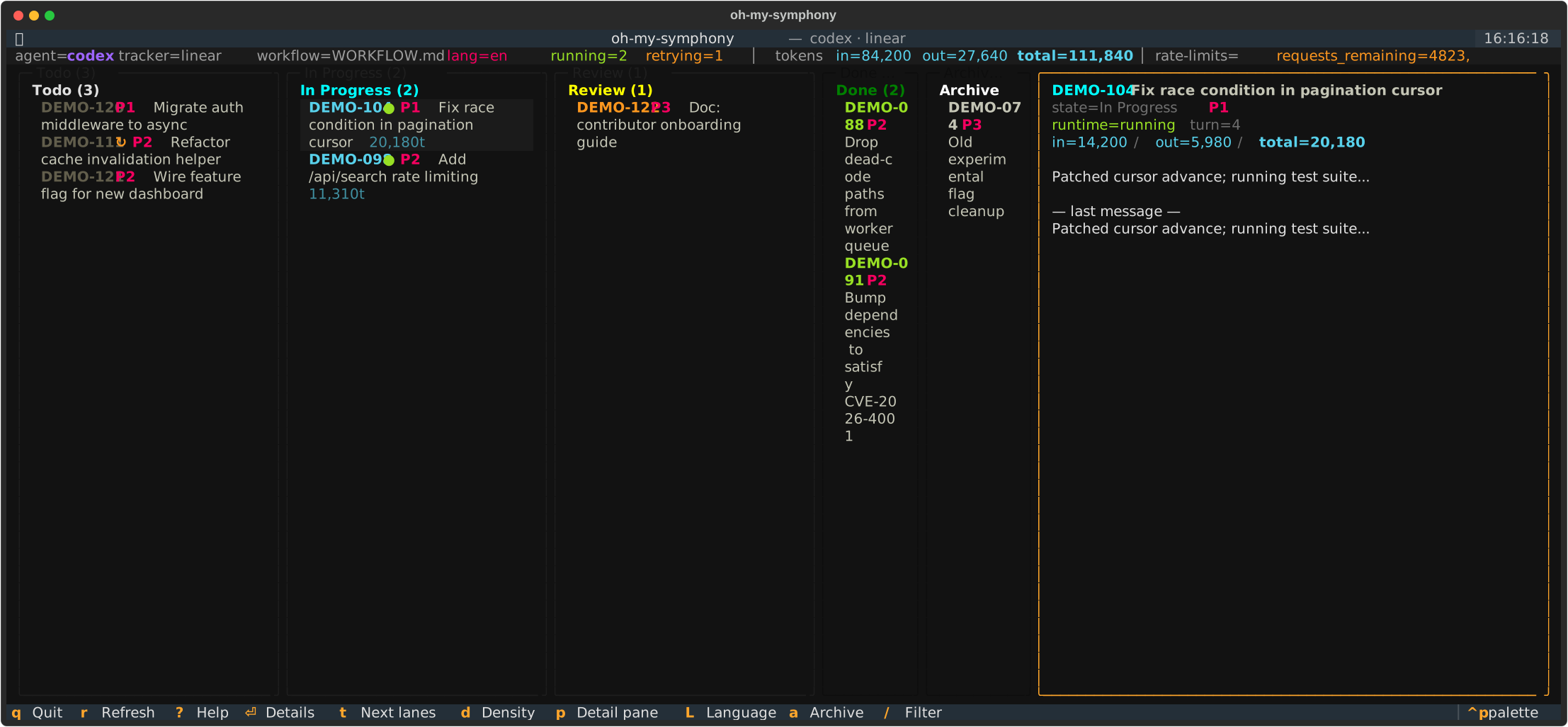
symphony tui ./WORKFLOW.md — columns are your tracker's states; cards show the active agent, turn count, last event, and accumulated tokens. Live indicators: ● running, ↻ retry queued, ✓ done.
Stop juggling AI coding CLIs. Symphony hands each Kanban ticket to the
agent you want, runs them concurrently in isolated git worktree workspaces,
and shows live progress — turn counts, token usage, rate-limit headroom — in
a Jira-style TUI you never have to leave your terminal for.
Try it in 60 seconds, no AI CLI required →
Why Symphony?
- No vendor lock-in. Swap Codex ↔ Claude Code ↔ Gemini ↔ Pi with one
YAML line, or mix backends per ticket. New agents (Ollama, local models,
anything with a CLI) drop in behind a thinAgentBackendProtocol — four
steps, no orchestrator changes. - See what your agents are actually doing. Live Kanban shows turn count,
last event, accumulated tokens, and rate-limit headroom for every running
card. No more "is it stuck or just thinking?" — and no SaaS dashboard to
log into. - Run dozens of tickets in parallel, unattended. Concurrency is built in:
every ticket gets its owngit worktreeworkspace, so agents can't step on
each other. Headless mode mirrors progress to a Markdown file you cantail -Fin any editor; macOS keep-awake stops the lock screen from
killing overnight pipelines. - No SaaS, no API key, no signup to try. File-based Markdown Kanban
means tickets live ingitnext to your code. Linear is supported as a
drop-in tracker; you don't need it. - Battle-tested core. Forked from
OpenAI's official Symphony reference implementation.
The orchestrator, scheduler, retry policy, workspace lifecycle, and prompt
renderer are all upstream — this fork is a thin layer that adds the four
backends and the TUI. - Operator-grade tooling out of the box.
symphony doctorcatches the
five most common first-run failures (port collisions, missing CLIs,
placeholder URLs, unwritable workspaces) in one pass.symphony service start/stop/restart/logsruns the orchestrator as a managed background
service. A web viewer adds Pause / Resume for running cards and a real
branch-picker for feature / merge branches.
Who is this for?
- Solo devs running unattended overnight refactors across dozens of
tickets while they sleep. - Teams parallelizing bug fixes, doc updates, or migration tickets across
multiple coding agents simultaneously. - Researchers and reviewers comparing how Codex, Claude Code, Gemini, and
Pi tackle the same task side by side, with identical prompts and
workspaces. - Anyone who hit the "one chat window per agent" ceiling and wants a
real orchestrator with a Kanban they can read at a glance.
How it works
Plain-text version of the TUI (for terminals viewing raw README) agent=codex tracker=linear workflow=WORKFLOW.md lang=en running=2 retrying=1 │ tokens in=84,200 out=27,640 total=111,840
│ rate-limits=requests_remaining=4823, tokens_remaining=1.2M
╭── Todo (3) ──────╮ ╭── In Progress (2) ──╮ ╭── Review (1) ──╮ ╭── Done (2) ──╮ ╭── Archive (1) ──╮ ╭── detail ───────────────────────╮
│ DEMO-120 P1 │ │ DEMO-104 ● P1 │ │ DEMO-122 P3 │ │ DEMO-088 │ │ DEMO-074 │ │ DEMO-104 │
│ Migrate auth … │ │ Fix race condi… │ │ Doc: contri… │ │ Drop dead-… │ │ Old experim… │ │ Fix race condition in pagina… │
│ #backend … │ │ turn 4 20,180t │ │ #docs │ │ DEMO-091 │ │ │ │ │
│ │ │ Patched cursor… │ ╰────────────────╯ │ Bump deps… │ ╰─────────────────╯ │ state=In Progress │
│ DEMO-111 ↻ P2 │ │ │ ╰──────────────╯ │ runtime=running │
│ Refactor cach… │ │ DEMO-098 ● P2 │ │ turn=4 │
│ retry #2 tur… │ │ Add /api/sear… │ │ in=14,200 out=5,980 │
│ │ │ turn 2 11,310t │ │ total=20,180 │
│ DEMO-121 P2 │ │ Added token-bu… │ │ Patched cursor advance; │
│ Wire feature … │ ╰─────────────────────╯ │ running test suite... │
│ blocked by D… │ ╰─────────────────────────────────╯
╰──────────────────╯
q quit · r refresh · enter details · 1-9 zoom lane · t/T page lanes · d density · p detail-pane · L language · a archive · / filter · ?
A multi-agent fork of OpenAI's Symphony reference implementation.
Upstream polls a tracker (Linear or a local Markdown Kanban) and runs a Codex
session inside a per-issue workspace. This fork keeps that orchestrator and
adds:
- A pluggable AgentBackend layer with four concrete adapters:
- Codex —
codex app-server(JSON-RPC stdio, multi-turn) — original - Claude Code —
claude -p --output-format stream-json --verbose
(NDJSON events, per-turn subprocess with--resume) - Gemini —
gemini -p ""(one-shot per turn, stdin prompt → stdout result) - Pi —
pi --mode json -p ""(JSONL events, per-turn subprocess with--sessionresume; supports Anthropic / OpenAI / Gemini / Bedrock backends
under one CLI — see pi.dev)
- Codex —
- A Jira-style CLI Kanban TUI built on Textual
that replaces the upstream server-rendered HTML dashboard. Columns are
tracker states; cards show the active agent, turn count, last event, and
accumulated tokens. Cards are focusable, the mouse wheel scrolls each lane,
and pressingenteron a card opens a full-detail modal.
The orchestrator, scheduler, retry policy, workspace manager, tracker layer,
and prompt renderer are unchanged from upstream — this fork is a thin layer
on top of a battle-tested orchestrator core.
Pick an agent
Set agent.kind in your WORKFLOW.md:
agent:
  kind: claude          # codex | claude | gemini | pi

claude:
  command: claude -p --output-format stream-json --verbose
  resume_across_turns: true
  turn_timeout_ms: 3600000

pi:
  command: pi --mode json -p ""
  resume_across_turns: true
  turn_timeout_ms: 3600000
Each backend reads its own block (codex, claude, gemini, pi); only the
one matching agent.kind is used at runtime. The Codex linear_graphql
client tool is only advertised when agent.kind=codex.
agent.kind is the global default. A file-board ticket can opt into a
different backend by adding ticket frontmatter:
agent:
  kind: codex
The flat alias agent_kind: codex is also accepted for hand-edited cards.
All backend command and timeout settings still come from the matching globalcodex:, claude:, gemini:, or pi: block in WORKFLOW.md.
When creating file-board tickets from the CLI, usesymphony board new TASK-2 "title" --agent-kind codex.
For file-board workflows, agent.auto_triage_actionable_todo defaults totrue: a Todo ticket with a body and an Acceptance Criteria section moves to
Explore with a one-line ## Triage note without spending a model turn. Bug
tickets, blocked tickets, ambiguous tickets, and Linear trackers still use the
Todo prompt.
Install
python3 -m venv .venv
source .venv/bin/activate
pip install -e ".[dev]"
Make the relevant CLI available on $PATH:
agent.kind |
required CLI on $PATH |
|---|---|
codex |
codex (with app-server subcommand) |
claude |
claude (Claude Code) |
gemini |
gemini (Gemini CLI) |
pi |
pi (Pi coding-agent — npm i -g @earendil-works/pi-coding-agent or curl -fsSL https://pi.dev/install.sh | sh; sign in once via pi → /login (OAuth, credentials cached at ~/.pi/agent/auth.json) — no env var needed) |
Try it in 60 seconds (no agent CLI required)
Want to see the TUI move cards around before installing codex, claude,
or gemini? Use the bundled mock backend — it speaks the same JSON-RPC
protocol as Codex but does no real work, just simulates turns and emits
token-usage ticks.
git clone https://github.com/cskwork/oh-my-symphony.git
cd oh-my-symphony
python3 -m venv .venv && source .venv/bin/activate
pip install -e ".[dev]"

# WORKFLOW.md pointed at the mock backend
cat > WORKFLOW.md <<'YAML'
---
tracker: { kind: file, board_root: ./kanban,
           active_states: [Todo, "In Progress"],
           terminal_states: [Done, Cancelled, Blocked] }
polling: { interval_ms: 5000 }
workspace: { root: ~/symphony_workspaces }
hooks:
  after_create: ": noop"
  before_run:   ": noop"
  after_run:    "echo done"
agent:  { kind: codex, max_concurrent_agents: 1, max_turns: 3, max_total_turns: 60 }
codex:  { command: python -m symphony.mock_codex }
server: { port: 9999 }
---
You are picking up ticket {{ issue.identifier }}: {{ issue.title }}.
YAML

symphony board init ./kanban
symphony board new TASK-1 "smoke test"
symphony tui ./WORKFLOW.md
Within ~5 seconds TASK-1 grows a green ● indicator in the Todo column,
with a turn counter and token totals climbing. Quit with Ctrl-C when
you've seen enough; then proceed to the real walkthrough below.
Cards stay in their original column under the mock — only a real agent
would rewritekanban/TASK-1.mdto move the card to Done. The mock
exists to prove the orchestrator → backend → workspace → hooks pipeline
end-to-end without an LLM call.
Tunables for the mock:
SYMPHONY_MOCK_TURN_SECONDS=12,SYMPHONY_MOCK_FAIL_EVERY_N_TURNS=3, etc. — seesrc/symphony/mock_codex.py.
Preflight — symphony doctor
Before launching, sanity-check your setup:
symphony doctor ./WORKFLOW.md
Output (one line per check):
PASS  server.port=9999              127.0.0.1:9999 is free
PASS  agent.kind=claude             claude → /usr/local/bin/claude
FAIL  hooks.after_create            contains placeholder 'my-org/my-repo' — every dispatch will fail with rc=128. Switch to the worktree default or replace with a real clone / `: noop`.
PASS  workspace.root=~/symphony_workspaces  exists and is writable
PASS  tracker.board_root            ./kanban (3 tickets)
Exit code is 0 when all checks pass, 1 if any FAIL, 2 if WORKFLOW.md
itself can't be loaded. The doctor catches the most common first-run
failures in one pass: port collision, missing CLI on $PATH, the shipped
placeholder clone URL, unwritable workspace, missing board directory.
Quickstart — your first task end-to-end
This walks from a clean clone to a running ticket, using the file-based
tracker and Claude Code as the agent.
1. Initialize the board
symphony board init ./kanban
# → initialized board at ./kanban, sample ticket DEMO-001.md
Each ticket is one Markdown file with YAML frontmatter at kanban/<ID>.md.
The orchestrator only reads ticket files; the agent writes them when
it transitions state.
2. Author WORKFLOW.md
Use the file-tracker example (the other one, WORKFLOW.example.md,
points at Linear and needs an API key):
cp WORKFLOW.file.example.md WORKFLOW.md
Four blocks matter for first-run sanity:
tracker:
  kind: file
  board_root: ./kanban
  active_states: [Todo, "In Progress"]
  terminal_states: [Done, Cancelled, Blocked]

workspace:
  root: ~/symphony_workspaces

hooks:
  # Each ticket gets its own workspace at workspace.root/<ID>.
  # The shipped default attaches it as a `git worktree` of the host repo
  # on a `symphony/<ID>` branch — host working tree stays untouched.
  # Use `: noop` instead while you experiment without a host repo.
  after_create: |
    : noop                       # ← swap for the worktree default in WORKFLOW.file.example.md
  before_run: |
    : noop                       # runs before every agent turn
  after_run: |
    echo "run finished at $(date)"

prompts:
  # Symphony sends base plus only the file for the ticket's current state.
  base: ./docs/symphony-prompts/file/base.md
  stages:
    Todo: ./docs/symphony-prompts/file/stages/todo.md
    "In Progress": ./docs/symphony-prompts/file/stages/in-progress.md
⚠ The shipped
WORKFLOW.example.md/WORKFLOW.file.example.mddefault to
attaching the per-ticket workspace as a git worktree of the host repo
(the directory containingWORKFLOW.md) on asymphony/<ID>branch. The
host working tree is never disturbed; merge results back withgit -C <host> merge symphony/<ID>(or open a PR from that branch) when
you're satisfied — explicit operator action, never automatic.If your code lives in a different remote than the WORKFLOW.md repo,
swap the hook forgit clone <remote> .instead. While experimenting
without any repo, use: noop.
3. Add a ticket
symphony board new TASK-1 "Fix flaky pagination test" \
  --priority 2 \
  --labels backend,test \
  --description "tests/test_pagination.py::test_cursor_advance is flaky on CI."
# → created kanban/TASK-1.md
Inspect:
symphony board ls                    # all tickets
symphony board ls --state Todo       # filter by state
symphony board show TASK-1           # full body
4. Launch the TUI
symphony tui ./WORKFLOW.md
Within one poll tick (polling.interval_ms, default 30s) the orchestrator
dispatches a worker, the card grows a green ● indicator (with turn counter
and token totals), and the agent runs. On success the agent rewriteskanban/TASK-1.md to set state: Done and append a ## Resolution
section — that file edit is what moves the card from the Todo column
into Done. Quit with Ctrl-C.
Cards are placed in columns based on the ticket file's
statefield
(tui.pyreads it on each tick). The green ● indicator is overlaid on
top of the card and does not change which column it sits in. So a
running ticket stays in Todo until the agent itself rewrites the
file — that's by design (the orchestrator only reads ticket files; the
agent owns writes).
The TUI needs a real terminal (TTY). If you launch it from a script /
background process / non-interactive shell, the process exits silently —
always run it in a foreground terminal.
4b. Headless mode + WORKFLOW-PROGRESS.md
Drop tui to run the orchestrator without opening the Kanban UI:
symphony ./WORKFLOW.md                  # headless; progress mirror auto-on
symphony ./WORKFLOW.md --no-progress-md # headless; no progress file
A live WORKFLOW-PROGRESS.md is rewritten next to your workflow file on
every tick (default ~30s) and on every state change in between. Open it
in your editor to follow along without a TTY:
# Symphony Progress
_Updated: 2026-05-16 14:22:31 UTC_

## Kanban
| State        | Tickets |
|--------------|---------|
| Todo         | OLV-005, OLV-006 |
| In Progress  | OLV-002 (8m12s · 12k tok) |
| Review       | OLV-001 |
| Done         | OLV-003, OLV-004 |

## Recent transitions
- `2026-05-16 14:22:31Z`  **OLV-002**  Todo → In Progress
- `2026-05-16 14:18:04Z`  **OLV-001**  In Progress → Review
Override location or limits via WORKFLOW.md frontmatter (or --progress-md-path):
progress:
  enabled: true                     # default true; CLI --no-progress-md wins
  path: docs/STATUS.md              # default: WORKFLOW-PROGRESS.md beside WORKFLOW.md
  max_transitions: 20               # how many recent transitions to keep
The mirror is read-only output — Symphony rewrites the file atomically;
do not edit it by hand.
macOS keep-awake
While a run is active, Symphony holds a wake-lock on macOS so the screen
saver / lock screen cannot interrupt a long unattended pipeline (the
process itself is fine either way, but a locked display blocks operator
attention and many auto-suspend policies). Disable per run with--no-keep-awake, or persist in WORKFLOW.md:
system:
  keep_awake: false   # default true; CLI --no-keep-awake also wins
Non-macOS hosts log keep_awake_skipped and continue without a wake-lock.
Slack notifications (optional)
Opt in by setting a Slack incoming-webhook URL. With the block below inWORKFLOW.md, Symphony posts one message per tracker state transition.
Omit the block and nothing is sent — the feature is fully off by default.
notifications:
  slack:
    webhook_url: $SLACK_WEBHOOK_URL    # required; $VAR resolved at load time
    enabled: true                       # default true when webhook is set
    notify_on_states: []                # empty = every transition; or e.g. [Done, Blocked]
    templates:                          # optional per-state overrides
      Done: "✅ ${identifier} ${title} (${workflow})"
      Blocked: "🚧 ${identifier} blocked — ${title}"
    username: Symphony
    icon_emoji: ":robot_face:"
    timeout_ms: 5000
Template placeholders: ${identifier} ${title} ${prev_state}${next_state} ${workflow} ${reason}. Bad templates render the unknown
key literally — they never raise. Network errors are caught and logged
(slack_notify_network_error) so a Slack outage cannot block the
orchestrator's transition path.
5. Inspect the result
symphony board show TASK-1               # the agent's ## Resolution lives in the body
ls ~/symphony_workspaces/TASK-1          # workspace it operated in
Symphony writes structured logs to stderr only. To keep them around,
redirect at launch:
mkdir -p log
symphony tui ./WORKFLOW.md 2>> log/symphony.log
# or, while running headless:
symphony ./WORKFLOW.md --port 9999 2>&1 | tee -a log/symphony.log
Then tail -F log/symphony.log works.
6. Move tickets manually (rare)
symphony board mv TASK-1 Blocked # forces a state transition
The orchestrator re-evaluates on the next poll tick. Manual transitions are
for unsticking — normally the agent transitions tickets itself per the
stage-specific prompt files configured by WORKFLOW.md.
How dispatch works in one diagram
┌────────────┐    poll      ┌──────────────┐    matches active_states
│  kanban/   │  ─────────▶  │ Orchestrator │  ─────────────────────────┐
│  *.md      │   30s tick   │ (scheduler)  │                            │
└────────────┘              └──────────────┘                            ▼
      ▲                            │                          ┌──────────────────┐
      │                            │ creates workspace        │  Workspace       │
      │ agent writes               ▼                          │  ~/sym…/TASK-1   │
      │ ## Resolution     ┌──────────────────┐                │  + after_create  │
      │ + state: Done     │  AgentBackend    │  ◀────────────│    hook ran      │
      └───────────────────│  (codex/claude/  │                └──────────────────┘
                          │   gemini)        │                          │
                          │  per-turn loop   │  before_run hook ──▶ turn(s)
                          └──────────────────┘                          │
                                                                        ▼
                                                                  after_run hook
Per-ticket artefacts
Every artefact a ticket produces lives under docs/<TICKET-ID>/<stage>/. See docs/PIPELINE.md for the layout, what to commit, and the ${LLM_WIKI_PATH:-./docs/llm-wiki}/ carve-out.
Custom prompts
WORKFLOW.md can point at editable prompt files under docs/:
prompts:
  base: ./docs/symphony-prompts/file/base.md
  stages:
    Todo: ./docs/symphony-prompts/file/stages/todo.md
    Explore: ./docs/symphony-prompts/file/stages/explore.md
    Plan: ./docs/symphony-prompts/file/stages/plan.md
    "In Progress": ./docs/symphony-prompts/file/stages/in-progress.md
Symphony sends base plus only the prompt file for the ticket's current
state, keeping each turn smaller than the old all-stage prompt. If theprompts block is absent, the inline body of WORKFLOW.md still works as
the legacy fallback.
Run
Background service + JSON API
symphony ./WORKFLOW.md --port 9999
JSON API endpoints (unchanged from upstream):
| Method | Path | Purpose |
|---|---|---|
| GET | /api/v1/state |
Snapshot — running, retrying, totals, limits |
| GET | /api/v1/<identifier> |
Issue detail (404 with structured error) |
| POST | /api/v1/refresh |
Coalesced trigger of poll + reconcile |
The HTML dashboard at / from upstream has been removed in this fork; the
primary UI is the CLI Kanban below.
CLI Kanban TUI (primary UI)
symphony tui ./WORKFLOW.md
# equivalent
symphony ./WORKFLOW.md --tui
Recommended default: TUI + JSON API together
The TUI is the primary operator view and the JSON API is the
programmatic / curl-friendly view. Run both in one process by pinningserver.port in WORKFLOW.md and launching with --tui
(tools/board-viewer/ remains available as an optional in-browser
kanban, see below):
# WORKFLOW.md
server: { port: 8765 }
symphony --tui ./WORKFLOW.md
# kanban renders in the terminal, JSON API listens on 127.0.0.1:8765
curl -s http://127.0.0.1:8765/api/v1/state | jq
Use --port N on the CLI to override the workflow value, or drop theserver block to disable the HTTP API entirely.
Columns are tracker states (active_states first, then terminal_states).
Cards display issue identifier + title, priority, labels (or blockers), and a
runtime indicator:
- ● green — currently running, shows
turn N, last event, accumulated tokens - ↻ yellow — in retry queue, shows
retry #Nand the last error - ✓ green — completed in this session
Key bindings (also auto-listed in the footer):
| Key | Action |
|---|---|
q |
Quit (drains active workers cleanly) |
r |
Force a refresh + re-poll the tracker |
? |
Show all key bindings as a notification |
tab / shift+tab |
Move focus to next / previous card or lane |
j / ↓ |
Scroll focused lane down one row |
k / ↑ |
Scroll focused lane up one row |
space / pgdn |
Page down |
b / pgup |
Page up |
g / home |
Jump to top |
G / end |
Jump to bottom |
enter |
Open the focused card's full-detail modal |
esc / q |
Close the modal (when one is open) |
Mouse: clicking a card focuses it, the wheel scrolls its lane.
Managed background service
For day-to-day operation, prefer the built-in service command over ad-hoc
shell jobs. It records the workflow it started under.symphony/run/<workflow-hash>.json, so the same WORKFLOW.md cannot be
started again on a second port by accident:
symphony service start ./WORKFLOW.md --port 9999 --viewer-port 8765
symphony service status ./WORKFLOW.md
symphony service restart ./WORKFLOW.md
symphony service stop ./WORKFLOW.md
symphony service logs ./WORKFLOW.md
service start runs symphony doctor before spawning, starts the
orchestrator with Python's module runner, and starts tools/board-viewer/
when that folder exists. Commands are launched without a shell, so the same
path works on macOS, Linux, and Windows.
Since v0.4.7, the board viewer (default --viewer-port 8765) is no longer
read-only: running cards surface Pause / Resume buttons and the header
refresh button triggers an orchestrator poll + reconcile. The header also
shows real local git branch dropdowns for agent.feature_base_branch andagent.auto_merge_target_branch, so operators can choose where new feature
branches start and where Learn merges land without editing YAML by hand.
One-shot launchers
For developers who don't want to remember the full symphony tui invocation,
the repo ships two launcher scripts that prefer .venv/bin/symphony overPATH, run symphony doctor first, then open the TUI in a new terminal
window:
./tui-open.sh                     # macOS / Linux — uses iTerm or Terminal.app
./tui-open.sh path/to/WORKFLOW.md # explicit workflow path
tui-open.bat                      # Windows — uses cmd /k
Both scripts abort the launch if doctor reports a FAIL so you do not paint
the alt-screen on top of unreadable preflight output.
File-based Kanban tracker
If you don't have Linear, use the local Markdown-file tracker (unchanged from
upstream):
tracker:
  kind: file
  board_root: ./kanban
symphony board init ./kanban
symphony board new DEV-1 "Title" --priority 2
symphony tui ./WORKFLOW.md
Layout
src/symphony/
  backends/
    __init__.py        AgentBackend Protocol + factory + normalized events
    codex.py           Codex JSON-RPC stdio backend (was upstream agent.py)
    claude_code.py     Claude Code stream-json backend
    gemini.py          Gemini one-shot backend
    pi.py              Pi --mode json backend (per-turn subprocess, --session resume)
  trackers/
    __init__.py        TrackerClient Protocol + factory
    file.py            FileBoardTracker (Markdown ticket files)
    linear.py          LinearClient (Linear GraphQL)
  cli/
    __init__.py        re-exports `main` for the `symphony` console_script
    __main__.py        keeps `python -m symphony.cli ...` working for service.py
    main.py            root dispatch + `symphony [WORKFLOW]`
    board.py           `symphony board ...` file-tracker helper
    doctor.py          `symphony doctor` WORKFLOW.md preflight checks
  utils/
    archive.py         auto-archive selector
    auto_merge.py      symphony/<ID> branch → host repo merge
    keep_awake.py      macOS caffeinate wrapper (no-op on other platforms)
    wiki_sweep.py      Learn-prompt wiki integrity sweep
  agent.py             back-compat shim re-exporting backends.* symbols
  workflow.py          typed config — adds AgentConfig.kind + Claude/Gemini/Pi configs
  orchestrator.py      scheduler; uses build_backend() + build_tracker_client() factories
  tui.py               Textual Kanban TUI (replaces server.py dashboard)
  server.py            JSON API only (HTML root removed)
  service.py           `symphony service` background lifecycle
  mock_codex.py        runnable via `python -m symphony.mock_codex` for demos/tests
tui-open.sh            cross-platform launcher (macOS / Linux): doctor preflight + open TUI in a new terminal window
tui-open.bat           Windows equivalent
Tests
pytest -q
The test suite covers the upstream conformance suite, backend unit tests for
the factory, event normalization, Claude / Pi usage accumulation, Gemini
session synthesis, and Pi failure-reason detection, plus TextualPilot-driven smoke tests for the TUI app. Subprocess-driven integration
tests against real CLIs are intentionally not in CI — run them locally.
Design notes
Why four different lifecycles behind one Protocol?
- Codex opens one
app-serversubprocess per issue and speaks the
currentcodex app-serverJSON-RPC protocol (initialize+thread/startturn/start+ streamedturn/completedanditem/completed
notifications). Multi-turn within one process. Olderv2/initialize-style
releases are not supported — pin tocodex-cli ≥ 0.39(current upstream).
- Claude Code has no persistent server; sessions are tracked by ID. Each
run_turnspawns a freshclaude -pand uses--resume <session-id>from
turn 2 onward. - Gemini CLI is one-shot per invocation with no native session model.
Each turn is independent; we synthesize agemini-<uuid>session id so the
orchestrator's bookkeeping stays consistent. - Pi has no persistent server but auto-saves sessions to
~/.pi/agent/sessions/. Eachrun_turnspawns a freshpi --mode jsonand
passes--session <id>from turn 2 onward. The session id is read from the
first{"type":"session"}JSONL line; per-messageusageis accumulated
offmessage_endevents, andagent_endis treated as the terminal event.
Auth is delegated to Pi: the OAuth/API-key store at~/.pi/agent/auth.json
populated by/loginis inherited by the subprocess, so Symphony itself
never handles credentials.
The AgentBackend Protocol hides these differences. The orchestrator only
sees normalized events (session_started, turn_completed, turn_failed,
…) and the latest usage / rate-limit snapshots.
What the TUI does and does not do
The board is observer-only: cards move when the agent rewrites the underlying
ticket file (file tracker) or transitions the issue (Linear), never as a
direct UI action. That matches the upstream design philosophy — the
orchestrator is the source of truth and the UI is a thin reflection.
What you can do interactively:
- Focus any card with
tab/shift+tabor by clicking it. - Scroll a lane with the mouse wheel,
j/k, or page keys. - Open a focused card's full description in a modal with
enter.
What is intentionally out of scope:
- No card drag-drop. Move tickets via
symphony board mv ID State
(file tracker) or in your tracker UI directly. - No agent-output log pane. Agent stdout/stderr goes to the structured
log; tail it withtail -F log/symphony.login a side terminal. - No write actions to the tracker beyond what the agent does itself.
What is not implemented
Inherited from upstream:
- SSH worker extension — single-host only.
- Persistent retry queue across process restarts.
- Tracker adapters beyond Linear and the file-based Kanban.
- First-class tracker write APIs in the orchestrator. Ticket writes still
happen through the agent (linear_graphqlfor Codex, direct file edits for
the file-based Kanban).
Fork-specific gaps:
- Claude Code's mid-turn streaming usage events are read but not surfaced;
the terminalresultevent is the source of truth for token totals. - Gemini token usage is not reported by the CLI in stable form, so totals
stay at zero for that backend. - Multi-turn continuity for Gemini is not supported (no session protocol
exists in the CLI). Eachrun_turnis independent.
Contributing
PRs welcome. External contributions should target dev by default; see
CONTRIBUTING.md and the PR template for the full review
checklist. Before opening one:
pip install -e ".[dev]"
pytest -q          # must stay green
Backend adapters live under src/symphony/backends/. Adding a new agent
(e.g. an Ollama-driven local model) means:
- implementing the
AgentBackendProtocol in a new module, - registering it in
build_backend()(src/symphony/backends/__init__.py), - adding a
<kind>Configdataclass toworkflow.pyand threading it
throughbuild_service_config+validate_for_dispatch, - extending
SUPPORTED_AGENT_KINDS.
The bar for upstreaming a backend is: passes the existing factory + event
normalization tests, doesn't bleed protocol-specific types into the
orchestrator, and ships a default <kind> block in WORKFLOW.example.md.
Acknowledgements
This project is built on top of OpenAI's
Symphony reference implementation. The
upstream Apache-2.0 licensed work provides the orchestrator, the scheduler,
and the workspace lifecycle that make this fork possible. See NOTICE for
attribution details.
The TUI is built on Will McGugan's Textual
framework, with rich used directly for
text styling inside cards.
Pipeline stage rules adapt the evidence-first ideas of cskwork/backend-dev-skills (MIT).
License
Reviews (0)
Sign in to leave a review.
Leave a reviewNo results found