flow-crew
Health Uyari
- License — License: MIT
- Description — Repository has a description
- Active repo — Last push 0 days ago
- Low visibility — Only 5 GitHub stars
Code Gecti
- Code scan — Scanned 12 files during light audit, no dangerous patterns found
Permissions Gecti
- Permissions — No dangerous permissions requested
Bu listing icin henuz AI raporu yok.
Ship a brief, walk away. FlowCrew orchestrates a planner, parallel coders, and QA gates on top of Claude Code or Codex — with campaign memory that learns across
FlowCrew
The orchestration layer for AI work that should not fit in one chat.
Plan in Claude Code. Ship through Codex. Verify with QA gates. Preserve what every run learned.





flowcrew quick "fix the checkout race condition and prove it with a regression test"
FlowCrew turns a task brief into a supervised team of agents: planner, coder, researcher, reviewer, QA, and supervisor. It is built for work that needs retries, evidence, long-running execution, and memory across attempts.
It is not just a prompt runner. FlowCrew gives your AI workflow a run state, a dashboard, deterministic reality checks, and a knowledge graph of decisions, findings, results, and dead ends.
Highlights
| Highlight | What It Gives You |
|---|---|
| Claude Code planning -> Codex execution | Discuss the plan conversationally, then use /ship to dispatch the confirmed work to FlowCrew's Codex-default backend. |
| Planner-generated DAG | The planner turns a brief into explicit stages with dependencies, gates, and retries. |
| QA gate retry loop | Failed gates trigger targeted fix stages and re-checks instead of asking you to babysit the run. |
| Backend-driven supervisor | A configurable observer reads stage output and run state, then guides, aborts, replans, or detects completion. |
| Run Memory Graph | Goals, approaches, findings, insights, results, user hints, and dead ends stay attached to the run. |
| Campaign intelligence | Related runs share metrics and failure history so future attempts can pivot instead of repeat. |
| Reality-Gate | Deterministic checks block fabricated or unsupported terminal success. |
| Dashboard + CLI + skills | Use the interface that fits the moment: /ship, terminal, or browser dashboard. |
The Recommended Loop
FlowCrew works best as the execution layer behind your interactive coding agent:
1. Discuss scope, constraints, and acceptance criteria in Claude Code.
2. Type /ship.
3. FlowCrew creates a task brief and dispatches it to Codex by default.
4. Agents plan, execute, verify, retry, and summarize.
5. You inspect the dashboard, run summary, artifacts, and knowledge graph.
Why this pairing works: Claude Code is strong for collaborative plan shaping, while Codex is the default FlowCrew execution backend and is often the better fit for long multi-agent sub-runs when your Codex subscription has more generous execution budget.
Install the skills once:
./skills/install.sh
Then ship from the conversation:
> Split auth into token validation and session management.
> Keep the public API compatible and add focused regression tests.
> /ship
From Brief To Verified Run
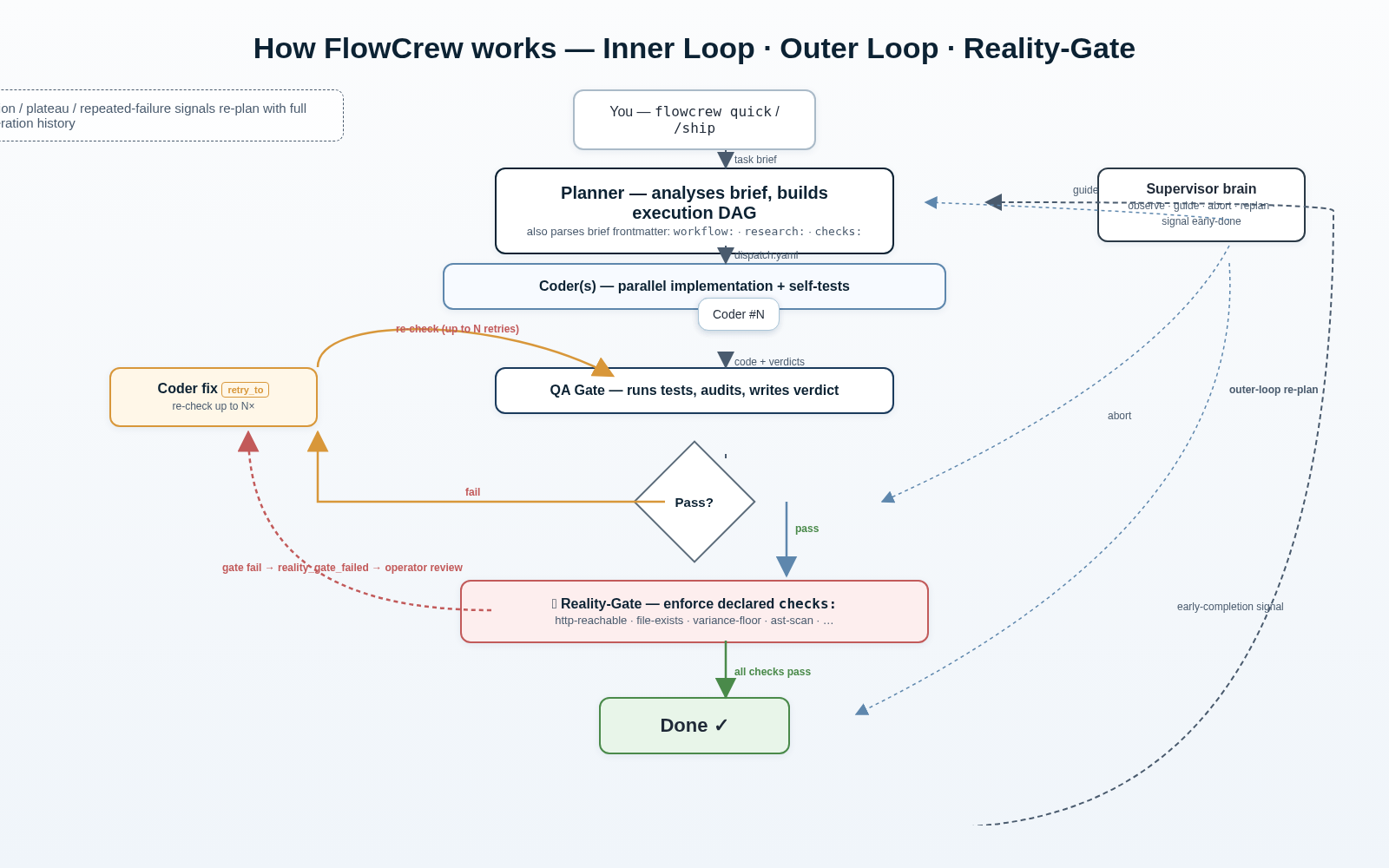
The important boundary: the supervisor steers, but it does not edit files or run commands directly. Work happens in worker stages; evidence is checked by gates and Reality-Gate.
Why It Is Different
| One-shot agent | FlowCrew |
|---|---|
| Best effort answer | Auditable run with state, artifacts, verdicts, and summary |
| One context window | Persistent run memory and campaign history |
| Manual retry after failure | Gate -> fix -> re-gate loop |
| "Looks done" | Deterministic evidence checks before terminal success |
| Lost rationale | Knowledge graph of decisions and evidence |
| Single backend assumption | Codex default with Claude/Codex per-role overrides |
Quick Start
npm install
npx flowcrew init
npx flowcrew doctor
Ship directly:
flowcrew quick "fix the failing checkout flow and add a regression test"
Ship from a file or stdin:
flowcrew quick --task "$(cat task.md)" --max-iterations 3 --timeout 600000
echo "audit docs for stale API examples" | flowcrew quick -
Start the dashboard:
npx flowcrew start
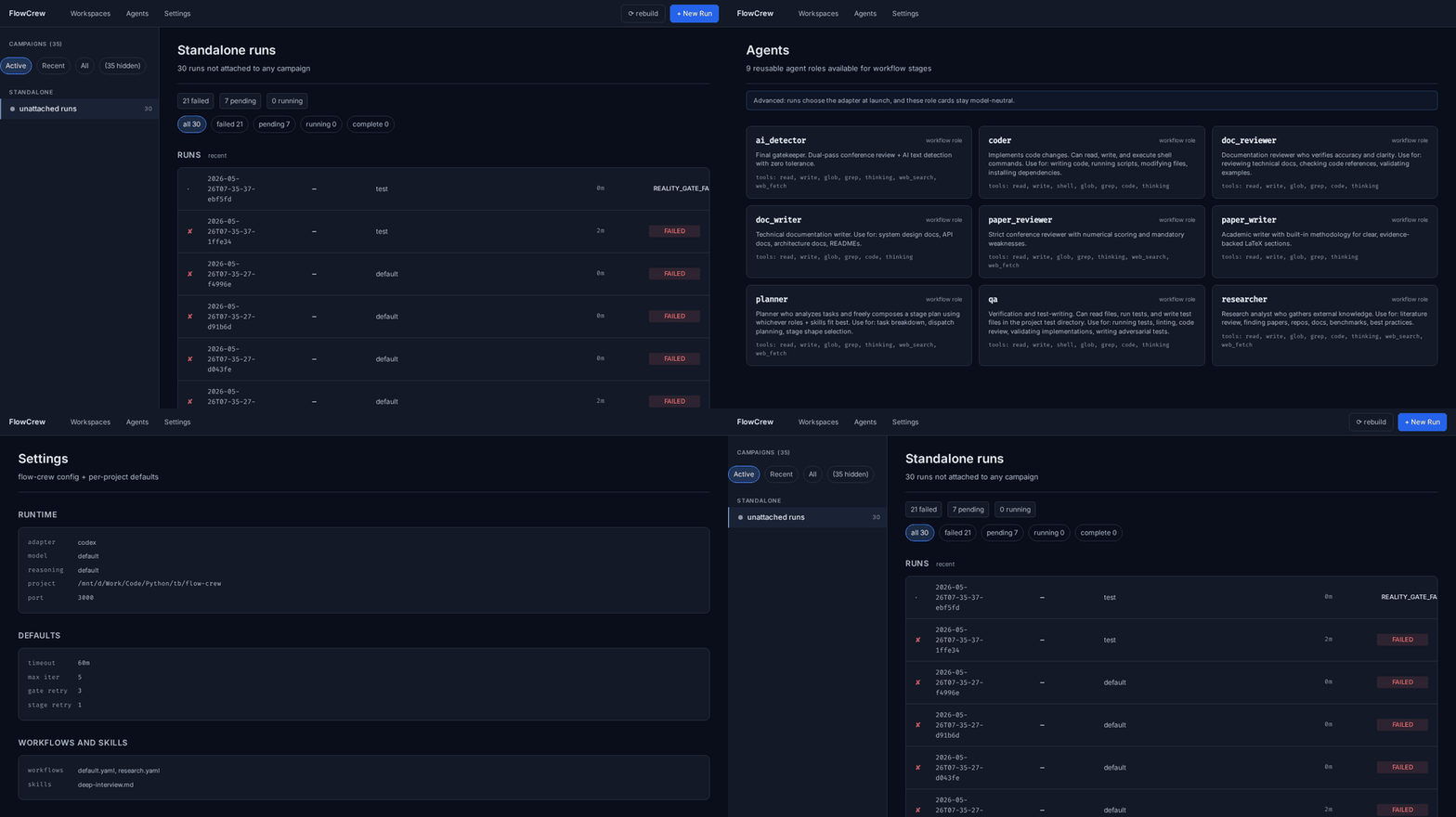
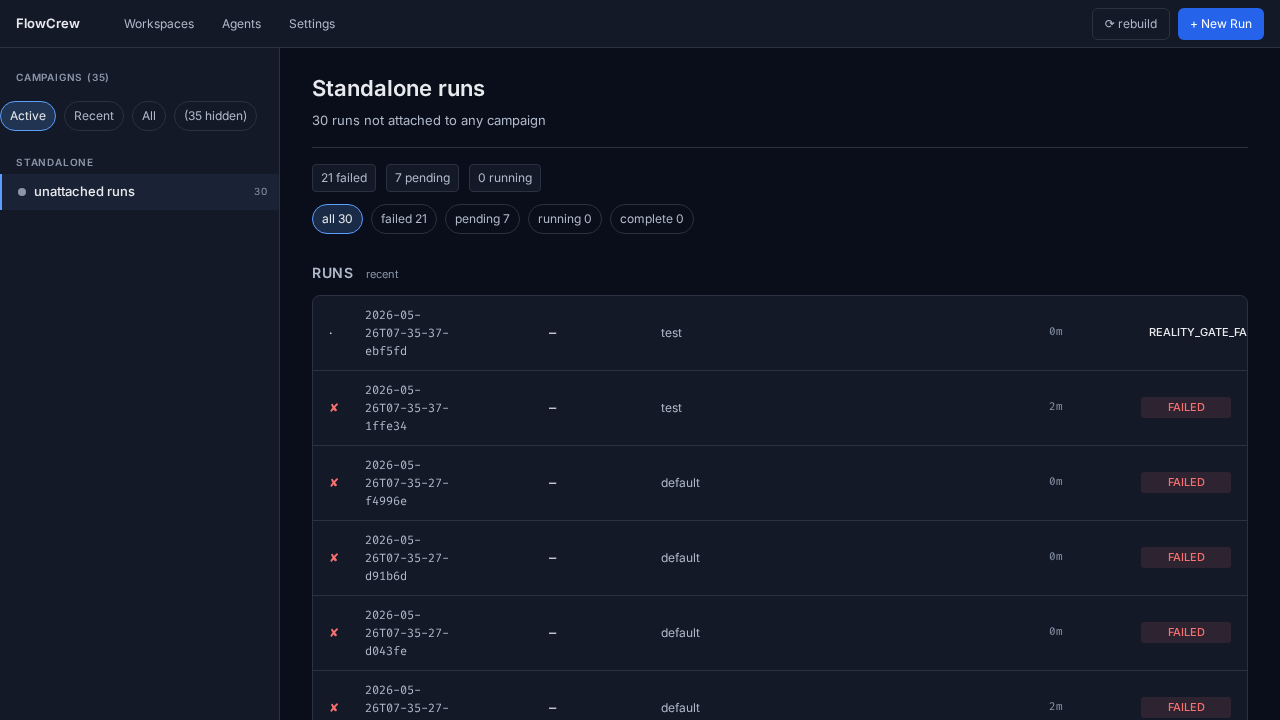
Open http://localhost:3000 to inspect live stages, QA verdicts, artifacts, campaign scores, summaries, and run memory.
What You Can Run
Unknown bug hunt
flowcrew quick --campaign checkout-bug "Find the root cause of an intermittent checkout failure.
Acceptance:
1. Add a reproducer test that fails before the fix.
2. Document the root cause in docs/root_cause_checkout.md.
3. Fix the bug and make the reproducer pass 50 consecutive times.
4. Do not repeat any hypothesis already marked dead_end in the campaign."
Research loop
flowcrew quick --campaign model-eval "Improve src/model.py on data/validation.jsonl.
Baseline: accuracy 0.72. Target: accuracy >= 0.85.
Each iteration tries one new approach, records the metric, and stops after target hit or two non-improving rounds."
Review-gated writing
flowcrew quick "Polish docs/design.md until reviewer score is >= 8/10 on clarity, evidence, and reproducibility.
Never invent citations, never change reported numbers, and only rewrite passages the review gate flags."
Run Memory
FlowCrew records why a run made decisions, not just what files changed.
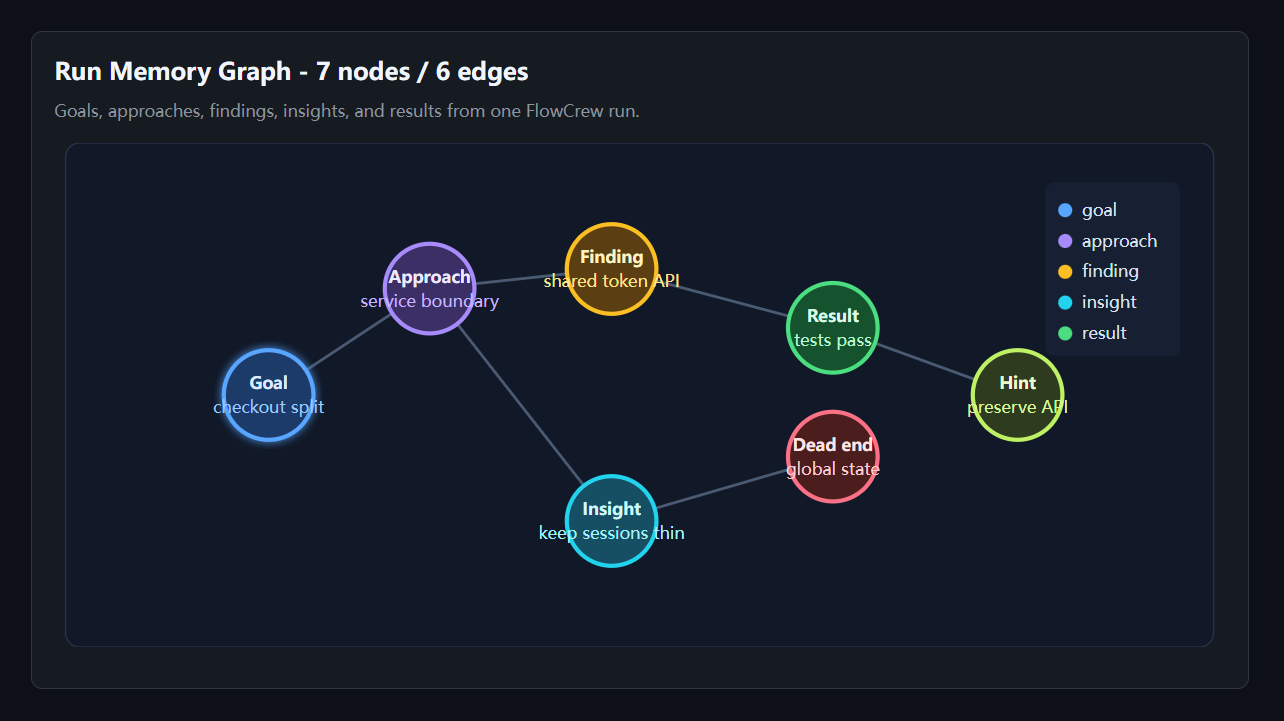
Common node types:
| Type | Meaning |
|---|---|
goal |
The objective being pursued |
approach |
Strategy selected by the planner |
finding |
Evidence discovered during work |
insight |
Reusable lesson from a stage or iteration |
result |
Measured outcome |
dead_end |
Failed direction that future runs should avoid |
user_hint |
Human guidance preserved for future stages |
Configuration
FlowCrew reads config/defaults.yaml. The current default backend is Codex:
default_timeout_ms: 3600000
default_max_iterations: 5
default_gate_retry_loops: 3

adapter: codex
model: default
reasoning_effort: default

supervisor:
  stuck_threshold_ms: 600000
  # Optional: use Claude for higher-level supervision while stages use Codex.
  # adapter: claude
  # model: claude-opus-4-7
  # reasoning_effort: high
Override a single role when useful:
# config/agents/qa.yaml
adapter: claude
model: claude-opus-4-7
reasoning_effort: xhigh
CLI
flowcrew init
flowcrew quick "task"
flowcrew quick "task" --background
flowcrew status
flowcrew list
flowcrew guide "message"
flowcrew start
flowcrew doctor
flowcrew audit-reality
Documentation
- Architecture: scheduler, worker, supervisor, loops, and storage.
- Campaigns and Run Memory: campaigns, plateaus, pivots, and knowledge graph semantics.
- Reality-Gate: deterministic evidence checks before terminal success.
- Configuration: defaults, adapters, per-role overrides, supervisor settings.
- Agent Skills:
/ship,/fc-status, and skill installation. - CLI Reference: command list and common flags.
License
Author
FlowCrew Captain
LinkedIn: Profile
Yorumlar (0)
Yorum birakmak icin giris yap.
Yorum birakSonuc bulunamadi