CONTINUUM
Health Gecti
- License — License: Apache-2.0
- Description — Repository has a description
- Active repo — Last push 0 days ago
- Community trust — 23 GitHub stars
Code Gecti
- Code scan — Scanned 12 files during light audit, no dangerous patterns found
Permissions Gecti
- Permissions — No dangerous permissions requested
Bu listing icin henuz AI raporu yok.
CONTINUUM: Verifiable semantic recovery for long-running AI agents. Semantic checkpoints (not conversation dumps), an idempotent action ledger that refuses duplicate side effects, and a hash-chained tamper-evident event log, all exposed as a deny-by-default MCP server. Framework-agnostic, Python 3.11+.
CONTINUUM: Verifiable semantic recovery for long-running AI agents. Semantic checkpoints (not conversation dumps), an idempotent action ledger that refuses duplicate side effects, and a hash-chained tamper-evident event log, all exposed as a deny-by-default MCP server. Framework-agnostic, Python 3.11+.






Contents
Why · Quick Start · How it works · Features · Security Extension · Empirical Verification · MCP Integration · Framework Integration · Core Concepts · Architecture · API and CLI · Roadmap · What CONTINUUM Is Not · Related work · Status and limitations · Contributing · License
Why
Modern AI agents run long tasks (hundreds of LLM calls, tool invocations, file and database writes). When they crash, the usual response is to replay everything from scratch, which duplicates work, duplicates side effects, wastes tokens, and loses decisions.
CONTINUUM asks a narrower, harder question: can an agent resume from a compact semantic representation of its task state while independently verifying that state is still valid in the current environment? Its differentiator is three-part:
- Semantic checkpoints: a compact, versioned representation of what the agent needs to continue, not a conversation dump.
- Independent environment revalidation: every checkpoint component is verified against the current environment before resume, with staleness propagating through the dependency graph.
- Provenance-aware state: every fact traces to its origin, so agent-reported progress is never self-certifying.
Quick Start
Not published to PyPI yet. Install from a clone. One clone is enough to get the library, CLI, MCP server, and every adapter ready for contribution.
git clone https://github.com/Cyrax321/CONTINUUM.git
cd CONTINUUM

uv venv && source .venv/bin/activate     # macOS / Linux; Windows: .venv\Scripts\activate

# Contributors (recommended): library + CLI + all test tooling + every adapter
uv pip install -e ".[dev]"

# Or pick only what you need: . (minimal), [mcp], [otel], [langgraph],
# [openai], [langchain], [attest], [postgres]
pip fallback: replace
uv pip installwithpip installin every command above.
Verify:
continuum --help                 # CLI entrypoint
continuum-mcp --help             # MCP server entrypoint (needs [mcp] or [dev])
pytest -q                        # ~1,300 passed (exact count and skips vary by environment)
ruff check src/ tests/ examples/ && ruff format --check src/ tests/ examples/
mypy src/continuum               # the three gates CI enforces
The core library has one runtime dependency (pydantic>=2.7); everything else is opt-in. The full package map, extras matrix, Postgres test setup, and per-command verification are in references/install.md.
Wire a coding agent in two minutes
For Claude Code, Gemini CLI, or Codex, you do not write Python and do not need a prompt file:
continuum start my-task --goal "What the agent should do"
continuum hooks install claude-code --with-gate   # also: gemini, codex
From then on every file the agent writes is captured as hash-chained evidence, its session starts with an automatic status briefing, unclaimed side effects registered in .continuum/gate.json are refused before they fire, and a fresh session after any crash resumes with executable next steps. No CLAUDE.md required.
Minimal library example, record and recover:
from continuum import EventType, Run, SQLiteStorage, project

store = SQLiteStorage("agent.db")
store.create_run(Run(run_id="run_4821", goal="Analyze 10,000 documents"))
store.append_event("run_4821", EventType.RUN_STARTED, {"goal": "Analyze 10,000 documents", "total": 10_000})

for i, doc in enumerate(documents):
    analyze(doc)
    store.append_event("run_4821", EventType.WORK_COMPLETED, {"doc": i})

# After a crash, a new process picks up exactly where it stopped:
state = project("run_4821", store.read_events("run_4821"))
print(state.progress.completed)            # already done, not repeated
print(store.verify_events("run_4821").ok)  # True, chain intact after the crash
Run the proof yourself:
python examples/crash_recovery_agent.py   # real process kill, real side effect
python examples/context_compaction.py     # transcript lost, checkpoint survives
python examples/model_switch.py           # Model A dies, Model B resumes safely
python scripts/mcp_smoke.py               # real subprocess, real JSON-RPC traffic
The e2e-autonomy-test/ kit scripts a real invoice-batch task, a hard-kill mid-run, and a fresh resume session, then scores the outbox, ledger, and event chain out of band. Run 1 scored 7/7 mechanics against a real Claude Code session. Full walkthrough in references/e2e.md.
How it works
CONTINUUM separates LLM context (temporary) from durable task state (permanent). Instead of saving conversation history, it constructs a semantic checkpoint, the minimum verified information required to continue.
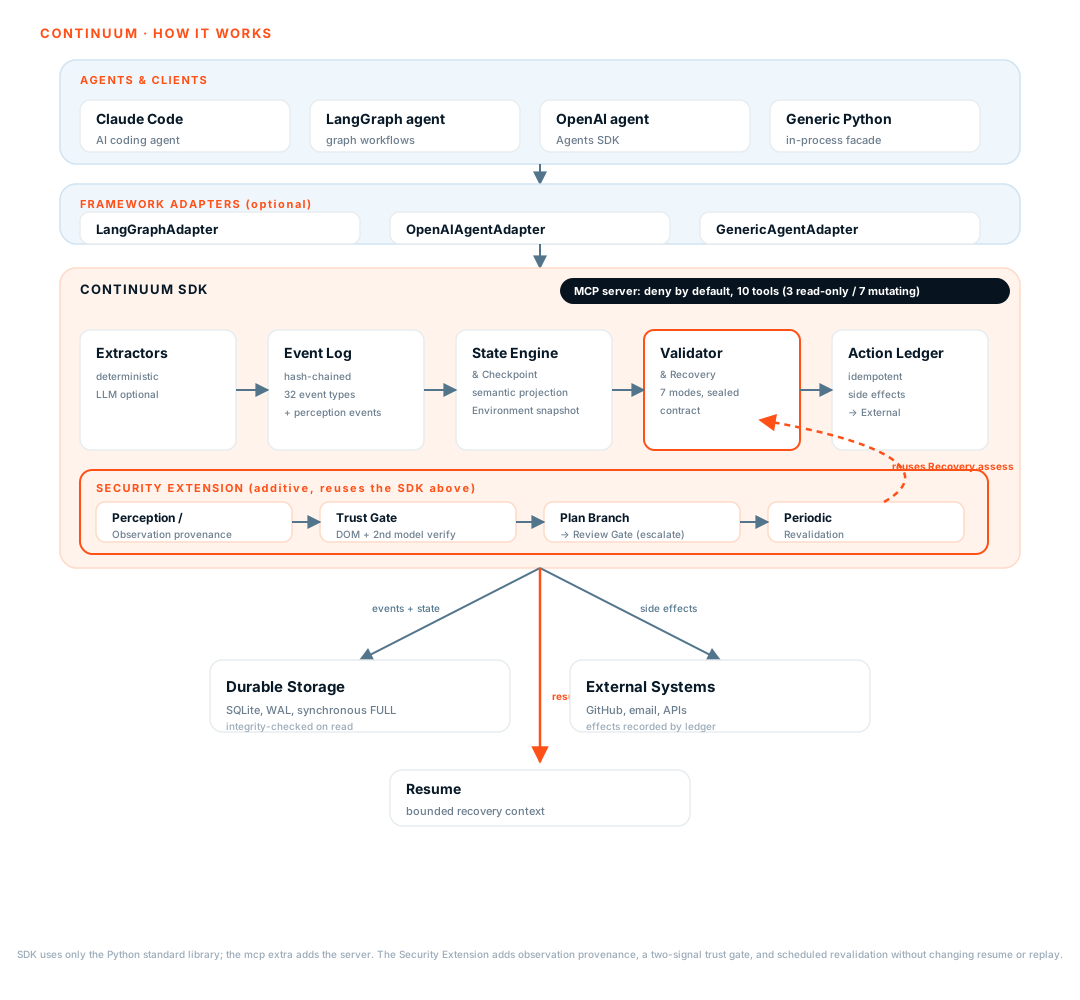
The detailed explanation, the projection model, and the recovery context are in references/architecture.md.
Features
| Capability | What it gives you |
|---|---|
| Semantic checkpoints | Compact, versioned, inspectable state, not a transcript dump |
| Idempotent action ledger | Refuses duplicate external side effects; surfaces uncertain ones for reconciliation |
| Environment revalidation | Every checkpoint component verified against the current world before resume |
| Provenance-aware state | Agent-reported progress is marked REQUIRES_REVIEW, never self-certifying |
| Recovery engine | Seven recovery modes with a deterministic, sealed next-action contract |
| Deny-by-default MCP server | Eleven tools, read-only/mutating split, caller allowlist |
| Framework adapters | Generic Python, OpenAI Agents SDK, LangGraph, and LangChain integrations |
| Secure planning loop | Two-signal observation verification escalates high-risk branches to REQUIRES_REVIEW |
| Periodic revalidation | Environment re-checked on a schedule, catching mid-run drift within one cycle |
| Tamper-evident log | Hash-chained event log (34 event types) with integrity verification |
| Enforcing gate | Unclaimed side-effect calls are refused before they fire; deny messages teach the claim protocol |
| Observation hooks | Every file a coding CLI writes becomes digest-verified evidence, outside model control |
| Session briefing | Fresh sessions learn run state deterministically at start, no prompt file |
| Reconciler probes | Registered commands settle uncertain side effects automatically; humans see only the rest |
| Executable guidance | Resume/validate render next steps as runnable commands, not statuses |
| Enforcing HTTP gateway | Outbound calls in any language require claims; responses settle them from reality |
| OpenTelemetry bridge | Tool-call spans from production tracing become evidence with zero code changes |
| Action index | Cross-run idempotency lookups are indexed reads, not full-log scans |
Security Extension
Two additive security extensions sit on top of the recovery and checkpoint substrate. They do not change resume, replay, or the existing crash-time revalidation path.
- Secure Planning Loop: observations carry provenance and are verified by two independent signals (
verified/unverified/contested). A plan branch gated on an unverified or contested observation is escalated toREQUIRES_REVIEW. Decisions are appended to the ledger asPERCEPTION_OBSERVEDandBRANCH_RESOLVEDevents. - Periodic Revalidation: reuses the recovery engine on a step interval (default 25) and on app switch, so mid-run environment drift is caught within one cycle instead of only at the next crash.
See docs/PROBLEM.md, docs/RESULTS.md, and STATUS.md.
Empirical Verification
CONTINUUM is verified against real LLM agents, live protocol boundaries, and hard process crashes, not just mock unit tests.
- Real agents: multi-session Claude Code invoice batches with mid-run
SIGKILL, scored 7/7 on mechanics; resumed sessions queriedcontinuum_resume, routed side effects through the two-phase ledger, refused to duplicate verified writes, and respectedrequest_human. Live testing surfaced prompt-drift dedup gaps, closed by canonical path normalization and token-based fallback inActionLedger.claim(). - Third-party clients: Gemini CLI and Kilo Code connected over stdio JSON-RPC against the live SQLite store, validating multi-agent co-existence and authorization isolation.
- Protocol compliance: driven end to end with
@modelcontextprotocol/inspector --cliacross process deaths; mutating tools deny by default behindCONTINUUM_MCP_MUTATING_CLIENTS; external claims degrade toREQUIRES_REVIEW(safe: false). - Self-healing: hard-killed servers recover from orphaned SQLite
-wal/-shmsidecars via single-retry cleanup at startup. - Scale: roughly 1,300 tests passing on Python 3.11, 3.12, and 3.13 (unit,
hypothesisproperty-based, concurrency, adversarial); CONTINUUM-Bench runs five crash scenarios proving 0 duplicate work and 0 duplicate side effects. - Adversarial audit: the full MCP surface was audited over the live protocol; three defects were found and fixed. Method and reproduction steps in test.md.
MCP Integration
CONTINUUM ships an MCP server so an agent can record progress, checkpoint, and route external side effects through the ledger without embedding the library:
uv pip install -e ".[mcp]"
CONTINUUM_MCP_MUTATING_CLIENTS=your-client-name continuum-mcp
Eleven tools over stdio. Three are read-only (continuum_validate, continuum_resume, continuum_list_actions); eight mutate. Side effects are two-phase (claim, perform, complete), and mutating tools deny by default behind an allowlist. Agent-reported state is recorded with Origin.EXTERNAL_AGENT provenance and marked REQUIRES_REVIEW.
Verification details, including crash recovery at startup and the end to end Claude Code test, are in references/mcp.md. If a registered server reports CONNECTION_CLOSED, the cause is almost always PATH resolution rather than the server itself: docs/api/mcp.md has the diagnosis and two remedies.
Framework Integration
Nine adapters ship in src/continuum/adapters/ (one in-process facade plus eight integrations), all optional installs so the core stays standard-library-only:
| Adapter | Class | Notes |
|---|---|---|
| Generic Python agent | GenericAgentAdapter |
In-process facade; writes trusted (Origin.DETERMINISTIC) state. |
| Filesystem sandbox | FilesystemSandboxAdapter |
Local directory sandbox, no external service, default for docs and CI. |
| Python in-process | PythonInProcAdapter |
Runs Python in a temp workdir, records via ledger. |
| Container | ContainerAdapter |
Docker backed, guarded skip when docker is absent. |
| Browser | BrowserAdapter |
Playwright backed, guarded skip when not installed. |
| Kubernetes | KubernetesAdapter |
kubectl backed, guarded skip when not configured. |
| OpenAI Agents SDK | OpenAIAgentAdapter |
Experimental. Hooks ToolContext / RunHooks; optional openai-agents. |
| LangGraph | LangGraphAgentAdapter |
Experimental. Wraps a StateGraph; optional langgraph. |
| LangChain | LangChainAgentAdapter |
Experimental. Drops checkpoint_node into an LCEL Runnable pipeline and the create_agent tool-calling loop; optional langchain. |
Each adapter records progress through the ledger and routes external effects through the two-phase intercept/complete protocol. All three framework adapters have end-to-end integration tests and have been driven against a live OpenRouter model, where the runs surfaced and then closed an LLM argument-drift dedup gap and two OpenAI-adapter bugs. Full usage, live-model results, and runnable examples for every adapter are in references/adapters.md.
Three further production frameworks are covered by thin, SDK-free hook surfaces in adapters/thin.py:
| Framework | Interception surface | Entry point |
|---|---|---|
| CrewAI | global before/after tool-call hooks | install_crewai_hooks(storage, run_id) |
| AutoGen core | FunctionTool.run_json wrapped in place |
wrap_autogen_tool(tool, storage, run_id) |
| Pydantic AI | async Hooks capability | Agent(capabilities=[wrap_pydantic_ai_hooks(storage, run_id)]) |
For stacks none of these reach: continuum gateway enforces claims on outbound HTTP from any language, and continuum.otel.make_span_processor(storage) turns existing OpenTelemetry tool spans into evidence.
Resuming agent- or MCP-reported runs
State reported over MCP, or through the OpenAI adapter, carries Origin.EXTERNAL_AGENT provenance and resolves to request_human until confirmed. LangGraph and LangChain runs use Origin.DETERMINISTIC and resume directly. To clear review and resume:
continuum confirm <run_id>   # records REVIEW_CONFIRMED, then re-assesses
continuum resume <run_id>    # now reports RESUME
Over MCP the equivalent is the continuum_confirm tool followed by continuum_resume. Confirmation is a one-time, human-attested event: the escape hatch for the self-certification safety, so an externally-driven run is never permanently stuck.
Core Concepts
The deep reference for each concept lives in references/concepts.md.
- Semantic Checkpoints - a compact, versioned representation of what the agent needs to continue.
- State Validation - every component independently verified; staleness propagates through the dependency graph.
- Idempotent Action Ledger - external side effects tracked and de-duplicated; uncertain outcomes raise instead of silently retrying.
- Recovery Modes -
RESUME,REPAIR_AND_RESUME,ROLLBACK,WAIT,REQUEST_HUMAN,ABORT(plusREPLAN). - Recovery Contract - a deterministic, integrity-sealed, gated next action.
Architecture
The system is built on immutable Pydantic v2 models with a cryptographic hash chain. State is projected from an append-only event log by a pure fold, not stored and mutated. The full reference is in references/architecture.md; a system diagram and enumerated reference in references/architecture-diagram.md.
Key guarantees: append-only events, atomic sequence allocation, durability on append_event return, write races fail loudly, and corruption is refused rather than returned.
CONTINUUM is one library (src/continuum, 100 Python files) plus a large test suite (93 files, roughly 1,300 tests). All modules append to and replay one hash-chained event log:
| Module | LOC | Role |
|---|---|---|
events.py |
397 | Append-only, hash-chained event log and verify() |
state/ |
1,662 | Projection, validation, extraction |
storage/ |
2,485 | SQLiteStorage (v2 schema), postgres.py, migrations.py |
actions/ |
1,265 | Idempotent action ledger, reconciliation, claim/complete |
checkpoint/ |
993 | Policy-driven checkpoints |
recovery/ |
1,838 | Engine (max-severity wins), planner, sealed contract, retry budgets |
adapters/ |
2,798 | Generic, LangChain, LangGraph, OpenAI Agents SDK, thin SDK-free hooks |
mcp/ |
1,621 | Eleven stdio tools plus authz.py (token auth, allowlist) |
serve/ |
841 | Language-agnostic newline-JSON sidecar mirroring MCP |
cli/ |
2,329 | argparse commands (dashboard, hooks, gateway), exit codes as verdict |
benchmark/ |
1,130 | CONTINUUM-Bench scenario harness |
environment/ |
514 | Snapshots and diffs |
security/ |
608 | Provenance, trust gate, revalidation (in progress) |
interchange/ |
312 | B4 portable recovery-state JSON envelope |
concurrency/ |
255 | B2.2 lease and distributed-lock coordinator |
plugins/ |
174 | Registry and capability seams |
models.py, observability.py, __init__.py |
~1,212 | Shared models, metrics, public surface |
Three entry points: the continuum CLI, the continuum-mcp server, and the continuum serve sidecar. The storage, state, adapters, mcp, cli, actions, and checkpoint layers hold roughly 72% of the core and are the mature, heavily-tested layers. security/, the Postgres backend, migrations, and concurrency/ are committed but newer; the Postgres backend skips without a live DSN. interchange/ is done and tested.
API and CLI
Python surface (EventType, Run, SQLiteStorage, diff_states, project) and the adapter API are documented with runnable examples in references/api.md. The CLI is the same surface in shell form:
continuum runs                                   # list runs
continuum inspect <run_id>                       # semantic state
continuum validate <run_id> --env dataset=v4     # validate, read-only
continuum resume <run_id> --env dataset=v4       # recovery decision + contract + next steps
continuum checkpoint <run_id>                    # force a checkpoint, mutates
continuum actions <run_id>                       # external side effects
continuum reconcile <run_id>                     # settle uncertain effects with probes
continuum complete <run_id>                      # close a run as done, from the keyboard
continuum verify <run_id>                        # re-audit the event hash chain
All wiring is host-side; the model's cooperation is optional:
continuum hooks install claude-code --with-gate   # coding CLIs: evidence, briefing, gate
continuum gateway --port 8765                     # enforcing HTTP proxy for everything else
provider.add_span_processor(continuum.otel.make_span_processor(storage))  # OTel to evidence
continuum-mcp                                     # anything MCP-capable: the eleven-tool server
Optional registries live beside your code and are data, not code: .continuum/gate.json (side-effect tools + stable-key templates), .continuum/reconcilers.json (probes that check external systems), .continuum/gateway.json (upstream routes).
Every command accepts --json, and read-only commands never write, so they are safe against a live database while an agent is mid-run. Exit codes are a safety contract (only a verified-safe run exits 0). Full command list, exit-code table, and state-diff output in references/cli.md.
Roadmap
| Phase | Component | Status |
|---|---|---|
| 1-11 | Data models, semantic state, persistence, checkpointing, validation, action ledger, recovery engine, CLI, crash-recovery examples, environment snapshots/diffs, framework adapters | Complete |
| 12 | Benchmark suite (CONTINUUM-Bench) | Complete (minimal harness) |
| 13 | Cloud API (FastAPI + PostgreSQL) | Planned |
| 14 | Dashboard | Complete (continuum dashboard) |
| 15+ | Enforced durability: observation hooks, gate, session briefing, reconciler probes, enforcing gateway, OTel bridge, action index, executable guidance, multi-client installers | Complete (see issue #213) |
Beyond the original plan: the MCP server, MCP authorization layer, provenance and anti-self-certification, community files, schema versioning, and a bounded recovery context are shipped. See STATUS.md for the verified-vs-believed breakdown and open correctness bugs.
What CONTINUUM Is Not
| Not this | This instead |
|---|---|
| An LLM | A reliability layer for agents that use LLMs |
| An agent framework | A recovery layer that plugs into any framework |
| A vector database | Structured semantic state, not embeddings |
| A RAG system | Verified checkpoints, not retrieval-augmented memory |
| A workflow engine | A recovery layer, not an orchestrator |
The core abstraction: semantic state + environment validation + action reconciliation = safe recovery.
Related work
CONTINUUM sits at the overlap of durable execution, idempotent side-effect tracking, and crash recovery for LLM agents. The closest neighbors are machine-checked resume contracts (Khan 2026), agentic transaction processing with constraint-gated admission (Mnemosyne 2026), checkpoint-rollback attack analysis (ACRFence 2026), and design-level prompt-injection defense (CaMeL 2025). The full annotated list, foundations, and citation audit are in references/related-work.md.
Status and limitations
- Tested: roughly 1,300 tests passing across Python 3.11, 3.12, and 3.13; exact counts and skips vary by platform and optional services such as Postgres (see STATUS.md). The MCP surface has also been audited adversarially over the live protocol; see test.md.
- Not on PyPI. Install from a clone (see Quick Start).
- MCP caller authentication is opt-in per deployment. When
CONTINUUM_MCP_TOKENis set, the server refuses every mutating tool unless the caller presents that shared secret in theinitializehandshake's_meta.authToken. Without it, authorization is by declared identity only (the historical default, preserved for local single-user use). - Confirming self-reported state over MCP requires a separate secret.
continuum_confirmrefuses every caller until the operator setsCONTINUUM_MCP_CONFIRM_TOKEN, because an agent allowed to record progress must not also be able to confirm it. The default path stays human-driven: runcontinuum confirm <run_id>on the host. - Unbuilt components: Cloud API (Phase 13).
- Framework adapters are experimental. The OpenAI Agents SDK and LangGraph adapters do not yet carry the same crash-and-resume verification coverage as the generic facade. Prefer
GenericAgentAdapterfor production recovery. - Agent/MCP runs need an explicit confirm before auto-resume. Externally-reported state is
REQUIRES_REVIEW, socontinuum resumereturnsrequest_humanuntil a human confirms. By design, not a bug; see Framework Integration. - e2e autonomy test series (issue #6): three full Claude Code runs scored 7/7 mechanics with unprompted recovery behavior observed. Further iterations across diverse prompt styles remain open.
Contributing
Contributions are welcome. This project is open source under Apache 2.0 and deliberately built to be extended: by researchers validating the recovery semantics, by engineers porting the ledger or MCP server to other frameworks or languages, and by anyone turning the planned roadmap into reality. A good place to start is the good first issue label on the issue tracker, or the open correctness bugs listed in STATUS.md.
Open an issue before submitting large PRs. See CONTRIBUTING.md for the full contribution guide, including the Code of Conduct.
Contributors






License
Apache 2.0 - see LICENSE.
Deep reference material:
- references/install.md - prerequisites, install levels, package map, verification
- references/concepts.md - semantic checkpoints, validation, ledger, recovery modes, contract
- references/architecture.md - data model, event log, projection, storage, checkpointing, recovery engine, security
- references/adapters.md - framework adapter usage and live-model validation results
- references/api.md - Python and adapter API
- references/cli.md - full CLI command list, exit codes, state diff
- references/mcp.md - MCP server status, verification, open questions
- references/bench.md - CONTINUUM-Bench design
- references/quickstart.md - install, examples, the proof scripts
- references/e2e.md - end to end autonomy test walkthrough
- references/testing.md - test suite layout and conventions
- references/related-work.md - annotated related work and citation audit
Yorumlar (0)
Yorum birakmak icin giris yap.
Yorum birakSonuc bulunamadi