daimon
Health Gecti
- License — License: Apache-2.0
- Description — Repository has a description
- Active repo — Last push 0 days ago
- Community trust — 18 GitHub stars
Code Gecti
- Code scan — Scanned 12 files during light audit, no dangerous patterns found
Permissions Gecti
- Permissions — No dangerous permissions requested
Bu listing icin henuz AI raporu yok.
Dream-briefing for AI coding agents: a cognitive checkpoint at session end, a 'while you were away' briefing at session start.

Daimon

A dream-briefing for your AI agent: a skimmable "while you were away / here's where we left off" artifact, shown when you resume a session.
Documentation: daily-nerd.github.io/daimon — setup guides, configuration reference, concepts.
Your agent forgets everything between sessions. Daimon writes a small cognitive checkpoint when a session ends and turns it into a briefing when the next one starts — so the agent resumes from a faithful prior state instead of a confident guess:
While you were away — here's where we left off.

VERIFY BEFORE TRUSTING (state may have changed outside this session):
- [✓ verbatim] PR #212 state — you said you'd merge it yourself from the UI  — "I'll merge it after the demo"

Open loops:
- [✓ verbatim] Retry policy for the payments webhook — exponential or fixed?  — "don't ship the retry loop until we pick a policy"
- [~ inferred] The staging config drift needs an owner [carried] [≈ corroborated ×2]

Decisions made:
- [✓ verbatim] Postgres advisory locks over Redis locks for the scheduler  — "let's not add a Redis dependency for this"
- [~ inferred] Feature-flag the new invoice path; default off until QA signs off

Active topic: Migrating the scheduler off cron to the new worker pool
Every item carries its trust class: ✓ verbatim items are pinned to an exact quote from the transcript and are never reworded — not by carry-over between sessions, not by rendering, not by budget truncation. ~ inferred items are the agent's own conclusions and are allowed to evolve. Items carried from older sessions say so. That distinction — knowing which memories are quotes and which are guesses — is the point.
≈ corroborated ×N is a separate axis: N independent sessions have witnessed that claim. It never promotes the trust class, and daimon's own briefing and recall echoes are excluded from the count by construction — see trust classes.
See it happen
Two sessions: commit to the AWS cert, then pivot to GCP. The next briefing carries the old commitment flagged as likely superseded — with the confirm/reject commands inline — instead of injecting it back as current fact. One command confirms, and the stale decision is withheld from then on:

And because the briefing is injected automatically when a session starts, the agent itself answers from it — no commands, just ask:
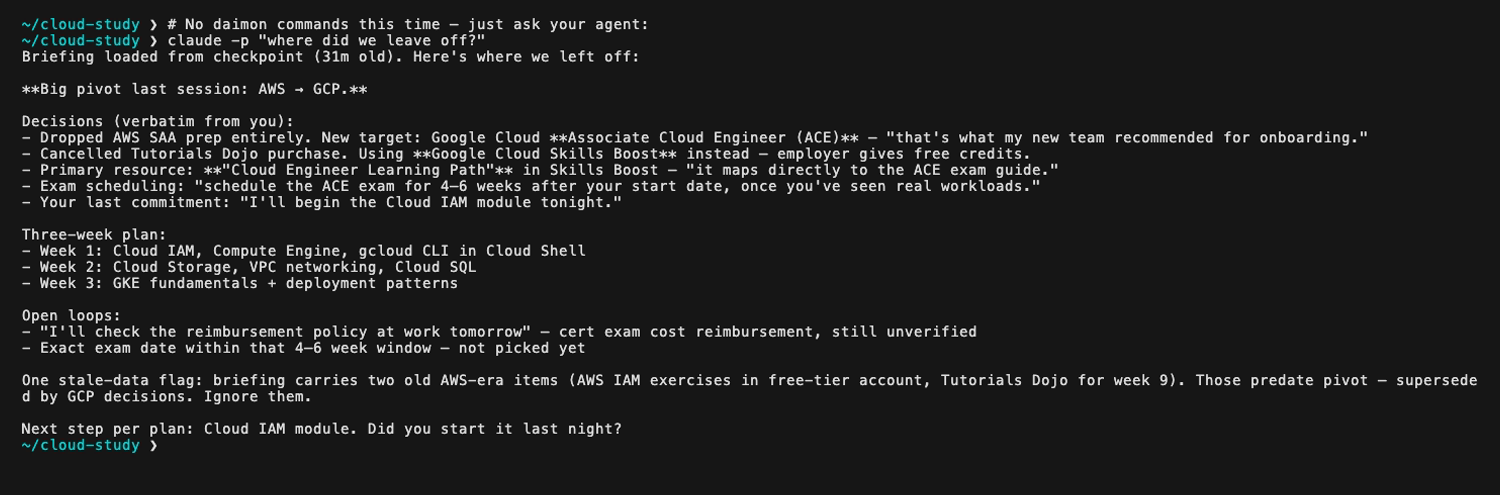
Nothing here is mocked — the transcripts, the recording scripts, and the steps to reproduce it are in docs/demo/.
Install
uv tool install 'daimon-briefing[pretty]'   # pipx works identically
# upgrading: uv tool upgrade daimon-briefing
#   then `daimon hooks install <host>` to refresh installed hook scripts (non-plugin hosts)
Serialization needs an LLM endpoint. If the claude CLI is on your PATH you are zero-config — daimon configure prints ✓ ready and you're done. Otherwise any OpenAI-compatible endpoint or headless CLI works: see configuration.
Claude Code (plugin — recommended):
/plugin marketplace add Daily-Nerd/daimon
/plugin install daimon@daimon
Agent-side skills, any host:
npx skills add Daily-Nerd/daimon
Adds daimon-briefing and daimon-end to whichever agent it detects. Use --skill daimon-briefing for one of them. Claude Code users who installed the plugin above already have both, so there is no need to run this as well.
Other hosts (Windsurf, Codex, Kimi Code, Gemini CLI): per-host guides at daily-nerd.github.io/daimon/docs/hosts.
That's it. End a session → a checkpoint is written; start the next → the briefing appears. Check state anytime with daimon status — it reports capture health honestly, including failures, skips, and crashes; a failed capture self-heals on the next start.
Beyond the briefing
daimon recall <terms>— full-text search over your whole checkpoint history (and your team's, if enabled). This is also the working-set boundary, stated plainly: one live checkpoint per project feeds the briefing, and an item that falls out of carry never re-enters a briefing on its own — it stays reachable here, permanently, but only when asked for.daimon why <item-id>— inspect a recalled item's independent capture, provenance, source, byte-integrity, current-support, verifier, lifecycle, and corroboration evidence. Add--sourcefor one bounded redacted source window. See the Trust Inspector guide.- Context switching —
daimon projects,daimon brief --slug <slug>: read another project's memory deliberately, provenance-labeled — never automatic. - Proactive recall — when a new prompt overlaps prior work from an older session, the briefing surfaces it, in English or Spanish.
- Code anchors —
daimon anchor <file> <symbol>pins a belief to a code symbol; drift is flagged in the next briefing. Offline, stdlibast. - Item lifecycle —
daimon resolvecloses loops,daimon forgetremoves an item with a tombstone event; supersession is tracked, not silently overwritten. - Negative-knowledge ledger —
daimon refuterecords scoped, evidence-cited rejected approaches outside checkpoint decay; agents propose candidates, humans ratify active guards, and overturns remain auditable. - Team memory (opt-in) — checkpoints mirrored through a private git remote; teammates' topics and decisions appear clearly attributed, never merged into yours.
- Signed receipts (opt-in) —
DAIMON_RECEIPTS=1pairs each checkpoint with an offline vitni signature binding its exact bytes to its source transcript; verify withdaimon verify-receipt. - Scar harvest (opt-in) —
DAIMON_SCAR_HARVEST=1drafts negative-knowledge candidates (dead ends, intentional-looking weirdness, non-obvious couplings) from each session into.scars/candidates/for human review. Zero-LLM, path-anchored, active only in repos that already have a.scars/directory; review and promotion tooling lives in Scar.
What's net-new here
- Trust-classed, quote-pinned memory: every briefing item is marked verbatim (exact quote, immutable everywhere) or inferred (allowed to evolve), with provenance and supersession tracked extractively. No embeddings, no graph database, and no required daemon: per-project JSON plus a derived SQLite FTS5 index, stdlib-first and offline-first.
- The briefing UX — memory that arrives as a session-start artifact you can skim in 30 seconds, ordered by what to verify first.
- Host-agnostic hooks — Claude Code (live-validated daily), Windsurf (live-validated), Codex (live-validated capture since 2026-08-06), Kimi Code (briefing and capture; the briefing arrives with the first prompt, since that host has no session-start injection channel); other hosts are reachable via the same thin adapter shape.
An independent reading
Agent Memory Atlas, a commit-pinned survey of agent memory systems, has read this codebase several times since July 2026. From its latest executive summary:
This is one of the very few that treats the model's own trust label as a claim to be falsified before it is stored.
It is not praise alone. The same summary names the weak half: "The retrieval half is much less proven." Both halves are checkable against the card's file and line citations, and every reading is recorded with the commit it was pinned to.
Status
| Surface | State |
|---|---|
| Claude Code plugin + hooks | live-validated daily |
CLI (brief, status, recall, why, projects, heal, anchor, forget, configure, hooks, skill) |
stable, on PyPI |
| Windsurf adapter | live-validated |
| Codex adapter | live-validated capture (real sessions serialized since 2026-08-06) |
| Kimi Code adapter | briefing and capture, probe-measured; no ruling checks yet |
| Gemini host hooks | blocked upstream (gemini-cli#14715) |
| Team memory | shipped, opt-in, early |
Daimon is self-contained at runtime: no external memory backend or required daemon.
The MCP server and browser viewer are optional local read surfaces. The full evidence
trail behind every design decision lives in research/; the
current component map is documented in
Runtime Architecture.
License: Apache-2.0 · Org: Daily-Nerd · This repository starts at v0.2.0 (earlier development happened in a private lab repo; the research trail ships in research/).
Docs
- Documentation site — setup, hosts, configuration, concepts
- Runtime Architecture: current layers, components, and data flow
- MVP: Dream-Briefing: historical foundation of the shipped runtime
- Research Logbook — findings, decisions, evidence trail
- Contributing — dev setup, tests, lint, pre-commit hooks
The name comes from the Greek δαίμων — a guiding spirit (distinct from "demon") believed to accompany a person, offering counsel and warnings. This one shows its sources.
Yorumlar (0)
Yorum birakmak icin giris yap.
Yorum birakSonuc bulunamadi