Deeds
Health Uyari
- License — License: MIT
- Description — Repository has a description
- Active repo — Last push 0 days ago
- Low visibility — Only 5 GitHub stars
Code Basarisiz
- rm -rf — Recursive force deletion command in install.sh
- process.env — Environment variable access in plugins/deeds/cli/src/analyze.ts
- exec() — Shell command execution in plugins/deeds/cli/src/canon.ts
- process.env — Environment variable access in plugins/deeds/cli/src/commands/analyze.ts
Permissions Gecti
- Permissions — No dangerous permissions requested
Bu listing icin henuz AI raporu yok.
A CLI and Claude Code plugin that reads every commit's diff and counts what actually got better: new capabilities, fixes, and upkeep. A way to measure work done with AI that doesn't depend on counting PRs.
Deeds
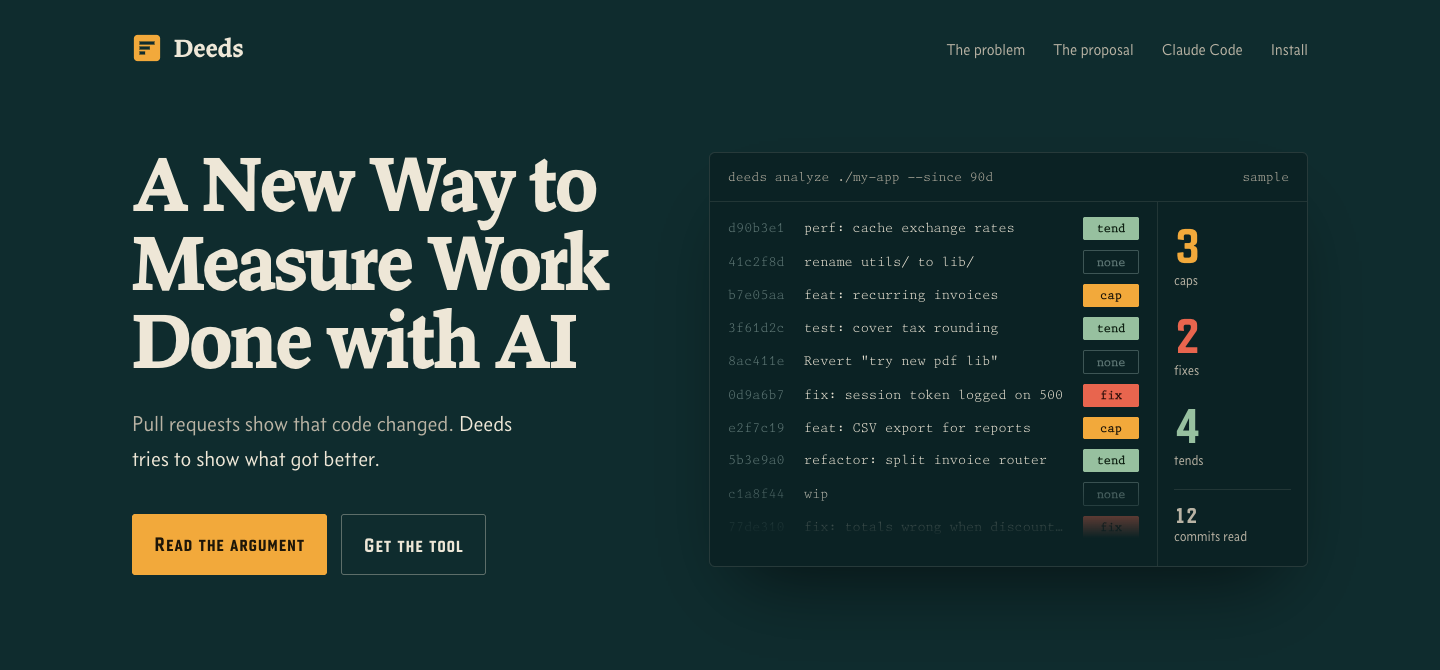
Measure the work in a code repo by what got better, not by how many PRs were opened.



Pull requests and commit counts measure activity. They show that code changed, not whether the product got better. A refactor, a revert and a typo fix count the same as a new feature, and someone building alone with AI agents may never open a PR at all.
Deeds reads the diff of every commit in a window and asks what that change did to the product. A change that made it better is a deed, and every deed is one of three kinds:
| Kind | What it means | Example |
|---|---|---|
| cap | A capability gained or deepened. The product can do something it couldn't before, or does an existing thing more fully. | added CSV export to reports |
| fix | Something moved from broken to working. Security fixes count here. | stopped logging session tokens |
| tend | Upkeep users never see: refactors, dependency bumps, performance work, tests. | bumped hono to 4.6 |
Renames, reverts and busywork produce no deeds. Commit messages are never read, so a commit called "feat: X" only counts as a cap if its diff adds one. The three counts stay separate and are never blended into one score. The argument for all of this is at workdeeds.ai.
What you get
An excerpt of a real run over the last 30 days of fabric, made on 2026-10-04 with nothing but a Jev key. All 208 commits were judged in under a minute:
$ deeds analyze github.com/danielmiessler/fabric --since 30d

github.com/danielmiessler/fabric
window   2026-09-06 to 2026-10-04   208 commits read
mode     jev on typesafe:jev-1.13.0   331339 input + 34391 output tokens

  18 caps      13 fixes      118 tends

week         caps fixes tends
2026-07-13   1    0     0
2026-08-31   1    1     1
2026-09-07   1    1     2
2026-09-14   2    0     3
2026-09-21   7    3     31
2026-09-28   6    8     81

by author
Kayvan Sylvan            9 caps    11 fixes   70 tends
github-actions[bot]      0 caps    0 fixes    34 tends
aiapienthusiast          1 caps    0 fixes    4 tends
DennyHo0917              1 caps    1 fixes    2 tends
ctbaum                   1 caps    1 fixes    1 tends
jamesf_coder             1 caps    0 fixes    2 tends
serply                   2 caps    0 fixes    1 tends
jiweiyeah                1 caps    0 fixes    1 tends
Anand Hegde              1 caps    0 fixes    1 tends
Thibault Jaigu           1 caps    0 fixes    0 tends
Eric Curtin              0 caps    0 fixes    1 tends
YE                       0 caps    0 fixes    1 tends

caps
  + claudecode   2ad20de Kayvan Sylvan
  ^ ollama   2568737 Kayvan Sylvan
  ^ errors   d3b1ee3 Kayvan Sylvan
  ^ chatter   9d8d782 Kayvan Sylvan
  + codeblock   9317265 Anand Hegde
  - providers config   2febe21 Kayvan Sylvan
  ^ youtube   299f025 Kayvan Sylvan
  ...
+ is a new capability, ^ a deepened one and - a removed one. Cap names come from the code itself: the route, command, UI handler or export the commit added, or else the part of the product it changed most. The full report also has a week-by-week trend and a breakdown by author, and --json gives you all of it as one JSON document.
Install
You need bun and a Jev key. That is the only key deeds needs: no OpenAI or Anthropic key. Get one at typesafe.ai, then:
export TYPESAFE_API_KEY=...
curl -fsSL https://raw.githubusercontent.com/danielmiessler/deeds/main/install.sh | sh
That runs install.sh from this repo. It puts the CLI in ~/.local/share/deeds and a deeds command in ~/.local/bin, and never uses elevated privileges. It downloads one tarball from this repo's latest release, checks its sha256 against the published checksum, and refuses to install if they differ. To pin the checksum yourself, set DEEDS_SHA256.
Check it worked:
deeds version
Claude Code plugin
The plugin bundles the CLI and a skill that knows how to run it, so you can ask in plain words.
/plugin marketplace add danielmiessler/deeds
/plugin install deeds@workdeeds
Then ask Claude Code something like "show me deeds progress". It runs deeds analyze . --json on the repo you are in and answers with the three counts, the week-by-week trend and the caps by name.
The first run installs the CLI's locked dependencies with bun install --frozen-lockfile. That is the only download the plugin makes, and later runs start without touching the network. If your Jev key lives in a file instead of your environment, point ~/.config/deeds/config.json at it:
{ "keys": { "typesafe": { "envFile": "~/.secrets/.env", "var": "TYPESAFE_API_KEY" } } }
Usage
deeds analyze [path | github.com/owner/repo] [--since 90d] [--until <date>] [--mode jev|full] [--vendor anthropic|openai] [--model <id>] [--json]
deeds analyze-many <list-file> [--since 90d] [--until <date>] [--mode jev|full] [--out <dir>] [--json]
deeds extract [path] [--rev <commit>] [--json]
deeds help --json
deeds doctor
deeds version
analyze takes a local folder or a public GitHub repo and any window: 7d, 2w, 6m, 1y, all, or anything git understands, such as 2026-01-01. It reports the totals, a week-by-week trend, a breakdown by author and the caps by name.
export TYPESAFE_API_KEY=...
deeds analyze . --since 30d
deeds analyze github.com/owner/repo --since all
deeds analyze-many repos.txt --since 90d --out reports/
analyze-many takes a file with one local path or github.com URL per line (blank lines and # comments are skipped) and writes one JSON report per repo, plus totals across all of them.
Every commit is judged by Jev: code reads the diff into exact facts (files touched, routes and commands added or removed, how big the change is), Jev answers a short set of typed questions about it, and a fixed policy turns facts and answers into deeds. On a public repo with 717 commits that takes about 16 seconds and lands within 10% of a full GPT model's counts for caps, fixes and tends. --mode full is an optional reference mode in which a large model reads each diff in full; it is slower and needs an Anthropic or OpenAI key, and nothing else does.
With --json the same run is one JSON document. A recorded one is in examples/fabric-30d.json.
Results are cached per commit, so a repeat run makes no calls for commits already judged. A first run costs one Jev call per commit that needs judging; commits code can settle on its own (docs-only, lockfiles, merges, release snapshots) cost nothing.
extract and doctor run with the network switched off by the operating system. That uses macOS's built-in sandbox; on Linux, add --allow-unsandboxed to run them with the in-process guard alone.
With --json, stdout is exactly one JSON document: {"ok":true,"command":...,"data":...} on success and {"ok":false,"error":{"code","message"}} on failure. A run where any commit could not be judged fails with code incomplete; rerun it, since judged commits are cached. Exit codes are 0 ok, 1 error, 2 usage, 3 denied. --model <id> or DEEDS_MODEL picks a different model for --mode full, and deeds help --json lists every command with its usage.
Privacy
- Only each commit's diff and its list of changed file paths leave your machine, and only to Jev (api.typesafe.ai) on your own key.
--mode full, if you choose it, sends them to Anthropic or OpenAI instead. No other host is ever called for judgments. The only other network use is cloning a public GitHub repo you name. - Anything shaped like a secret (API keys, tokens, private keys, passwords in config) is redacted from a diff before it is sent.
- Commit messages are never read.
- Deeds keeps two caches. Public GitHub repos are cloned over HTTPS into
~/.cache/deeds/repos, and per-commit results are stored in~/.cache/deeds/classified. - There is no telemetry and no account.
deeds doctorshows how the network restriction is enforced on your machine.
License
MIT. See LICENSE.
Yorumlar (0)
Yorum birakmak icin giris yap.
Yorum birakSonuc bulunamadi