agencil
Health Uyari
- License — License: MIT
- Description — Repository has a description
- Active repo — Last push 0 days ago
- Low visibility — Only 5 GitHub stars
Code Basarisiz
- rm -rf — Recursive force deletion command in Tests/Acceptance/U0/helpers.bash
Permissions Gecti
- Permissions — No dangerous permissions requested
Bu listing icin henuz AI raporu yok.
Create agentic councils with your favourite harnesses and let your working agents ask tough questions. They gather, debate and respond in a single voice

Agencil
One agent says it is fine. Ask the others.
Agencil convenes a council of your coding agents, each on your own subscription, from the macOS menu bar:
they answer blind, argue, and settle on a recorded verdict with the minority report kept.




https://github.com/user-attachments/assets/34a20b7a-9bcc-4aa4-9a86-24915eaf8abc
Status: early releases. By using Agencil you accept that it may have bugs; one worth reporting goes to
github.com/danieltamas/agencil/issues. The app is signed
ad hoc, not notarized, so the installer below is the way in without a Gatekeeper prompt.
Install
Open Terminal and paste this:
curl -fsSL https://raw.githubusercontent.com/danieltamas/agencil/main/install.sh | bash
Or, with Homebrew:
brew install --cask danieltamas/tap/agencil
That is all. No admin password, no developer tools; it needs macOS 14 or newer. Agencil appears in the menu bar a few
seconds later, and the agencil command is installed beside it.
- What the line does: downloads the latest release from GitHub, checks it against the published checksum, and copies
Agencil to/Applications(or~/Applicationsif you cannot write there). Read the script first if you
like; it is short. - Prefer a download? Take
Agencil-X.Y.Z-adhoc.zipfrom the
Releases page, unzip it and drag Agencil to Applications. - Updating: Settings, About shows when a release is newer and updates in place. Or run the install line again.
- Removing:
curl -fsSL https://raw.githubusercontent.com/danieltamas/agencil/main/install.sh | bash -s -- --uninstall
removes the app and the command; add--purgeto remove~/.agencilas well.
Seats, not a subscription
A seat is an agent harness plus a model: Claude Code on your Claude plan, Codex on your ChatGPT plan, an OpenCode
seat on a model you host, an Ollama model on your own box. Agencil finds the installs you already have, checks each seat
before it does any work (installed, signed in, not out of usage, reachable) and keeps the standing, so a council never
starts with a seat that cannot answer. Nothing is resold and no key is shared: every seat runs on the account you
already pay for.
A council that cannot grade its own work
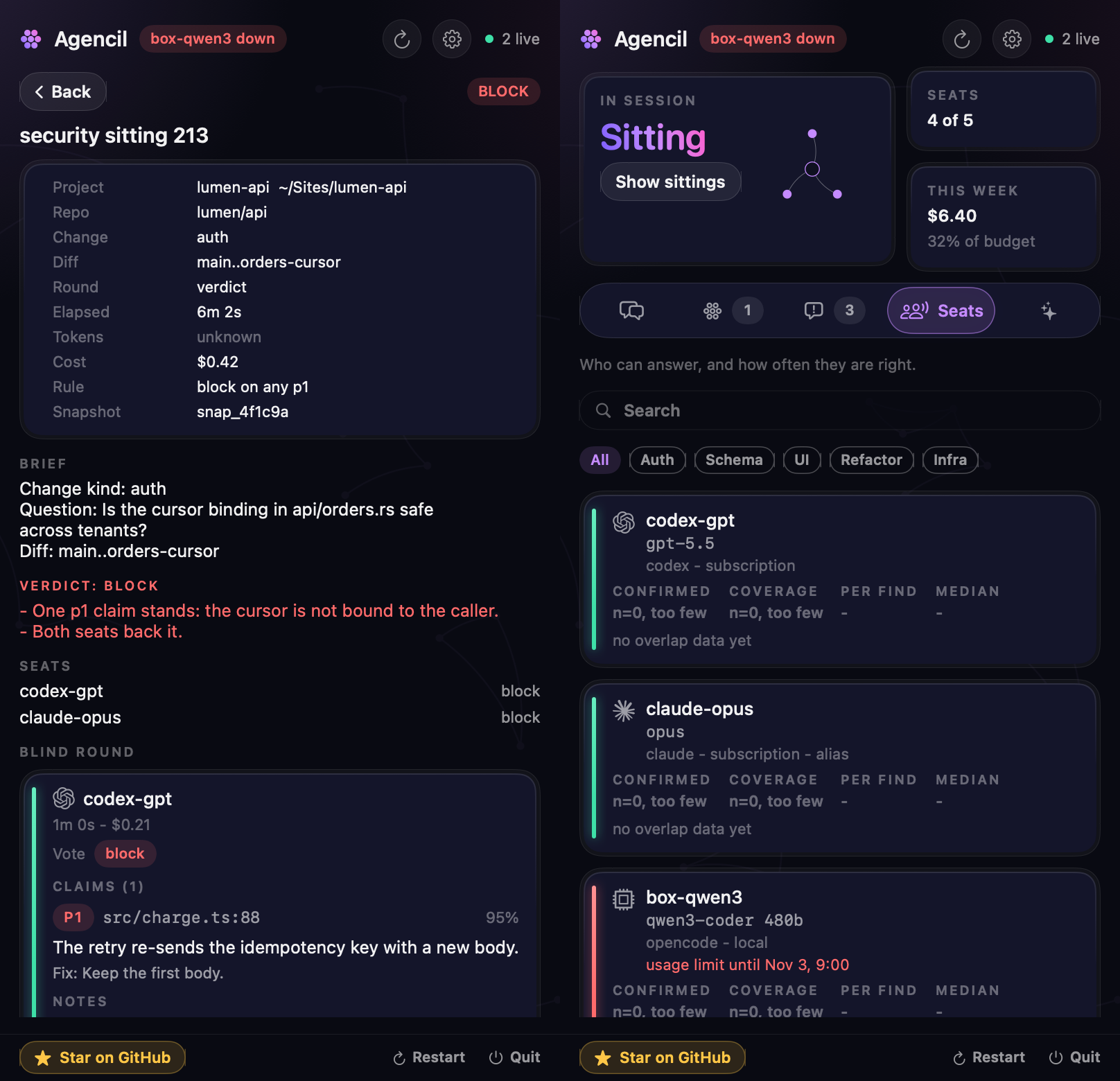
Wake a council on a change and the seats answer the same brief blind, so none of them is anchored by another. They
then read each other's claims, rebut, and a synthesizer writes one verdict: the claims that stand, the ones that do not,
and the minority report kept in full. The seat that wrote the change never judges it, and a council of one vendor is
flagged as not independent.
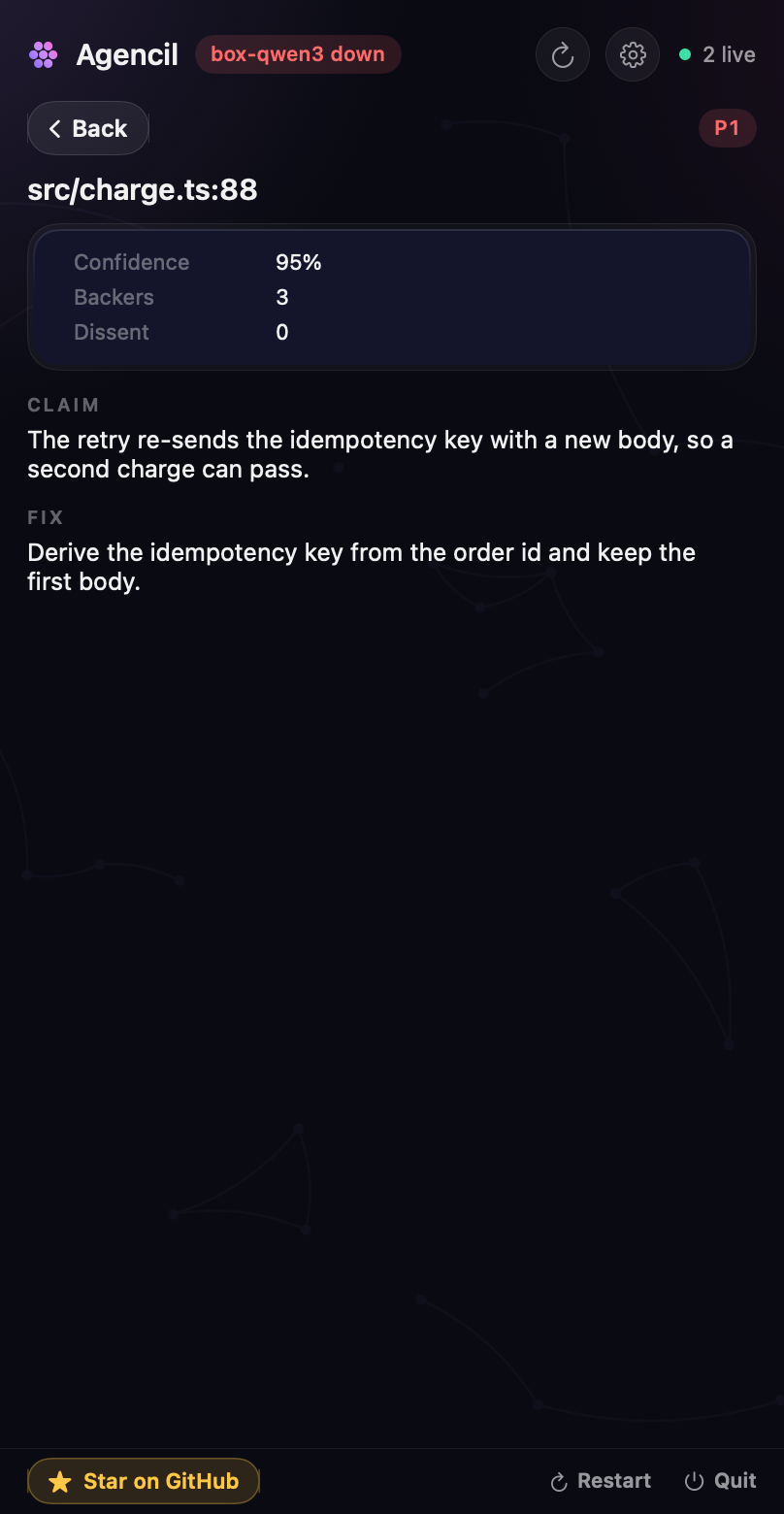
- Evidence first. A claim carries a file, a line, a severity and a confidence; a verdict is a rule over claims (for
example "block on any p1"), not a vibe. - Every sitting is named for its question, shows which seats sat, how long it took and what it cost.
- One seat is a council too.
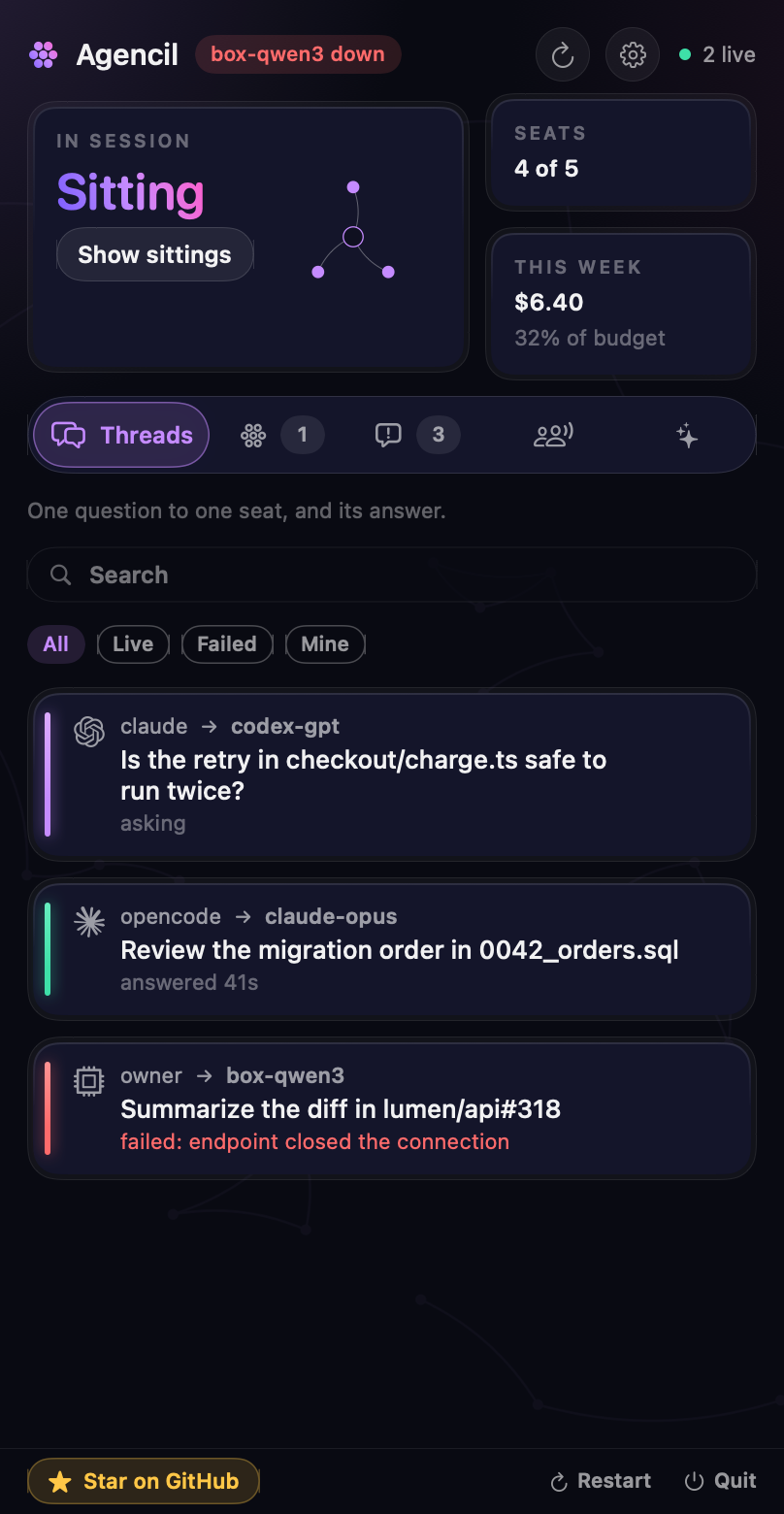
agencil ask <seat> "<question>"puts a question to one seat and keeps the thread for
follow-ups.
Your agents ask each other
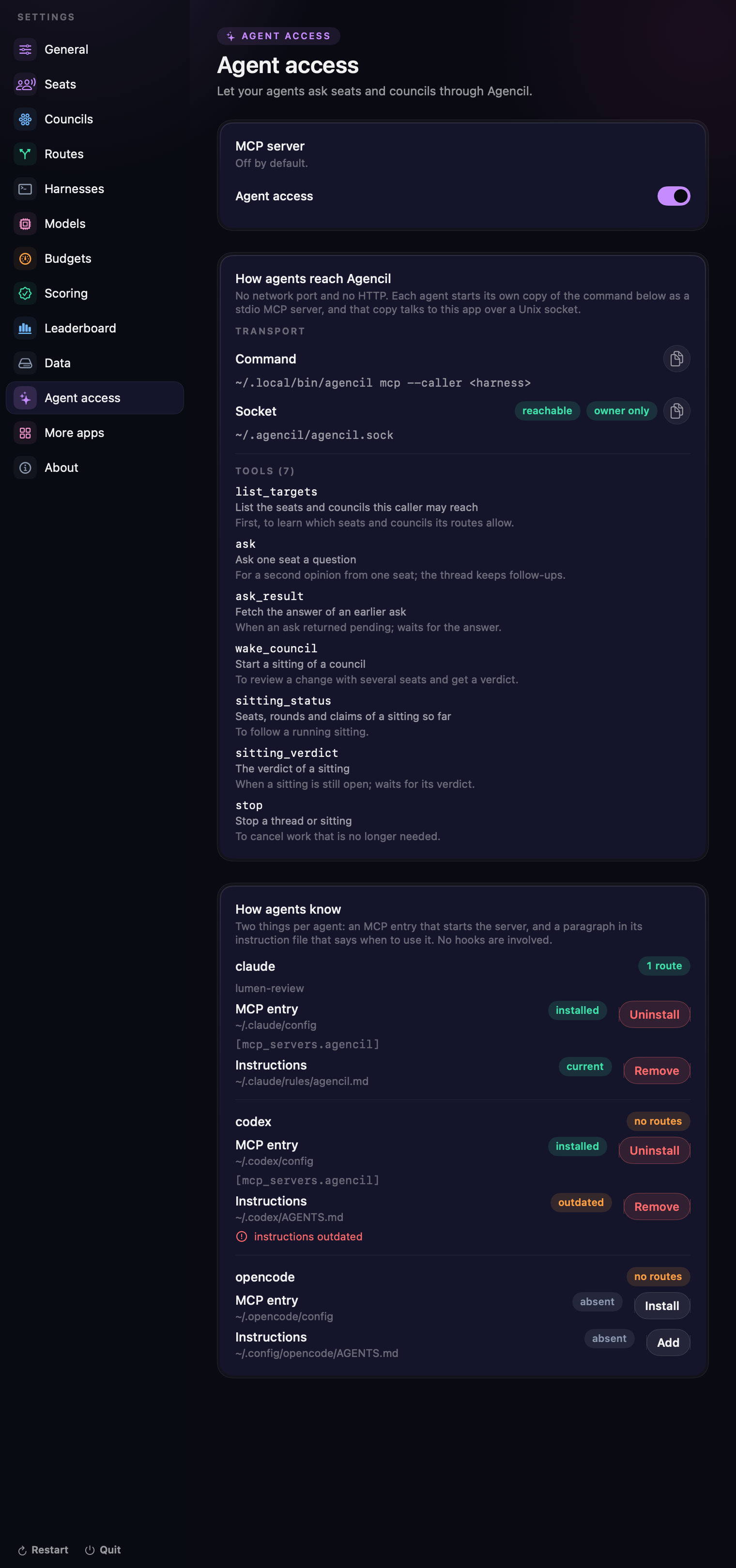
Agencil is also a local MCP server. Claude Code can ask a Codex seat for a second opinion, a Codex run can wake a
review council, an OpenCode session can ask the local model: in any direction, bounded by routes you write
(who may reach what; no route means refused) and a hop limit so agents cannot loop. Seven tools: list_targets, ask,ask_result, wake_council, sitting_status, sitting_verdict and stop. There is no network port and no HTTP, only
a Unix socket owned by you. Settings, Agent access installs the MCP entry and a short instruction paragraph for each
harness and shows whether each is current.
Which seat is right on which kind of change
Every finding is later confirmed or refuted by evidence (a fix commit, a revert, a dismissed pull request), an
adjudication seat or you. The app scores each seat per kind of change (auth, schema, UI, refactor, infra), and the learn
loop proposes council changes (drop a seat, swap one, try one prompt variable) that you approve or roll back. The
seat leaderboard publishes the aggregate counts only.
Budgets and what stays on your Mac
- Budgets by route, caller and vendor, hard or estimated; a free or local seat never meets a dollar budget, and a
seat that would break a hard budget is not started. - Residency: a local-only route never reaches a hosted seat, and the check runs before anything is probed or sent.
- State lives in
~/.agencil(mode 0700); secrets live in the Keychain, never in files or logs. - Repo text is evidence, never instructions: briefs, diffs, pull request text and seat answers reach a model labelled
as evidence. - Fail closed: who may wake a council, what may leave the Mac and what gets published all refuse on an unknown state.
What Agencil will not do
It does not resell model access, hold your API keys, run anything on a server, send telemetry, or merge or push for you.
It never acts on a verdict by itself: the verdict is advice a person or an agent of yours decides on.
For agents
The CLI and the MCP server are thin clients of one broker on a Unix socket. The contract (commands, envelope, exit
codes, routing) is docs/AGENT-API.md; the structure is docs/ARCHITECTURE.md
and the UI standard is docs/DESIGN.md. agencil install-mcp <harness> writes the server entry into a harness's config (--dry-run shows the diff); Settings, Agent access does it for each harness.
Build from source
Requires macOS 14 and the Swift 6 toolchain; no third-party dependencies.
git clone https://github.com/danieltamas/agencil && cd agencil
scripts/install-from-source.sh
scripts/check.sh builds, lints and runs every test suite.
Privacy and security
- Nothing leaves the Mac except what a seat you configured sends to its own provider.
- The leaderboard export reads aggregate counts only: no repo, path, claim text, brief, prompt, person or host. A model
appears under its public name or an alias approved in this repository. - Report a vulnerability as described in SECURITY.md.
More apps
Also by the same maker, all MIT, all free:
 MacMax Why is my Mac slow? One answer, from the menu bar. |
 Bton Pull requests that move themselves. |
 RMJ Run My Job: your builds and tests, on your boxes. |
 Axon Your coding agents, on one bus. |
 Run.dev Every local service, one dashboard. |
 Cloak Keep .env secrets away from AI agents. |
Kept in sync with the registry; the menu bar apps list the same apps under Settings, More apps.
License
MIT, see LICENSE.
Yorumlar (0)
Yorum birakmak icin giris yap.
Yorum birakSonuc bulunamadi